
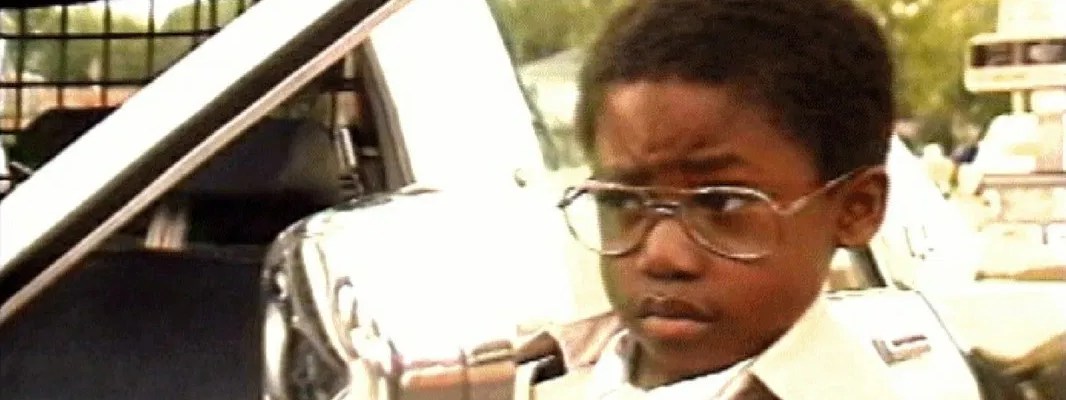
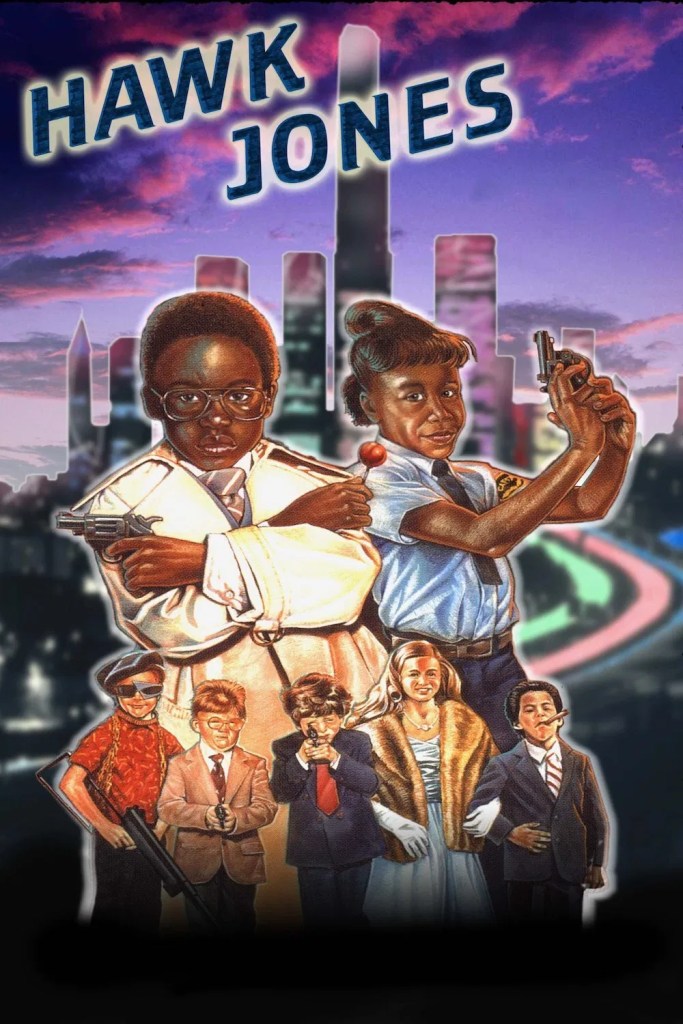
In 1986, 21-year-old Richard Lowrey and his brother, Tor Reyel Lowry, undertook the arduous task of directing their first feature film, Hawk Jones. His vision included a city under siege by a crime syndicate, a hardened cop hot on their trail, a seedy atmosphere grounded in an urban backdrop, and elements of blaxploitation films, all punctuated by action-packed shootouts. The twist? Children play every single character. It wasn’t the first time this concept had been attempted; in 1976, Alan Parker’s debut film Bugsy Malone featured an all-kid cast. Bugsy Malone takes place in the prohibition era, is a full-on musical, and boasts much more extravagant sets and costumes. Conversely, Hawk Jones is a modern (at the time) noir-tinted police procedural that has more in common with 48 Hours (1982). That being said, though it was made on a much smaller budget, it has a lot of heart; the scrappy sets, shot-on-video aesthetic, and earnest acting give it an indie vibe and a regional flair.
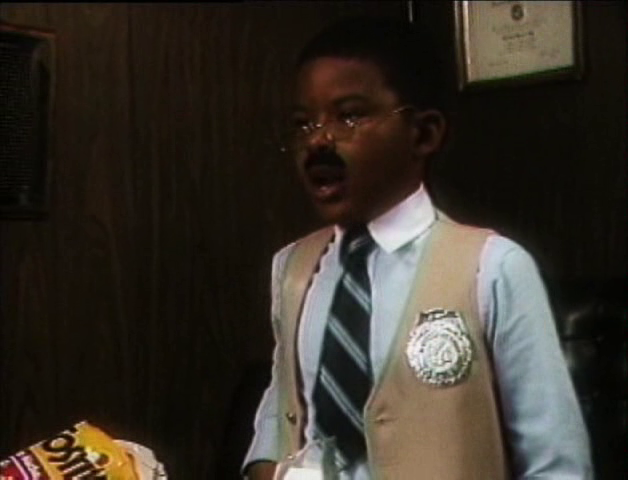
Hawk Jones takes place in Minitropolis, a gritty burgh emulating New York City, which is under the thumb of Antonio Coppola (Tyler Vargas), a ruthless mob boss bent on controlling the populace through terror and crime sprees. After a fierce wave of felonies, the local police force had enough, and they got one of the most infamous investigators, Hawk Jones (Valiant Duhant), on the case. Jones is a tough cookie, brisk and aggressive, and, like all the best cops, is constantly butting heads with the commissioner, who beats at his junk-food-covered desk and sports a fine, bushy fake mustache. The job is too dangerous to do alone, so Jones is assigned a female partner, the sassy and independent McAllister (Charmella Roark). The thing is, Jones isn’t a fan of the ladies, and he voices his displeasure at every chance he gets. “Females are like chocolate chip ice cream; cold and lumpy!” he exclaims. If these characters were adults, Jones would come off as a misogynist, but since they are children, it leans more into “Ewww, girls have cooties” territory.
One of the funniest aspects of the film is the sight gags involving the children’s short stature. The shots aren’t set up to make them look adult-sized, and often, you can see the actors struggling to reach things or open heavy doors. Additionally, often during puberty, girls get their growth spurt a few years before boys do, so many of the actresses tower over their male counterparts. Early in the film, Jones and McAllister take a ride in a police car, and it’s apparent that Jones can’t physically see over the steering wheel, but that doesn’t stop him from putting the pedal to the metal. Although the novelty of seeing kids act like adults wears off sooner rather than later, Lowrey continuously finds new ways to make light of the situation. Some standout moments include an “old” couple wearing grey wigs with walkers, a soap opera clip where a wife finds out her husband is cheating on her, complete with the camera zooming in on their shocked faces, and a tough gas station robber wearing a cheap Halloween mask with a fake five o’clock shadow stippled haphazardly onto his face.
Although the narrative makes a few changes to keep things family-friendly, for example, switching out liquor for cold glasses of milk in the local nightclub, one thing it doesn’t skimp out on is the violence. There are shootouts aplenty, and the cops and robbers alike have realistic-looking guns with no sign of the bright orange safety tips. If anything cemented this film strictly in 1986, it’s the lack of concern about the optics surrounding children and guns, but this was before school shootings became so prevalent in American society. In Bugsy Malone, the kids also have authentic-looking firearms, but they shoot whipped cream and throw pies instead of bullets, while Hawk Jones replaces the muzzle flashes with comic book-style POW onomatopoeia. There are a few casualties shown, but it’s played for laughs, and the blood is scarce.
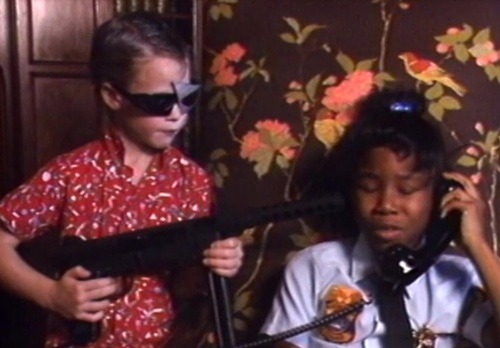
The tone occasionally walks an uneasy line as the adult situations and dialogue clash with the young actors. This is especially apparent in the nightclub scene, which, in real life, is the domain of adult activities. Yes, the booze is replaced with milk, and some goofy flirting is played for laughs, but just underneath that veneer is the promise of loss of innocence. The children are shielded from the connotations, but the adults watching the film know the score. This isn’t a negative aspect; it gives what is primarily a carefree affair a bit of depth. A burlesque dance number featuring a girl dressed like a flapper and mini-sailors commences, but it feels like a school play instead of something more salacious. There is a scene where the chalk outline, which usually indicates where a dead body was previously, is replaced with a silly stick figure. Death and murder are unknown concepts to children, and this scary fact of life is rendered inert by the wholesome playfulness of youth.
Jones is involved in a love-triangle of sorts; he meets up with Lola (Casey Depape), an actress and old flame, who is nothing but trouble. However, McAllister might also be harboring some feelings for the grumpy detective, despite their constant bickering. As the stakes rise and all three of them are thrust into grave danger, they have to work through their differences and conflicting interests to find common ground. It never goes any further than the typical schoolyard crush, though the mature writing gives it more weight. It’s difficult to take anything completely seriously with some of the line deliveries bookended with barely contained giggling.
As the narrative approaches the midway point, it starts to veer into more ridiculous set-pieces. Angered by his inability to take out Jones, Antonio Coppola hires a hit man, The Destroyer (who arrives by a plane piloted by two kids in uniform), a stone-cold punk rock killer decked in ripped clothing and numerous chains. He’s also sporting some grade-A zany ’80s shades and a spiked-up hairdo to complete the look. He has one mission: take out Hawk Jones. On top of this, Coppola’s scientists have invented the “Copper Stopper,” a machine that vaporizes any cop within a hundred yards, its abilities demonstrated on a pint-sized mannequin wearing a police hat and holding a pair of handcuffs. Hawk Jones leaves behind its ’80s buddy-cop flick channeling a pastiche of ’40s noir movies and dives right into ’50s sci-fi schlock.
The third act is an action-filled extravaganza, as Coppola kidnaps McAllister and uses her to lure Jones to his compound. There’s a cute sequence where Jones suits up a la Rambo: First Blood Part 2 (1985), complete with a bow and arrow and a lollypop. What follows is an over-the-top battle with guns blazing, an encounter with the “Copper Stopper,” and an intense swordfight between Jones and the cigar-chomping Coppola. Jones wins the encounter by the skin of his teeth, makes amends with McAllister, and saves Minitropolis from being overrun by crime. Has McAllister finally cured Jones of his hate towards dames? Only time will tell. The ending credits have a sitcom feel, with some of the actors coming back to life after being killed to happily wave at the camera.
While Hawk Jones was shot on three-quarter-inch videotape, the staging and editing are highly professional and well done, making it look more like a movie than a home video. There are many locations used throughout the film, including a makeshift police station, a gas station, and even a real airport! Richard Lowrey also composed the soundtrack, a rad, synth-heavy, saxophone-infused score reminiscent of Harold Faltermeyer’s score for Beverly Hills Cop (1984). For the most part, the kids’ acting ranges from stilted to excellent, but it’s evident that most of them are not professional actors and are locals from Iowa, where it was filmed. There is a lengthy behind-the-scenes video on the Lowrey brothers’ YouTube channel that showcases how hard it was not only to wrangle tons of kids but also to get consistent takes from them, especially with the complex dialogue. The children seem happy to be there, and the Lowrey brothers are patient with them. The famous quote by W.C. Fields, “Never work with children or animals,” might not be gospel, and perhaps the workaround is to work with all children.
Hawk Jones was a somewhat obscure cult VHS oddity that commanded high prices on resale sites. However, it made its mark on pop culture with a limited boutique VHS release and a DVD sold on the director’s website. Another surge of popularity occurred in 2019 when the film was featured on Red Letter Media’s The Best of the Worst, a YouTube film criticism channel (with special guest Macaulay Culkin). Despite the odds and the limited distribution, Hawk Jones continues to capture the imaginations of adults and children alike.
~~~
Michelle Kisner is a film critic, freelance writer, and advocate for physical media.
Categories: Screen



 The Cultural Gutter