
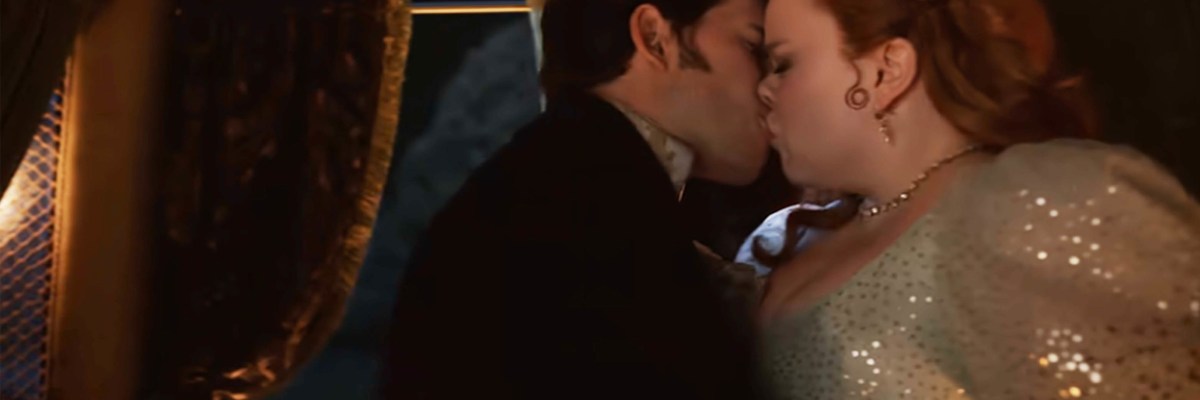
You might reasonably think that as one of Netflix’s top 10 shows of all time, Bridgerton season 3 is not exactly Gutter material, but I ask you: is there anything more gutter than millions of people obsessively listening to a classical string arrangement of a Pitbull song they heard during a sex scene in a romance show to the extent that Mr. Worldwide has become a gateway to a greater appreciation for classical musicians? “Give Me Everything” (Pitbull, Afrojack, and Ne-Yo) turning out to be the perfect score for the iconic Bridgerton Carriage Scene seems to have surprised everyone, including the producers, cast, audience, and Pitbull himself. It made me question by what path we arrived at this cultural moment, and that path winds through bawdy songs in Renaissance sacred masses, the Boston Pops orchestra, the birth of electronic music, period performance, and Radiohead’s “Creep” sung by a Belgian girls’ chorus.
Throughout music and art history there has been an ebb and flow of integrating popular elements to engage audiences or explore new creative boundaries and railing against their inclusion on moral or aesthetic grounds. Many Renaissance masses or motets composed for use in church services were based on folk melodies, sometimes rather bawdy ones, up until the Catholic church purged them from the repertoire and discouraged composers from using the complex polyphonic textures they felt obscured the sacred lyrics and interfered with the primary purpose of music, which was worshipping God. In the opposite direction, Black artists like Sister Rosetta Tharpe and Ray Charles brought gospel to rock and roll through Tharpe’s blazing guitars and combination of sacred and secular themes, and Charles’ use of religious gospel forms for songs about love, sex, drugs, and dancing.
The division between “high” and “low” in Western art dates back to the end of the 19th century, around the same time as the Boston Symphony Orchestra launched the Boston Pops, which has now sold more commercial recordings than any other orchestra in the world. Conductor Arthur Fiedler (1930-1979) first introduced popular songs to the symphony’s repertoire to bring in wider audiences, and John Williams brought in film music when he took over in 1980. The Pops paved the way for the rise of today’s classical pop Candlelight concerts and groups like the Vitamin String Quartet and Archer Marsh, who created many of the classical pop arrangements for Bridgerton.
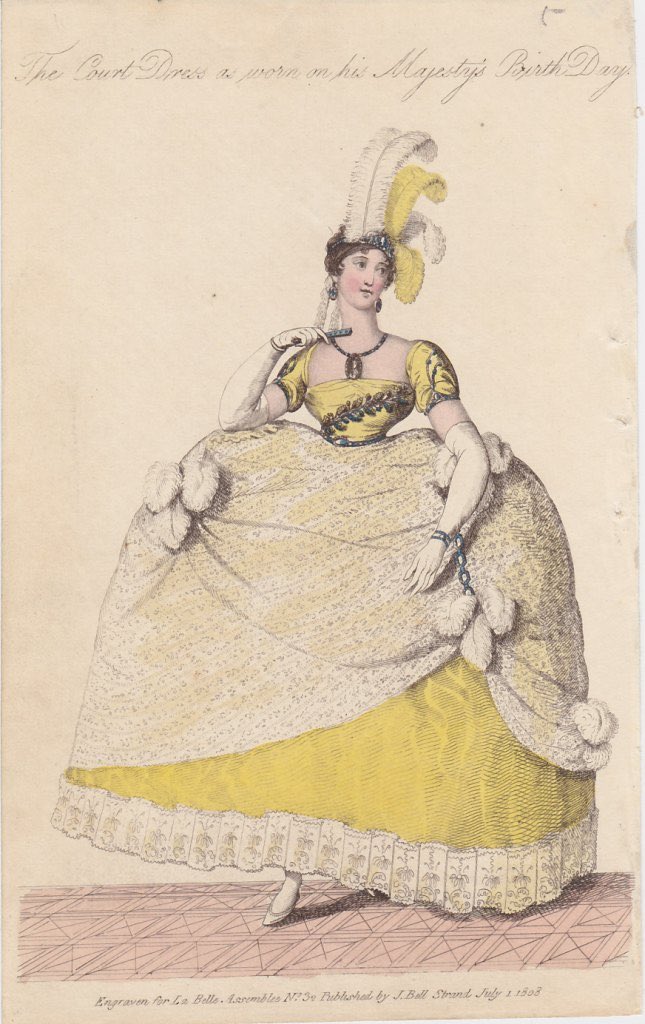
Bridgerton is not the first show to use classical versions of pop songs, but it does handle it in a uniquely integrated way. They play organically in the background as live music for dancing at the various Regency era balls rather than being spotlighted like key songs usually are in other shows or films. Pulling in subtext from an external source is a high art concept that draws on the modern notion of the viewer or reader bringing their own knowledge to a text and participating in making meaning. For viewers who don’t know classical music it might not stand out at all. For those who do but don’t know the song, they might catch that it’s modern and nothing more, but if you know the song then you have access to a whole level of subtext that adds another dimension to the scene. One of my favorite examples is the use of GAYLE’s song “abcdefu”, which adds a satisfying litany of silent “fuck yous” to the scene where Penelope (Nicola Coughlan) enters the ball in the elegant new look she chose for herself and turns the heads of everyone who has looked down on her since she entered society in the endless flow of relentlessly tacky yellow floral gowns her mother picked out for her. (Spectacular tacky yellow floral gowns, so kudos to the costume design team, but definitely deserving of a fuck you from Penelope’s perspective).
One of the artistic goals of Bridgerton, and one of the central reasons for its fantastic success, is to update period pieces and traditional romance narratives with diverse casting, queer inclusion, feminism, and modern sensibilities. Adaptations are all about successfully maintaining the spirit and emotional impact of a piece while transforming it to work within a new medium (i.e. book to screen), era, or context (i.e. 1980s straight white neurotypical romance to 2020s diverse romance). There’s an entire other article series in the updating of the costumes alone, from the Queen’s magnificent high drag wigs to Cressida Cowper’s super-extra pink ruffle overdress, but suffice it to say that the actors have to read as sexy to us in their clothes and actual Regency court wear and underthings would not have cut it. As Cora Harrington, author and founder of The Lingerie Addict blog, noted in a social media post, “Bridgerton is actually a very good example of how costume design takes into account the spirit of the era rather than strict historical accuracy because we would be guffawing and cackling if they showed actual Regency court gowns on screen.” I imagine Colin and Penelope’s first time together would have had a very different feel if he’d stripped his pants off to reveal baggy cotton knee-high pantaloons!



When it comes to period music, making it modern in some way can be essential to evoking the emotional response you’re looking for from viewers. Composers from the Baroque era (1600-1750), and especially Bach, began to normalize and popularize the musical keys and chord progressions our ears now take for granted as a basis for Western music. Medieval and Renaissance music included 12 modes, or scales, that Gregorian chants or choral compositions might be written in, with the original modes tracing back to Ancient Greece. Current popular music in particular relies on standard chords and satisfying melodic resolutions that have roots in Baroque and Classical era music theory. What Bach was composing sounded new and fresh to people at the time, but to make it feel that way now requires some creativity.
Take Switched on Bach, a groundbreaking album series of Bach’s music played on the synthesizer which was released in 1968 by electronic music innovator Wendy Carlos. Again, that may sound a bit underwhelming to us current day folks for whom the synthesizer seems like a commonplace musical instrument, but at the time the synthesizer was just being developed and no one had considered it seriously for much beyond sound effects. Switched on Bach won three Grammys, sold over a million copies, and basically blew people’s minds. Wendy Carlos was a trans woman who dropped her studies in physics and computers to pursue a career in music. She ended up working with Robert Moog, inventor of the Moog synthesizer (1964), applying her knowledge to help him develop and popularize it as an instrument. The success of Switched on Bach helped her fund her gender transition and led to three movie soundtracks where she got to hone her craft: A Clockwork Orange (1971), which included a synthesized rendition of Beethoven’s “Ode to Joy” for which she and her colleagues had to invent a new vocoder that mimicked choral sounds, The Shining (1980), and Tron (1982) which was one of the first projects to incorporate synthesizer music with an orchestra.
The very entertainingly candid music critic Dave Hurwitz chose Switched on Bach as part of “The Most Important Recording Projects Ever” series on his Ultimate Classical Music Guide YouTube channel. He talked about how the album made people think about the possibilities of hearing classical compositions on different instruments than they were used to and how that same thinking played into the development of period performance, where music is played on instruments from the historical era it was written in. He points out that somewhat ironically, the period performance movement comes from a totally modern context where the sound is still conditioned by our modern aesthetic sensibilities and ears. Similarly, the challenge of making effective historical period pieces, whether music, costumes, or stories, is balancing historical elements with a modern sensibility in a way that makes them relevant, relatable, and appealing.
Other film composers and musicians were engaged in different kinds of experiments with blending classical and popular music at the same time as Wendy Carlos, for instance Walter Murphy’s famous disco-funk version of the first movement of Beethoven’s 5th Symphony, “A Fifth of Beethoven”, which went platinum and was part of the Saturday Night Fever (1976) soundtrack. Brazilian jazz pianist and composer Eumir Deodatu’s album Prelude (1973) included a jazz-funk version of classical composer Richard Strauss’ “Also Sprach Zarathustra” which became the theme for 2001: A Space Odyssey (1968).
More recently and directly connected to the music choices in Bridgerton, Brian Helgeland’s medieval action-comedy film, A Knight’s Tale (2001), featured 1970’s music in the soundtrack, including a scene where squire William Thatcher (Heath Ledger) posing as the knight Sir Ulrich von Liechtenstein is called on to teach the court a dance from his assumed home of Gelderland. It begins with an awkward dance to period-style music, but partway through morphs into 70s dance moves to David Bowie’s “Golden Years”. And very recently, the soundtrack for the CW period drama Reign (2013-2017) about Mary, Queen of Scots used modern songs by bands like the Lumineers as well as a few classical arrangements by the Vitamin String Quartet that foreshadow the more complex integration of classical pop that would show up in Bridgerton several years later.
The closest comparison I can think of to Bridgerton, though, is composer Ramin Djawadi’s amazing work on Westworld (2016-2022), which had viewers eagerly awaiting which piano arrangements of pop songs he’d chosen for each episode. Some standouts include Nirvana’s “Heart Shaped Box”, “Amy Winehouse’s “Back to Black”, and a piano version of the Vitamin String Quartet arrangement of Radiohead’s “Motion Picture Soundtrack”. Some of the songs just play in the background as part of the score, but “Back to Black” is organically built into the scene. It’s on the player piano in the saloon as the kick-ass android hostess, Maeve, comes back in full control after having been dismantled and reset over and over again, adding “I died a hundred times” as a subtextual gut-punch.
Being included on the soundtrack to a popular show or movie has always brought in new fans for older songs and artists who are out of the mainstream radar, like the sudden top 40 experience Kate Bush had after “Running Up That Hill” became Max’s lifeline song in Stranger Things, which I doubt anyone could have predicted given the song’s subcultural first run. What’s especially interesting is when that popularity opens up doors for unexpected performers or genres. Another Radiohead adaptation that really took off and has been credited with motivating the trend for cover songs in movie trailers was for David Fincher’s Facebook documentary, The Social Network (2010). It had an Academy Award-winning score by Trent Reznor and Atticus Ross of the Nine Inch Nails – already unusual – but for the trailer Fincher hired a specialist trailer editor, Mark Woollen, who is known for coming up with iconic ways to market films that are difficult to sum up in bite sized form. His choice to use a Belgian girls’ choir covering “Creep” was a stroke of genius.
As columnist Alex Pappademas described in The New Yorker (“How the Cover Song Conquered Movie Trailers.” New Yorker, July 31, 2019):
“The irresistible ingredient,” Woollen said, “was one hundred Belgian girls singing ‘You’re so fucking special’ in full voice.” The trailer instantly turned Scala and Kolacny Brothers into the most famous Belgian girls’ choir the world had ever heard. “They played Coachella, they played South by Southwest,” Woollen said […] that was them, in 2012, singing Metallica’s “Nothing Else Matters” in a trailer for Kathryn Bigelow’s “Zero Dark Thirty.”
For Bridgerton, composer Kris Bowers describes the trial and error process of coming up with the right blend of classical and modern to suit writer Chris Van Dusen’s vision, saying he tried period music recorded in a modern way, which felt too traditional, then music in the style of Beethoven sampled into beats, which felt like too much of a departure, and finally took inspiration from the dreamy, romantic 20th century sounds of Ravel. For the theme song, he applied the progression, melody, and rhythm conventions of a pop song to a classical sound, and of course, for the pop covers in the dance scenes, music supervisors Alexandra Patsavas (season 1) and Justin Kamps (seasons 2 and 3) provided song options to the producers and Van Dusen to choose from. Fans responded enthusiastically, jumping on the season 3 playlist as soon as it dropped with as much excitement as any new release music.
Season 3 showrunner, Jess Brownell, said that “for better or worse” she is responsible for the Pitbull song: “I didn’t pick a lot of the songs, but I weirdly picked the Pitbull song. I never thought I would pick a Pitbull song for a sexy moment, but the build of it just works perfectly.” The cast reaction to hearing it in the edit is very entertaining. There was a lot of “Pitbull?! Pitbull…”, and Nicola Coughlan quipped, “From now ‘til the day I die I will be associated with Pitbull.” And how did Mr. Worldwide respond? He politely thanked everyone and posted: “This again shows the world how music is the international language that transcends over boundaries more so how a hit song can remain timeless.” It’s possible no one was more surprised by where his song ended up than him.
~~~
Alex MacFadyen does not care to admit to how many times he may or may not have watched the Bridgerton carriage scene for research purposes.
Categories: Screen, Uncategorized



 The Cultural Gutter