

Confession time: I’ve never been a big consumer of the live meta-commentary subset of horror, or live commentary on movies in general*. I very rarely turn on the director’s commentary on DVDs, and I can count on one hand the number of Mystery Science Theatre or Joe Bob Briggs episodes I’ve seen. If I’m watching a movie in real time, and this equally goes for my friends talking to me during movies as well as recordings of the directors or talent or the foley guy, I just want to watch it, you know?
Johannes Grenzfurthner’s Razzennest (“Rat’s Nest” in German) plays with the idea of director’s commentary in a way that I can honestly say I’d never experienced or even considered. The concept of the film is that you’re watching a stylized, dialogue-free art film by a provocative and ill-tempered South African filmmaker. Overlaid is a commentary track in the form of an interview between the director Manus Oosthuizen (Michael Smulik), his producer Ellen Zampaglione (Anne Weiner), and his cinematographer Hetti Freisenbichler (Roland Gratzer) ahead of a screening at Fantastic Fest, where Razzennest actually premiered last year, and where I first saw it. Joining them are ill-prepared host Babette Cruikshank (Sophie Kathleen Kozeluh) and laid-back sound engineer Pat “The Pat Man” Kirkpatrick (Jim Libby). But the commentary, as recorded, depicts something alternatingly annoying, darkly funny, and outright terrifying, even as the images you see don’t quite match up. Razzennest upends many traditional horror beats by playing on this dissonance between audio and video, and combines it with the awkwardness of listening to several people aggressively cat at one another. If you have a taste for the kind of talk radio where people call in to yell at, or with, the host, this might be a familiar experience for you, if not necessarily a pleasant one.
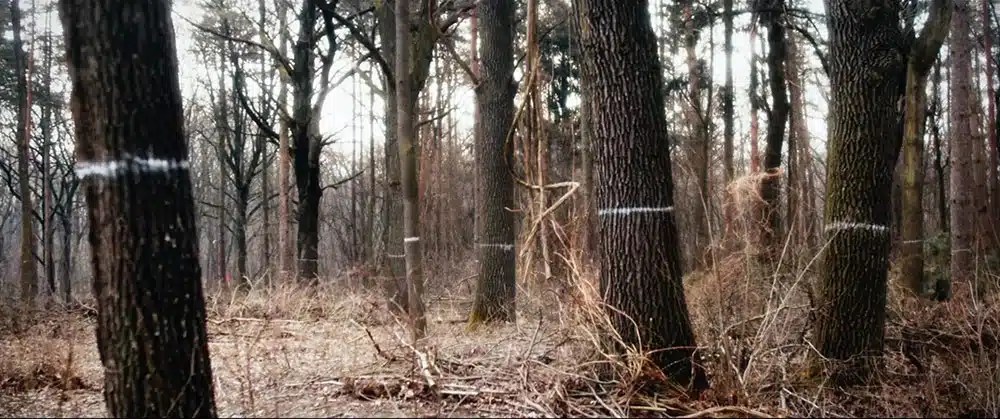
The film-within-a-film in Razzennest is also (confusingly, if you’re trying to write about or describe it) called Razzennest, and depicts locations, writings, and locations in Austria which are associated with The Thirty Years War in a non-narrative format and completely absent of humans. This very real war, true to its name, was fought in central Europe between 1618 and 1648 and is known as one of the most brutal and most protracted conflicts in human history, which resulted in somewhere between five and eight million casualties, both civilian and soldier. The imagery in the meta-film is mostly innocuous on its own and would be little more than b-roll in a different context – long shots of forests, rocks and caves, weird architecture, or ruined buildings covered in graffiti – but takes on different meaning with the audio over top. The images themselves, becoming increasingly dark and abstract, haunt and eventually infect those exposed to them as it becomes clear that the war dead are communicating (and then some) through the living. Towards the end of the film, with the gimmick starting to show signs of losing its novelty, the imagery becomes slightly more literal to what’s being described, though never depicting what’s going on in that recording studio. At least, I think it gets more literal – it’s either that or I just got used to the rhythm.
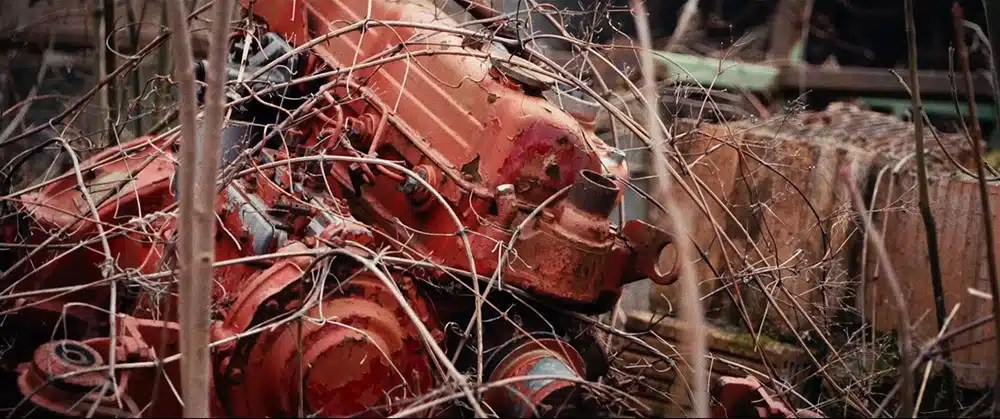
A film that never visually depicts humans but manages to spin a narrative through audio certainly isn’t unheard of. That’s a radio play, of which there are many, including several classic horror stories in the format. But mashing them together with an abstract piece of art that is both bolstered and undermined by the format and content of the audio narrative is a new one for me. As Manus says at one point, “I refuse to show the thing I want to address.” It’s a laugh line, meant to develop Oosthuizen’s artistic pretensions, but it rings true when what’s important is somewhere between the lines. Grenzfurthner, the film’s ‘real’ director, says in an interview that “[Razzennest] allowed me to realize my decades-old dream of making a film about the Thirty Years’ War and its endless atrocities without needing a budget of millions of dollars to depict the war’s bloody significance.”
Visual imagery in Razzennest that you parse as beautiful might be undercut with some of the most caustic and irritating characters imaginable, providing the worst possible film and cultural commentary, while also describing a film production process that sounds both insufferable and borderline abusive. Alec Empire’s intense and insidious score, which is–again, confusingly–the score for both Razzennest and ‘Razzennest’ acts as a third demand of your senses. Almost none of the three elements–dialogue, score, and visual–work together in unison, and I think that’s by design. In this year’s tradition of difficult horror films like Skinamarink, the bleeding edge of horror is begging you, as a viewer, to put in some work. Unlike Skinamarink, though, this is not a minimalist approach by any means. It’s certainly not asking you to stare silently at a blank wall for several minutes at a time (though there are walls to stare at, if that’s what you’re after). Razzennest puts an arthouse spin on the maximalist approach of Best Picture Winner Everything, Everywhere, All At Once**. It’s a movie that’s openly belligerent, offering up a cacophony of assaults on your senses and sensibilities, but keeps you watching, like horror does.
And make no mistake, Razzennest is horror through and through. There is something worse about being narrated a scene in which someone vomits up a black, viscous substance than actually seeing it depicted visually. Nothing accomplished with practical or digital effects could come close to what’s in my mind’s eye. And what’s perversely beautiful about that is the fact that your black, viscous substance is going to look very different from mine. Razzennest uses that idea, while mildly steering you into its world with visual hints of what you should be thinking about–setting, colours, and mood. The performances get better in the second half of Razzennest too, when the infection takes hold and the horror becomes more explicit. What feels like a meta-balancing act (including humour that only sometimes lands and 2020’s-specific film culture references so inside that I felt I wrote it) at the beginning gives way to something truly unhinged from reality. Wails of pain and the narration of acts of violence and degradation, often while maintaining a self-satisfied smirk are what’s waiting for you in Razzennest’s climax, but I can’t say that the first half, clumsy in execution as it might be, doesn’t prepare you for it. Then, at the end of Razzennest, the film rewards your perseverance with…Joe Dante. Yes, that Joe Dante narrates the last third of the film, presenting a heartbreaking monologue that puts the film into a new context. It’s a reminder that underneath all the jokes in Razzennest is a story about generational trauma and the ways in which historical atrocities can reach forward and affect the present. As the film’s log line says, “history is written by the dead.”

As with Skinamarink and with all sorts of arthouse horror, I don’t know if I can give Razzennest an unqualified recommendation. There’s more here, I think, that hits than misses but the full experience requires a little effort on the audience’s part to pick away the layers it creates. Even though one could certainly look away from the screen and ignore the visual elements, consuming Razzennest as a pure radio play, a critical part of the film–which seems silly to say since it would be the film itself–would be lost. Similarly, if the meta-dialogue (basically all of the commentary besides the Joe Dante bit at the end, which is part of Oosthuizen’s production) were to be stripped out, leaving only the visuals and score–Razzennest, the film-within-a-film–behind, it wouldn’t fully work either. All of Razzennest’s humour and much of the context would be excised, though there would still be something haunting and beautiful and laden with pathos. Neither half works fully without the other, and that’s what makes Grenzfurthner’s a success. Razzennest makes you work for it, but you’ll be rewarded with – at least the deconstructed pieces of – one of the most inventive horrors I’ve ever seen.
Razzennest is currently available to stream on Fandor in the United States.
* With some exceptions! Shoutout to online tweet-alongs the CineJanes and the Drive-In Mob, though I mostly mean audio commentary because despite having not one but two ears, I can only listen to one thing at once. I live in a country with legal cannabis and cannot abide two concurrent audio streams.
** I will never ever stop referring to it this way because I am so damn proud, regardless of how I feel about industry awards.
~~~
Sachin Hingoo is better heard than seen.
Categories: Screen



 The Cultural Gutter