
Given all the other things I like, it should come as no surprise that the wrestling I love most is disreputable wrestling. Wait, you might say, all wrestling is disreputable. That’s true, but some kinds of wrestling are more disreputable than others among reputable wrestling fans. And it is absolutely predictable that I would go for the kind of wrestling least respected by wrestling bloggers, vloggers, online discoursers, and journalists. I am, as usual, bored by “realism.” I like my wrestling artsy, conceptual, indie-flavored, wondrous and weird.
I did watch more reputable wrestling for a time. I even got a literary award in college for talking about wrestling as American myth. (I could not have foreseen how much wrestling explains so much of current American politics, though). I watched WWE / WWF in the Attitude Era and into the 2000s, basically as long as the Undertaker was sacrificing people, Kane was rampaging, the Rock smelled what everyone was cooking, and Mankind / Mick Foley overwhelmed opponents with his sock puppet friend Mr. Socko’s Mandible Claw. But the WWE took a new direction with less classic wrestling hair, more booty shorts, and more technical wrestling, and I moved on. Now I just can’t go back because I just can’t with the McMahons.
So I watched what Kaiju Big Battel I could—wrestling matches that were between towering giant monsters, mad scientists, aliens and henchmen over cityscapes threatened by their titanic struggle. I watched a little of Mexico’s Lucha Libre AAA when I could find it. I remember an interview with Electroshock and the late La Parka in his skeleton suit, sitting on stools as the interviewer tried to resolve their differences peacefully. They didn’t, but I wished more American and Canadian wrestling had interviews with guys in skeleton suits.

Then I discovered El Rey Network’s Lucha Underground (2014-18), conceived of and co-produced by filmmaker Robert Rodriguez. I enjoyed the mix of stories and athletic feats—the leaping, the flipping, the wrestlers from space and the underworld, and Dario Cueto (Luis Fernandez-Gil), a shady manager with a suitcase full of cash running an underground wrestling ring in an abandoned warehouse in Boyle Heights. Even better, there was an overarching storyline wherein the warehouse was literally a temple and the wrestlers’ matches were blood sacrifices to awaken an ancient Aztec god. Lucha Underground was everything I wanted in wrestling—a fine mix of wrestling, horror, telenovela and science fiction. Lucha Underground had bands play at their taping, and I even discovered some music I liked. But one day, Lucha Underground faded away into the mists of eternity. Well, not quite. Elements of Lucha Underground continued in Major League Wrestling’s Azteca Underground on MLW’s YouTube channel, but it wasn’t the same. Still, I am sad that I’ll never find out what will happen after Dario Cueto returned from the dead.
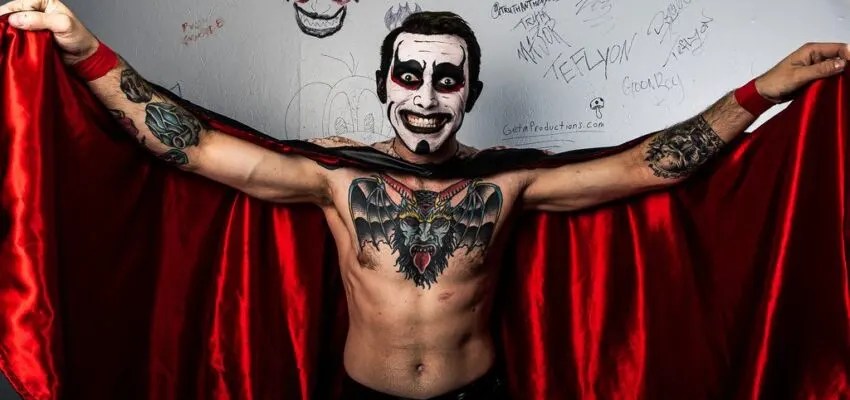
Recently, the Gutter’s own Sachin Hingoo has interested me in watching pro wrestling again. He encouraged me to watch All Elite Wrestling, noting that some of the wrestlers from Lucha Underground had found a home at AEW. I became interested in some of the wrestlers he wrote about—particularly Danhausen (a very nice, very evil, very funny demon with a face like Pazuzu’s and a desire for a blimp and human monies) and Orange Cassidy (who might have initially been based on Paul Rudd in Wet Hot American Summer (2001)). I watched some of their matches in the indie circuit and found the kind of wrestling I love. Weird, even artsy, almost performance art or improv with physical feats that were sometimes spectacular and sometimes Buster Keaton-esque. I watched Game Changer Wrestling’s grudge match between the Invisible Man and his jackhole brother, Invisible Stan, officiated by Bryce Remsberg, now a referee for AEW. As well as being just plain enjoyable, the match really helped me appreciate the physicality of the referees and their role in matches.
I also watched matches between Super Cop Dick Justice and Orange Cassidy, which are both hilarious and as trenchant commentary as I think you will find in wrestling on law enforcement. The first match has an unexpected ending as the combatants and referee decide what to do after an officer involved shooting. The second match between Orange Cassidy and Super Cop Dick Justice goes even further. I am there with the audience, ducking as Super Cop Dick Justice swings his finger gun around wildly while Orange Cassidy desperately attempts to wrest the weapon away.
And in a third match, Super Cop Dick Justice must exercise his law enforcement responsibilities and help serve a subpoena on his tag team partner, Colt Cabana. I cannot even begin to express how much I love this.
After watching enough indie matches to dry my eyes out, I started watching AEW’s weekly wrestling shows, Dynamite, Rampage, and Collision. AEW features many of the wrestlers I had enjoyed in Lucha Underground, plus many of the wrestlers I’d come to love in the indie promotions. It’s kind of ironic that in trying to create a monopoly, the WWE might have helped spawn different kinds of wrestling as artsy weirdos excluded from WWE and its developmental promotions created new homes for themselves and found an outlet online. Regardless, I appreciate that AEW includes a wide variety of wrestling styles from high-flying acrobatics to extreme wrestling to more “realistic” technical wrestling. And I appreciate the acceptance and even celebration of queer identities in indie promotions and in AEW when the McMahons wrestling biz set such a homophobic tone for so long.
Last weekend was AEW’s All-In pay-per-view event at Wembley Stadium in London. It was AEW’s biggest event so far in its short history. Orange Cassidy was in a “stadium stampede” match teamed up with the Best Friends, Chuck Taylor and Trent Beretta, and Penta El Zero Miedo (formerly Pentagon Jr. and Pentagon Dark in Lucha Underground) and fan favorite Eddie Kingston. They were generally collectively representing the kinds of things I enjoy in professional wrestling and faced off against the Blackpool Combat Club, whose wrestling I recognize as good, but I do not enjoy. During this match, John Moxley apparently gashes Orange Cassidy’s head with a fork. And afterwards, I read fans saying things like Orange Cassidy has paid his dues now. All I can think is that they hadn’t paid attention to his remarkable physical feats, his excellence at maintaining his character, and his ability to work a crowd. It is true that for many fans this is when Orange Cassidy became a real wrestler because they can see the external signs—the signs codified within professional wrestling—of him pushing his body to extremes. Sure, it’s his blood and it’s real blood, but it’s not any more real or less real than anything he has already done.
“Wrestling is fake” is an assertion that irritates wrestling fans and, rightfully, wrestlers. It’s easy to see why. Wrestlers can do extraordinary physical feats at the risk of their bodies and their long term health. For most of pro wrestling history, wrestling’s secrets, like the secrets of stage magicians, were kept very quiet and hidden behind the idea of “kayfabe,” slang for “fake” that means so much more.
Putting over a pro-wrestling persona is not easy. The task requires a thorough mastery of “kayfabe,” a carny-derived term for the extreme strain of method acting peculiar to the sport. American pro wrestlers treat kayfabe with a devotion that requires denying the obvious. It’s a head game. When you know you’re faking and the audience knows you’re faking and you know the audience knows you know you’re faking because the fact that pro wrestling is fake has been documented, verified, and repeated to the point of cliché, and yet you stay in character on the walk from the locker room to your Mazda just in case someone is pointing his phone’s camera at you from a window above the alley—that’s kayfabe.
Michael Brick, Harper’s, May 2013 via Merriam-Webster.
But now more people know more about how professional wrestling works—or at least think they do—than ever before. And in the last couple of decades, WWE in particular has found it profitable to have wrestlers talk about “kayfabe” and the mechanics of wrestling. Meanwhile, the wrestling press makes bank reporting on purported beefs between wrestlers and backstage drama, making fans feel like smarter marks than ever. The breach of kayfabe switched fans’ focus from figuring out what was fake to trying to determine what was real. It’s a nice trick and it turns out that keeping fans guessing this way is just as effective in getting an audience engaged. Is there really heat between those two wrestlers? Is Mick Foley, Orange Cassidy or whoever really injured or is this part of the show? Often, the answer is both. I think the admission of wrestling as performance has also left fans with more of a hunger for what feels “real” in matches. And possibly this revelation makes fans more impatient if they see wrestling’s seams—like say, wrestlers slapping their thighs to make a blow sound more painful or a wrestler making sure his feet are in position before leaping off the top rope onto another wrestler.

One of the Blackpool Combat Club’s taglines is, “Be Real.” Some fans are drawn to “realness,” to use the language of drag, another performance grounded in the exaggerated expression of gender with a choreographed physical component featuring music, melodrama, comedy and sparkles. (Toni Storm and Dalton Castle bridge these worlds). Some fans are drawn to the raw realness of wrestlers executing technical moves and “juicing”* or wrestlers throwing each other onto barbed wire-wrapped planks or a ring covered in thumb tacks. I do not need to see Mick Foley’s tooth protruding from his nose and Jon Moxley’s explosive forehead veins. These are not my things and don’t need these things for wrestling to feel real for me. I am down with the more “unrealistic” forms of pro wrestling— I like fun and flips, the masks, pageantry and exaggerated stories. I don’t mind seeing Komander or Hijo del Vikingo take a moment to get their footing on the top rope before they do something spectacular. I want to know the match is as safe as possible in order to enjoy it. I have decades of experience now suspending my own disbelief, whether it’s Godzilla, Luchasauras being a luchasaurus, or everything about Danhausen, his life and his curses. I want to—and can—believe.
Once kayfabe—or the old kayfabe, at least—was breached by wrestling promotions, it allowed for other possibilities that are central to the kind of wrestling I love: an embrace of the fake, the unreal, the exaggerated, the impossible. I love to see wrestlers and promotions play with the conventions of pro wrestling. I don’t need Orange Cassidy’s sloth style kicks or his near invulnerability when his hands are in his pockets explained as “mind games.” I prefer the indie world where his kicks and half-hearted chops were taken seriously as devastating blows. My favorite development is the wrestling that embraces that unreality and pairs it with athleticism. My town has a Festival of the Pollinators and last year it featured a wrestling match between a bee, Big Bruce Buzzbee, and a pesticide Guy Phosphate. Just that it exists filled my heart with joy. I like the weird wonders of wrestling. And the thing is, right now, none of us have to choose between the kinds of wrestling we love. We can have it all.
*In wrestling, juicing is not using steroids, though there is clearly steroid use in professional wrestling, it’s cutting one’s forehead with a concealed blade to make it bleed for dramatic reasons. It’s the wrestling version of tearing off one’s wig to demonstrate passion while lip syncing for one’s life, maybe.

~~~
Carol Borden would like to offer you a unique opportunity.
Categories: Wrestling



I’m not sure you can really call it wrestling if there isn’t an ancient god in the basement…
LikeLiked by 1 person
I know, right?! What is the point otherwise?
LikeLike
Also, Is it a very nice, very evil opportunity?
LikeLiked by 1 person
I would say it’s a very nice, very evil opportunity for at least one person…
LikeLike