

When I think about the last year in film, it feels like one that was a study of extremes and surprises. Films seemed to fall into a ‘difficult or at least demanding to watch’ end of the spectrum, like Oppenheimer, or they leaned into a candy-coated, fun end like Barbie. What I found interesting was that films that marketed themselves as being serious ended up being less so, while the films that felt like they’d lean towards trite ended up being some of the most meaningful film experiences I had in 2023. Objects in the ol’ black mirror seemed to run counter to how they initially appeared, in a mostly pleasant way.
Starting off 2023 for me was Brandon Cronenberg’s Infinity Pool, which – even before you got to the Director’s Cut – showcased a staggering amount of bodily fluids being spilled onscreen. It’s been derided as being (and I’m paraphrasing here) ‘too opaque’ or ‘too complex’ despite many of those same reviews praising how beautiful it is, or that it’s laden with frightening and impressively fun performances. If you know me, weird and frustrating is my bread and butter when it comes to horror and most art, and a film with a straight-ahead message or theme is as likely to turn me off as it is to bring me joy. In this case, Cronenberg’s often-literal skewering of the rich and powerful in a tropical paradise – kind of a body horror buffet at a White Lotus resort – was exactly what I was looking for in 2023 and provided me with some of the earliest horror delights of the year.

Though I actually saw it in 2022 at the Fantasia Festival, Kyle Edward Ball’s Skinamarink was unleashed widely in early 2023 and I really got the chance to delve into it’s bizarre delights when it was released on Shudder and became accessible to me on demand. Like Infinity Pool, Skinamarink taps into a vein of Canadian-produced weirdness that felt unlike any film experience I’d ever had. Sure, a lot of the runtime is staring at a wall, but it unquestionably became the movie I thought about and kept coming back to the most out of any I saw this year, and I wrote about it two separate times (three, if you count what you just read and approximately infinity, if you count my group chats). More than almost anything, Skinamarink seemed to set the table for a year of downright bizarre film (and TV, but I’ll get to that later) that asks a lot of the viewer, while never promising satisfaction.
2023 also found the horror world upending a couple of classic monsters, in particular Bram Stoker’s Dracula (and vampires in general) and Mary Shelley’s Frankenstein. Andre Ovredal’s The Last Voyage of the Demeter took a vanishingly small section of Stoker’s original story – placing Dracula on a boat from Transylvania to England – and expanded it into a story that was a welcome surprise and a refreshing (and refreshingly, for me, undemanding) antidote to the heavy, despair and trauma-based horror that I’ve been consuming by making ol’ Drac into a fairly straight-ahead (inasmuch as the character of Dracula allows) and most importantly, fun slasher villain.

Similarly, though Dracula himself isn’t named in the film, Viktor Ginzburg’s Empire V takes the vampire mythos and concepts and upends them in exceedingly stylish fashion. What’s a vampire story without the sex and where the blood is a secondary concern, anyhow? Ginzburg answers that question with a film that definitely gave Vladimir Putin a few night terrors, after having banned it from release in Russia. Controversy aside, though, the sendup of Russia’s elite society and an incendiary takedown of misinformation and the subjugation of the working class made it a standout of the year for me, and did it in slick and enrapturing fashion.
Bomani J. Story’s The Angry Black Girl and Her Monster, as well as Yorgos Lanthimos’ Poor Things provided two very different but equally invigorating takes on Frankenstein this year. I already wrote about the former, and I honestly didn’t expect that another, completely different take on Mary Shelley’s monster would be another one of my favourites of 2023. Poor Things continues Lanthimos’ record of subverting expectations and conventions with a dark fairy tale centred on Emma Stone’s Bella Baxter, a reanimated woman who is undergoing the stages of human emotional development – toddler to mature woman – at an accelerated pace. It’s the film that made me laugh the most this year, from its stilted and wonderfully blunt and literal dialogue to it’s out-of-control costuming, to a beautiful and violent dance number that made me wonder what I’d signed up for, exactly, before sending me into peals of laughter in a too-small theatre. Lanthimos and his cast, which includes one of my new favourite Willem Dafoe roles as the mad scientist with a heart of gold, do some of the best world-crafting that I saw in 2023.
Speaking of monsters, my other favourite movie this year was Studio Toho and Takashi Yamazaki’s Godzilla: Minus One. A Godzilla movie that aims, and hits a target for terror rather than just awe is rare these days, and all but absent from the American entries into the Godzillaverse. The most recent outings for the Stateside ‘Zillas (the Godzilla of Godzilla vs Kong and the upcoming Godzilla x Kong) give our favourite nuclear-powered reptilian overlord a more human touch, and portray Godzilla as a heroic ally (albeit a chaotic one) rather than a threat. American Godzilla is a thrill ride, not a thriller, while Minus One is a monster movie first, rather than (just) a movie studio tentpole.
Taking us back to World War 2 and Godzilla’s first appearance on the shores of Japan, Minus One’s Godzilla is explicitly an existential threat, a city-destroying force of nature, and the film isn’t interested in a nuanced portrayal of Godzilla’s intentions. The Godzilla of Minus One is absolutely something to be feared, and brings the series and the portrayal of its titular monster back to pure horror.
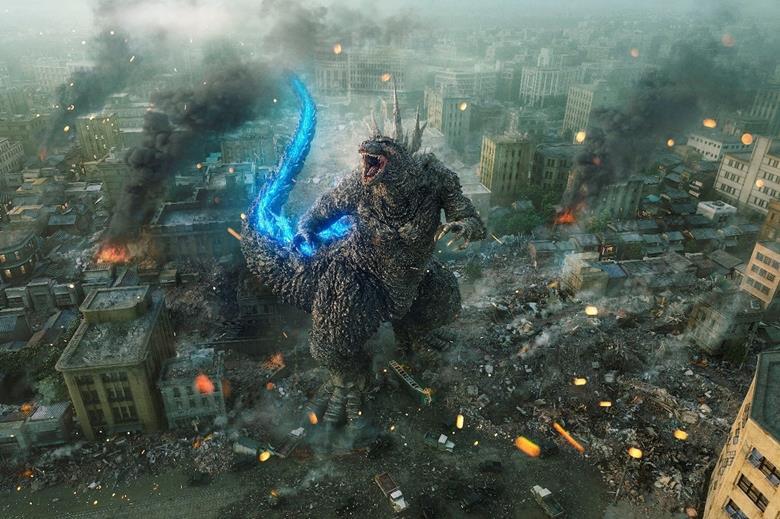
It’s 1945 and we meet Koichi, a kamikaze pilot who chickened out of his assignment at the last minute, feigning engine failure as a reason not to complete his suicide mission. This is compounded by the guilt from his failure to stop Godzilla when he had the opportunity to put a bullet right between Godzilla’s eyes, causing the death of an entire platoon of soldiers. Koichi returns to his home city and finds it in ruins from the bombs which devastated Japan at the end of World War 2. His neighbor, one of a scant few survivors, is furious with Koichi and blames him and his cowardice for the deaths of her own children and his own parents.
The ways in which Koichi grapples with his own mediocrity, as a soldier, a (potential) husband, and as a father, form the lynchpin of Minus One, and develop a uniquely affecting human story that may be one of the first of it’s kind across the dozens of Godzilla properties over the last seventy years. It was a profoundly beautiful experience, made even more affecting by the fact that my entire IMAX theatre seemed to shake whenever Godzilla’s scales lit up and he hit the old heat breath.
Finally, how could I not talk about The Curse, a series on Showtime from A24 which stars Nathan Fielder and Emma Stone as a pair of house-flipping clout-chasers who are exploiting a small town for a prospective HGTV series called Flipanthropy. There is an actual curse involved, but for a series that takes its name from the concept, it’s (as of Episode 9 of 10) not exactly clear if it’s real or in the imaginations of our unreliable narrators.

You’d think that my mention of Benny Safdie’s (of the Good Time and Uncut Gems Safdies) involvement as co-writer, co-director and co-star of The Curse might be a partial explanation of the tone and level of discomfort this show has cultivated in me, but in truth it barely scratches the surface. The Curse is one of the most complex, subtext-heavy series I’ve ever seen, short of perhaps Twin Peaks. It’s a show where no one and nothing is trustworthy, and which is intensely layered in double and triple meanings. Seemingly polite conversations are dripping with contempt when we know the characters hate each other. Shows like Succession (another favourite that wrapped up this year) depicted this masterfully as well, but the way that Fielder, Stone, and Safdie, along with a supporting cast that feels uncomfortably real, do it feels so much more viscerally skin-crawling.
I’ve compared The Curse to Skinamarink in the way that I can’t tell if I enjoy it because so much of the experience of watching it is with my eyes squeezed shut, or darting about in confusion or discomfort. There are long stretches where, to recant the plot beats, it seems like nothing happened in the episode but with each scene so saturated in the kind of personal horror that you might find in your everyday life – perhaps an uncomfortable conversation with a co-worker or partner – it’s compelling and intense in a unique way. For the same reasons, I find it difficult to recommend outside of the objectively wonderful acting that Emma Stone is doing here, and the surprise of Nathan Fielder and Safdie himself rising to her level in each scene they share. But as a skewering of the kind of gentrifying white saviours that HGTV has made a business of incubating, it’s one of the best things I saw on any screen (of any size) this year.
2023 was, for me, a year where the films and TV series I watched – at least my favourites of them – took me to places I didn’t expect. Some of those, like The Curse and Skinamarink were deeply uncomfortable places, but I’m a horror fan and can find the joy in that experience. Others, like The Meg 2 and M3GAN felt like I was strapping in for something intractably silly and ended up feeling pure joy. It was a year that was filled with wonderful surprises nearly every time I turned on a movie or tv show, and I can’t ask for much more than that. There are so many films and TV series that I could talk about this year – charmingly sweet but not saccharine holiday fare The Holdovers from Alexander Payne, the wonderful Lessons in Chemistry and Julia, both about powerful women exerting their strength as TV chefs (but also scientists and authors and TV producers), Pablo Berger’s Robot Dreams, a wordless animated wonder which made me laugh and broke (and subsequently rebuilt) my heart, Robbie Banfitch’s The Outwaters, which took a loveable group of friends to the desert and painted it with their entrails, Demian Rugna’s When Evil Lurks which left me stunned long after the credits rolled, or Cameron and Colin Cairnes’ Late Night With The Devil that brought demonic horror to a 1970’s TV talk show studio. In a year when studio greed almost torpedoed the entire industry – at least in the United States – it allowed for smaller, quirkier, freakier, and surprising projects to step into the spotlight, in the most Hollywood (and non-Hollywood) ways possible.
Sachin Hingoo thought about turning this into an easily-digested numbered list like my more kindly Gutter colleagues, but decided that nothing would encapsulate 2023 better than a mildly chaotic mess. You’re welcome!




 The Cultural Gutter
1 reply »