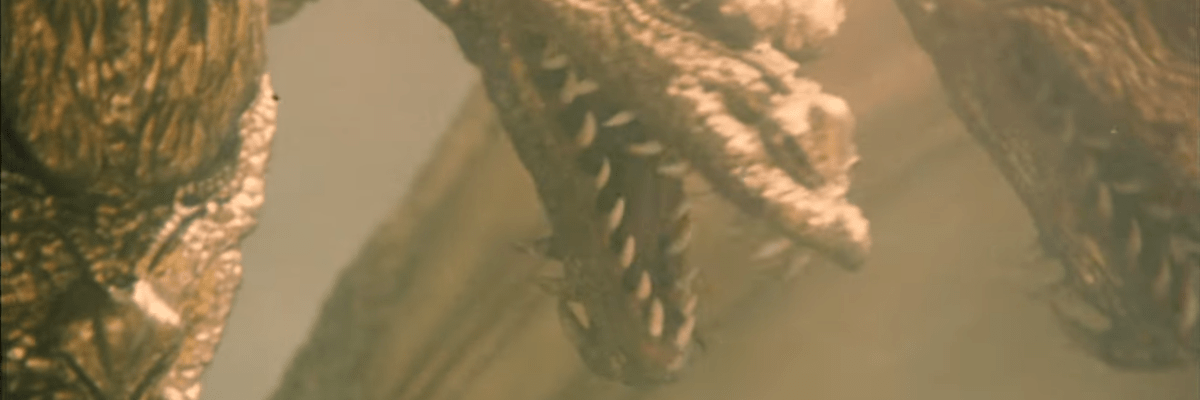
Happy Year of the Dragon, everyone! The Year of the Dragon only comes once every 12 years and I have let it slip by before without writing about my favorite dragon, well, favorite space dragon, His Chaotic Majesty, King Ghidorah. As the Year of the Dragon commences, and with Valentine’s Day just passing us by, it seems like a good time to proclaim my love. I have seen all of Ghidorah’s movies—really Godzilla’s movies. I have read comics featuring him. And in my own doings, I have also drawn him on the cover of a zine I used to make, featured Mecha King Ghidorah as an underworld kingpin in a noir story, and even though it’s late, I might yet make a Year of the Dragon relief print featuring King Ghidorah.
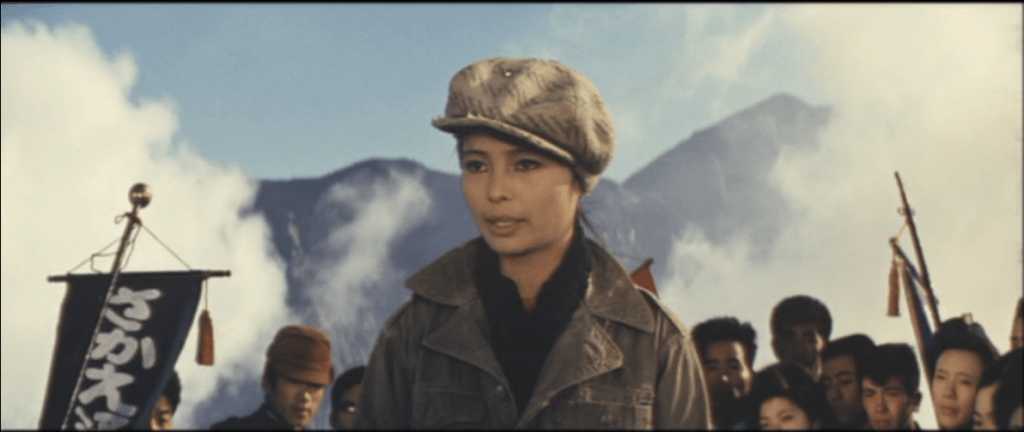
King Ghidorah first appeared almost 60 years ago in Ishirō Honda’s Ghidorah: The Three-Headed Monster (1964). In the film, a Venusian spirit possesses the Princess of Selgina, Maas Doulina Salno (Akiko Wakabayashi), in an attempt to warn humankind that the space-dragon that had destroyed Venus was coming to lay waste to Earth. The princess flees her entourage and travels Japan, prophesying kaiju-related events and disasters that come to pass. There is a whole fun 1960s intrigue plot as different factions try to retrieve her. Also, there is a lot of fashion going on.


Meanwhile, a UFO club sees signs and portents of impending doom after a mysterious meteor crashes in the mountains. When it finally explodes, Ghidorah (Shōichi Hirose) emerges from the flames like a phoenix. Ghidorah is a threat that not even Godzilla (Haruo Nakajima) can defeat alone and so Mothra (Katsumi Tezuka) and the tiny Shobijin (Emi and Yumi Ito, aka, The Peanuts) who often summon her to save humankind, broker an alliance with Godzilla and Rodan (Masaki Shinohara) to defeat him. While Godzilla and Rodan hate each other—and are understandably conflicted about humanity—they decided they like Mothra and hate King Ghidorah more. Ghidorah, the Three-Headed Monster also contains one of my favorite Shobijin summonings of Mothra, with the eternal lines, “Why are you weeping happiness?” The voiceover in the English-language version of the song is especially entertaining. (If you click the link, be aware there are some issues with Pacific Islander representation).

A year later, Ghidorah returned in one of my all-time favorite Godzilla films, Invasion of the Astro-Monster / Godzilla vs. Monster Zero (1965). Directed by Ishirō Honda and written by Shinichi Sekizawa, the film is an Japanese-American co-production. This time, Ghidorah (Shōichi Hirose) has been captured and weaponized by the aliens of Planet X. Astronauts Kazuo Fuji (Akira Takarada) and Glenn (Nick Adams) travel to a planet that has mysteriously appeared in Earth’s solar system. They meet the Controller of Planet X (Yoshiō Tsuchiya), who asks for Earth’s help because Planet X is under attack by Monster Zero, aka, King Ghidorah. The Controller promises a cure for cancer or any disease (depending on which dub you watch) in return for letting the X aliens take Godzilla (Haruo Nakajima) and Rodan (Masaki Shinohara) to fight Ghidorah. While Earth considers the request, the aliens sneak Godzilla and Rodan off planet. It turns out that the people of Planet X, whose emotions are controlled by electronic computer, have weaponized King Ghidorah, Godzilla and Rodan in order to take over our planet. Will a love beyond computation save us all? Can an invention that makes a really annoying noise save the Earth by freeing Godzilla, Rodan and Ghidorah from this tyranny and restore their freedom? Yes!

At least he is until another of my favorite Godzilla movies: Kazuki Ōmori’s Godzilla vs King Ghidorah (1991). In this movie, we discover poor King Ghidorah (Hurricane Ryu) has been created from some adorable, Muppet-y creatures called Dorats and is/was/will be unleashed upon the world by time-traveling Futurians intent on stopping Japan from rising to global dominance in the 23rd Century. There are problems with the film, but I love the kaiju design—especially King Ghidorah’s design. And, of course, the important part is that it features King Ghidorah and even his post-death incarnation as Mecha King Ghidorah. Because like Godzilla, Ghidorah never catches a break.
Ghidorah has appeared in more Godzilla movies than these–from the Showa to the Millennium Era and even in one of the recent Legendary movies.* And perhaps the only thing that has stuck with me from Michael Dougherty’s Godzilla: King of the Monsters (2019) is King Ghidorah (heads performed by Jason Liles, Alan Maxson, and Richard Dorton) traveling the Earth in/as a tropical storm. For me, this detail and his appearance was the best thing about that film.

As I sat in the theater for Takashi Yamazaki’s Godzilla Minus One (2023), I thought how terrifying King Ghidorah would be in its world. And Ghidorah has appeared not only in Godzilla movies, he/they briefly swings around on screen in Pee-Wee’s Big Adventure (1986), which was very exciting for me when I first saw it and delights me even now.
King Ghidorah was created by special effects master Eiji Tsuburaya, as he did so many other monsters for Japanese movies and series.
“King Ghidorah is an awesome and demonic creation—a golden, three-headed, bat-winged, twin-tailed space dragon, widely considered a masterpiece among Tsuburaya’s myriad monster creations. Designed by Akira Watanabe, this triple-threat creature was based on a combination of traditional Chinese dragons and the mythical eight-headed serpent Yamata-no-Orochi from Japanese folklore. Originally, King Ghidorah was to be a multicolored creature with rainbow-striped wings, and this version appears in some early publicity photos. Tsuburaya had wanted the creature to be a devilish crimson, but when the staff began to consider which color would look most impressive on screen, they settled on gold.”
August Ragone, Eiji Tsuburaya: Master of Monsters: Defending the Earth with Ultraman, Godzilla and Friends in the Golden Age of Japanese Science Fiction Film. (San Francisco: Chronicle Books, 2007): p. 90.
While a crimson red would indeed be impressive on screen, I am glad they settled on gold. Gold is a bold and iconic look for a chaotic space dragon. It is a more complicated color choice than something that solely associates him with the devilish. And it is one of the reasons why I love King Ghidorah. I love his gold scales and manes. I love his three dragon heads. I love their chaotic waggling. I love that he has three heads, but two tails. I love that he breathes gold lightning and that it travels in seemingly random, meandering lines. I love his strange physiology and his precariously attached wings. I have loved all his calls from 1964 to 2019. Ghidorah’s roaring reminds me of both mechanical creakings and the unlikely calls of bald eagles and elk. Shouldn’t something so fearsome sound more fearsome? And yet, King Ghidorah sounds appropriately and eminently alien. I love the ominous theme that composer Akira Ifukube wrote for him and how well his calls weave into it. I love that, Dorats aside, it is not entirely clear where King Ghidorah is from, or how he exists.
I wonder how Ghidorah makes decisions or if he even does make decisions in the way we understand making decisions or even thinking. Ghidorah’s heads do not appear to be in accord. They snap and bite at each other sometimes and stray in different directions all the time. They do seem to agree that they hate Godzilla. Maybe they are angry all the time. Maybe there is no malice at all. Maybe the malevolence Ghidorah appears to project is just, well, projection. Maybe this is just what Ghidorah does—flying and shooting gold lightning in all directions all the time. Ghidorah is a mystery and his—their?—ways are mysterious. He seems impossible, almost too absurd to ever understand within our current paradigms of the possible or the realistic.

With Godzilla, I like the forms of science around him—the blown up images of his cells, the descriptions of his biology, the discussion of his secondary brain. But while I sometimes think about Ghidorah’s neurology, and whether Ghidorah is three or one or both, I don’t want a definitive answer. Like Godzilla, I think that Ghidorah exists best outside of the tedious constraints of contemporary “realist” aesthetics. One of the satisfactions movie science can provide is not just that escapist fantasy—competence–but the idea that we can, and often already do, understand the universe and how it works. But there is a lot of weirdness in our own world that we don’t understand yet. And that gives me hope.
For me, the joy of his existence aside, King Ghidorah represents something that seems impossible, something too crazily weird to exist—but does. King Ghidorah is a dragon of chaos upsetting the assumptions in the world. King Ghidorah represents the promise that there is something beyond us and that no matter how much we learn, there always will be something outside our understanding and our models of reality and realism. King Ghidorah is the absurd, the unknowable, the incomprehensible, wiggling and flying impossibly across the screen shooting possibly random golden lightning that detonates assumptions, paradigms and smug complacency. And King Ghidorah gives me hope that there is always more wonder not just out there, but right here, right now. King Ghidorah makes space for the new, the possible in a time when possibilities seem increasingly foreclosed—especially in art, especially in film.
Happy Year of the Dragon, everyone!

*I assume he his in the Monarch series, but I just can’t seem to get into it despite the presence of giant monsters.
~~~
With the Cultural Gutter, Carol Borden has found a love beyond all computation.
Categories: Screen



 The Cultural Gutter
2 replies »