

“It’d be great if people saw this…and learned from my mistakes. Not that I’m a tragic person…But it would just make my heart soar if someone out there saw this and she said to herself ‘be strong, trust yourself, love yourself. Conquer your fears. Just go after what you want and act fast, because life just isn’t that long.’” – Pam Beasley, The Office
My daughter’s watching The Office for the first time, and towards the end of that series, former secretary Pam (Jenna Fischer), once lonely despite being in a relationship and directionless at seemingly-doomed paper company Dunder Mifflin, has blossomed into a new career and, in all ways, a new life. She has unlocked and started to grow into talents she always had but only recently started to nurture. She finds love and has started a family, and all of it is because she made the unsafe choices, the ones that required her to open herself to the world. She warns that “life just isn’t that long,” leaving unspoken a warning that time is coming for us all.
Jane Schoenbrun’s I Saw The TV Glow is the darkest possible approach to The Office’s message. It’s the bad cop showing you the consequences of living safely and comfortably as your body and mind rebels. Where ‘The Office’ uses humour and, in its best episodes, love to drive that message home, Schoenbrun’s second feature (after their dreamlike 2021 debut, We’re All Going To The World’s Fair, which is also about teenage interior life through the lens of media) is an ominous soft-glow warning that is itself both very “Pink” and very “Opaque,” like the in-universe tv series the lead characters obsess over. It’s an open and unsubtle message about gender dysphoria and, more broadly, the horror and danger of squandering our limited time with passive acceptance rather than embracing one’s true self. I Saw The TV Glow implores you as a viewer to make the bold and precarious move and to bet everything on your true identity, whether that means gender identity or something else. And if you fail to do so, you risk imprisoning yourself and, perhaps, tearing yourself apart.

Owen (portrayed by Ian Foreman at first, and then Justice Smith as he gets older), who we follow through various points of his life – at 13, at 16, at 22, and at 32 – is awkward and lost. His mother is terminally ill and his stepfather (played by a terrifying Fred Durst) is distant at best and antagonistic at worst. At 13 Owen meets Maddy (Brigette Lundy-Paine) for the first time, and the two develop a deep and platonic friendship based on their shared fandom of “The Pink Opaque”, a quintessentially 1990’s TV series about two teenage women named Tara and Isabel who have a psychic connection and who battle both ‘monsters of the week’ and a ‘big bad’ named Mister Melancholy. Owen isn’t actually allowed to watch the series and his initial fandom is kind of aspirational. The series airs on the “Young Adult” network at 10:30pm every Saturday but with a bedtime of 10:15 and his overbearing stepfather who asks if the show is “for girls,” Owen has no opportunity to experience it. But Maddy, desperate for someone – anyone – with whom to share her obsessive fandom, offers to let Owen watch at her place and later begins to slip him VHS tapes of episodes decorated like mixtapes and annotated with Maddy’s notes. Owen walks the halls, time passing quickly, as the elements of “The Pink Opaque” and Maddy’s obsession with it begins to supplant his sheltered and unhappy life.
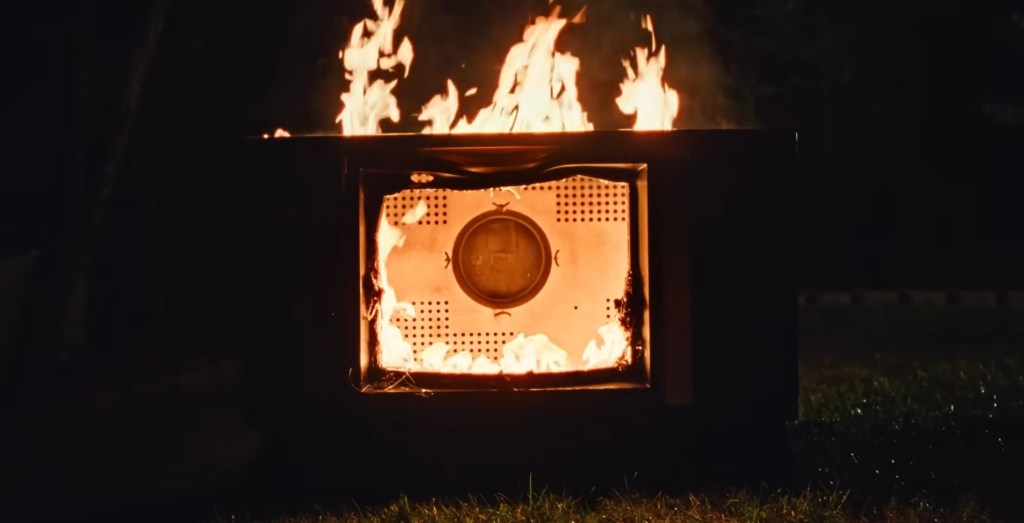
It’s at this point that Maddy suddenly comes to Owen with a radical and impossible-sounding proposition – to run away and become part of “The Pink Opaque.” Owen feels compelled to join her, to enter the unknown, but balks at the last minute. Maddy disappears suddenly, the only remnant being a burning TV in her backyard. “The Pink Opaque” airs it’s final episode the same day, and Owen is left rudderless again. He’s left empty and searching, catching reruns when he can and trying to figure out what’s become of his best – and only – friend. Eight years pass in an instant and Maddy returns, desperate once again. She claims to have been inside “The Pink Opaque” and has come out the other side enlightened as a result of a ritual that has her buried alive. Maddy, now claiming to be Isabel, wants to bring Owen along with her to be her Tara, but here’s where the cautionary tale kicks in. Owen does what probably many or most of us would do if confronted by a long-lost friend who asks us to do the impossible, to perform a ritual that is likely to kill us if it doesn’t achieve catharsis. He balks yet again, and the horrors of I Saw The TV Glow begin. Not mere monsters of the week in low-budget and cartoonish practical effects, but existential dread and a painful unraveling.
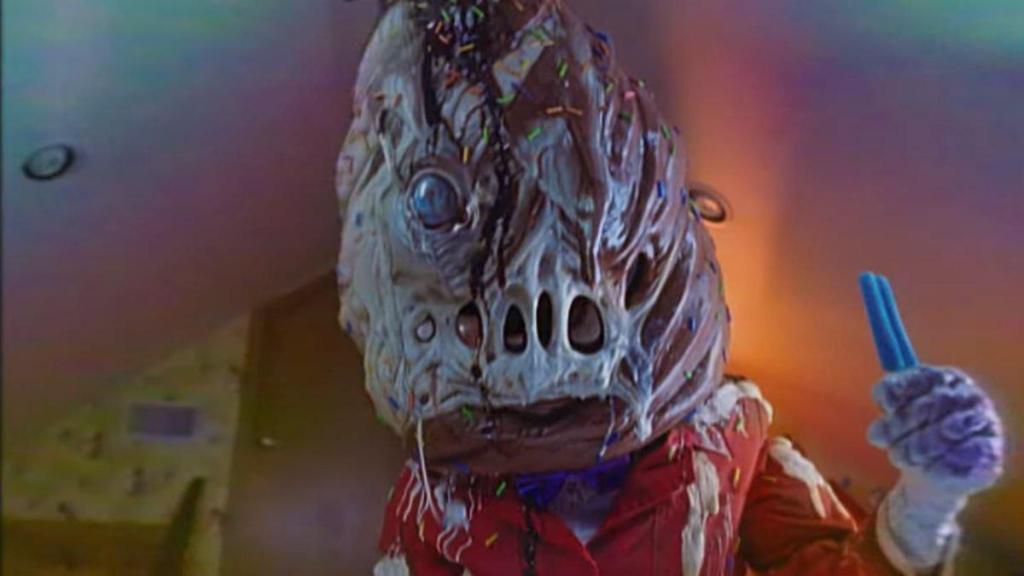

Buffy The Vampire Slayer is the clear influence for “The Pink Opaque” (Schoenbrun has done many interviews about this and if you’re as much a font nerd as I am, you’ll immediately recognize the look of “The Pink Opaque’s” credits) but the central idea of the film could work with almost any series, past or present, as long as you have a connection with it and you consumed it at a pivotal time in your life when your identity was shaped. Depending on your age it might be Are You Afraid of the Dark, Supernatural, True Blood, or Riverdale. As with The People’s Joker and Vera Drew’s parasocial relationship with Batman Forever which also unlocked truths about their gender identity, I Saw The TV Glow is about the totemic nature of the media we consume, and the rituals we go through to watch them. As its title suggests, it’s a love letter to a certain kind of television, and its unique power to bring us together and find kinship. It’s also about the things about TV and media in general that we’ve lost as we have so much – too much – available at our fingertips thanks to streaming. Late in the film, Shoenbrun laments the cheapness and emptiness of the media we love when it’s delivered through the filters of Netflix. With movies we’re robbed of the hunt through a video store’s aisle, not knowing what’s available or what new adventure or idea that we’ll discover. Without turning this into a ‘kids these days’ essay, it’s just not the same as flicking through the menus of a streaming service, especially when you know there’s an algorithm pushing certain things at you. The breadth of choices can be, and often is, strangling. And when so much new media is created as ‘content’, it turns the stuff we enjoyed when we were younger – on VHS tapes or late-night tv – into the same easily-consumed fluff.
Because the ritual is what’s really important, far more than the actual text or content of the shows or films we loved. When Owen has to deceive his parents, sneaking out under cover of night to sleep over at Maddy’s place, or surreptitiously pilfer videotapes from Maddy in order to experience “The Pink Opaque,” the show has value and real weight that just isn’t there when he discovers the series again on a streaming service, years later. At that point, so little of Owen’s life – mirroring the emptiness of the twinned life occurring on the other side of the screen – seems real or valuable even to him. Time slips through his fingers and decades pass like a skipping DVD, to the point where some of the most frightening shots in I Saw The TV Glow are title cards that signal a significant jump forward. He says he’s got a family that he loves, but we never see them. He has a job at an amusement centre that packages and bottles the idea of fun for children’s birthdays, as Owen himself is twisted up in misery. He bottles his real self, his emotions, his memories of Maddy, and “The Pink Opaque” so far down that it suffocates him.
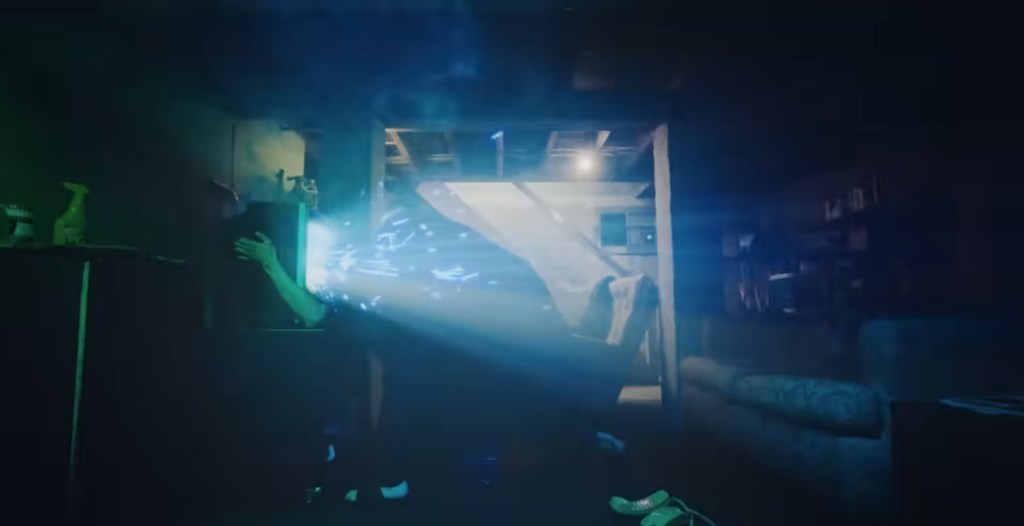
Much of the third act, including perhaps the most horrific scene in I Saw The TV Glow is centred around Owen trying to undo his two pivotal moments of cowardice. Like so many great horrors it depicts the futile attempt to undo one’s mistakes, only to be drawn further underneath. When Owen tries to crawl into his television in an attempt to replicate the ritual that Maddy went through to become Isabel, he’s violently yanked away by his stepfather and thrust under water to wake him up from his delusion. But when “The Pink Opaque”, as Maddy intimates, is “more real than real life,” it leaves him numbed and half-asleep.
With I Saw The TV Glow, Jane Schoenbrun has once again invited us to visit the other side of the screen as they did in We’re All Going To The World’s Fair. Their portrayal of a life filtered through, and then indistinguishable from, media is more than profound and more than relatable. As a dire warning about the ravages of time, and the peril of not reconciling your identity (chosen or otherwise), and the media you consume and internalize, it feels essential.
~~~
Sachin Hingoo can be seen every Friday at 9pm on the WB Network.



 The Cultural Gutter
1 reply »