
I thought I’d seen most of the pro wrestling tie-in films out there, both good and, being honest, mostly bad. From Stallone’s post-Rocky salami-centric* Paradise Alley (1978) to the (allegedly) cocaine-fuelled Hulk Hogan/Vince McMahon project No Holds Barred (1989) to the soulless promotional vehicle Ready To Rumble (2000) to higher-brow recent projects like The Wrestler (2008) and The Iron Claw (2023), wrestling’s been depicted in a variety of ways onscreen at all possible levels of quality and perspective.
But one of the first pro-wrestling movies, one that I’d never seen before a few weeks ago, is 1980’s Below The Belt from director Robert Fowler. Based on (the film uses the term “Suggested By”, which is a new one for me) the fascinating Rosalyn Drexler’s 1972 novel ‘To Smithereens’ which chronicles the multi-talented Drexler’s dalliance as a wrestling performer, Below The Belt depicts the rise of a woman wrestler in an interesting time. The 1950’s, when Drexler donned the spandex and ran the ropes, predates by decades the modern, television-focused wrestling product. It’s a portrayal of wrestling at its grittiest – performers riding the roads and, in wrestling parlance, “making towns.” The women in Below The Belt engage with the seediest of society even as they wrestle in front of huge crowds. Like Netflix’s ‘GLOW’, which would come around 45 years after Drexler’s novel, Below The Belt depicts an important period and subculture of wrestling that is rarely talked about, and a pivotal time for women in the industry.
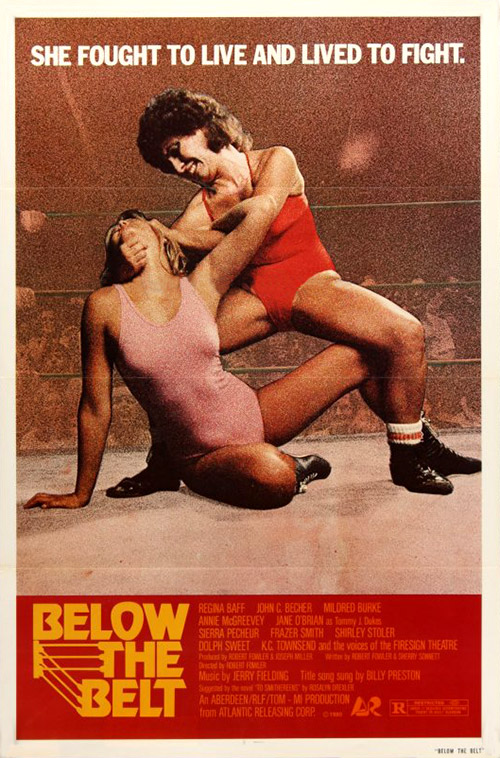
To say the production, or I guess the release, of Below The Belt was fraught is an understatement. Despite the film being completed in 1974 and ready for release that year, it was warehoused until 1980. I can find no concrete reason for this, but I think it’s a safe assumption that the distributors that year didn’t see much promise in a film about combat sports, especially w…w…w…women in combat sports before the success of Rocky in 1976. To add a thick layer of irony onto that, Drexler adapted Stallone’s script for Rocky for the film’s novelization, doing so under the pen name Julia Sorel. It’s also very likely that Below The Belt led to Robert Aldrich’s All The Marbles, which began production in 1980, almost simultaneously with Fowler’s film’s release. Mildred Burke would also be involved with training the wrestlers in that film. Between these films and Scorsese’s Raging Bull which also dropped into our public consciousness in 1980, it was a real touchpoint for combat sports films, and cements Below The Belt as being forthrightly ahead of it’s time.

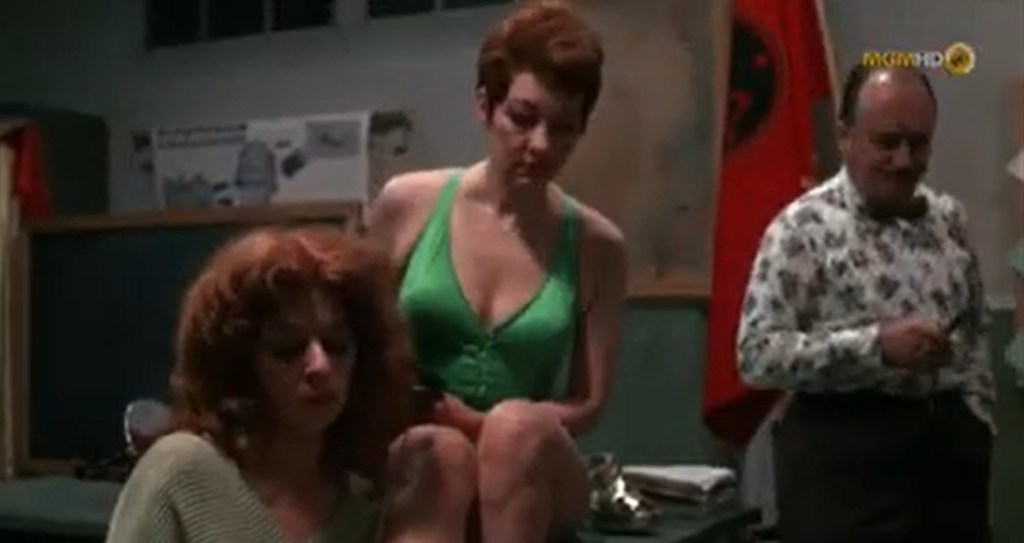

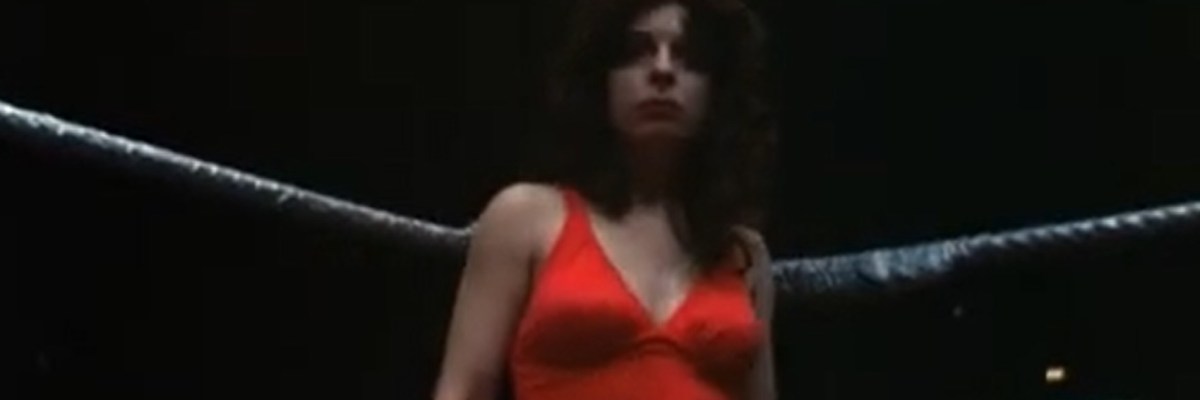
Opening on a wrestling event, likely filmed at an actual WWWF event during the film’s production in 1972 or 1973, promoter Bobby Fox (John C. Becher) spots concession stand worker Rosa Rubinski (Regina Baff) beating up a refreshment vendor who’s getting a little too handsy with her. You can almost see the dollar signs in his eyes as he sees Rosa kneeing the creep right in the junk and knocking him right on his ass right there in the hallway. Fox sends Rosa to real-life bona fide women’s wrestling legend Mildred Burke – playing herself – to train. After a, ahem, rocky start on the mat, Rosa’s considerable natural talent earns her a spot in the matches as she heads down through the American South to tour. The rest of Below The Belt‘s runtime chronicles Rosa’s relationships with fellow wrestlers like The Beautiful Boomerang (Annie McGreevey) and Trish (Shirley Stoler), with whom she develops something of a sisterhood as they travel the country, seeking fame. The climax of Below The Belt features Rosa’s most high-profile match against Terrible Tommy (real-life wrestler Jane O’Brien) in front of an arena crowd, capping off her first year in the business.
The copy of Below The Belt I watched features some very not-great ADR audio, but aurally-speaking, a soundtrack of showtune-like pieces by comedy troupe The Firesign Theatre and Billy Preston that are often on-the-nose literal are an unexpectedly hilarious high point for Below The Belt. The tone of the songs don’t always match up with what’s onscreen even when the lyrics do completely (an almost stream-of-consciousness song about learning the ropes has been stuck in my head for approximately a week), but the effect is an interesting dissonance especially when contrasted with the wrestling action. It’s this dissonance that I think helps Below The Belt stand out. It’s largely about the camaraderie between Rosa and her fellow performers, even in a business where they’re ostensibly pitted against one another both in and out of the ring, and it walks an interesting line between giving away the choreographed nature of wrestling and making it look like a real fight. There’s an undeniable charm to the scenes of the women travelling and training together and many scenes are imbued with real emotion, even as the production often lets them down. Regina Baff, who holds a PhD in Psychology and for whom Below The Belt is her last acting role, is a vision who probably deserves more accolades than she’s received.

I can’t get this far without talking about Drexler herself, with whom I wasn’t familiar before deep-diving into Below The Belt. Drexler is, perhaps, the most interesting woman in the world, or at least one of them. A visual artist, sculptor, found-object curator, playwright, teacher, and novelist based out of Brooklyn, Drexler has lived one of the fullest lives it is possible to lead, and that’s before even talking about her dalliance with wrestling. She’s hobnobbed and collaborated with many of the heavyweights of the art world, including Andy Warhol, and I encourage you, my reader friend, to seek her out as even at 97 she is one of the most eclectic, decorated, and prolific creators in America.

A New York Times review of ‘To Smithereens’ says that it’s “a novel about self‐definition. It is also a domestic comedy, a collage of ideas about art, a treatise on sexual fantasy, and the best account of the wrestling scene [the author has] ever read. Compared to Rosalyn Drexler’s other novels… [it is] the first of Drexler’s novels not to proceed entirely from the consciousness of the heroine, which is to say that it is the first book she has written that does not appear to be rooted in dreams.” I know what the author is getting at, that ‘To Smithereens’ is somewhat less esoteric than Drexler’s other works, but I find it hard to agree that it (and Below The Belt) isn’t ‘rooted in dreams.’ Both projects take their protagonists – strong, resilient, talented women – and set them out on the open road in pursuit of what else, but a dream. Whether the slimy and seedy wrestling business in the 1950’s (or in any decade) is worthy of their ambitions and talents, though, is questionable. Despite my love of wrestling, I can’t help but think that at least the 1950’s version feels beneath the talents of even these fictional women, but certainly Drexler who would go on to leave her mark in so many more interesting ways.
I’ve long wondered if a movie like A League of Their Own (1992) could work with wrestling, and long before both that movie and Netflix’s ‘GLOW’, that’s basically what Below The Belt is playing at. It’s about a woman finding her place in the world, her purpose and a hidden talent in the world of athletics. Most reviews I’ve read of Below The Belt tend to denigrate it for exposing its troubled production, and that’s understandable when it seems like the editors of the film deliberately tried to sweep it’s legs out from underneath by overusing montages or other techniques when a straight-ahead presentation that lets the considerable chemistry between its cast shine would work just as well. I think the film works in spite of those challenges, though. The offbeat soundtrack, uneven script, and mishmash of actual wrestling footage and perhaps copious zooms into still images feel a little chaotic and campy, but what’s wrestling if not both of those things? Iron, in this case, sharpens iron as they say about wrestlers, and it’s true as well of the filmmaking process.

Below The Belt provides a look at a subculture of women’s wrestling that was still very much in its infancy, and after a period of huge popularity in the 1980’s, fell dormant until very recently. These days, women’s wrestling and women performers are massive draws on the biggest wrestling stages (and in mainstream media) and are more than capable of main-eventing wrestling shows both big and small. It’s largely on the substantial shoulders of Mildred Burke and the women she worked with and trained that these modern-day superheroines stand. The women both performing and portrayed in Below The Belt, especially Rosalyn Drexler, deserve some of that credit too.
Below The Belt can occasionally be found on “the people’s streaming service” TUBI and will be released as a special edition Blu-Ray on September 24 from Kino Lorber.
Sachin Hingoo would be humbled to do in his entire life what Rosalyn Drexler presumably does on an average Tuesday.
*Not a euphemism




 The Cultural Gutter