

In a world of cloud storage and where even elementary school children, most of whom do at least some of their learning in the cloud, are taught about redundant backups, lost films shouldn’t still be a thing. When something is made, especially by the hands of dozens or hundreds of artists and creators, there shouldn’t be a situation where a film is sucked into a black hole, never to be exhibited or seen again. It’s not like there are, or there shouldn’t be, a single point of failure like a 1965 studio fire which consumed hundreds of MGM’s early silent prints. In theory, there should be multiple digital clones of any piece of film floating out there for people to find.
In my travels online and between doomscrolling, I rediscovered, after being turned on to it a couple of years ago in a Guttersnipe, an unreleased workprint (animatic) of Genndy Tartakovsky’s unreleased 2013 animated adaptation of Popeye. Animatics are early drafts of an animated film, often used to pitch ideas or as a proof-of-concept, and this version of Popeye gives a pretty good sense of what the final product would have looked like. Even as a casual Popeye enjoyer at best, I’m intrigued. A well-crafted animated film that they don’t want me to see? Sign me up!
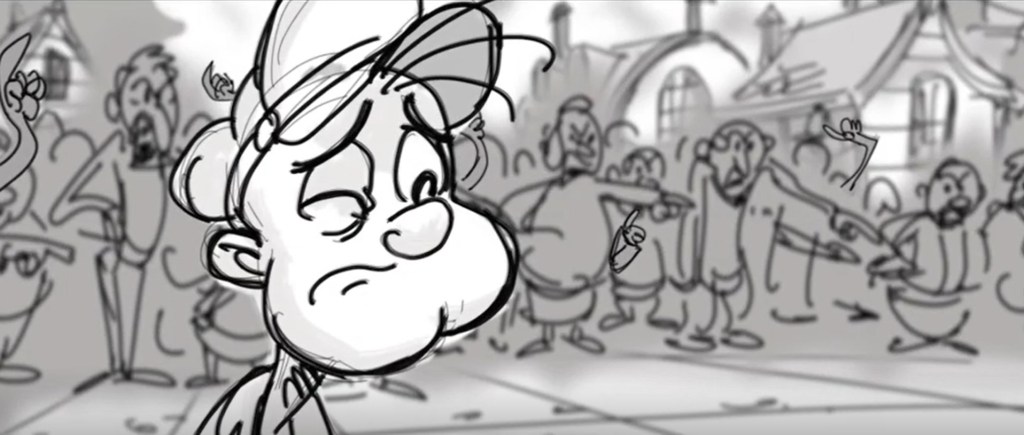

With it’s low-framerate, minimalist style, this Taratovsky’s Popeye feels very much like it’s own thing and a wonderfully watchable curiosity. The voices are mostly intact, though like every aspect of this animatic, they lack polish. Still, there’s enough of a fleshed-out origin story here about Popeye’s parentage and his relationship with Olive Oyl that, were a finished version ever released, I could probably have been tricked by my children into watching and even enjoying, like Trolls World Tour (2020). It’s a rare feeling to watch something like this, or the workprint of X-Men Origins: Wolverine (2009) that was famously leaked online years ago, undercutting that film’s theatrical release. You feel like you’re doing something just a bit naughty (probably because you are) and are peeking behind the curtain to see unfinished visual effects and scenes that would later be cut from the final version.
Films, in the past, have been intentionally destroyed for many reasons – censorship, lack of success, and even being a potential fire hazard – but it stings a little more when a film like WBD’s Batgirl is warehoused despite being complete. It stings still more when assets from the film, like the Popeye animatic, make their way into the hot little hands of the internet. This is the case with the (also memory-holed by WBD, because David Zaslav would better serve humanity from the bottom of a well) Coyote vs Acme project by director Dave Green, whose screenplay was leaked online and which makes for a fascinating read.

Coyote vs. Acme’s script sets the animated characters and hyperreality of the Looney Tunes world against the reality of the human one, Roger Rabbit style. But the opening line perhaps sets the tone even better:
“The movie starts with a flashback to 1985. A cartoon Peter Lorre (and it is specifically Peter Lorre) interferes with an Acme assembly line and gets thrown into a portable hole.”
Will a kid watching (or potentially watching) this film in 2024 even have a reference point for Peter Lorre? Unlikely, for an actor who died and whose last roles were in 1964. But the inclusion of the WB mainstay as a reference is important for a film that seems to be very self aware of itself as both a love letter to, and a charmingly sly dig at, its parent studio.

The screenplay is filled with extremely deep cuts like this. For example, lead character Kevin, played by Will Forte, works for a law firm called ‘Avery, Jones, and Maltese’ which is a reference the creators of the ‘Merrie Melodies’ cartoon series in the 50’s – actor and artist Tex Avery, director Chuck Jones, and storyboard artist Michael Maltese – that I can only imagine a tiny handful of Coyote vs Acme’s audience would get.
It is sadly unsurprising that a studio executive, balance sheet in hand, would choose what I think is a soulless ‘remember this?’ intellectual property extravaganza like Space Jam: A New Legacy (2021) over a potentially more ‘inside’ project like Coyote vs Acme. That’s just the calculus that happens all over Hollywood these days, but especially at David Zaslav’s Warner Brothers Discovery. The calculus means a hollowing of big-budget cinema, though, in favour of forgettable content production to inevitably pad the Animation tab on a streaming service like MAX or whatever WB is calling their online product this week. It’s even more irksome to me that this was done with a property like Space Jam (1996) which, in my humble opinion is a near-perfect movie. But at Zaslav’s WB, an idea like “what if Space Jam, but with nary a Monstar, Michael Jordan, nor a single rendition of the seminal hip-hop smash ‘Hit Em High’?” will take precedence over a finished film that is a fawning homage to a studio and it’s history. No, I’m not bitter.
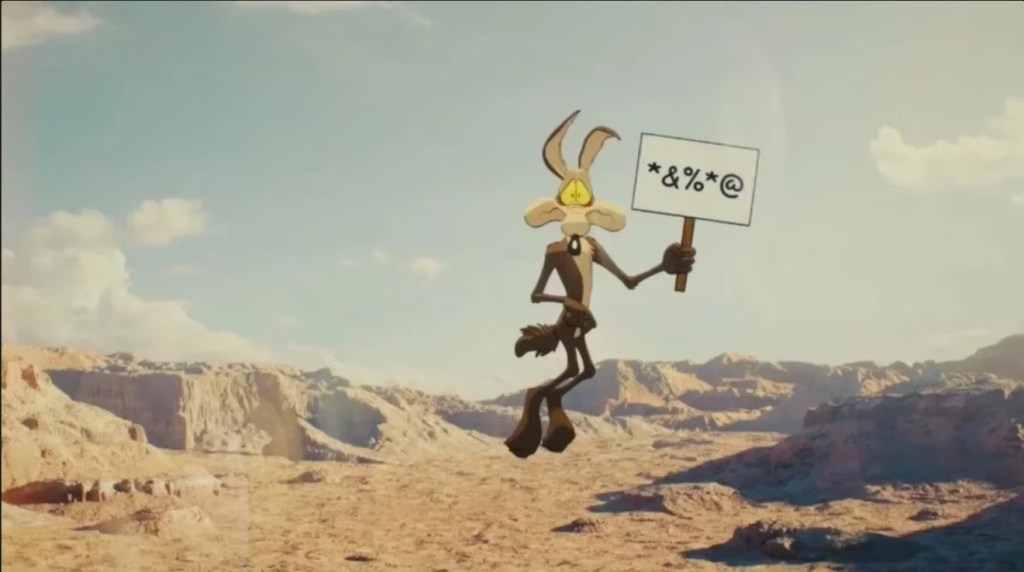
I’m not the only one, either. Creators from all over, including award-and-acclaim-winning animated filmmakers Christopher Miller and Phil Lord of ‘Spiderverse’ fame, star John Cena, and director/producer/writer Keith Calder both went to bat online for Coyote vs Acme, but at least as of this writing, to no avail. Money talks, folks, and much too loudly for a few genius artists to be heard.


So many projects disappear without being given a chance. In the cases of both Coyote vs Acme and Popeye, these films vanish not due to their mercurial creators whims or out of a safety concern, but the opaque economics of a studio boardroom or arbitrary directive to squeeze more profits to fund a c-suite raise. No matter the cause, but especially in the latter case where it comes across as literally senseless, it’s impossible not to feel like we’re cheated out of something we either love or have the potential to love.
Who, then, will step up to save the hidden gems, the offbeat cinema, and the projects that fall through the cracks? As YouTube increasingly seems like it’s algorithm is driving us to madness, social media is run by a cadre of maniacs, and even the last bastion of (at least online) preservation, the Internet Archive, is a worryingly singular point of failure, what now?

Perhaps a new streaming service (I know, we all need another one) called Eternal Family could be an option. Just launched last week, Eternal Family contains a small but well-curated selection of feature films, shorts, video game playthroughs, and “found tapes and lost oddities” to satisfy your, or at least my most esoteric tastes. It reminds me of one of my favourite places in Toronto, the now defunct Suspect Video store whose collection of oddities (both their stock and their employees) shaped many of my artistic tastes in my teens and early 20’s. Suspect has since disappeared, maintaining a small but mighty online presence, but Eternal Family seems to have many of the same vibes. I can almost see the walls of Suspect with VHS and DVD cases, each promising something truly bizarre and unique, as I scroll through the selection there. From obscure pottery documentaries to calming DVD demo discs, Eternal Family (for now) satiates my need for weird stuff, though the collection isn’t exactly vast.
I also don’t want this to come off as an ad for that (or any) service, not least because they have not paid me. But I think it’s important to highlight and prop up anyone, the Internet Archive especially and most of all, that is making the effort to preserve things that might be otherwise gatekept by the Zaslavs of the world. Warner Brothers Discovery, despite being inextricably linked with my favourite pro wrestling promotion (yes, they have both TBS and TNT championships) seems to be going through it as of late. Between fiscal losses and the loss of the rights to broadcast the NBA, things aren’t so rosy on Planet Zaslav. To this day, the warehousing of content for no good reason continues, even to Tartakovsky again with his ‘Fixed’ animated series. Whole archives of The Cartoon Network and the old MTV site, going back 20 years, have been scrubbed (this one’s on Paramount, just so you don’t think WBD is the only culprit here). More and more, nostalgic, substantial and, wildly, completed projects are vanishing.
Art is really only art when it’s enjoyed, or at least consumed. A painting or a TV series or a whole network of animated classics is nothing at all without someone to view, enjoy, and discuss them. As hard as faceless boardroom ghouls want to make it for us, it’s important to enjoy the art we can, and to support the folks out here doing the work to preserve it. Because even in a time when we have so many ways to save movies and moments, they can be fleeting. All I can implore you to do, reader, is to enjoy it while you can, and squirrel away the media you love in whatever way you feel most comfortable. It might not be around tomorrow.
Sachin Hingoo has been pulled off the air after four measly episodes.
Categories: Screen



 The Cultural Gutter