

As it sets the stage for the upcoming year of film, I attended the 49th edition of the Toronto International Film Festival (my 23rd) and, clutching my press lanyard and a Google Wallet full of virtual tickets, I saw upwards of 30 films in ten days. Through my blurred vision and a diet consisting mainly of popcorn and free samples of candy and non-alcoholic Peroni, patterns began to emerge. One of these patterns in this year’s lineup is that there’s a clear anxiety about climate change and a world seemingly at the brink of collapse. This anxiety is made plain in films about the extreme measures humanity will have to take in order to mitigate the effects of environmental devastation, and the resultant projects are fascinating in the themes they share, the vastly different forms they take, and conclusions at which they arrive. I’m sure that if I really thought about it, there were more films of this type than these, but after ten days of marathoning film, these are the three apocalyptic narratives that stood out the most for me.

The Assessment (UK, Germany, USA, 2024) dir. Fleur Fortuné
In the near-future, climate change-ravaged world of Fleur Fortuné’s The Assessment, having children is a privilege exclusive to the most wealthy. Each family must appeal to the state in order to be granted permission and after an extensive application process, is assigned an Assessor to determine if they are worthy of reproducing. Mia (Elisabeth Olsen) and Aaryan (Himesh Patel), a talented botanist and a genetic engineer respectively, are at this stage of the process. When their Assessor Virginia (Alicia Vikander) arrives, she insinuates herself into the couple’s life, literally play-acting as their child. This behaviour comes complete with temper tantrums, outbursts among company, and an increasingly-escalating series of provocations in an effort to test Mia and Aaryan’s mettle as parents. But petulance eventually turns more dangerous, and the psychic damage of the assessment threatens to rip Mia and Aaryan’s entire lives – career, relationship, standing in the world – to shreds.
Fortuné does a spectacular job of world-building, fleshing out an entire social structure, climate, and characters. Aaryan and Mia’s ultra-modern home feels imbued with as much personality as any of the people in the story, which is a feat when it needs to house such powerhouse actors as Olsen, Vikander, and Patel. Through both exposition and a brilliantly subtle series of shots and scenes, we’re given small glimpses of the ruined world outside Mia and Aaryan’s home, and it makes the work of Mia, who is developing and revitalizing plant life which no longer exists, and Aaryan, who designs virtual animals in a world devoid of them, feel vital. I was gripped for every twist and turn that The Assessment takes, and the shifting motivations of all three characters, in particular Vikander as the often inscrutable Virginia – childlike in one moment and fiercely authoritarian in another – were so compelling. As a parent myself, I wondered what a world would be like if such tests were given before embarking on an experience that disrupts every single aspect of one’s life, and how many people would go ahead with it anyway. In many ways, The Assessment is the most openly horrifying of the films I list here.

Can I Get A Witness? (Canada, 2024) dir. Ann Marie Fleming
In Can I Get A Witness?, climate change is tackled with population control in an equally radical way as The Assessment, but unlike that dark, dystopian nightmare, Ann Marie Fleming’s fourth feature somehow manages to build something sweet and tender from it. Again in the face of a collapsing world where electricity and cars are rare, the particularly Swiftian (not that one) solution is that no one is permitted to live past the age of 50. To this end, Documenters are employed by the state to administer and watch over end-of-life ceremonies for people at the end of their allotted time. There is no photography in this world, so artistic talents like Kiah (Keira Jang) are recruited to sketch images of the soon-to-be-departed in their final moments. As Kiah learns from her mentor Daniel (Joel Oulette) about the etiquette and customs attached to these solemn ceremonies so they can be held respectfully and safely, she also needs to grapple with the fact that her own mother Ellie (Sandra Oh) is also rapidly approaching her own 50th birthday.
The soft and gentle tone of Can I Get A Witness? cleverly conceals the pitch-blackness of it’s premise so well that you often find yourself forgetting about it. It features tender performances from all three of it’s leads, and a stunning and seamless integration of beautiful animation as Kiah’s drawings literally come to life. This is a society that, by and large, has accepted it’s limited time and it feels truly impactful when someone resists. It asks important questions about how much time is enough, and what an extra year or an extra ten years of life for each individual person might mean for environmental impacts. Most importantly, Fleming’s film gently and kindly asks us how we would spend our time differently – or if we would – if it had a set and standard expiry date.

The End (Denmark, Germany, Ireland, Italy, United Kingdom, Sweden, 2024) dir. Joshua Oppenheimer
Okay, this one’s a little bit literal, but bear with me. In The End, Joshua Oppenheimer brings the same stark contrast of beauty and horror that he engaged for his heart wrenching, impossible-feeling documentaries, The Look of Silence (2014) and The Act of Killing (2012), to his first fictional feature. Taking on the end of the world from the perspective of an oil company baron (Michael Shannon in his second ‘guy in a bunker’ role after 2011’s Take Shelter), his wife (Tilda Swinton), and son (George Mackay), The End has this trio holed up in a sprawling, elaborate bunker under a mountain for twenty years. Mackay’s character was born in this gilded cage, assisting his father in writing a book meant to lionize the efforts of a man who likely caused, or at least contributed to, the eradication of life on the surface. The bunker is not only a refuge from the ruined, barely habitable surface world where nearly all of humanity has been culled, but a beautiful one, filled with art and food and all the creature comforts of a world that has been wiped away. We never see even a glimpse of the post-humanity surface world, but are given an impression from secondhand accounts from our characters.
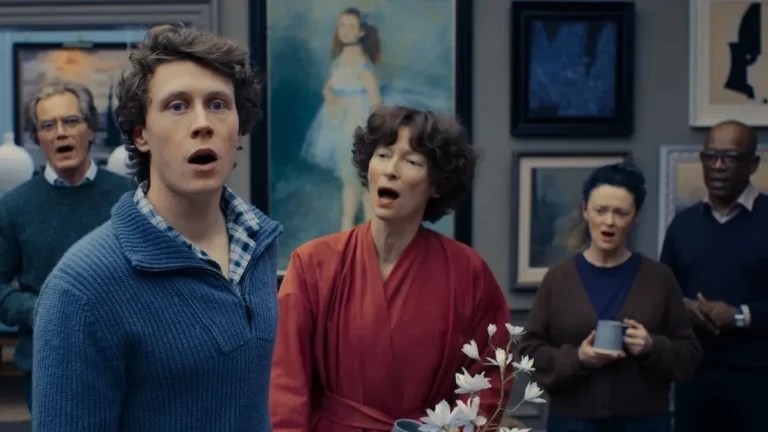
But I’m burying the lede here. Like with The Act of Killing, in which the director urges the real-life perpetrators of countless acts of monstrosity to reenact their crimes through song, Oppenheimer chooses to tell much of this it-probably-should-be-more-upsetting story through the lens of music. In the case of The End, it’s a Golden Age musical, and all the characters break into song and dance at the most inopportune times. You’d think this might lighten the mood as the characters jockey for position in the bunker, along with a few other survivors that have been taken in and one particular intruder (Moses Ingram), but as with Oppenheimer’s documentaries, it only brings clearer focus onto a feeling of wrongness. The songs might be catchy as all get-out-of-the-bunker, but again like The Act of Killing, the ideas that underpin them are sinister and disturbing and meant to indict and interrogate his audience.
As I found myself leaving the theatre, humming one of the more garish showtunes from composers Marius de Vries and Joshua Schmidt and having it play in my head for the rest of that day, only to remember the savage implications of it in the context of the film, I remembered what it is that Joshua Oppenheimer does best. He said it at Telluride at the premiere of The End when he said that the film is about “how we tell stories to obscure the world from ourselves, and to obscure ourselves from ourselves.” He disarms you with song, with dance, with beauty, and whether it’s a fictional oil tycoon or a real-life warlord, hits you with an undeniable ugliness.

I either have or will likely be writing more about these and the other TIFF films I saw over at my second home at Biff Bam Pop once the brain fog dissipates a little. And there are other huge themes that bubbled to the surface at this year’s Festival. I noticed that several films embraced the idea of chosen families, for instance. And there were at least two films – Coralie Fargeat’s magnificent and literal skin-crawling The Substance and Max Minghella’s Shell – which examined women’s struggle with self-image and the beauty industry through body horror. Of course, with enough sleep deprivation combined with a marathon of films, back to back to back, one is inclined to find commonalities anywhere. But, for me, this is a feature. It’s nice to think of a film festival as a pool, a melting pot of ideas, co-mingling and cross-pollinating with one another. And this is especially true when it’s selections are consumed quickly and in bulk, like a perhaps ill-advised trip to the buffet. If TIFF’s mandate is to ‘change the way we see the world through film’, perhaps these ideas about the end of that world will scare, or at least inspire the right person to head off that eventuality.
Sachin Hingoo is signing off to get approximately 72 straight hours of sleep. Nighty night!




 The Cultural Gutter