

One day, William Shatner will die, and every obituary will be for Captain Kirk. A paragraph or so down, they will mention his Emmys for Boston Legal, his numerous comebacks, T.J. Hooker and Rescue 911, and then go on to celebrate his diverse creative portfolio, his sprechgesang, his philanthropy, elding all the Twitter spats and how much George Takei still hates him.
But what about the horror of William Shatner? Never typed as a horror actor, he has still amassed a buffet of unmissable performances for your spooky szn consideration. Is it because he is so infrequently the villain, more a Patrick Wilson than a Vincent Price? Or if he were anyone other than OG Captain Kirk, would he then be better known for the scary stuff? And he’s so good at horror! Really! For an actor known so widely for the girth of his ego, I’m always struck by how without ego those performances are. He doesn’t care if he looks silly or ugly or evil. He goes where his character is supposed to be. And any good Shakespearean actor knows you can’t spell Hamlet without ham.
Speaking of ham then, let’s dig in. I give you William Shatner: Horror Icon.


1960s Anthology Horror: Twilight Zone and Boris Karloff’s Thriller.
If you needed a leading man type to absolutely lose his shit for your television program in the 1960s, you shone the Shatner signal. His performance in the classic Twilight Zone episode “Nightmare at 20,000 Feet” will be at the top of anyone’s Best Of lists from the period, although it was his second time starring in one of the classic anthology’s stories. First he appeared in season two’s “Nick of Time,” which like “Nightmare at 20,000 Feet” was written by Richard Matheson. Both episodes hit a lot of the same marks: Shatner’s character, at first likable and good-humored, cracks early and comes more and more unglued to the world around him, not least to the lady with a strained smile at his side, and they’re both tight little playlets that make excellent use of one main location. In “Nick of Time” he is held in thrall by a fortune-telling machine at a diner; in “Nightmare,” of course, there is a gremlin on the wing of the plane, and Shatner’s character is the only one who can see it. Both stand as immortal classics, as well as testaments to Shatner’s willingness and ability to lose himself in his character’s mortal terror.
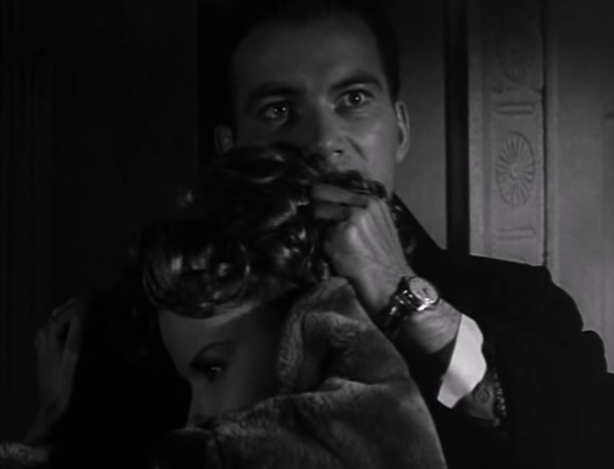
As great and iconic as his Twilight Zone episodes are, I love his pair of appearances on Boris Karloff’s Thriller every bit as much. In a way, they are the opposite of the Matheson plots, putting Shatner’s character among several other witnesses to scary stuff. In “The Hungry Glass,” based on a Robert Bloch story, Shatner plays one half of a young married couple who buy themselves a house overlooking the sea. Suspiciously cheap, side-eyed by the locals, and the site of more than one spoooooky disappearance, the house comes with a ghost story and an attic full of mirrors. It is a perfect little haunted house story, and Shatner’s character very much goes through it. Meanwhile in “The Grim Reaper,” based on another Robert Bloch tale, he plays the nephew of an eccentric horror novelist (Natalie Schafer) who buys a reputedly cursed painting of the image of Death, the owners of which have a habit of dying. The painting would be some sweet van art for sure, and it offers the added touch of a bleeding scythe whenever death is imminent, so that’s nice. As the loving nephew, Shatner pleads with his aunt to get rid of it, he angsts to his aunt’s beautiful secretary and laddish younger husband, but all to no avail, and then his hand comes away from the painting smeared with blood. Bwahahaha. Not quite as straightforward as “The Hungry Glass,” “The Grim Reaper” scratches the itch for a different, nastier sort of scary story, one with a vein of noir shot right down the middle.

Incubus (1966)
Thought lost in a fire until the 90s, Leslie Stevens’ Incubus is weird and lush and dreamy and also in Esperanto, which only enhances its weird lush dreaminess. Something about this film just demands blunt subtitles in heightened language. Its story is a surrealist blend of medieval mystery play and folk horror vibes, where a jaded succubus (Allyson Ames) yearns to damn a really saintly person to hell and instead finds herself falling in love with a young soldier (William Shatner) who is too virtuous to tempt.This was, of course, at the height of Shatner’s long-lashed pre-Star Trek prettiness. And so, like many sitcoms of the period, Incubus is fundamentally about how a lady’s career only causes trouble for her dude. Her devil fam is predictably disappointed in her choice, too, as in their very Munsters logic, they say his pure, no funny stuff courtship defiles her.
This film works for me on the same level as one of the vignettes in Häxan (1922) or the absurd murders of one-dimensional girls in Hausu (1977) or even the ritual battles for the Rose Bride in Revolutionary Girl Utena, where narrative takes the day off so stylized moral conflict and occult symbolism can run the shop. I mean, the name of the village where our lovers meet is Nomen Tuum, or “your name” in Latin. It is allegory, it is surrealism, it is vibes. It also features the first goat guy on our list, but not the last.
The Horror at 37,000 Feet (1973)
Very much not to be confused with “Nightmare at 20,000 Feet” or indeed a real movie, The Horror at 37,000 Feet attempts made-for-TV folk horror for the jet age but it never really clears the runway. Mostly it’s B-listers yelling. But this can also be fun.
The premise is a super rich architect (Roy Thinnes) is flying the altar of an abbey belonging to his wife’s (Jane Merrow) family from London to New York. The sparsely-populated “extra” flight’s passenger list also includes Buddy Ebsen as a surly millionaire, Paul Winfield as an odd English doctor, Will Hutchins as an unfortunate haircut, and Tammy Grimes as the witchy doomsayer hounding Roy Thinnes and his wife for uprooting the altar at all. Also along for the ride, Shatner plays Paul Kovalik, an ex-priest and current drunk whose dialogue seems taken from a Suicidal Ideation-themed Magic 8-Ball. Chuck Connors and Russell Johnson are flying the plane.
Here, we find Shatner at that post-Star Trek nadir where he turned in a lot of work that would not be appreciated, and it would be easy to let him go down with the ship on this one. It is so bad. But dagnabbit, he does a good job! I know I keep saying that, but he does! Kovalik, mourning his faith and bitter as day-old coffee, is an exceptionally heavy lift, and he might have matched the energy of the rest of the cast–save Winfield, whose character is resolutely subdued–and just yelled until the director said cut. Bless him, he doesn’t phone in a syllable.
Watch this one with your best snarky robots.

The Devil’s Rain (1975)
Helmed by Robert Fuest, art director for The Avengers TV show and the director of both Dr. Phibes features, The Devil’s Rain is a prime example of a species of Satanic cult horror that enjoyed popularity in the mid to late 70s, like The Sentinel (1977), Race with the Devil (1975), To the Devil a Daughter (1976), and of course The Omen (1976), where devil worshiper conspiracies were everywhere and everything and you’re doomed, doomed, doomed. In this particular one, the satanic cult, led by a man named Corbis (Ernest Borgnine) is hunting the descendants of the Preston family a) for betraying him in colonial times and b) to retrieve a very important devil book of damned soul receipts. Shatner plays Mark Preston, the oldest son and effective head of the family after Corbis murders his father. As the movie opens, Mark goes to confront the devil priest in an eerie ghost town and from there it gets bleak and gooey.
For once Shatner is not the best part of the movie, not least because he seems to have had Tom Skerrit finish his shift as hero. No, the best part of The Devil’s Rain was and is Ernest Borgnine, who portrays Corbis not with excessive zeal, but a joyful, unperturbable serenity. Ida Lupino, Tom Skerrit, and Keenan Wynn all takes turns shouting at the camera in some of the worst performances I’ve seen from any of them, and as far as that goes, Shatner’s turn is somewhat dyspeptic, but throughout this bleakity bleak film, Corbis is a sparkling delight. He also has an adorable goat form!
Kingdom of the Spiders (1977)
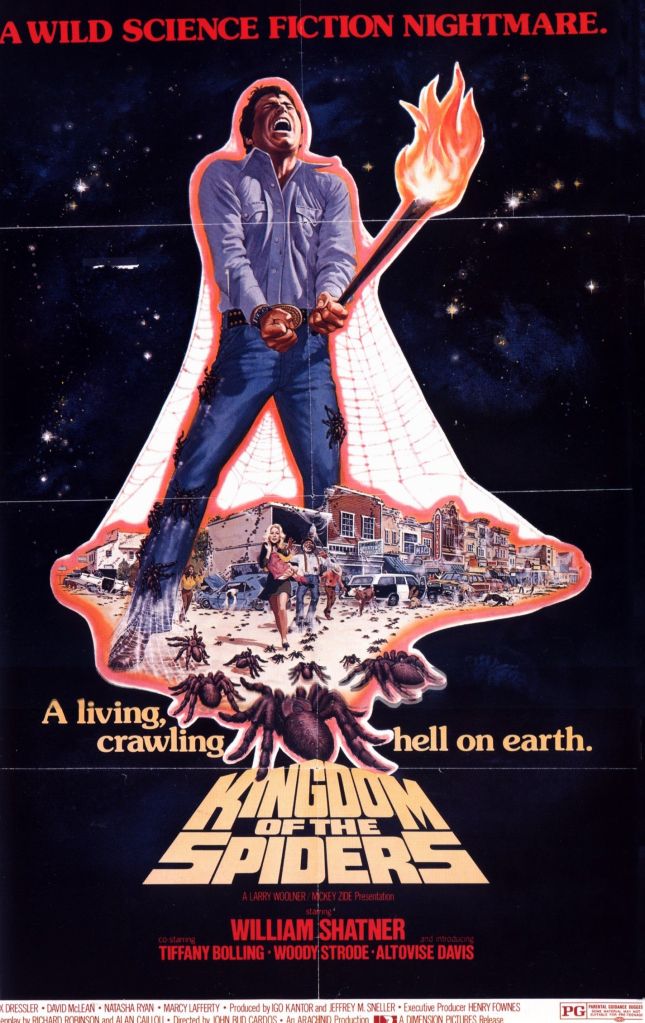
There is a Rifftrax version of this film, and that is a good use of the material. Maybe the best use. But like The Horror at 37,000 Feet, its flaws are still fun to watch. As a late example of another popular 70s horror trend–eco-horror, or what I like to call the Revenge of Stirred-Up Critters–like Frogs (1972), Night of the Lepus (1972), Food of the Gods (1976), and Squirm (1976), Kingdom of the Spiders would like to lecture on what might happen if migrating tarantulas decided they’d had quite enough of humans humaning up the joint.
Shatner plays the rugged local vet who joins up with a lady arachnologist when a farmer’s (Woody Strode, another reason to watch this) prize calf mysteriously dies. The calf will not be the last victim claimed as clever spiders soon overrun the rural Arizona town where Shatner practices. Of all the eco-horror critter features from the time, this is one of the more plausible ones, though 70s gender norms and how they are expressed through Shatner’s wooing technique is the most disturbing part.
No goats, but cute spiders.
Groom Lake (2002)
In the new millennium, aside from an Emmy here, a minor hit album there, Shatner kept doing reps as the best part of some of the worst crap, including a few more horror titles I will not be highlighting, like American Psycho 2: Electric Boogaloo. But we will conclude this overview with 2002’s Groom Lake, with Shatner fully in auteur mode as writer-director-producer-star. Groom Lake isn’t exactly a horror movie–it probably isn’t exactly a movie, period–but it asks very Horror Movie questions: what happens when I die? Is anything out there?
It also asks: if you took good performances of labored material from actual professionals like Amy Acker, Dick Van Patten, and Shatner, but filmed it on cheapo video, would the writing and video drag them down? And the answer is yes. Very much so.

And yet, Groom Lake deserves a chance, just like it deserved a budget…(and a rewrite and maaaaybe another director, I don’t know.) Shatner has been candid that he conceived the movie as a way to channel grief for his wife Nerine, who died in an accidental drowning related to her use of drugs and alcohol. He has a less Neil Breen-y articulation of that same pain on his album Has Been, in which he recounts finding her body.
It’s not Shatner’s character principally confronting his mortality in Groom Lake though, but Amy Acker’s character Kate, who is diagnosed with lupus (shut up, House) and decides to go with her boyfriend to Groom Lake, aka Area 51, to find evidence of more things in heaven and earth than are dreamt of in your science. In the tradition of William Shatner characters, Amy Acker’s unstinting commitment here is a big draw here. Come for the audacity, stay for the authenticity: that’s Groom Lake. Maybe that’s William Shatner, too.
I hope you have enjoyed this tour through some of the less-appreciated genre work from one of TV’s icons and, dare we but knowledge it, one of our greatest living actors, and the latex life mask of Halloween. Angela, out.

~~~
Angela hopes William Shatner doesn’t block her for this article.
Categories: Uncategorized




 The Cultural Gutter