
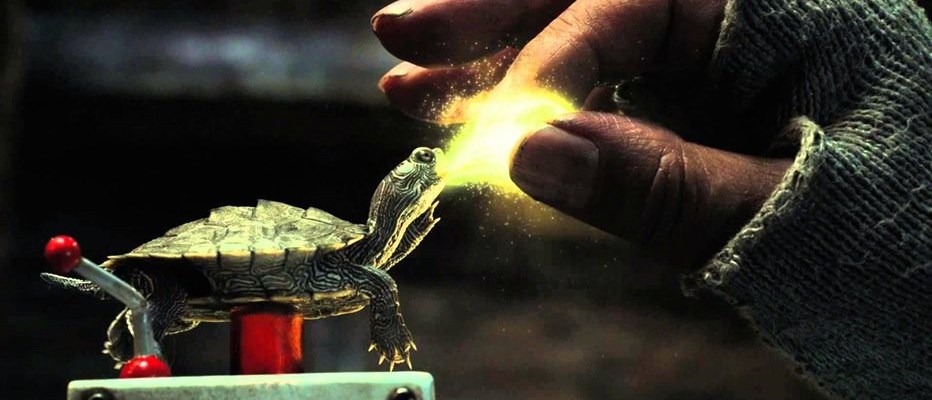
When I find myself in times of trouble, certain movies comfort me. In my various chats with friends on both sides of the US/Canada border in the past couple of weeks, I’ve been mentally taking notes about the media they’re consuming in an effort to find a cultural salve against the creeping threat of the worst people and their worst instincts. Is it a form of spiraling? Perhaps, but it’s the spiraling I know, so please let me have it.
Being unable to provide much in the way of political reassurance and disinclined to fall into ‘live laugh love’ empty comforts to my people, I try to offer the one thing I do well which is movie recommendations. The films that I always turn to when things are tough. Whether it’s something as high-level as a monster in a position of unchecked power, or something as small-scale as a particularly bad mushroom trip, these are the films – oddly, both released within a year of one another – that provide a warm blanket of stability for me. Maybe they will for you, too.
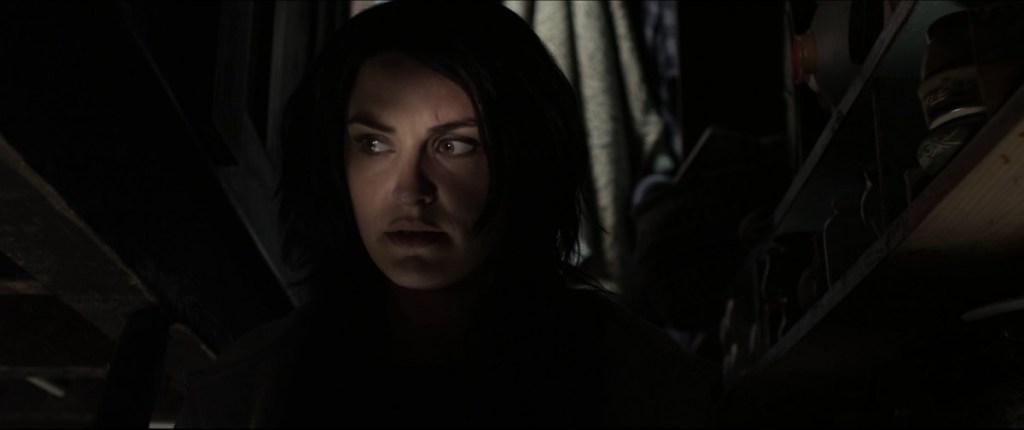
Housebound (2014, dir. Gerard Johnstone, New Zealand)
One of the first films to break the dam of great horror comedy from New Zealand (along with What We Do in the Shadows which was turned into comfort TV for me), Gerard Johnstone’s Housebound has been kind of a north star for me for a full decade now, and is always my first click in the ol’ Tubi queue when I’m feeling low. It’s a small, perfectly crafted thing that reminds me of the soothing power of unbridled creativity.
After a botched ATM robbery, Kylie (Morgana O’Reilly) is sentenced to house arrest, complete with electronic ankle bracelet to prevent her from straying, at her childhood home with her mother (Rima Te Waita) and stepfather (Ross Harper). Each week her therapist Dennis tries to peel away Kylie’s tough exterior, but with little success. Before long, the brooding miscreant is plagued by strange, seemingly supernatural happenings on the property, leading to the revelation that her mother has long suspected that the house is haunted. What follows is a seemingly-endless series of twists and turns as Kylie, her mother, and the bumbling but charming parole officer Amos (Glen-Paul Waru) attempt to unravel the truth.

Housebound melds the best elements of a haunted house film, a murder mystery, a kind of twisted family drama, and something approaching a National Lampoon-style comedy. But Johnstone does this – all of this – without feeling like the kind of filmmaker that’s throwing stuff against the wall. Rather, it feels intentional and perfectly formed and a situation where everything is in it’s right place, even if the climax is a kind of barely-controlled chaos. I think what first drew me to Housebound over ten years ago at a local film festival is it’s genuine quality. For a horror comedy, it navigates between real scares and actually hilarious gags derived both from banter and physical slapstick with a deftness that evokes Bong Joon-Ho for me. And like a great Bong, Johnstone manages to include a genuinely great mystery that’s a joy to unravel and a lovely family dynamic that you watch establish itself, grow and, finally gel over the course of the film. It’s one of those films that, regardless of how cruel the characters might seem to one another, it feels as though the cast is having just a wonderful time of it all.
With an almost criminally spartan filmography, Johnstone would go eight years after Housebound‘s release before making another feature film. He would re-emerge with another feature that I love, the AI/robotics horror M3GAN (and it’s upcoming sequel M3GAN 2.0) which has many of Housebound’s off-the-wall charms while also adding a murderous android that does Tik Tok dances. Some filmmakers just get me, and Gerard Johnstone is one of them.
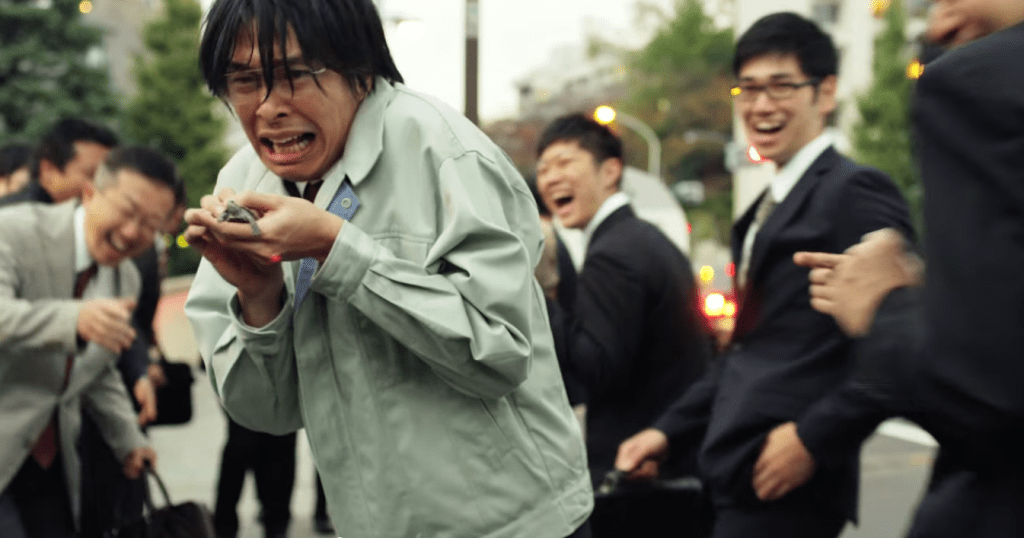
Love & Peace (2015, dir. Sion Sono, Japan)
This one is a harder choice, but perhaps more dubiously appropriate for the ~current climate~. My once and now former favourite working director, Sion Sono was outed as a creep of the highest order back in 2022 which has caused me to reexamine and discard many of the films from his canon that I adore, and once clung to as a source of peace when life felt chaotic. His unrelentingly prolific (at least prior to his outing) filmography is mostly dead to me, but at least one stands out as something irreplaceable, and that’s 2015’s Love & Peace.
2015 was a banner year for Sono, and made me wonder if a stronger or more evocative term than ‘prolific’ existed. That year, he directed an incredible six feature films and a TV mini-series. And the projects were all over the map. A minimalist spacetrotting sci-fi film based on a script Sono wrote years prior in film school (The Whispering Star), a time-bending story about alternate realities and the crushing strain of patriarchal structures (Tag), and a manga adaptation about a young man who obtains psychic powers while masturbating (Everyone is Psychic!: The Movie) only scratches the surface of what Sono put out that year. So it was with less fanfare than one might expect that Love & Peace, a film about turtles, kaiju, and somehow Santa Claus, was dropped right in the middle of it.
Ryoichi Suzuki (Hiroki Hasegawa) is a downtrodden office worker with big aspirations. As Japan prepares to host the world for the 2020 Olympics, Ryoichi dreams of success as a famous musician. The world around Ryoichi, though, seems intent on crushing these dreams before they ever really get on the ground. His boss and his coworkers – other than the equally-awkward Yuko (Kumiko Aso) – bully and humiliate him at every opportunity. Ryoichi imagines that the talking heads on TV are insulting him too and, coupled with the crushing loneliness he feels, something has to change.
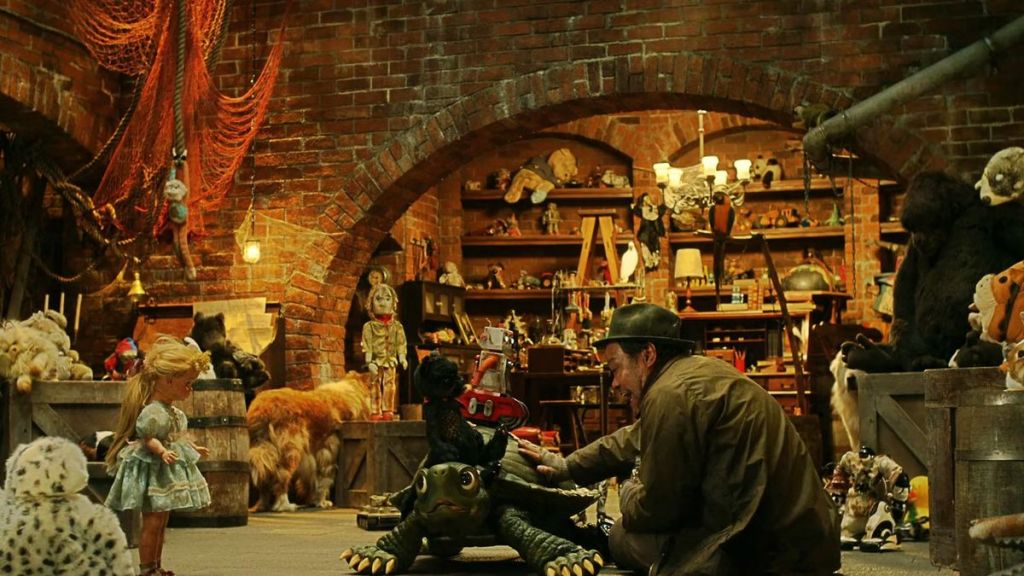
The spark of change in Ryoichi’s life and circumstances comes from his adoption of a tiny turtle, who he names “Pikadon” to confer the great strength and potential he sees in the diminutive amphibian. When Ryoichi is bullied into flushing Pikadon down the toilet, though, in an act he immediately regrets, the little turtle’s adventure is only beginning. Pikadon floats through the sewer and encounters a charming homeless man (Toshiyuki Nishida) who runs a kind of Island of Misfit Toys. Broken dolls, robots, stuffed animals, and more surround the little piece of the hobo’s domain, but there’s more going on here than it appears. The Mysterious Old Man, as he is never named in the film, imbues his companions with magical properties using an unexplained but fantastical alchemy. Pikadon is granted the ability to grant wishes, and finds his way back to Ryoichi in a beautiful reunion scene. As Ryoichi’s dream and his success grow, so does Pikadon. And when Ryoichi’s talent and celebrity grow out of control, so does the “little turtle” expand to gargantuan proportions, obliviously mauling Tokyo in the process like our favourite kaiju.
Love & Peace is another film, like Housebound, that chaotically crams so much into a relatively manageable runtime. But unlike Johnstone, Sono has never been concerned with a disciplined or intentional approach. Oftentimes his films feel like stream-of-consciousness, because they probably are. But I find that comforting, too, in the way that I can basically always be soothed by a great song, an underground lair, and turtles of any size. A scene where a tearful Yuko walks the streets with a derogatory note (calling back to Ryoichi’s bullying in the early part of the film) is heartbreaking, and sets your spirits up to be impossibly lifted as Pikadon walks a parallel path, both destined to confront Kyo as his song echoes through the city. Sono’s ouvre is decidedly adult, but this breaks from tradition and eschews his usual salaciousness for unbridled sweetness and joy. Sion Sono himself may be persona non grata around these parts, but I’ll always make an exception for Love & Peace.
For obvious reasons, people are in deep need of comfort at the moment. Those of us here in Canada are in the position of being both a source of comfort for our American friends while also managing the ever-creeping threats that tendril their way across the border, because we’re next. And when our turn comes around, whether it’s this fall or the can is kicked further down the road, I’ll be looking to these and hopefully a new set of small comforts to make the days feel a little shorter and easier to digest. Now, movies – no matter how good or how many haunted houses or banging rock songs they feature – are not going to get us through the next four (or more?) years on their own. That is manifestly too much to ask. But I guess what I would like to see is for us to turn to the art and beauty, whatever form that takes, that we love and hold it closer for as long as it takes to rebuild the will to fight against the shitheels. And to seek out the happy endings where we can.
Sachin Hingoo aspires to, one day, converse with a magic turtle.
Categories: Screen




 The Cultural Gutter
While we differ in our tastes, we share the same thought: provide comfort to others whenever and however we can. Thank you for sharing your recommendations. All I can add is this: for every action, there is an equal and opposite reaction. A**holes come and go, but we inch our way forward nonetheless. Deep breaths – we shall overcome.
LikeLiked by 1 person