
As long time Cultural Gutter readers will know, I love horror. Love it, live by it, curl up next to it to fall asleep. I still avoided Damien Leone’s Terrifier series for a long time. I avoided it for the same reason many people avoid horror altogether: ew. Splatter is just not my thing. I can’t hang with Herschell Gordon Lewis and all that he loosed on the earth, and I’ve never really enjoyed horror comedies either, with the odd exception for something exceptional like Shaun of the Dead. Generally the more gleeful about gore and grossness a film is, the less I’m into it. Which is not to say these movies don’t work on me. The zit popping scene from Slumber Party Massacre II lives rent-free in my head, right next to the eyeball gobbling from Black Christmas (2006), Chris Hardwick’s pathetic post-scalping hair strands in House of 1000 Corpses, deep-fried lady head in Blood Diner, and the entirety of Thankskilling. Bleurgh. I don’t quail from gore in service of the story or even for shock value. But there has to be a point. I mean, that’s the thing that separates fiction from real life, isn’t it? That’s what I want from horror, even at its bleakest. Give me a catharsis, and if you can’t do that, at least give me a lesson. There has to be a point.
For a good many of the above examples, the cruelty is the point. And that’s surely true of the Terrifier series, too. These films have brokered practical effects wizardry and dazzling audacity into a word-of-mouth brand that can do what few movies manage post-pandemic–pack the seats of your local movie theater. It is the promise–and the fulfillment!–of unrivaled spectacle filling those seats, a spectacle of cruelty for cruelty’s sake. Because story is not the strong point of this series. The first film didn’t have a story at all beyond Art the Clown (David Howard Thornton) stalking and murdering two friends on Halloween night.* It didn’t really need anything more than that. Leone did supply the next two with an underlying cosmic mythology and a background story for his heroine (Lauren LaVera) that I actually really like, but I’m not sure that it puts much more flesh on those bones. And again, it doesn’t really need it. The people want Art, the people need Art, and Art only requires enough story to queue up victims he can turn inside out.
There is a difference in the cruelty of Terrifier though. Actually there’s a couple differences. The first is simply tone. The Terrifier universe spans many aesthetics, many palettes, from slimy and rusted darkness to technicolor dreamscapes, but it’s all in service of a world that feels like a carnival attraction. So-called torture porn–Hostel, Martyrs, Saw–is one thing. Grim and grisly, torture porn films fixate so hard on abandonment to sadism that watching can feel like self-harm. They depend on realism, or a bleakness that is so unbeautiful it can be mistaken for realism by the pessimistic. But Terrifier is something else. I’m not sure where the line gets drawn, and as horror is an emotional genre, like romance or comedy, the line is drawn in each individual’s heart, but the Terrifier movies are not torture porn. They are not scary, at least not to me. They show you point-blank mutilation and torture, they show you Art the Clown (and sometimes others) gleefully delight in that point-blank mutilation and torture, but the tone of that presentation forbids serious comparison with something like Martyrs, something that requires the viewer to suffer. Maybe, with its obvious delight in guts and pain, Terrifier should be crowned as the true torture porn? It has torture! It has a very pornographic approach to the torture! But that doesn’t feel true either, because the things that Art does to people in these films, however anatomically correct, never approaches reality. The kills are too over-the-top, too cartoonish, and their surreality is only magnified by Art’s capering mime act. Maybe Art sawing the lady in half makes you laugh, maybe it makes you throw up, maybe it makes you stare in disbelief. But for it to be comparable to something like Saw, which might make you turn a lot greener to watch Cary Elwes hacksaw through a lot less, you would need to believe it on some level, and I don’t think that happens very often in the Terrifier movies.
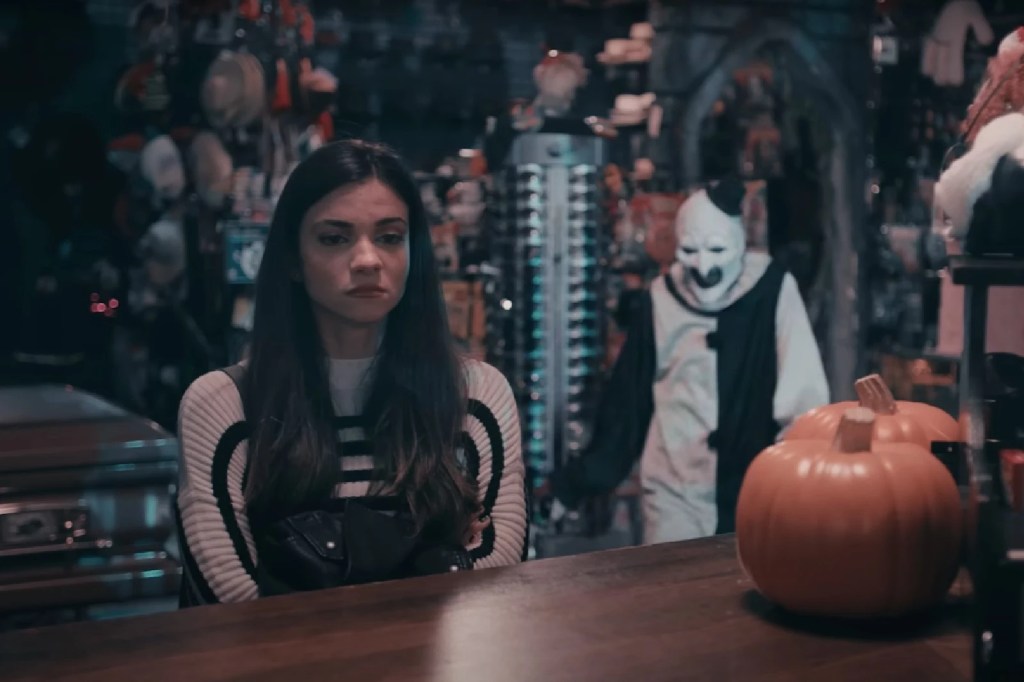

The other difference in Terrifier’s cruelty lies in how drawn out the kills are; indeed, how survivable they are. This also goes to their surreality and absurdity. In addition to bringing Itchy and Scratchy-levels of violence to bear on real people with limbs that break and intestines that spill, victims in Terrifer movies really go through it. They last. No passing out, no merciful shock rushing in to kill you before it can hurt. Long after the camera would have panned off and we would have assumed Michael Myers’ latest victim is in a better place, Art the Clown’s victims’ eyes pop open, full of sentience and helplessness. Can you survive having your face ripped off? I do not know and don’t wanna. But in the Terrifier movies, it happens kind of a lot. Combined with the Looney Tunes ultraviolence itself, the effect of having the scene go on and on and get worse and worse alienates you from the alleged suffering. The violence itself already barely seems real. What do I feel at the end of those scenes, when nothing human remains, just a maniacal clown straddling glop? About the same I feel when Elmer Fudd shoots Daffy Duck in the face to be honest, and for the same reasons. Watching Art take his time with his victims in Terrifier 3, I was put in mind of Johnny in this year’s In a Violent Nature, and how drawn out and elaborate a couple of his kills were, but again, the difference in their emotional impact was rooted in tone and approach. Johnny’s kills bothered me. Art’s entertained me.

The sum total of these differences is embodied in Art the Clown himself, the serial killer for our age, brought to life beautifully in all three Terrifier features by David Howard Thornton. Art has no tragic backstory. Art never speaks. He communicates solely through excellent mime, occasionally a little horn, and I appreciate that he stays committed to the bit even when he’s being shot, beaten, or flayed himself. If the Terrifier movies ever inspire gooseflesh, it must certainly be in those rare moments where Art’s grinning facade drops and he shines pure black malice onto a soon-to-be victim. I love Art’s design, which is unambiguously ugly and threatening, and yet mistaken by so many as innocuous. And again, part of this is just how good Art is at being mischievous. You can tell he really loves his work. And that is another key difference for Art, in a field of horror bogeymen who have reasons and sermons and cursed origins. He is neither the silent brick of death in the mold of Johnny or Jason or Michael Myers, nor the evangelist of pain like Candyman and Pinhead and Jigsaw. If anyone, he resembles Freddy Krueger best, who also loves a good joke and thinking outside the box. But then Freddy was ultimately killing for revenge. Art is a purer soul than that. It’s cruelty all the way down.
The Terrifier films are obviously made with love, stuffed with plenty of cameos and easter eggs and references for fans of horror movies by someone who seems to be living his dream making them. Damien Leone is doing good work and people are getting something they need from it right now. You love to see it. While these films are going to disturb some people and they should–apart from the scale of the bad stuff, they do also feature fatal violence against animals and children–for some, Terrifier is just going to be an Ode to Joy, largely because of its inherent absurdity. The wrongness of Art and his gore spree is so heightened that it becomes Bugs Bunny and Daffy Duck. But I don’t think that makes it less legitimate. We probably have enough elevated horror about grief for the moment. We have horror about bodily autonomy covered. What about horror about just being fucking fucked? What if I need to laugh in the face of that?

I have long thought that my own solace in horror movies, ones that are a good deal more conventional than Terrifier, resides in the fact that I’m an anxious person, and so watching people escape scary things is a nice little psychological headpat for me. And probably to some extent the story that starts in a scary place feels more trustworthy to me than the one that begins in a sitcom-lit kitchen. There’s no solace in absurdity like we find in Terrifier and even less of a point, but there is some catharsis in facing it, even as an audience. You face it. You conquer it. I know there’s always concern that ultraviolent films will desensitize people, but children are no more in peril from Art in Terrifier than they are from going to school, are they? Are we desensitized to that? And if we are, wouldn’t it help to recontextualize it as something that should only happen in bad demon clown movies? But I digress. For Art, cruelty is the point and cruelty is his canvas. It distinguishes Terrifier among the crowded field of powerful horror films emerging over the last decade. But taking the piss out of that cruelty is the secret of Terrifier’s joy, showing you the worst thing that could possibly happen and also making it hilarious.
Take that energy into the second Trump administration.
*Plus everyone they cross paths with.

~~~
Angela is taking off from the Gutter to go write terrible fiction things, but maybe one day, if she’s very lucky, you will get to read some of those. Love y’all.
Categories: Horror



 The Cultural Gutter
Sorry to see you leave the circus!
LikeLike