The whole process of finding your true nature is one continuous mistake .
– Shunryu Suzuki Roshi
‘Tis the day after Christmas and as my thoughts turn to the start of another year, I find myself ruminating on the definition of success and how hard it is to predict what will actually bring us happiness. I’m thinking of all the times I got what I thought I wanted only to discover that it was nothing like the way it played out in my head, and how often something that I wouldn’t have chosen has surprised me by being just what I needed. I’m also thinking of how many times I’ve watched people (real and fictional) blunder into succeeding while the folks around them who’ve been systematically working at it for ages grind their teeth, and how sometimes that isn’t actually an accident or lack of effort but rather punching a hole in a system that fails to recognize the value of different approaches or account for the reality of circumstances. These thoughts tie together two excellent but dissimilar British shows I enjoyed this year: the darkly humorous comedy-drama series Big Mood and the sardonically bleak spy thriller Slow Horses.


I’ve been rereading a collection of Pema Chodron’s lectures on Buddhist practice called The Wisdom of No Escape, in which she retells one of the Buddha’s sutras about the excellent horse, the good horse, the poor horse, and the really bad horse. The gist is that the excellent horse knows what to do and does it without you having to make any effort and the really bad horse basically won’t do what you want it to until you make its life a living hell. The point she’s making is about knowing which horse you are at any given point in time and working with it, but there was one thing she said that stuck out for me, not because it was a new idea but because I felt like the way she said it made it especially relatable. Having compassion for the worst horse is critical “because in our heart of hearts almost all of us feel that we are the worst horse.”
It actually seems perfectly natural and inevitable to me that this would be the case. Nobody has to try harder to get us to do things than ourselves. No one else sees the goals we set for ourselves – those shiny things we reach for in our minds – so no one else sees how very far short we fall of them. By the time we show up and do whatever it is we’re supposed to do we may look like the best horse, but we know we had to drag our miserable carcass through the existential mud all morning to get it there. Or sometimes despite our best efforts we fully fall on our faces in the mud right in front of everyone. It’s not that I think most people feel like the worst horse most of the time, it’s just that our perspective makes it hard not to feel our flaws keenly.
There’s a phrase I’ve always loved from Polish American poet Czeslaw Milosz’s poem, “Love”:
Love means to learn to look at yourself
The way one looks at distant things
For you are only one thing among many.
Part of having compassion for the worst horse means learning to understand ourselves as one worst horse among many, which in turn transforms the hierarchy of the “worst horse.” That we are all, sometimes or in some way, the worst horse makes it a common human experience rather than an individual character flaw and that’s something creator/writer Camilla Whitehill has really tapped into with the British series Big Mood (2024-present). It’s a portrayal of mental health and friendship that somehow manages to be simultaneously sensitive and full of stupid humor, which is a very difficult balance to strike. So often humor that involves a character with mental health challenges ends up being, however unintentionally, at the expense of that character, but it never feels to me like they fall into that trap.


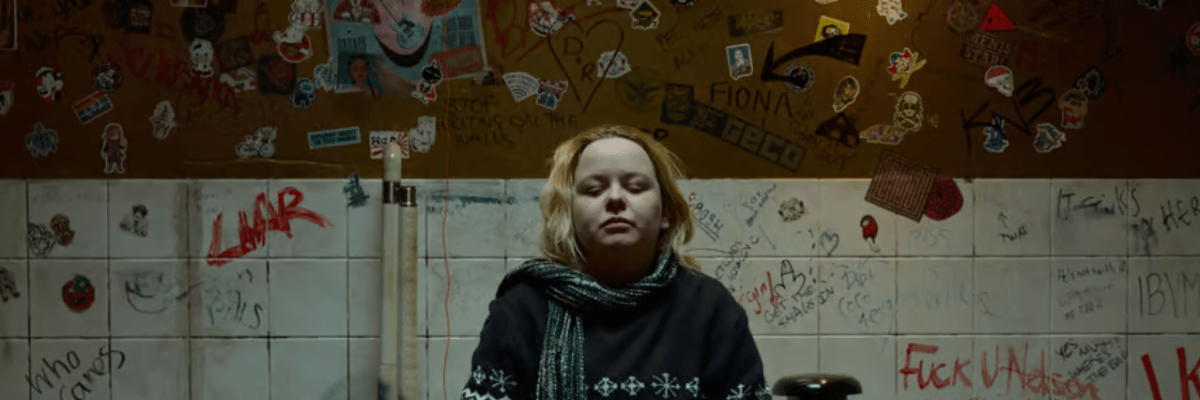
Maggie (Nicola Coughlan of Derry Girls) is a 30-something playwright with bipolar disorder who went off her meds because they kill her creativity and is in the process of descending into a manic-depressive spiral. Her best friend, Eddie (Lydia West of It’s a Sin), is trying to save the rat-infested dive bar she and her brother inherited from their dad while keeping Maggie afloat. They’re both a hot mess in different ways, and although the show hits similar notes to something like Broad City, there is some seriously heartbreaking, heavy content in Big Mood. The first episode begins with Maggie riding a scooter through town in a hot pink track suit before giving it away to random girls on the street and ends with her lying on the sofa in a grotty old t-shirt, unable to leave her apartment. The structure of the show mirrors Maggie’s swings from manically reckless to inconsolably miserable, with episodes where mental health issues and trauma lurk beneath ridiculous shenanigans and others that insert dark humor into candid depictions of trauma and mental illness.


I love that Big Mood shows both how hard it is to have a mental illness and how hard it is to support someone with a mental illness in a nonjudgemental way that left me rooting equally for both of them, and most of all for their friendship. It’s not all Eddie taking care of Maggie – there’s a real give and take in their relationship within the bounds of what each of them is able to give – and part of the brilliance of Whitehill’s writing is in creating comedy out of how their issues and trauma collide. Coughlan’s acting brings a depth and relatability to Maggie’s character that makes her sympathetic and lovable despite being an absolute disaster. A lot of comedy relies on making fun of the worst horse in us all, but when that’s done without enough compassion it’s straight up cringy, or just insulting and painful. Don’t get me wrong, theres a lot of cringiness in Big Mood (which often horrifies me more than actual horror so I tend to peek through my fingers like other people would watch a chainsaw massacre) but it’s infused with empathy in a way that made me keep watching and trust where they were going.
Another way of looking at it is that working with your worst horse energy also means seeing ways the worst horse is sometimes the best horse. In Slow Horses (2022-present), everyone sees the MI5 agents consigned to the purgatory that is Slough House as the worst horses, including themselves. Rejects from the service who have profoundly screwed up but for whatever reason can’t be sacked are sent to Slough House, where they’re assigned to drudgery designed to drive them to quit . They’re under the derisive supervision of the distasteful department head, Jackson Lamb (Gary Oldman), who thinks they’re a bunch of losers but gets pissed off when people mess with them because they’re “his losers”. The rest of the service calls them the “Slow Horses” and they’re never supposed to be doing anything actually important, but somehow each season they get drawn into working on high-profile cases where people’s lives or the fate of the nation hang in the balance.

Based on the Slough House novels by Mick Herron, it’s a very well-acted, clever, grimly entertaining series that illustrates how the worst horse can sometimes be the best horse. The Slow Horses manage to keep solving cases even though everyone thinks they’re useless. They do all kinds of things wrong by the standards of people around them who want and expect things done in the very British way that Things are Done, and to be fair many of the ways they do things are truly inadvisable and end badly, but they also refuse to play by the rules that govern the profoundly unethical methods of the high-level MI5 and government officials. They harness their worst horse energy to mess up some things that should be messed up, and they (mostly) continue to try to do the right thing in their own messed up ways.
The best horse may be the one you want to ride in real life, but in art it isn’t really very interesting or relatable. One of the things that fiction does best is make us feel less alone, and much like Milosz’ poem about love, stories about people being messy make it a little easier to see ourselves as one thing among many.
~~~
Alex MacFadyen suspects that if asked, horses would apply a very different rating system to themselves.
Categories: Screen



 The Cultural Gutter