
She shakes out a summer-weight blanket, showing a leg you did not want to see. Except for that, you look at her and understand the law that requires two people to be with the body at all times.
“I thought of something,” she says. “I thought of it last night. I think there is a real and present need here. You know,” she says, “like for someone to do it for you when you can’t do it yourself. You call them up whenever you want—like when push comes to shove.”
She grabs the bedside phone and loops the cord around her neck.
“Hey,” she says, “the end o’ the line.”
Amy Hempel, “In the Cemetery Where Al Jolson is Buried”
Amy Hempel’s story “In the Cemetery Where Al Jolson is Buried” , one of my favourite pieces of writing of any kind, is about a pair of women – one dying, one living – talking in a hospital room. They’re old friends, and as conversations like this often go between people familiar enough, it starts polite, weaves and winds it’s way through humourous non-sequiturs and in-jokes, and ultimately lands on the heavy things surrounding mortality. Through these stories, these half-remembered anecdotes and tales from the past that colour a life that is rapidly coming to an end, we understand the bond between these two people, and the importance of that bond.

I’ve always gravitated towards Pedro Almodovar’s films, snapping them up as soon as they become available to me, because he’s the ur-example of a filmmaker that never zigs when he can zag. His tendency to never choose the easy narrative or aesthetic choice, but instead take the harder and more memorable road has not only made me a lifelong fan, but has informed my tastes in almost all the media I consume, looking for the same instincts in everything I watch or listen to. The Room Next Door is Almodovar’s first English feature, though he has dabbled with a couple of terrific short films – The Human Voice and Strange Way of Life – that were also in English. Bringing his particular eye and sensibility to English actors and dialogue only makes the illusive nature of the story even more apparent.

Pedro Almodovar’s new film, The Room Next Door, based on Sigrid Nunez’s novel What Are You Going Through, reminds me so much of Hempel’s story. It, too, is about two friends grappling with mortality. Successful writers Ingrid (Julianne Moore) and Martha (Tilda Swinton) have drifted apart but are reunited upon Ingrid hearing the news that Martha is stricken with inoperable cervical cancer. Ingrid rushes to her friend and former colleague at Paste Magazine’s side as Martha undergoes an ultimately unsuccessful experimental treatment. As the spectre of death hangs over both women, their friendship is almost immediately reignited through stories from Martha’s past as a war reporter that are expository but also feel like they’re part of some unmade prequel that develop Martha and Ingrid’s remarkably full and eventful lives in 1980’s New York, including dating the same sexual dynamo Damian (John Turturro) who reemerges to support Ingrid when things start to go south.



Martha decides that continuing with the painful, invasive, and ultimately futile treatment that has robbed her body of the ability to sustain her appetite for food, reading, and writing is not how she wants to spend her final days. Instead, she rents a beautiful house in the mountains, orders a suicide pill from the dark web, and recruits Ingrid (not her first choice, which will have repercussions later in the story as Ingrid is potentially implicated) to give her a ‘dignified death’ and accompany her to handle the post-suicide care. This unleashes, as it does, a torrent of emotions in Ingrid, who is terrified of death and is conflicted about aiding her friend in an act that is illegal, potentially immoral, and ultimately final. As the days wear on, Ingrid begins to wear thin and question Martha’s confidence in her decision. And herein lies the Almodovar of it all. While this sounds like a dark and morose story, these scenes feel light and I daresay almost breezy when it seems impossible for that to be the case. This lightness works on top of a tension running through the film about when exactly Martha will choose to self-euthanize, signaling her intent by closing her red bedroom door to the world and that juxtaposition, like so many of the contrasts afoot in Almodovar’s story, is absurdly delicious to experience.

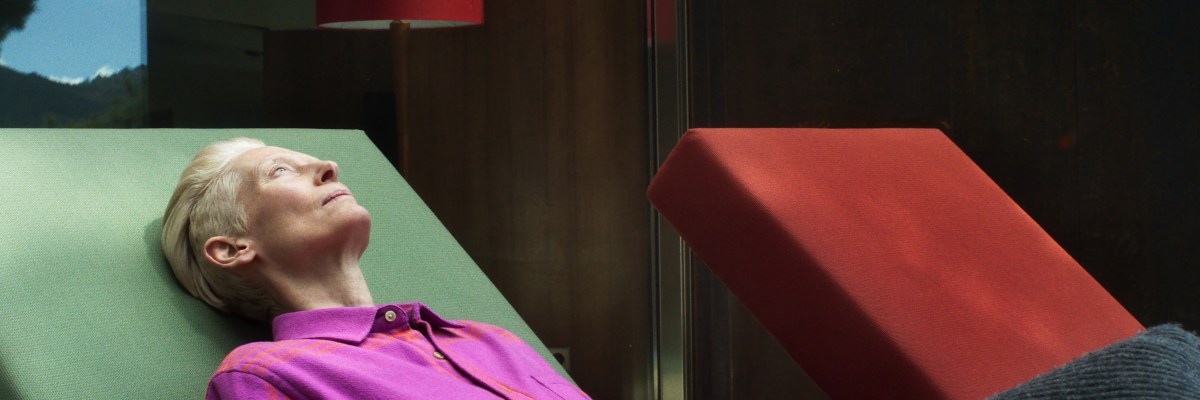
A word you never hear about movies that tackle this kind of subject matter is ‘lush’ or perhaps ‘vibrant’ but The Room Next Door is unapologetically both. I’m not sure there’s another film about death that features colours so rich that they jump off the screen. Brilliant hues permeate nearly every frame, and the titular door and the loungers on which Ingrid and Martha spend their days discussing, contemplating, and perhaps enacting Martha’s ‘dignified death’ pop off the screen in vibrant reds. The stunning and palatial modernist ‘country house’ that Martha chooses for her final days is breathtaking, almost as much as the stunning scenery on which it sits. Even the hospital where Martha receives her treatments – long, torturous, and painful – is stunningly decorated with leaf patterns and soft, colourful hues. This aesthetic, along with the particular way Almodovar uses stilted and disarming dialogue, contributes to the director’s trademark shifted and stylized reality. Authentic and always moving, but slightly off-centre, even overly-poised in a calculated way.

The Room Next Door is a powerful English feature debut for Almodovar that hinges on his longtime collaborator Tilda Swinton’s performance, and if you’re at all familiar with Tilda Swinton, you know she’s not going to miss. Even snapping up the opportunity to embrace a dual role as she plays her own daughter, Swinton is having a great time here and shows her full range of dominance and vulnerability. And Moore’s performance is right there to match it note for note. Unexpectedly bringing some of the film’s funniest moments and one key secret about which she has not been honest with Martha, Ingrid holds onto the crux of the film until the very last moments. The pair, like so many aspects of the film are juxtaposed–Ingrid’s deep anxiety about death and Martha’s embrace of it. And then there’s John Turturro, playing perhaps the sexiest incarnation of John Turturro to ever be put to film, in multiple ways. He is there to provide his unwavering support to both women and all the while, they’re reminding you of his ample sexual prowess. If this is your sort of thing, you probably won’t need chips or popcorn for this film as Turturro is more than enough of a snack.
Like Almodovar himself, neither Martha nor Ingrid is inclined to release anything after or before its time. Not secrets, and not people. There is much to be cherished and savoured, and after you might expect the film to end there’s a few more beats in Almodovar’s back pocket. But this is a reminder that one’s time to depart or ascend or transition, as The Room Next Door asserts and the characters in Amy Hempel’s story would agree, should be our own decision. And we should enter into it with an open eye, an open heart, and at least one of our dearest friends.
~~~
A version of this article originally appeared at Biff Bam Pop!The Room Next Door is currently in wide release throughout North America.
Like the pills in this movie, Sachin Hingoo is also readily available on the Dark Web.
Categories: Screen




 The Cultural Gutter