
Humphrey Bogart and Katharine Hepburn.
Lucille Ball and Desi Arnaz.
Lady and the Tramp.
They were all legendary couples of the Silver Screen in the 1950s, but the greatest cinematic pairing of the decade was Insects and Radiation, two great tastes that mutate together. If the movies were to be believed, the deserts and big cities of America were crawling with bugs the size of insurance buildings. Filled with a bottomless and amoral nuclear rage, these creatures desired only to destroy and consume, taking their revenge on the puny humans who changed them on a sub-atomic level.
Except that wasn’t the case at all. There was no animosity in the super insects. They were doing regular, tiny bug stuff on a massive scale.
When gigantic ants attacked New Mexico and attempted to start a colony in the tunnels beneath Los Angeles in 1954’s THEM!, they hadn’t formed some devious master plan to destroy humanity. They were doing what ants naturally do. Ants like sweet stuff, so the movie ants tore open bags of sugar and chowed down. Queen ants sprout wings and fly great distances to start new colonies. It’s not just what THEM! did, it’s what ants do.

Insects do not need radiation to be utterly terrifying. Despite the plethora of movies in which creepy-crawlies got zapped by radioactive materials and unnaturally swollen to hundreds of times their original size, mouths transformed into gaping maws, and antennae enlarged to the thickness of underwater communication cables, regular bugs are terrifying. We flinch when they crawl across our skin. When they enter our homes, we smash them with heavy things or spray them with poison. Raining death upon bugs may make humans feel better for a moment, but that doesn’t negate one simple fact.
There are more of them than there are of us. It’s a numbers game, and humanity is losing.
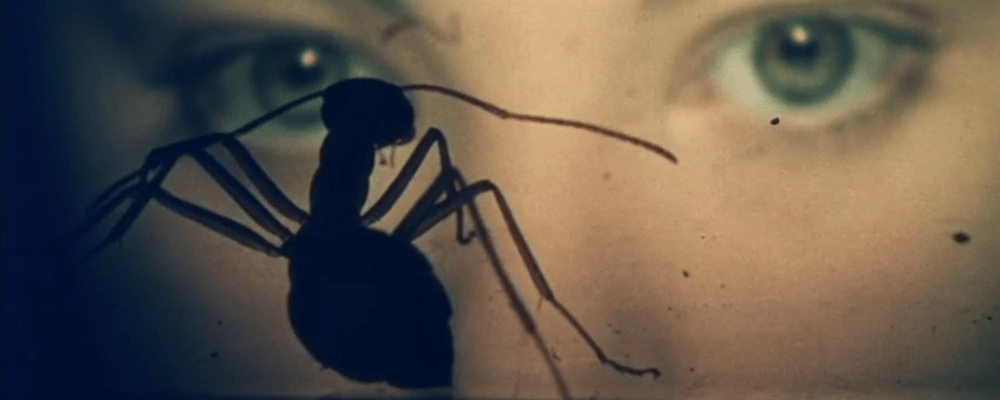
It wasn’t until 1971 that a documentary called The Hellstrom Chronicle asked a single, terrifying question. What if the bugs we thoughtlessly stomp on as bothersome inconveniences not only outlive humanity but also function as an active part of our downfall?

Calling The Hellstrom Chronicle an ecology movie is like saying ALIEN was an instructional film about ore mining. It was directed by Walon Green, the writer of The Wild Bunch and, perhaps more importantly, the co-writer of the 1986 schlocksterpiece, Solarbabies. David Seltzer, author of The Omen, created the grim script. Dr. Nils Hellstrom, the entomologist who narrates the film, wasn’t a doctor, although he did play one on TV*. Hellstrom was portrayed by Lawrence Pressman, a fine actor you may remember from the series Doogie Howser, M.D. as Dr. Benjamin Canfield. There may be nothing real about The Hellstrom Chronicle except the bugs.
Some people consider The Hellstrom Chronicle to be satirical. Even director Green said in a 2012 interview with Grantland that the filmmakers “were giving the audience an elbow to the ribs every third time.” Amidst the gruesome scenes of battle and devastation in the unforgiving land of the insect, one could be forgiven for missing the humor. That is, unless watching bugs murder each other in berserker mode somehow tickles your funnybone.
Did I mention The Hellstrom Chronicle won the Oscar for Best Documentary in 1971? Gods, the 1970s were bleak and confusing.

“He’s right behind me, isn’t he?”
Pressman portrays Hellstrom as twitchy and unreliable, given to spouting apocalyptic statements like a tweaking street preacher, his wavy hair blowing in the Essene wind like John the Baptist summoning another à la carte meal of honey and locusts. His calm manner collides with his anguished refusal to blink, making him difficult to trust. Even Hellstrom acknowledges that the ideas he espouses sound like “lunacy.” But when he introduces footage of blind soldier ants eating lizards and dragging them back to the hive like deranged 311 fans, how can we not see ourselves in those grey carcasses? We have met the enemy and they are tiny, numerous, and unspeakably hungry.
While nature in its natural state of brutality is horrifying to see, it doesn’t have a thing to do with radiation. These insects don’t need any help to kill each other and, ostensibly, us. Our esteemed guide and narrator takes us to a nuclear testing ground to show us bugs happily crawling and buzzing about the irradiated ground. He tells us that the common insect, “in a frightening tour-de-force of adaptability, proved conclusively that he could endure where man would ultimately fail.”
Like a lot of nature documentaries, The Hellstrom Chronicle revels in graphic displays of miniature violence. A male spider finishes mating before the female, who, in a stunning moment of post-nut clarity, attacks and wraps their lover up in a web, saving them for a late-night snack. It reminds me of how my grandmother used to buy Arby’s sandwiches in bulk and freeze them. Bee wolf wasps (and isn’t that a terrifying name) invade a honeybee hive with ravenous intent. In an underground lair, black ants and red ants battle for territorial supremacy. Pincers clamp onto thoraxes and abdomens. Ant heads, separated from their little ant bodies, still wave their antennae and open and close their mouths as if to say, “It’s just a flesh wound.” It’s torture porn for science geeks.
Towards the end of The Hellstrom Chronicle, Dr. Hellstrom (if that is his real name, which it is certainly not) discusses how insects communicate. What human ears interpret as a random cacophony of chirps and clicks is a complex language. Insects convey the location of food sources, a willingness to mate, and where to meet up. It’s a lot like the internet. As far as we know, they’re dictating lengthy introductions to food blogs and leaving one-star reviews for picnic areas with poor service and weak margaritas. Then again, they could be transmitting battle plans, preparing to flank major cities and strip us of our skin with a chitinous efficiency.
Things could only be worse if the insects could set things on fire.
Oh, wait.

In 1975, pioneering horror producer William Castle (13 Ghosts, House on Haunted Hill) unleashed the cleverly titled drive-in programmer, Bug. Based on co-screenwriter Thomas Page’s novel, The Hephaestus Plague, Bug tells the sweet love story between Professor James Parmiter (a scruffy, perspiration-drenched Bradford Dillman) and a bunch of insects that shit fire.
Not really, but it sure looks like it.
After an earthquake hits a small town, a heretofore unknown strain of cockroaches emerges from the cracks. Released from their dark underground lair, they survey the colorful surface world, rub their flinty back legs together, and start setting things ablaze. One bug journeys into the exhaust pipe of a truck and makes it explode. Another roach sets a cat on fire. There’s no point in describing the burning cat. Your imagination will barely do it justice. In one memorable scene, a woman in the kitchen of the house formerly inhabited by the Brady Bunch has a bug crawl into her exquisitely fixative-infused helmet hair before turning her tradwife head into a giant stanky candle.

Upon closer scientific examination, Professor Parmiter learns that the firebugs eat ashes and survive on carbon. Hit ‘em with a hammer, and their thick armored carapaces will protect them. But it is neither beauty nor brawn that kills the beasts. It’s pressure. All the firebugs suffer from decompression sickness, like a diver who comes up from the depths too fast. Parmiter isn’t willing to let the species go extinct, so he places one in a pressurized tank along with a regular, presumably non-radioactive cockroach. Since the bugs all get prettier at closing time, there are soon hybrid roachy babies on the way.
Raising children is always difficult, especially when they’re carnivorous, sizzling-sphinctered cockroach mutants who, for some reason, know how to spell. They gather together like gnarly marching band members to form words all over Parmiter’s exceedingly run-down hovel. It is important to note that of all the phrases the bugs could have chosen to make, none of them is “radiation.”
Are the firebugs mutants? Absolutely. Much like one would expect a backwoods family that eats nothing but the flesh of trespassing strangers and breeds solely through incestuous relations to have certain genetic deficiencies, as do the bugs. They succumbed to instinct in Parmiter’s peer pressure tank and became something more than they were. Smarter. Faster. Maybe a bit more pretentious.
But Bug increased the audience’s fears of both cockroaches and unexplained fires. It wasn’t beyond reason that firebugs, mysterious and elusive, could be the cause of the Fortean phenomenon of spontaneous combustion. Something must be to blame for Auntie Pearl’s blackened skeleton found by well-meaning nephews in her favorite wingback chair, a hollow stare fixed towards her portable black-and-white television, her pink floral nightgown untouched by the flames. That’s what I would have thought, anyway, but I was an impressionable lad, given to flights of fancy.
Cockroaches, already considered by humans to be disgusting, disease-carrying scurrying things, may not have yet attained the final form. What if the average Periplaneta americana were evolving underneath your refrigerator at night, advancing their species to new levels, without the advantages of uranium? What if they learned how to speak French? Or, they could just be doing math like some ant nerds.

Famed animator Saul Bass’s single feature-length live-action film as a director was 1974’s ant-stravaganza Phase IV, which was advertised with one of the most lurid posters of the decade, and that’s saying a lot. A painting shows an ant bursting from a bloody hole in a human hand. Above that disturbing image are the words, “The Day the Earth Was Turned Into a Cemetery! Ravenous Invaders Controlled By a Terror Out In Space… Commanded to Annihilate the World!”
Look: none of that happens in Phase IV. I bet thousands of teenagers hoping to frighten their partners into some jump-scare-induced drive-in nookie were super mad when Phase IV turned out to be a movie about ants learning geometry.
Is there, as the poster exclaims, a “Terror Out in Space?” I wouldn’t go that far. No one knows what happened. In an opening voiceover, actor Michael Murphy says that people on Earth were paying attention to some cosmic event he calls the “Effects of Space.” We see something resembling an eclipse with a blue corona emanating from a celestial body. That’s all the explanation there is. No one says it is aliens. It doesn’t present as a “terror.” Radiation is never mentioned. Whatever the Effects of Space are, they had their blue glowing eye focused on the American desert.
Somewhere in the lower pubic region of Arizona, all species of ants had some kind of city council meeting and began cooperating. There’s no infighting, nothing like the cannibalistic carnage displayed in The Hellstrom Chronicle. Instead, the ants worked together to remove most of their natural predators, making them the desert’s alpha critters, except for the few humans who remain.
Murphy and Nigel Davenport play researchers looking into the smart ant phenomenon. Grumpy and ragged, Davenport feels the best thing to do is to wipe the ants off the face of the earth by using a foamy, thick pesticide called Yellow. Murphy, the more analytical of the two, wants to communicate with the ants via the universal language, mathematics. There’s also an innocent girl involved because why not? Meanwhile, the ants are constructing gigantic, angular ant hills and devising ways of destroying the scientists’ fancy computerized geodesic dome.

“I don’t know art, but I know what I like.”
Even before the Effects of Space began, the ants were smart. They could organize, go into battle, and raise babies. Those activities take a modicum of brains. To paraphrase Davenport, the ants were defenseless as individuals but crazily unstoppable en masse. The ants in Phase IV weren’t mutants, they were mathletes. The Effects of Space saw the desert as a giant Sylvan Learning Center where they could teach ants how to do Chis-An-Bop.
With a vague psychedelic ending, Phase IV espouses rearranging the Natural Order of Things, leading the viewer to believe that the ants desire us to become part of their world, not vice versa. Whether the ants actively want us to be part of their world, or if that integration is the end game of the Effects of Space, isn’t clear. Regardless, it’s co-operation, not conflict, that takes precedence in Phase IV’s Antopian society. Also, we should probably know some advanced math. If that’s the case, I’m screwed.
Perhaps it comes down to the human desire not to be eaten. People understand that larger animals could devour them. Grizzly bears. Sharks. Corporations. That’s hunger and self-preservation, not the China Syndrome. Most people have no desire to be ravaged by swarms of tiny bugs, the death of a million little cuts, leaving nothing behind but shiny bone. Dignity be damned, it’s gonna happen anyway after we die. Radiation or not, the bugs will win.
*Here’s the phrase that begins the end credits for The Hellstrom Chronicle: “Nils Hellstrom, M.S., Ph.D., is a fictional character who was portrayed by Lawrence Pressman. His statements relating to the impermanence of the human species have been synthesized from contemporary opinions. All statements about the insect world are factual and have been reviewed by Roy Snelling and Charles Hogue, Ph.D., of the Entomology Department, Los Angeles County Museum of Natural History.”
~~~
Jeffery X Martin currently has his head inside a microwave oven, hoping the radiation will make him smarter. You can read more of his writing at Biff Bam Pop! or buy his weird little books at Amazon.
Categories: Guest Star




 The Cultural Gutter