
“I wish I could live through something.”
Saoirse Ronan as Christine “Lady Bird” McPherson, Lady Bird (2017)
After the Toronto International Film Festival wraps up each year and really throughout the duration, I find myself thinking about the ways in which the films dovetail with one another in theme, aesthetic, or otherwise. It’s just the way my brain works and since watching 30+ films in ten days, often with minutes between screenings, causes them to run together somewhat anyway it feels natural – even though consuming and thinking about this marathon of movies in such a compressed period is anything but.
One movie that I saw in the back half of TIFF seemed to connect several threads of the festival together, and I found myself thinking about it at every screening I attended after having seen it. Anyone that knows me will tell you that I’m a sucker for an unconventional animal-themed film and while it doesn’t have the in-your-face animated aesthetic of last year’s Flow, György Pálfi’s new film Hen chicken-scratches that itch in a major way.

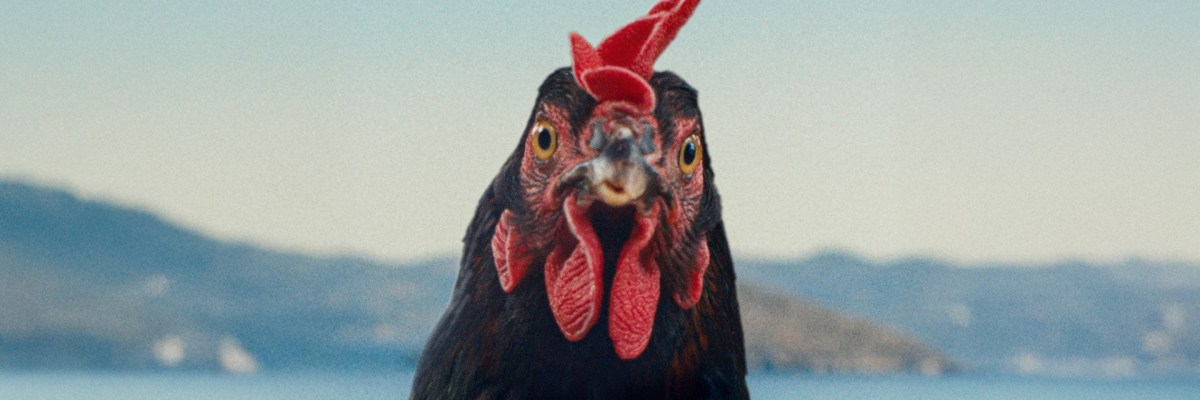
Hen is one of those films that delivers precisely what it promises (a hen), but it goes so much further. A literal birth-to-death story of a seemingly unremarkable figure living a remarkable life like Joel Edgerton’s protagonist in Clint Bentley’s Train Dreams, Hen opens on an egg being laid in full, slimy, close-up detail. We see the egg being pushed out and eventually hatching our eponymous Hen, who is blessed/cursed with majestic black feathers. Her different appearance earns our Hen disapproving looks from the other lily-white chickens and also from the farmer who wishes to sell them. No one will buy a black chicken, I suppose, so even though the farmer decides to bring our Hen back to the house for dinner, she immediately shows herself to be fiercely and determinedly capable and stages a dramatic escape from his truck, hitting the open road.
Literally. Our Hen, abandoned at a gas station, is pursued by a wild fox that she manages to evade briefly but is tracked down and cornered on the precipice of a highway. Why did the chicken cross the road? To earn her freedom and to avoid being devoured. This scene, watching our Hen dodge vehicular traffic with a hungry predator at her heels, is as tension-filled as almost any I’ve seen this year, even the reveal of a mother’s identity in Yeon Sang-ho’s The Ugly. This hen is nothing if not a survivor though, and traverses the highway while the fox does not enjoy the same luck.
Our Hen adapts. We see her learn from a few other members of the avian persuasion in her travels. She sees a group of pigeons foraging near a dumpster and asserts herself to join in and eventually take over the action. She learns to peck at and consume worms from yet another small bird. A hawk ruthlessly swoops down to capture a mouse and you can see our Hen internalize that ruthlessness and do the same, eventually turning it around on both the hawk and, later, her many other antagonists in the film like a feathered John Wick.
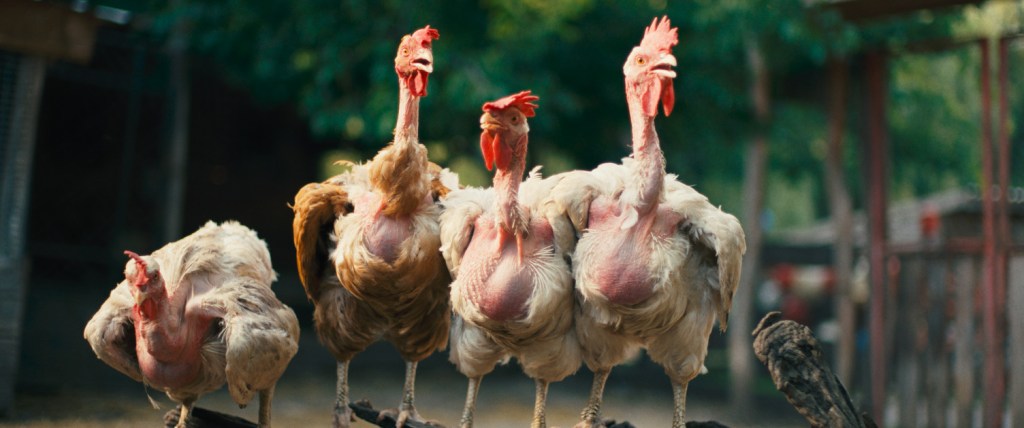
One thing I found surprising about Hen is that it’s one of the most forthrightly horny films of TIFF. We see our hen entertain a number of suitors, all roosters who look extremely strange to me even by rooster standards but are probably the Denzel Washingtons of the poultry world. And we see their relations in perhaps-too-clinical detail. But not unlike Rose Byrne’s put-upon mother in Mary Bronstein’s If I Had Legs I’d Kick You, our Hen finds herself routinely disappointed by the men in her life. She is a hopeless romantic, determined to lay and protect her eggs and falls in love (or at least lust) with nearly every fucked-up-looking rooster she comes across. But they’re all gone as soon as they appear and leave our heroic hen to tend and defend the eggs she lays. And this is the tragic undercurrent that runs beneath Hen, as these efforts are almost always in vain. The eggs are routinely stolen, processed, and there are multiple scenes where we see our hen looking longingly (have I mentioned how incredibly expressive the hen and her supporting players are?) at a grocery store display of eggs, or witnessing in horror through a kitchen window as an omelet is being made. It casts a sinister mirror on that other omelet scene from The Bear* and perhaps omelets in general. These scenes are one of the most remarkable achievements of Hen, doing more to make me reconsider my poultry-related decisions than most of the PETA campaigns I’ve seen.
But our Hen perseveres. We will see her, over the course of a scant 96 minutes, fall into all types of adventures. You won’t believe me, but she partakes in a protest like the activists in Roman Gavras’ Sacrifice, and she throws a wrench into a human trafficking ring like Joe Taslim and his ass-kicking pals in Kenji Tanigaki’s The Furious. She is a tough, tragic, nigh-unkillable creature like Guillermo del Toro’s monster from Frankenstein, both reviled and revered for their unconventional beauty. Both desperately seeking companionship and to carry on their legacies with offspring.
Pálfi’s film is not just a triumph, in my eyes, of concept and character but of craft as well. The love and intricate detail that went into Hen shines through almost as much as it did in its natural companion piece, last year’s Oscar-winning animated film from Gints Zilbalodis, Flow. Cinematographer Giorgos Karvelas and editor Lehmhényi Réka wrangled not one, not two, but eight identical hens (Eszti, Szandi, Feri, Enci, Eti, Enikő, Nóra, and Anett) to portray our protagonist here, while working with Pálfi to depict what looks and feels like a single performance. The cinematography, especially considering its difficult to manage subjects, is impeccable even as it subverts your expectations and beliefs. One memorable shot in particular makes a burnt piece of exposed chicken flesh look cruel and horrifying in its context even though I have consumed and prepared countless roast chickens. I can barely imagine the patience and complexity of such an undertaking, especially when the end result of the Hen production is so compelling and cohesive. More so, even, than many films where most or all of the actors have no feathers at all.

Unlike Flow, however, this isn’t a movie for kids. While our Hen lives through her harrowing tale of survival, she encounters so many examples of human misery and cruelty that you’ll never mistake it for an animated cat movie. The story, at times, becomes incredibly dark as it depicts the migrant crisis (which intentionally mirrors the treatment of both humans and animals as cattle) and a few other forms of human exploitation and neglect that make you wonder which, chicken or human, has it worse. This is probably a good place to warn you that Hen features a few animal deaths, if such things affect your decision to watch something (I know that I wish I’d been more prepared for them, or a whole lot of things in this movie).

In the end, Hen is the story of hope and perseverance. Something akin to ‘Black Beauty’ but with more beaks than hooves. It’s one of my biggest surprises of the 2025 edition of TIFF, and kickstarted my sleep-deprived brain into thinking about how it connected so many of the other movies I’d seen over the past week, as well as the broader themes of animal ingenuity and human misery. It left me mystified by both the performance of these remarkable creatures and the sheer originality of the vision of its director and the artists behind the production. Hen became the movie I talked about incessantly during, and in the days following, the Festival (probably much to the chagrin of my moviegoing companions). But I couldn’t let this ten days of cinema-centric conversation lapse without telling people about our hen’s journey and her determination. She faces an obstacle at every turn but just like that other Lady Bird, our hen thrives, survives, and most importantly, she lives through it.
*Infuriatingly, there are no bears in The Bear.
Sachin Hingoo is reconsidering the implications of the rotisserie chicken he just ate over the sink.




 The Cultural Gutter