

When I heard from a few friends that saw it in various festivals this year that Oliver Laxe’s Sirât was a sonic and visual ordeal so punishing that it nearly caused them to walk out, my interest in the film was immediately piqued. Just like Sayaka Murata’s ‘Earthlings‘, the work of Harmony Korine or Aphex Twin, and countless horror and avant-garde film projects like Skinamarink, when someone tells me that a particular piece of art is doing too much* or is somehow antagonistic to its audience my often detrimental sense of curiosity means that I’m on board to give it a whirl at least once. Even if it leaves me distraught or sitting there in stunned silence afterward.
An opening title card tells us that sirât in the Islamic faith refers to a treacherous hair-thin bridge between Jannah and Jahannam (Heaven and Hell, respectively, in Christian terms). Sirât itself is commonly referred to as the Bridge of Souls in other faiths and is in all ways a middle space, a pugatorial liminal blank slate, but one full of danger and uncertainty. Laxe’s Sirât depicts precisely a secular form of this purgatory, which can also be broadly defined as a path. A dusty, beige, largely featureless landscape between hope and hopelessness into which things just fade away. We won’t be privy to any beginnings or endings of this journey in the film. Sirât is a road movie at heart but a deeply cursed one that extends approximately forever.
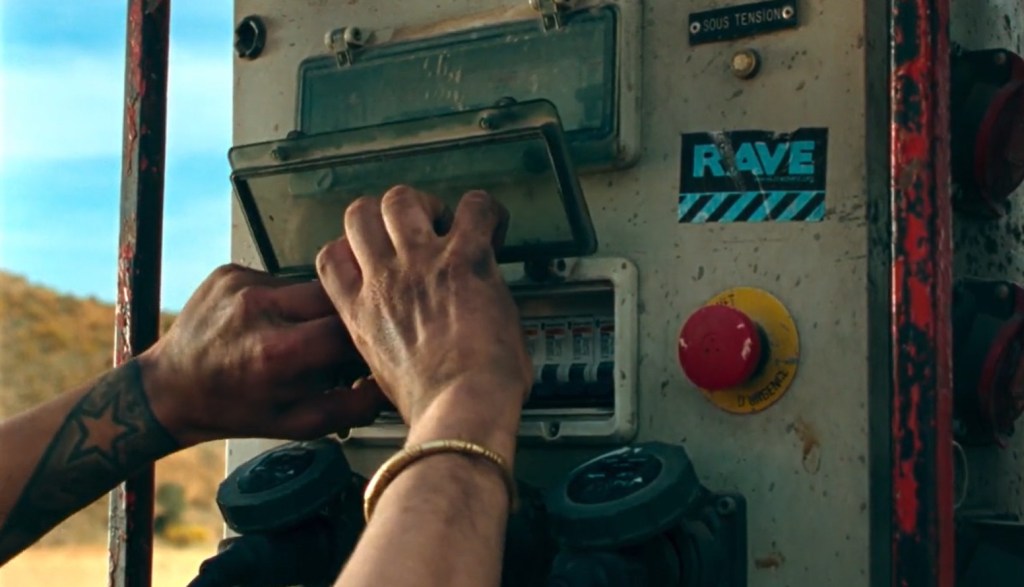
The first thing Sirât depicts for us is the assembly of a massive sound system in the Moroccan desert. It’s immediately as incongruous with the flat, sandy plains as much as the warbling techno music that begins to emanate from them is disruptive to the utter silence of the desert. Bodies soon appear – writhing, sweaty, intertwined – and the emptiness of the dune suddenly feels strangely crowded. I’ve been to a handful of music festivals that you might characterize as ‘Burning Man-lite,’ and they resemble this kind of bacchanalia pretty closely. A whole self-contained, self-sufficient little society that feels like it sprouted wholly and organically from a field or forest. But, I’m fortunate to say, none so psychically ruinous as the ordeal that Laxe is about to unleash on us all.
In the North African desert, Luis (Sergi López), his young son Esteban (Bruno Núñez Arjona), and Esteban’s dog Pipa (herself, in one of my favourite animal roles of the year) move through the crowd of undulating partiers. They distribute flyers with Luis’s daughter and Esteban’s sister Mar’s face on them. She’s been missing for several months and the pair have received a tip that she might be linked with the free party scene. Desperate and, for reasons we will soon find out, out of other options, the pair canvass the crowd without success. When Luis and Esteban show Mar’s photo to rave couple Jade (Jade Oukid) and Bigui (Richard Bellamy), they suggest that she might be headed to another party which will be taking place shortly and some distance away. The groups decide to merge and travel together just as the party they’re currently attending is broken up by the Moroccan military. It’s here that we come to understand that the world outside this desert, this specific party culture, is swiftly falling apart. We hear about statements from NATO and crowding and chaos at the borders across the world, and that Morocco has become a kind of gathering place for those caught between nationalities, or people willing to throw off their nationalities or dispense with the very idea of them. This is why Luis and Esteban are so desperate to track down Mar. As the world burns, the 4/4 beats churn father, son, and pup, along with these nomadic thrillseekers to some form of closure, or at least the next place.

Everything in Laxe’s world feels temporary, like there’s nothing to hold onto. For the folks that follow the Free Party movement and live in constant flux between “do’s,” there’s little permanence except for the companionship and support of one another. This is possibly why the small group of Bigui, Jade, and fellow travelers Josh (Joshua Liam Herderson), Steff (Stefania Gadda), and Tonin (Tonin Janvier) embrace Luis, Esteban, Pipa, and their desperate search. When even limbs (Bigui is missing a leg while Tonin is missing an arm) are fleeting, friends and family are all there is to hold you up. That also further drives the tragedy as the perilous and uncertain journey begins to claim lives, when members of the group are cruelly and suddenly dispatched. The group press on toward their destination, the beats pounding and pulsing in the background. They come together to face obstacles big and small, and scenes of the travelers trying to traverse terrain that could (and does) fall away and crumble right beneath their tires, or their feet, are filled with the kind of tension that had me averting my eyes. Later scenes of even greater tension and weight, like when Pipa ingests something she shouldn’t and the whole group rallies to help her, are filled with hope. It’s beautiful, until the very moment it isn’t.
Despite Lopez being the only established actor in the film, Sirât is filled with performances so authentic, tactile, and real-feeling that you very soon feel that you know them personally, and are summarily crushed when their characters exit the frame. It helps that the characters mostly use their own names, too. Even Pipa the dog and her stand-in Lupita earned and shared the prestigious Palme D’og this year at Cannes. Moments of tenderness punctuate the journey, giving almost every combination of the ragtag caravan a scene or two together to really establish their bonds with one another. Having this all set against World War 3 and the possible end of the world makes these bonds even stronger even as they might become more tenuous. Laxe seems to be playing with expectations even via Lopez himself, who is best known for his villain roles like Vidal in Pan’s Labyrinth (2006). He might be one of the last you’d expect to take such a tender and vulnerable role, but here on film – real film – that tenderness comes through in his every scene, especially those with Esteban.
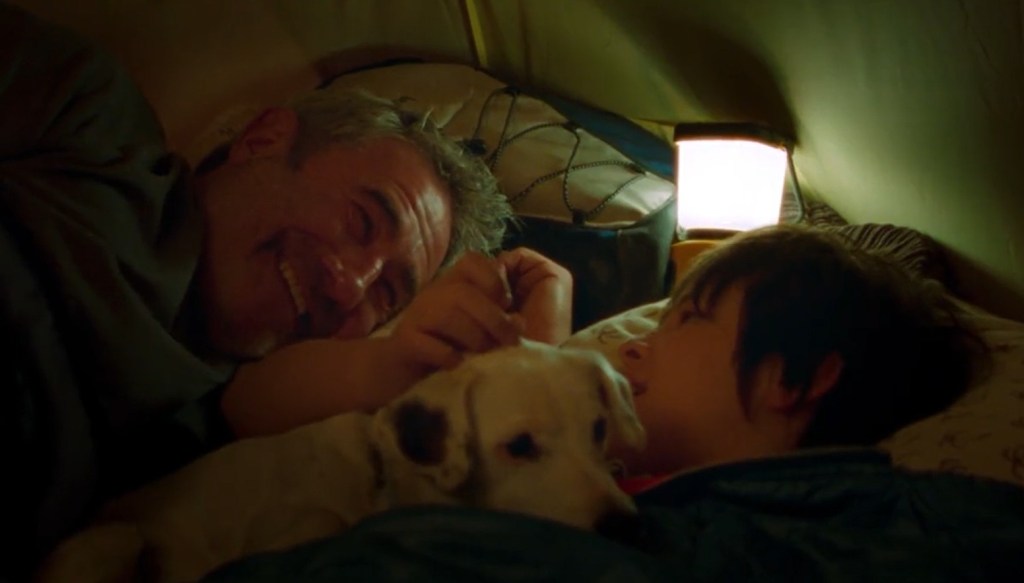
While it’s a sonic experience first and foremost to me, the visual presentation of Sirât , shot by Mauro Herce in Super 16mm, gives the film a kind of tactile quality. At times it feels like you can reach right inside and give Pipa a pet or two, both to comfort her and yourself. At other times when the Laxe takes a more antagonistic tone, both to his characters and his audience, the visuals are almost too vivid and caused me to avert my eyes from the screen at least a couple of times. The sun-soaked undulations of sand feel at once oppressive and cruelly expansive. The shots of laser lights and other rave accoutrements feel as jarring against the natural vibes of the desert sands as the tonal shifts between moments of calm and violent upheaval as the group makes their way across the country.
Even though I’ve spent more than my share of years in the rave/party scene, the techno genre of music was never my preference. Too often it was too minimal for my maximal tastes and something more suited to a ketamine trip (also not my preference) that lulls you into a kind of hypnotized fugue. Like Chappell says in ‘Femininomenon,’ “um, can you play a song with a fucking beat?!” But when set against the backdrop of the liminal desert environment, Kangding Ray’s soundtrack is exactly the kind of low-toned pulsing circulatory system that keeps Sirât moving, its menace bubbling just beneath the surface of the dust bowl. It feels like it’s both chronicling and contributing to the erosion of the ground and any sense of stability under our protagonists’ feet. Most surprisingly, it’s even given me an appreciation for the style of music. I might not, now or ever, be the kind of black-turtleneck-clad party attendee nodding almost imperceptibly in the corner of the dancefloor, but I find myself listening to the liquidly oozing beats and granular, crunched-out baselines of the Sirât soundtrack in the similarly liminal space of the subway on my commute to work.
Sirât’s closest cinematic relatives are Clouzot’s Wages of Fear (1953) and the various Mad Max films, including the recent Fury Road and Furiosa. They’re all perilous road movies that bring their viewers through a sensory ordeal while ratcheting up the tension, but none tap into the particular way that Sirât does it and certainly none have the pounding techno beats feeling like a tectonic shift underneath one’s feet (or seat). Sirât brings its travelers close together and then breaks them apart the such suddenness and regularity that it feels like one of those sand mandalas that are so beautiful and intricate before they’re brushed away into a clean slate to start over. As much as it’s story-driven via the search for Mar, Laxe has built a kind of free-form experiential nightmare of a journey that feels utterly exhausting by the end. And below it all, underneath the rumble of engines and the distant howl of the desert wind, the beat goes on.
Oliver Laxe’s ‘Sirât’ will be released in limited theatres for a week on November 14, 2025 from NEON and MUBI, with a wider release planned for January 2026. I saw it at the Toronto International Film Festival.
*or in the case of Skinamarink and similar projects, too little!
Sachin Hingoo, once again trapped in the liminal space created by a filmmaker, was left sonically ravaged by this film.
Categories: Screen




 The Cultural Gutter