This week, our Guest Star is Amy Coombe. Born and raised in California, Amy Coombe is an award-winning writer, editor and publisher. She has lived all over the United States and is now based in London. She’s an avid reader, a licensed mudlarker, an enthusiastic fossil-hunter, a fledgling birder, and a font of useless trivia. In a previous life, on the website Pornokitsch, she wrote a long-running column called Monsters & Mullets, about 80s fantasy films. Her debut novel, Stay For A Spell, is very much about books (among other things).
~~~
I’m currently in the midst of some very long and ongoing leadership training in my dayjob, and on the very first day of the training one of the coaches made a joke about the difference between saying something is unfair (an immature response! Not leadership material!) and something is unjust (an appropriate adult response to systemic issues!). I poo-pooed this a bit at the time (some things are simply unfair and it’s not inherently immature to point that out) but the general idea is a reasonable one: when someone complains about something being unfair, they’re coming from a position of powerlessness. “Fairness” is set by forces outside our control: parents, karma, sassy goblin kings. “Justice,” however, is a force over which we have power. We can only fulminate against unfairness, but we can take steps to right an injustice. The journey from unfair to unjust is a twisted maze, one littered with false starts and dead ends; it’s also, significantly, the journey undertaken in Labyrinth, from childhood to adulthood, powerlessness to power.
The problem with writing about Labyrinth is that, all told, it’s a genuinely good movie. There’s plenty to make fun of– there always is, with fantasy films. It’s very 80s; everything is so sparkly. All the rocks and makeup and shit floating around in the air. It all sparkles! There’s Bowie’s wig, a hairstyle so 80s it nearly defies description; it’s somehow both a mullet and… that thing where some of the hair is short but some bits are super long, and it’s all teased up so that it’s very big. There’s the music: the score, which occasionally features a soprano sax (that high-pitched reedy instrument Kenny G plays), and the soundtrack, which feature very 80s David Bowie songs, with lots of synth and danceable beats and liberal use of the word “baby.” Even though the movie is basically about a baby!
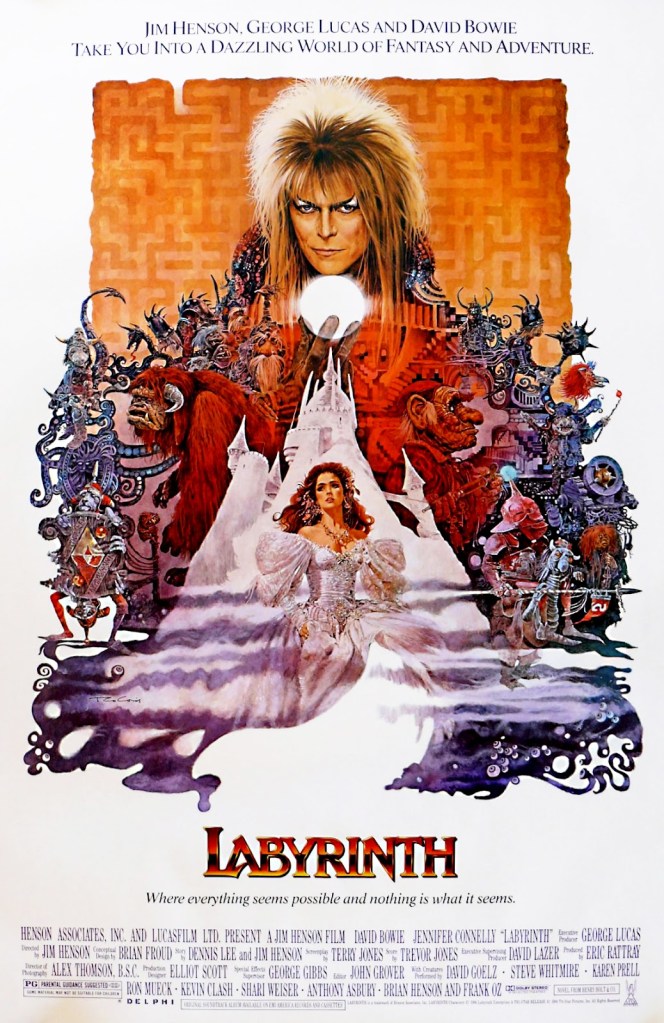
In its way, however, Labyrinth’s extremely 80s production design gives it an almost dreamlike, timeless quality now, forty years on, when many–perhaps, these days, the bulk–of its fans have no larger cultural context for it. Jareth’s hair is no less outlandish than anything you might see at ComicCon; the great cultural flattening of film and fashion over the last decade, thanks to Spotify and fast fashion, mean that the music is now no more or less 80s than it is anything else and the costumes are just kinda standard cottagecore. Labyrinth was so of its time in the 1980s it was immediately dated, but it’s so dated in so many ways that its dated qualities end up contributing to its timelessness. And its timeless message is one that retains its power today, for all of us.
Labyrinth is the story of Sarah, a younger teenaged girl who, in information that’s efficiently and gently revealed, has a dead mother, a new stepmother, and a new baby brother. Sarah longs for a time that never existed, literally. In her heart, she lives in a fantasy world populated by her childhood dreams: the fantasy novels she read, (a quick pan over her shelves reveals The Wizard of Oz, Disney’s Snow White, and many others), the personalities she imbued her toys with, and the fantasy of her mother’s life. A photo on her vanity shows the audience that Sarah’s mother was an actress in something romantic, co-starring someone who looked a lot like David Bowie. Sarah’s room, in fact, contains every single element of the labyrinth, from Esher’s stairs to the poofy, princessy gown she’ll later wear during the goblin ball. Sarah, the viewer can see, is clinging desperately to a childhood that was happy and stable, and is ferociously rejecting growing up.
But her father’s remarriage and her baby brother’s arrival has thrust some adult responsibility on Sarah, responsibility she resists and resents. When left to look after baby Toby, an angry and frustrated Sarah wishes the goblins would take him away. Fortunately for her, they’re listening and they do take him. Sarah, to her credit, regrets her act instantly and, happily, David Bowie as the Goblin King Jareth appears to give her the quest to rescue her brother: get to the goblin city at the centre of an impassible labyrinth before the clock strikes 13.
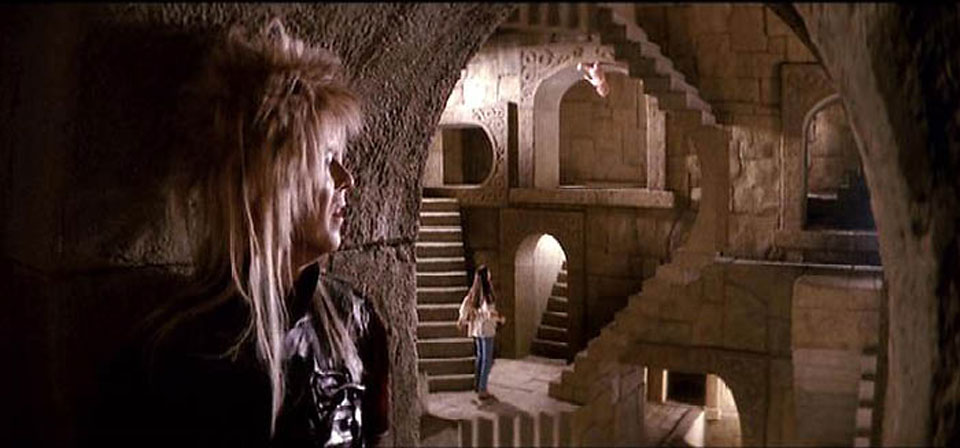
Sarah runs head first into the labyrinth and learns a lot of valuable lessons very, very quickly: ask the right questions, think through the answers, don’t act on impulse. Appearances can be deceiving. Sometimes things are unfair; that’s life. Kindness is its own reward. Friendship means trusting others, and being willing to be trusted in turn. Courage can come in small packages. Fancy parties look fun but can be incredibly anxiety-inducing. Handsome men who ask that you relinquish your own identity are not to be trusted, because what they’re offering isn’t love; it’s a trap. Even if those handsome men look like David Bowie.
There are hundreds of age-old fairytale tropes littered throughout this film, but perhaps the most meaningful is the emphasis the film places on the immense power of the spoken word. The film opens with Sarah acting out the climax of her favourite novel, The Labyrinth, in a local park. Significantly, she forgets the final line – and makes it clear she always forgets the line. This, of course, is because she has no lived context for the words; she’s just acting, and doesn’t yet understand why what she’s saying matters. When Sarah fumbles her way through her wish that the goblins will take her brother, they implore her to speak the “right words”. At the film’s climax, Sarah finally fully inhabits her own power over her destiny – and adulthood – by speaking the right words to Jareth, the same words she couldn’t recall at the beginning of the movie because they didn’t yet mean anything to her. By the time she’s facing Jared down, she’s grown far beyond who she was when she entered the labyrinth, and can remember the words – thus granting them power – because she finally understands their value… and her own.
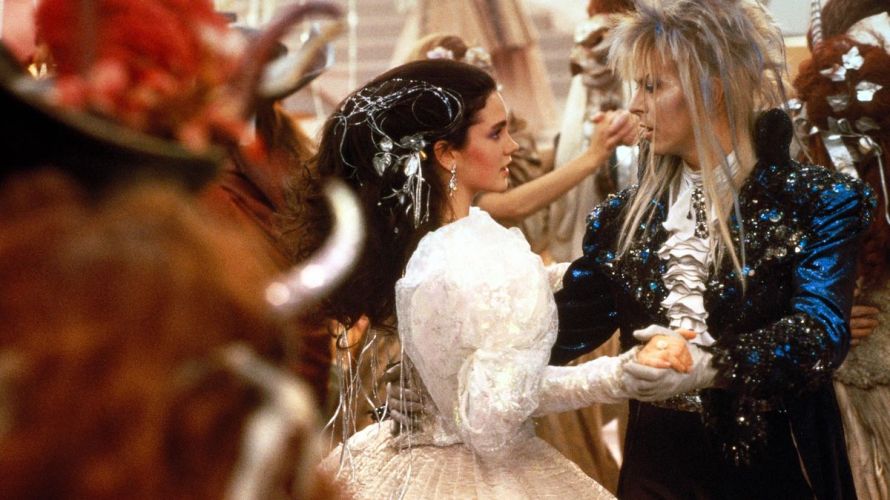
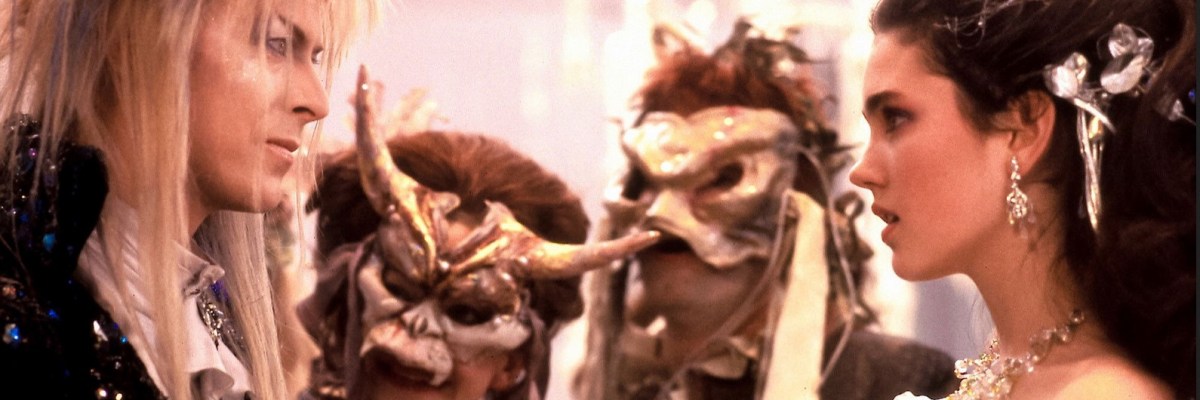
The right words, of course, are “you have no power over me.” It’s one of two phrases with exceptional thematic significance in the film, the other being “it’s not fair.” Over the course of the film, Sarah stops complaining about things being unfair as she steps into her power. She transforms from someone waiting for someone else to solve her problems to someone taking steps to solve her own problems, which culminates in her showdown with Jareth, the labyrinth literally suspended, in pieces, in the air around them. In this liminal space, he offers her everything she’s ever thought she wanted… as long as she cedes total control over her future to him: “fear me, love me, do as I say and I will be your slave.” There’s a romantic element to his plea, but a hideously infantilising one: he’s asking her to remain helpless, powerless, childlike, forever. Wanting things, and taking steps to get them–and occasionally being disappointed when those steps don’t work and they can’t be gotten–is a crucial element of adulthood. By acceding to Jareth’s demands, Sarah would allow herself to be trapped in her childhood fantasy, and thus her adolescence, forever.
Jennifer Connelly was only 14 when she filmed Labyrinth, so it’s truly impressive to see comprehension dawn across her face as her character realises the importance of that line she could previously never remember, and as she finally speaks her truth to Jareth: he has no power over her. His offer is a mirage, a bubble, a fantasy–a truth she now sees clearly. She can make her own choice about her future, and she decides to make that choice. That choice, to leave behind a comfortable fantasy and accept adult responsibility and adult power, is the final step in her journey, allowing to complete her quest and rescue her brother. Jareth, his pleading expression collapsing into disappointment, turns into an owl and flies away. (Typical.) The deconstructed image of the labyrinth dissolves around Sarah and she wakes in her own home, her brother asleep in his crib.
All this alone would have made Labyrinth a great movie about growing up, but it goes one step further, one that very few films about growing up permit themselves to do: back in her room, Sarah begins to put her toys away, then sees her goblin friends in the mirror behind her, saying goodbye. They reassure her that if she ever needs them, they’ll always be there for her. She tells them that of course she alwaysneeds them. Cue goblin party!
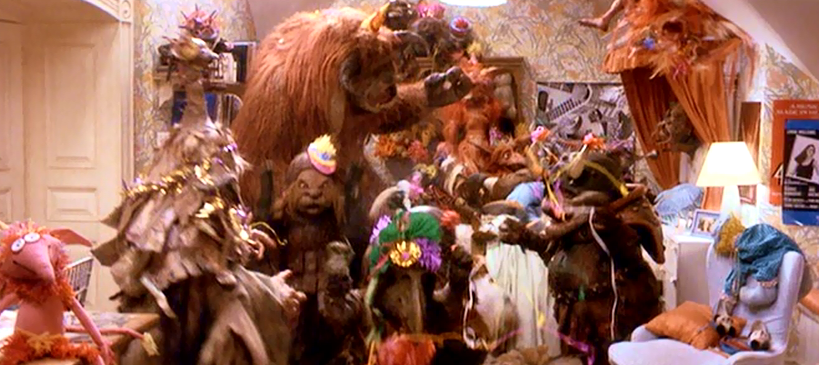
We can’t live in our childhood fantasies for our whole lives; we cede responsibility–and the power that adult responsibility grants us over our own future–if we do. And, Labyrinth warns us, if we carry the entire weight of our childhood around with us it bogs us down forever; it’s just stuff, and it can hold us back. But the idea of and the memory of what we loved as children gives us context, confidence and power as adults, from our friendships to our first crushes to the books we read and the toys we cherished.
Whatever shape our fantasies may take, Labyrinth tells us, they guide us out of childhood, and provide a roadmap through adulthood. But adulthood doesn’t mean giving them up entirely. They can still ground us, entertain us, and comfort us. Forty years on, at a time when the world feels both hideously unfair and unjust, Labyrinth serves as a reminder: our power lives inside us. We don’t have to cede any of it. We just have to take that first step into the maze, and remember the right words to speak when the time comes.
~~~
Born and raised in California, Amy Coombe is an award-winning writer, editor and publisher. She has lived all over the United States and is now based in London. She’s an avid reader, a licensed mudlarker, an enthusiastic fossil-hunter, a fledgling birder, and a font of useless trivia. In a previous life, on the website Pornokitsch, she wrote a long-running column called Monsters & Mullets, about 80s fantasy films. Her debut novel, Stay For A Spell, is very much about books (among other things).
Categories: Guest Star, Screen