
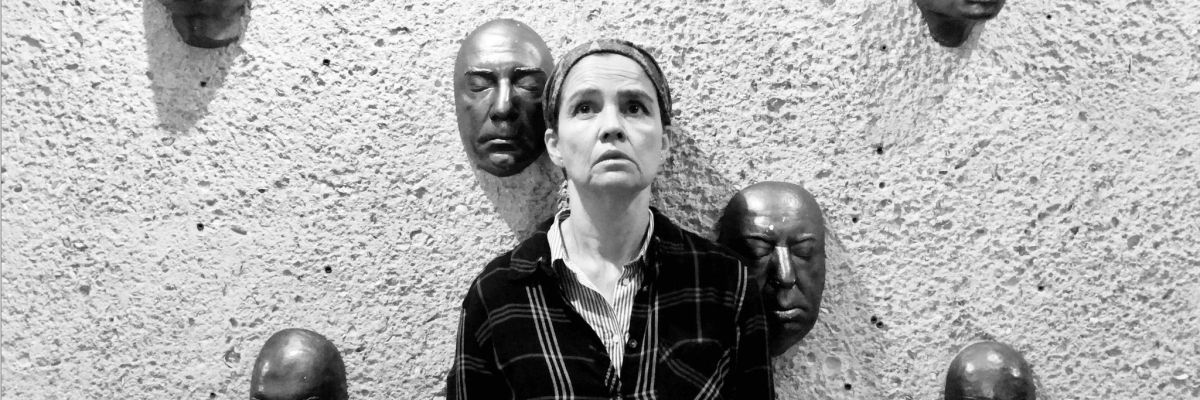
Director Damian Lahey’s contemplative film Simple Like Silver (2021) couldn’t come at a better time. At its core, it is about how people’s lives intersect, directly or indirectly. Even if someone never meets face-to-face, they are connected by universal truths and emotions like fear, sadness, hope, and exhilaration. The narrative follows the trajectory of three characters: Angela (Susanna Nelson), a woman who has to deal with the fallout after being drugged on a date; Lucia (Christina Marsillach), a middle-aged woman on vacation after being diagnosed with a chronic terminal illness; and Joe (Hudson Sims), a young boy who is an aspiring writer. Through twists of fate, these characters cross paths and inspire each other.
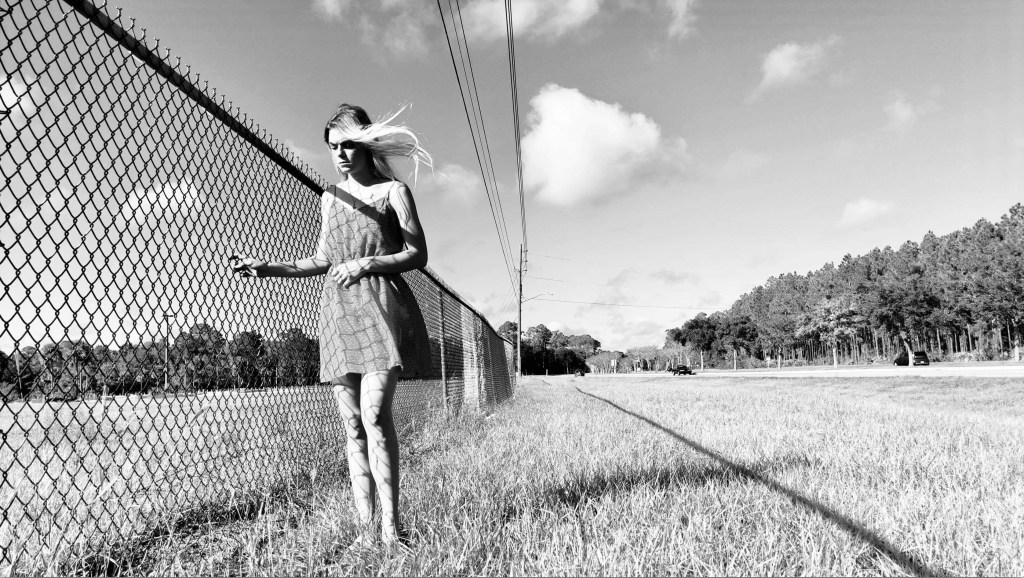
Angela opens the film, waking up disoriented in a field and struggling to piece together the events of the previous evening. As the memories drift in, she realizes that she was drugged by her date, a man she met online, and possibly assaulted. Feelings of shame and fear start to overwhelm her, and without a car, she makes the long trek back to her home. She is young, wearing a dress and broken-down flats, and woefully unprepared for a long journey. As she walks, she follows the train tracks, symbolizing how she has been trapped in one trajectory in her life. Women are often reluctant to come forward after they have been sexually assaulted because they are afraid of repercussions. Victim blaming is common, and sometimes, the initial reaction they get is disbelief. Angela spends much of her long walk home beating herself up for her choices instead of being angry at the man who hurt her, a testament to the way society has brainwashed women into trying to console others and not themselves.
Lucia has come to St. Augustine to relax and take her mind off of her recent brain tumor diagnosis; her doctor has given her twelve months to live. As it is a degenerative condition, she only has a few months left with her full faculties and the capacity to travel, so she has made the trek to live the last part of her life exploring the world. Lucia has no partner and no children; thus, she is alone with her grief but also free from expectations from others. Lucia muses that she is “filling the spaces between seconds with calm,” a theme woven into the film’s tapestry. All the dialogue in this film is internal monologue delivered via voiceovers, offering a unique and personal look at the characters’ inner thoughts. It gives the narrative a prose-like structure that is reminiscent of a novel.
Angela and Lucia are women in stasis, apprehensive about things they cannot control. Angela is worried about telling her parents what happened to her and how she will be perceived afterward, while Lucia is grappling with her pending death. They are both lost in a sense, wandering around and looking for guidance. They could be seen as two sides of the same coin, juxtaposing youth, maturity, and suffering. Luckily, Lucia at least seems to have found a light at the end of the tunnel, even if temporarily.
When women approach middle age and beyond, there is a phenomenon called Invisible Woman Syndrome, in which women are overlooked in social situations, the workplace, and broader society. As our looks fade, so does our relevance (through no fault of our own), and it is as if we disappear. Through the camera’s eye, Lucia is seen and acknowledged as she enjoys her vacation; initially apprehensive, she eventually lets her guard down and takes in the surroundings. There are several extended, dialogue-free sequences in which the camera follows her around, documentary-style, as she takes in the sights and sounds of St. Augustine.
In a literal sense, Christina Marsillach, the actress who plays Lucia, was an “invisible woman” for twenty-five years. She is best known for her role in Dario Argento’s 1987 film Opera, and she left acting altogether in 1994. Marsillach was impossible to contact during these years, though many tried and failed. In 2018, Lahey cast Marsillach in Simple Like Silver. In a 2021 interview with the website Money Into Light, Marsillach explained why she took such a lengthy break from acting: “Well, I was doing other things. I got married, and I gave a lot of importance to my sentimental life. I dedicated my life to other things related to art, but not as an actress, such as fashion and antiques. I needed a break. I think an actor needs to recharge between projects, if they can afford to financially. I’m not the same person through a whole year, and I need to fill my life with many different things.”
In the film, Lucia laments that she wasted her middle age being scared to do what she wanted, and it is refreshing to see that Marsillach spent her life doing what made her happy. The combination of this meta-context and Lucia’s impending death from her illness combines to form a profound sense of melancholy. Still, the sadness is tempered by beautiful time-lapse photography of nature and the lush, lively environment. Ordinary people are living their lives in the background, bustling to and fro, while Lucia is absorbing all the life that she can while she still has time left. Interspersed with Lucia’s jaunts into town are small vignettes where she explores her dreams and what they mean to her. Some of them are filled with regrets about opportunities not being taken or guilt about having aspirations to go out on her own. Being painfully aware of one’s mortality crystallizes these emotions and lays them bare for the world to see.
Just under the narrative’s surface are glimmers of darker prospects and sinister connotations. Lucia sees Angela get her throat slit, the blood splattering on the wall in front of her. Or did she have a vision, a hallucination brought on by her brain tumor? The mystery is never fully revealed, and it hovers at the edges of the film’s second half. Rather than informing the film’s overall tone, it echoes the genre of films that defined Marsillach’s career. The universe is full of light and dark, and those closer to death may be more privy to its ebb and flow. The gore is sparse; a quick slash is all that is seen, a blink-and-you-miss-it kind of moment.
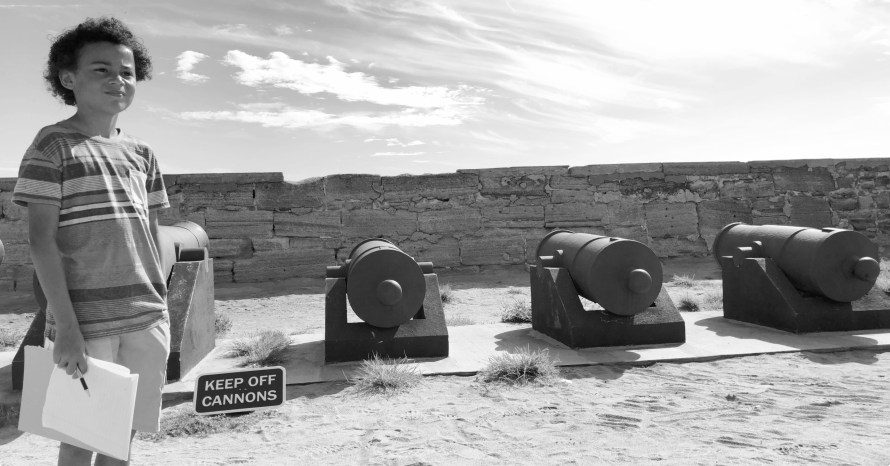
Joe, the precocious child writer, injects much-needed levity into the film with his childlike enthusiasm about life. As he walks around, pen and paper in hand, looking for inspiration, the audience is treated to his cheery thought process and boundless knowledge of quotations from authors. He eventually runs into Lucia, and they spend some quiet time together as he takes her mind off the troubling visions she has been enduring. Joe symbolizes the artist’s drive, fully embracing the creative spark and not yet beaten down by life. His character feels like a cool, cinematic breeze that rushes in after a door opens, refreshing the audience and bringing a sense of positivity.
Each character represents a different stage of life. Joe is childhood, full of optimism and energy. Angela is in young adulthood, when one becomes aware of life’s darker aspects, and Lucia is at the end of life, solemn and contemplative. Usually, these states of being cannot cohabitate in one person, but in this film, they cross over, synergizing to show the different perspectives simultaneously. While this sounds quite serious on paper, in execution, it is acutely aware of how self-serious this type of archetypal symbolism can come across. Lahey interjects the script with jabs at arthouse films and the tropes and cliches they tend to have. The mood is still sincere, but it feels more human and empathetic with these little touches of humor and introspection.
Although Simple Like Silver was shot between 2018 and 2019 and predated COVID, it was finally released in 2021, at the height of the pandemic. Film festivals were on hiatus, and most movie theaters were closed. I saw it initially streamed at home, and it made me feel sad and nostalgic for a time when one could go on a vacation and not be afraid of catching a deadly disease. At the time, it felt like things would never go back to “normal,” and watching Lucia enjoy her carefree vacation among groups of people felt like a balm to my soul.
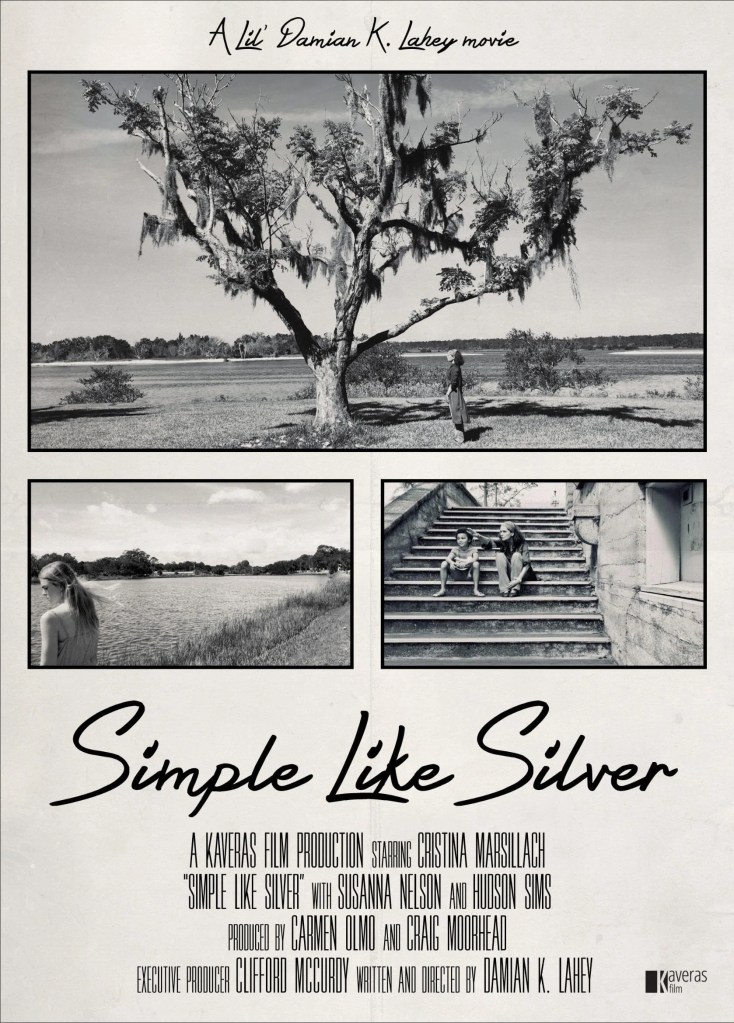
The cinematography is gorgeous, with black-and-white grading that highlights the scenery with striking contrast. Lahey shot the film on location in St. Augustine, Florida, with an iPhone X, giving him greater freedom to shoot on the go. Simple Like Silver joins the ranks of several other fantastic movies shot on an iPhone: Tangerine (2015), Unsane (2018), and Beyond the Infinite Two Minutes (2020). The iPhone gives the movie a handheld look, like Lucia has a friend with her recording her vacation, a much more intimate and almost voyeuristic point-of-view.
In an interview with We Are Cult, Lahey recounts his experience: “After some research, I decided to shoot the film with an iPhone X due to the ability to run and gun, and the autofocus is to die for, so that really sealed the deal. I went and bought one and downloaded Filmic Pro with the cinematographer kit and began doing tests with Craig to find the right look we wanted. We wanted the film in B&W and with a slight metallic feel to it. We found when the shutter speed shot through the roof we hit upon a sweet spot that really clinched the feel of the film for us – which was usually soon before the camera would overheat and shut down – a kind of hyper-real just slightly out of step and out of time look. Was this the perfect tool for this job? Yes, it was, given the production parameters we were working with. We shot some beautiful stuff with it.”
Composer David Wingo’s (Barry, Midnight Special, Take Shelter) evocative score wraps around the visuals like a gauze sheet, enveloping them in dynamic guitar work yet never overpowering the characters and allowing their stories to shine through. A few sequences are montages set to music with no voiceover, and Wingo’s score, combined with Marsillach’s expressive physical acting, is a match made in heaven, telling an entire story with no words.
Simple Like Silver is a poetic ode to living and moving forward despite strife and setbacks. If one stops to look around, one will find elegance, grace, and perhaps even peace of mind. On another level, it’s Lahey’s ode to art appreciation and simplicity, a writer’s film and a film about writing that inspires us not to give up on our dreams.
~~~
Michelle Kisner is a film critic, freelance writer, and advocate for physical media.
Categories: Uncategorized




88% AI written
LikeLike
This is actually an essay I wrote in back in 2023 that was featured in the extras (booklet) of the Severin Films Blu-ray release that same year. No AI was used. I don’t use it now either, I hate it, in fact.
LikeLike