

Christian Tafdrup’s Speak No Evil (2022), also called Gæsterne (The Guests) in Danish, easily places among the most disturbing horror movies I’ve ever seen, and not for the usual reasons. There’s no body horror, no stalking, no over-the-top violence. There’s hardly any violence at all for that matter, at least until the devastating final act. There’s not even a definite threat. Quite a lot of the film is spent marinating in uncomfortable silences, swallowed arguments, and social awkwardness, like the UK version of The Office. And yet dark thoughts of Ricky Gervais do not periodically sit on my chest grinning down at me while I’m trying to sleep.* Speak No Evil does.
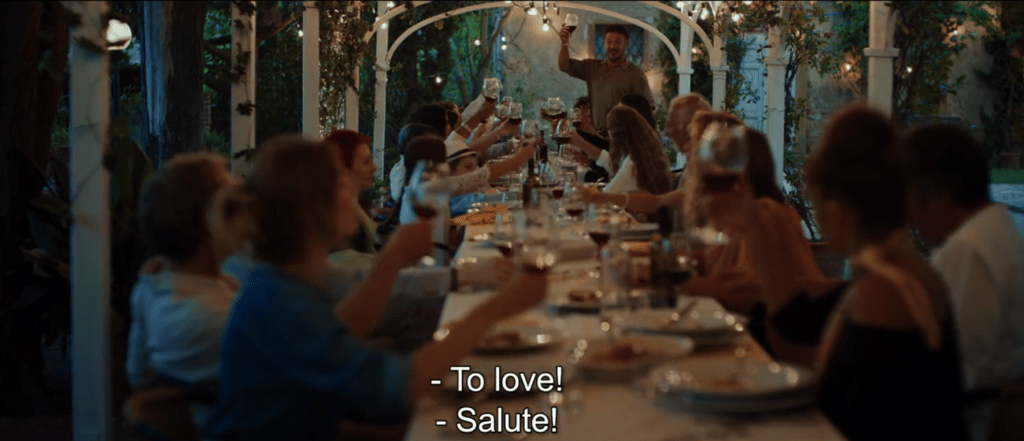
The story begins with a Danish family, Bjørn (Morten Burian), Louise (Sidsel Siem Koch), and their young daughter Agnes (Liva Forsberg), vacationing in Tuscany. Everything is a golden-lit Olive Garden commercial, sunshine and poolside and wine, a fine time for all, as they enjoy their resort alongside fellow tourists. Among these tourists, they strike up a rapport with a Dutch family–Patrick (Fedja van Huêt), Karin (Karina Smulders), and their son Abel (Marius Damslev). Patrick is particularly charismatic, and this works like a charm on Bjørn, a pleasant enough sort who nevertheless seems absently dissatisfied with all the good things around him. Meanwhile, Patrick’s attention and approval make him light up like a schoolboy.
There is something off though. When Patrick compliments Bjørn on retrieving his daughter’s lost rabbit toy, he’s so effusive about it that it almost seems like he’s winding Bjørn up, but he’s also…sincere? The same when Louise’s vegetarianism comes up. Patrick fawns over her conscientiousness. It’s weird. Even so, strait-laced Bjørn and Louise could never be as comfortable in their own skin as Patrick and Karin are, and you can see them reflect on that. And so when Patrick and Karin invite their new Danish besties to stay with them in Holland for a while, the new Danish besties are noncommittal, probably like you or I would be. Louise points out that they barely know them. But they don’t say no.
Back home, Bjørn and Louise tell friends about the invitation and end up talking themselves into it. It’s only an 8-hour drive, they think. From the jump, it’s challenging. They are a long way from home, the trip wasn’t as easy or as quick as they’d imagined, and they’re not comfortable. Patrick and Karin’s house would do for a catalog spread, but there’s not a lot of room for two families. Not only is the guest bed a tiny twin, they have–entirely seriously–prepared a space on the floor of their son’s bedroom as a bed for Agnes. Abel has so been looking forward to it, they say. Then Patrick offers vegetarian Louise a taste of a roast he has prepared for dinner; nonplussed, she takes a small bite. Later, Louise reminds him of her preferred diet, and Patrick apologizes. But he also disputes whether she can call herself a vegetarian when she still eats fish. It’s weird and aggressive and pettish. Is this really the same guy who praised her for being a vegetarian when they met?

It goes like this for a bit, Patrick and Karin pushing Bjørn and Louise and Agnes around with what really seem like deliberate microaggressions, but always, always, always with a veneer of plausible deniability. After all, what reason would they have to offend their guests or make them uncomfortable? And the guests do not want to offend their hosts with their own offense either. They’re aware of their responsibility to be flexible about cultural differences.
That said, Louise is more and more skeptical of Patrick and Karin, as well as more sensitive to what might be simple misunderstandings but could also be pure passive aggression, especially toward her child; Bjørn, wreathed in the ancient trope of men not listening to women in horror movies, falls back on more charitable assumptions. He also seems to idealize Patrick, and to some extent Karin, in a way that Louise doesn’t. But Patrick’s stern treatment of Abel does discomfit him. Not enough to leave, but enough to notice. And Abel appears in front of Bjørn on the first night, seeming to want something, opening his mouth wide. Of course Abel can’t be well understood, as the child has congenital aglossia–an undeveloped tongue.

All this conflict and adrenalin seems to loosen something in the routine collegiality that is Bjørn and Louise’s marriage though, and after a stressful night out–where Patrick ends up sticking his guests with the bill and drives home drunk–they end up having sex. Creepily, Patrick watches them briefly through the window. When Agnes wakes up and cries to be let into their room, they don’t want to stop. Later, Louise discovers that Patrick brought Agnes into their bedroom. And he was naked.
So. Um, cultural differences?! But Bjørn finally agrees with Louise that it’s time to leave, and they do. And they do it smart–under cover of darkness, not saying goodbye, just getting out like the audience has been telling them to for fully a half hour. Except Agnes doesn’t have her rabbit toy, and they are forced to go back to retrieve it. But at least at this point it is masks off, right? At least now Bjørn knows Patrick is not to be trusted, right?
It’s hard to talk about what happens next without spoiling or being frustratingly vague, and I want to, because this is key to what makes this film so remarkable, so disturbing. I generally scoff at spoilers, but in this movie, the tension of not knowing gives the ending so much of its power, and I do think that’s worth experiencing for yourself. But now Imma spoil some, so be warned.
Of course, Patrick and Karin are and have always been deliberately provoking their Danish friends. They are sociopaths and serial killers and child abductors, and before it’s over, Bjørn will have discovered evidence for himself, evidence that raises so many questions about how the couple could possibly have existed in this way, much less why. And it’s not just them! They have accomplices! And when it dawned on me the extent to which they have been telegraphing their intentions throughout the entire movie, it made me almost physically ill. The script is meticulously composed.
To back up a bit, after Bjørn and the fam returns for that damn rabbit doll, they have it all out with Patrick and Karin. Really Louise has it all out, as Bjørn is still inhibited. For their trouble, they get convincing apologies and explanations, including a reminder that the entire reason Agnes was in their bed at all was because they were missing. Guilt and gaslighting, gaslighting and guilt. It’s a strong enough cocktail to get them to stay. Bjørn and Patrick go out to buy groceries together and they end up bonding, with Bjørn relating how repressed he feels, and if this were a different movie, that might be an important turning point. Here, it is an epitaph. Patrick takes Bjørn to a deserted beach and encourages him to scream. And he does. They both do. Scream and scream and scream. And no one hears and no one comes. Patrick has given him a safe place for Bjørn to get all of his pent-up frustration out, and they leave closer than when they arrived, Bjørn’s relief palpable.

I can only imagine how it would have broken Bjørn to realize at the end that this is the same place Patrick has brought him to murder him and his wife. That Patrick knew you could scream on that beach because it’s not the first time he’s made someone scream on that beach. Even the method that Patrick and Louise use–stoning–is brutal while being cruel and oddly playful. It is, of course, also an execution method heavily associated with exile and rejection from a community.
That isn’t the worst thing in the film though. I mean, it’s pretty bad. But I think what hits the hardest and is most unique lies in its original title. So much of the movie is about how easily Bjørn and Louise (but also really just Bjørn) make themselves vulnerable for the sake of politeness. The supreme horror of their plight isn’t the plight itself then but how easily Bjørn and Louise just lambs-to-slaughter give up. Of course, the concern by the end isn’t politesse but their inability to put up a meaningful resistance at this point is practically routine. Especially where their daughter is involved. I think most parents watching the ending scenes are convinced they would not be so easily subdued, and if such a nightmare ever occurred, I’d hope they’d be right. Preventing and revenging such things is Liam Neeson’s whole career. In fact, Tafdrup goes so far to give Bjørn an action hero opening even at the last, when Patrick knows he knows, the game is up, they are going to die, and worse things will come for his daughter, too. He has a clear chance. And he doesn’t take it.
These final scenes brilliantly reveal the implicit threat humming within the entire piece, even as they convict Bjørn of a kind of weakness that is more troubling than Patrick and Karin’s gleeful sociopathy. Psycho killers are easy to understand. A man who can’t switch into Liam Neeson mode when his wife and daughter are on the line is too, but it’s not something anyone wants to understand, especially in a character we’ve been invited to identify with all movie long. That is such a brilliant and painful dilemma to sit with. When Bjørn finally asks Patrick why they’re doing it, Patrick simply replies, “Because you let me.” That line is a gut punch, but it also swivels focus right back to Bjørn, to his unvoiced needs, his social anxiety, his ambient dissatisfaction that made him perfect prey for someone like Patrick. Speak No Evil is an all right title, but I prefer the original because it underlines how everything turns around the guests, not their insidious hosts. The horror of something terrible happening to you and your loved ones is one thing, but it pales against the horror of simply letting it happen.

* Sorry for the image
~~~
Angela does seriously have so many questions about how Patrick and Karin could get away with this though.
Categories: Horror




 The Cultural Gutter