

Imagine a woman raised by wolves, a martial artist with white hair caused by ancient herbology rather than age. She is called a demoness or a witch by the righteous, though she punishes the cruel and the wicked ruthlessly. She rides the wind, white hair streaming in all directions and she can tear a man apart with her whip like you or I might pull apart soft bread. She first appeared in Leung Yu-Sang’s (Mandarin: Liang Yusheng) 1958 novel, Story Of The White Haired Demoness / Baifu Monü Zhuan. Leung was a newspaperman turned wuxia writer, which is a very cool thing someone could be in Mid-Twentieth Century Hong Kong. Leung wrote something like 35 novels and they have been adapted for film and television myriad times. Baifa Monü Zhuan was serialized in Hong Kong’s Sun Wun Pao newspaper and was the first of his ten novel Tianshan series.
I believe I first encountered the white-haired demoness’ story in Ronnie Yu’s dreamy, phantasmagoric, romantic masterpiece, The Bride With White Hair (Hong Kong, 1993), starring the beautiful Brigitte Lin as the white-haired bride, Lien Ni-Chang and the equally beautiful Leslie Cheung as the righteous Wu Tang swordsman, Cho Yi-Hang, who has been tasked with uniting the fractious orthodox schools of the Martial World. In The Bride With White Hair, we first encounter Ni-Chang fully grown and working for the evil Supreme Cult, run by conjoined twin martial arts masters who go by one name, Chi Wu-Shang (Frances Ng and Elaine Lui). Ni-Chang begins to imagine a different life, something more than being a weapon, after an encounter with Yi-Hang. In response, the twins send Ni-Chang to kill Yi-Hang. We see the story in retrospect, as Yi-Hang waits on a mountain top for a flower to bloom that can cure any illness. It only blooms once every 20 years, but Yi-Hang waits so he can save Ni-Chang’s life after a tragic conflagration of conflicting desires and loyalties.

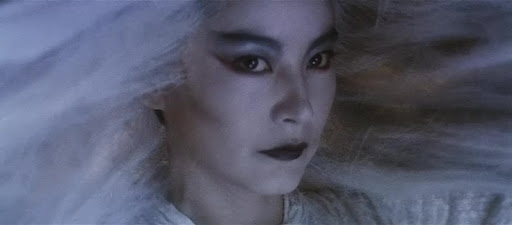
I can’t be positive it was the first time I encountered Ni-Chang because before there was The Bride With White Hair, there was Pearl Cheung Ling’s Wolf Devil Woman / Wolfen Ninja (Taiwan, 1982).* And it’s possible that I actually saw Wolf Devil Woman first on television. While Yu’s film was screened in both art houses and Chinese theaters—as well as on VHS and gray market VCDs–Wolf Devil Woman was exactly the kind of, sigh, “chopsocky” fantasy martial arts movies that were dubbed, cropped, chopped to hell and shown on late night tv. I could have seen the movie in such a distorted format that I wouldn’t recognize the story at all. Even now, the prints available in English are dubbed, formatted for old television aspect ratios and vary between 79 and 90 minutes in length. The 90 minute copy I used to rewatch the film is available on Tubi and it is dubbed and clearly a transfer from an old VHS tape, tracking weirdness and all. It even looks like it might have been a copy someone made from their television. It is certainly formatted for 1980s and 1990s television.
Born in Taiwan, Pearl Cheung Ling, aka, Pearl Chang Ling started out as an actor in 1970s Hong Kong and Taiwanese films. She played a lot of vagabond martial artists and swordswomen. These days she mostly produces. In fact, if Mubi is correct, Cheung was a producer on George Hickenlooper’s indie drama, Dogtown (USA, 1997). Cheung is a good actor and martial artist, but she was always eccentric even for 1970s and 1980s martial arts films. Her most famous role for Hong Kong film aficionados, is probably Emily, Jackie Chan’s partner-in-crime in Fantasy Mission Force (Hong Kong, 1983), also starring Brigitte Lin. In the 1980s, Cheung also began writing screenplays, producing, and directing. She directed and starred in a handful of movies that exist beyond pedestrian concerns of “good” or “’bad,” including Wolf Devil Woman (1982), as well as, Matching Escort / Fury of the Silver Fox (Taiwan, 1982), the more swashbuckling, Dark Lady Of Kung Fu / A Romantic Knight (Taiwan, 1983), and, Mad Flower & Angry Sword (1985).
Taiwanese wuxia is colorful and exuberant—full of wonders, chi blasts, and generally underfunded compared to the spectacles of the Shaw Brothers or current VFX heavy Chinese studios. Cheung’s Wolf Devil Woman is well within this tradition. It’s colorful, scrappy and delightfully committed to Cheung’s vision. The movie begins with optical effect lighting scratching across the screen and a sinister golden idol that appropriately resembles a partially melted Oscar. A man bound to a cross is tortured by the Demon, in all his sparkly glory. He has a rainbow-striped cape with a gold foil lining. He has bluish metal claws made from cones over his fingers. He has a long gold and black veil and a gold pointed wizard / KKK cap with a red skull and crossbones pasted on it. His lair is positively filmi.
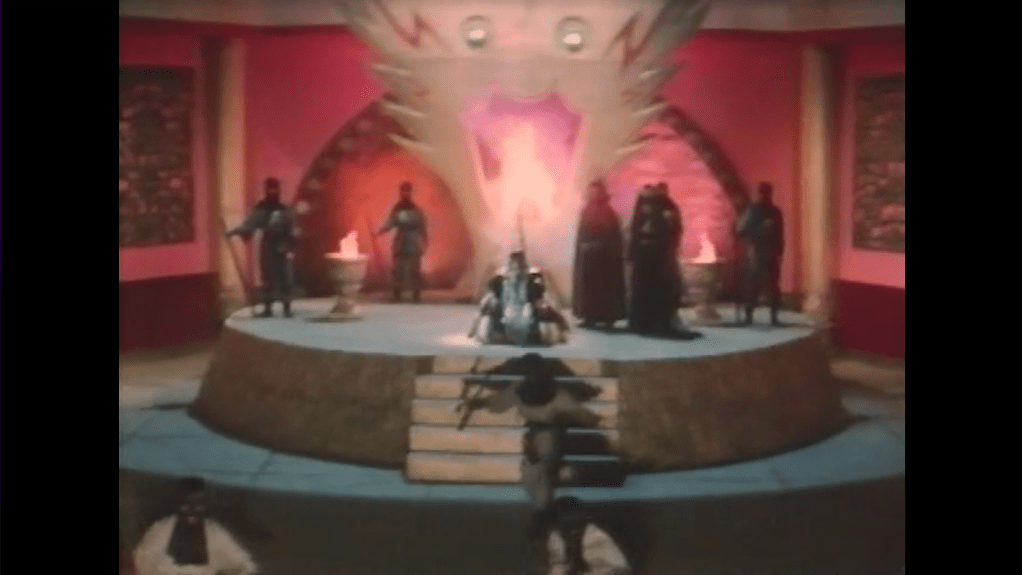
His chief henchmen wear latex Halloween monster masks commonly available at drug stores. And his cultists wear red satin ninja outfits. He has command over hopping vampires. And mark his words, they will rule the Martial World. To do so, the Demon sprays mind control gas from a tube concealed in his sleeve. He stabs black wax dolls with golden needles and dips them in a giant beaker full of bubbling pink liquid. He sets the righteous on fire with delightful animated flame. And he steals souls and traps martial arts masters who defy him as living statues in a gallery of fallen heroes circling his dais.
Confronted with this absolute villainy, a couple** flees his lair in horror and runs down a snowy mountainside, clutching their infant daughter. Realizing they cannot escape his shiny red minions, they deliberately start an avalanche, hoping their child will somehow survive. The cult searches the snow for them, but are driven away by wolves played by German Shepherds because Cheung is adapting epic wuxia fantasy with what she has. One of the wolves digs the baby out of the snow, feeds her raw meat, and raises it as her own pup in the wolves’ ice cave with cool ice bridge.
The child’s wolf mother, the White Wolf, is quite caring and when the girl becomes sick, treats her with the rare white ginseng. Ever after, when the wolf woman becomes angry or upset, she thrashes and her turns hair white. Unlike Bruce Banner, her secret is not that she is always angry. Her secret is the white ginseng and she only fully reveals the white ginseng’s power and becomes consistently white-haired at the film’s climax. Cheung commits to the role. She growls, howls, whines, digs and hunts like a dog. I mean, wolf. She wears a German Shepherd stuffy on her head to signal her membership in the pack.
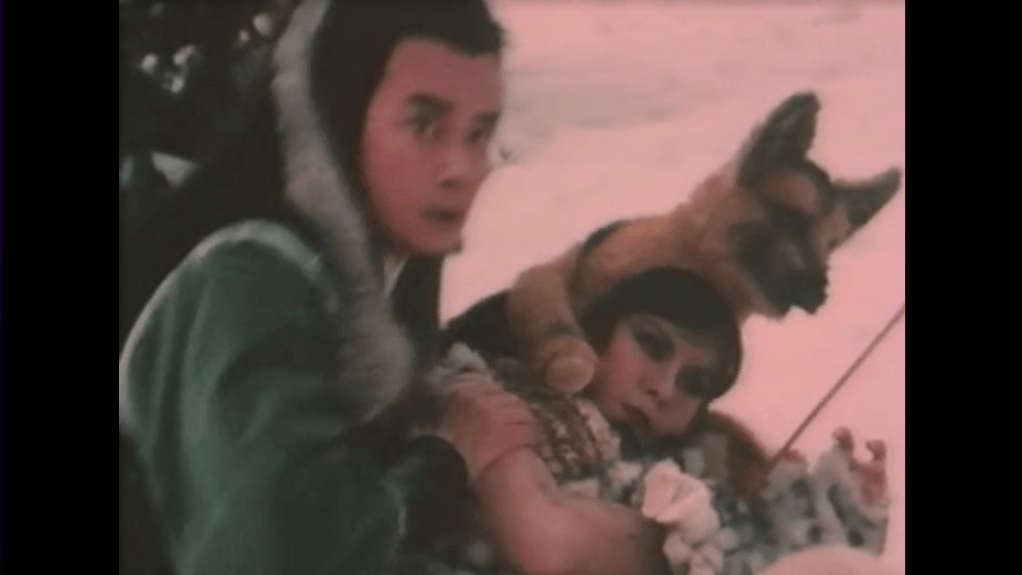
Eventually, traveling swordsman Lee (Sek Fung), and his comic relief servant Wong (Pa Gwoh) pass by. The swordsman’s master (Sek Ying) has sent him in search of the white ginseng in order to combat the Demon. This leads to the wolf woman being orphaned once more as Lee, thinking he’s protecting her and Wong, kills the White Wolf. Tragically, the wolf was protecting her human child. But Lee tries to make up for it by going all Pygmalion and giving her a name, Snow Blossom, teaching her to speak, and straightening out her spine-in a montage cutting between grabbing her and a metal model of a human spine. The movie begins to pick up after Lee and Wong admit that the White Wolf is actually dead after spending days or possibly a week telling Snow Blossom that her mom is out getting them something to eat. They leave to tell Lee’s sifu that the white ginseng has been consumed by a wolf woman. Snow Blossom mourns before the resting place of her dead wolf mother, depicted by a muzzle protruding from a wall in the ice cave.

After howling her grief out, Snow Blossom sets out to explore the human world, encountering Wong, Lee and the Demon once more. And in a Martial World divided into Orthodox (Shaolin, Wu Tang, Tianshan, etc.) and Unorthodox Sects (evil cults, ethnic and religious minorities, eccentric weirdos), Snow Blossom is firmly Unorthodox. Her demonstrated willingness to bite a swordsman, her rope with taloned ends, and her rad outfits bear this out. These include: her fun fur-clad wolf days; her transitional leather outfit for swinging from tree to tree as she travels; her quasi Bedouin outfit as she traverses a desert—foreshadowing, perhaps, the Pan-Asian design trend in many 1990s Hong Kong movies including costuming and make-up elements in The Bride With White Hair. Her amazing white and blue vengeance outfit as she goes to rescue the swordsman, is flawless on any budget.

Unfortunately, it’s not all amazing outfits and intense wolf woman method acting. There is real violence against real rabbits and chickens in the 90 minute version. I can’t say for sure animals were killed, but it looks real enough to be upsetting in a film where a woman wears a plushie on her head. And I suspect given the budget, it was cheaper to kill a rabbit and a chicken than to afford special effects. It strikes me as worse than some of the violence I have seen in other Chinese films of the time, which tends to be limited to one animal death. I wish this were not the case in an otherwise delightfully strange film. If you still want to watch the film while avoiding all this, you can skip to when she finally joins Wong and the sifu on a riverbank. Frankly, given Tubi’s apparent penchant for streaming edited films, I’m surprised this is the version that they have.
Cheung had a vision and she didn’t let a lack of resources stop her from trying to adapt a famous story by a beloved author. Along with Louis Cha/Jin Yong and Gu Long, Leung Yu-Sang was a founder of a new wave of wuxia stories in the 20th Century. So I suppose in American terms, it’s as if Cheung had decided to adapt J.R.R. Tolkien, Ray Bradbury or Clive Barker for $50 and whatever she and her friends could scrounge together.***

Both Wolf Devil Woman and The Bride With White Hair focus less on political intrigue than most wuxia stories and more on Ni-Chang/ Snow Blossom’s inner life and conflicting personal loyalties. But where Yu’s adaptation has its eerily beautiful strangenesses—Hello, Frances Ng and Elaine Lui!—Yu and his screenwriters don’t address Ni-Chang being raised by wolves or the loss of Ni-Chang’s parents. Instead the film focuses almost entirely on Ni-Chang’s conflicting loyalty and desire and the tragic love between the fearsome white-haired witch and the righteous, orthodox Wu Tang swordsman. In her adaptation, representing her sole unorthodox vision, Cheung focuses on what she finds compelling: Ni-Chang’s days as a wolf, her ferality, her distance from the world of humans, and, finally, her capacity for ruthless and efficient revenge. Cheung seems intent on making as complete an adaptation as she could, beginning with Snow Blossom’s infancy and moving as far as forward in Snow Blossom’s life as she can in 90 minutes. In Wolf Devil Woman, it is all compacted story—featuring a long stretch of intensely method wolf acting, a brief Pygmalion interlude wherein a swordsman and his servant kind of ruin her life. And then, as always, revenge.
We mock unsuccessful films and films without the resources to truly implement their visions, but they can also be inspiring. They demonstrate commitment. Sometimes incredibly wrong-headed commitment. But sometimes, a commitment to a vision that creates wonders that more well-funded, competent, orthodox films cannot achieve. And that can even be beautiful. I love Pearl Cheung Ling for trying to make an epic fantasy film with what she had. She was determined to make her vision happen and she did, maybe not fully, but she made it. She adapted the novel. She wrote the screenplay. She produced, directed and starred in the movie. That takes commitment. It’s inspiring. And it’s inspiring to see weird women auteurs out there, making films with their weird perspectives when female artists are rarely rewarded for being eccentric, weird, unorthodox.

Read more about Pearl Cheung Ling and Wolf Devil Woman at our old friend Todd Stadtman’s Die, Danger, Die, Die, Kill! and to Gutter Editor Emeritus Keith Allison’s Teleport City! And learn more about Taiwanese wuxia with Podcast on Fire‘s Taiwan Noir series, which Todd often co-hosted!
*I would love to see Lee Fa’s Story of the White-Haired Demon Girl (Hong Kong, 1959) and Cheung Sing-Yim’s adaptation, White-Haired Devil Lady / Sorceress’ Wrath (Hong Kong, 1980). There have been many subsequent adaptations in Cantonese and Mandarin on film and television since, including Zhou Tianyu’s recent White-Haired Devil Lady (China, 2020).
**Cheung plays a dual role as the wolf woman’s human mother and the wolf woman.
***One of those friends possibly being producer and ninja-movie marketing machine, Joseph Lai.
~~~
Carol Borden was not raised by wolves and is not a member of an Unorthodox School in the Martial World.
Categories: Screen



 The Cultural Gutter
3 replies »