
With the sprawling desert landscapes and vast rumbling sandworms of Dune 2 now gracing theatre screens, it seems like the perfect time to raise the specter of a very different Arrakis that never came to pass. While Denis Villeneuve’s treatment of Frank Herbert’s 1965 sci fi novel, Dune, seems to me like it basically does what it says on the box, in the world of quantum mechanics there is another possible future where we got something much more bizarre. In 1974, Chilean-French director Alejandro Jodorowsky spent several years in pre-production on what is arguably the strangest and most epic movie never made, a 14-hour surrealist interpretation of Dune starring Salvador Dali, Orson Welles, and Mick Jagger. The studio was hoping for 2 hours and did not end up greenlighting the project, but the circumstances of it are so wildly entertaining that it has an award-winning “making of” documentary about it anyway. Would you have watched it? What about a Marx Brothers movie written by Salvador Dali that involved flaming giraffes in gas masks? Or an Orson Welles Don Quixote where the Don and Pancho go to the Moon? Here are three of the strangest movies never made, and what was made of them instead.
Jodorowsky is best known for cult classics like El Topo, a violent surrealist Western that kickstarted the concept of midnight movie screenings when it played at the Elgin Theatre in 1970, and The Holy Mountain (1973), an LSD-infused mystical film partially funded by John Lennon and Yoko Ono that shocked audiences at Cannes with disturbing and sacrilegious imagery. Describing the inspiration for his Dune adaptation, Jodorowsky said: “Once, the Divinity agreed to say to me in a lucid dream: ‘Your next film must be Dune.’ I had not read the novel.”** He went to his local bookstore as soon as it opened and read the book, then producer Michel Seydoux called him that same day to say he wanted to make a film with him. Naturally Jodorowsky said he wanted it to be Dune and Seydoux arranged to buy the rights immediately.
Jodorowsky brought in a group of artists for the design elements and special effects, who would go on to great successes in the film industry, including biomechanical artist H.R. Giger, sci-fi illustrator Chris Foss, French artist and cartoonist Jean Giraud (pseudonym Moebius), and future F/X master Dan O’Bannon, who at that point had just finished collaborating with John Carpenter on his first feature-length film, Dark Star. They completed 3000 storyboard drawings which would make up the proposed 12 to14 hour run time of the film. With the soundtrack and casting he shot for the moon, and his stories about how he got everyone to agree to be in the film have exactly the element of lunacy to them that you’d expect from a surrealist.

He wanted Salvador Dalí to play the Emperor, saying, “In my version of Dune, the Emperor of the galaxy is insane. He lives on an artificial gold planet, in a gold palace […] in symbiosis with a robot identical to him. The resemblance is so perfect that the citizens never know if they are opposite the man or the machine…”** According to Jodorowsky, Dali said he wanted to be the highest-paid actor in Hollywood history. He asked for $100,000 an hour and insisted that his throne must be a toilet made up of two intersecting dolphins. He also said he would make up his own lines because his ideas were better than Jodorowsky’s. Jodorowsky reduced Dali’s speaking role to be filmed in one hour for $100,000 and proposed creating a robotic plastic puppet to use as his double in the rest of the film, which Dali agreed to on the condition that it would be donated to Dali’s museum after filming. Whether or not that robot would have resembled Dali so perfectly that they were indistinguishable is a question we will never get the answer to.
Jodorowsky cast Orson Welles as Baron Vladimir Harkonnen, luring him with the promise to hire the chef from his favorite Parisian restaurant to cook for him on set, and Mick Jagger as Feyd-Rautha Harkonnen, who he claimed had agreed to play the role when they met at a party in Paris. He also planned to have his 12-year-old son, Brontis, star as Paul Atreides, which I would be inclined to roll my eyes at except that apparently he “was initiated at nine years of age by a legendary bodyguard…to the combat with the knife (of real engagements), karate, the art of archery,”** so perhaps he was uniquely qualified for the role? For the soundtrack he set his sights on Pink Floyd, who had just released The Dark Side of the Moon and were reportedly eating hamburgers when he tracked them down to enlist them. He reported being incensed and shouting at them, “How do you not understand I am offering to you the most important picture in the history of humanity? It will change the world! And you are eating…BIG MACS! How?” (Jodorowsky’s Dune). He also reported that they agreed to do the film, but Roger Waters later said that the band thought the whole situation was much too weird even for them and bailed on the conversation as soon as they could.
Even though Jodorowsky’s vision of Dune was never realized, it has been vividly brought into the public imagination through Frank Pavich’s entertaining and award-winning documentary Jodorowsky’s Dune (2013). The film includes interviews with Jodorowsky and a look at the concept art, but it also makes a case for the impact the experience had, creating a spiderweb of relationships that went on to shape other major films. The team of O’Bannon, Moebius, Giger, and Foss went on to collaborate on Ridley Scott’s Alien and were each involved in many other high-profile films including Star Wars, Tron, Total Recall, and The Fifth Element, as well as Prometheus, which includes one of the temple designs that Giger originally created for Dune.
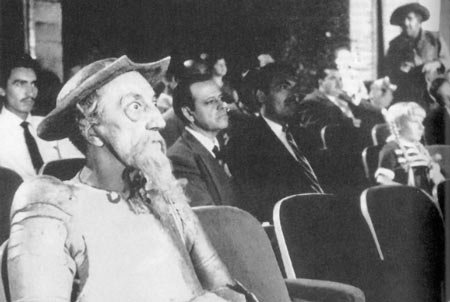
A much less bizarre but still strange film that never came to be was Orson Welles’ long term pet project, a version of Cervantes’ novel, Don Quixote, which he scripted over a thousand pages for without ever settling on a final vision. The existing footage sets it in modern or future times with Quixote and Sancho Panza interacting with cars, planes, television, and other new technology, including Welles’ own version of the tilting at windmills scene where Quixote mistakes a battle scene at a cinema for a real battle and attacks the screen with his sword. Welles said that he once had a finished version where Quixote and Sancho go to the moon, but then the U.S. went to the moon and that ruined it for him so he scrapped the reels. The footage was edited into a poorly received film in 1992 by director Jesus Franco, who had worked as a second unit director for Welles on Chimes at Midnight (1966), but Welles had intentionally split up and mis-labelled the reels to avoid having someone else re-edit his work, saying he didn’t want anyone who found them to understand the sequence. I feel like that should have been a clear cue to just let that sleeping dog lie.
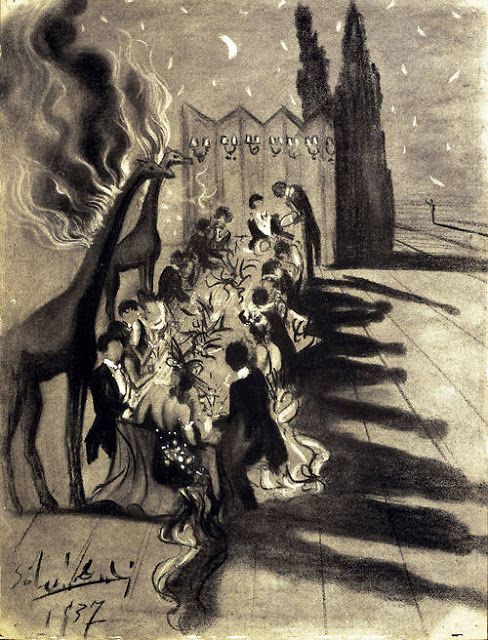
Interestingly, the final never made movie in this list also involves Salvador Dali. It was successfully remade in a creative way that was true to the source material and I suspect would have appealed to the original creators. Dali considered the Marx Brothers to be fellow surrealists in their brand of absurd comedy, and in 1937 he began working on a screenplay called Giraffes on Horseback Salad for his friend Harpo Marx. It was a love story between an aristocratic Spanish businessman named Jimmy (Harpo), and a beautiful surrealist woman whose face would never be shown. Her ability to transform reality into surreal fantasy entranced Jimmy, so he enlisted the help of Groucho and Chico Marx to help him enter her fantasy world. The scenes included giraffes on fire wearing gas masks, Harpo using a butterfly net to capture the smallest dwarves in the city, and people wearing roast chickens on their heads.
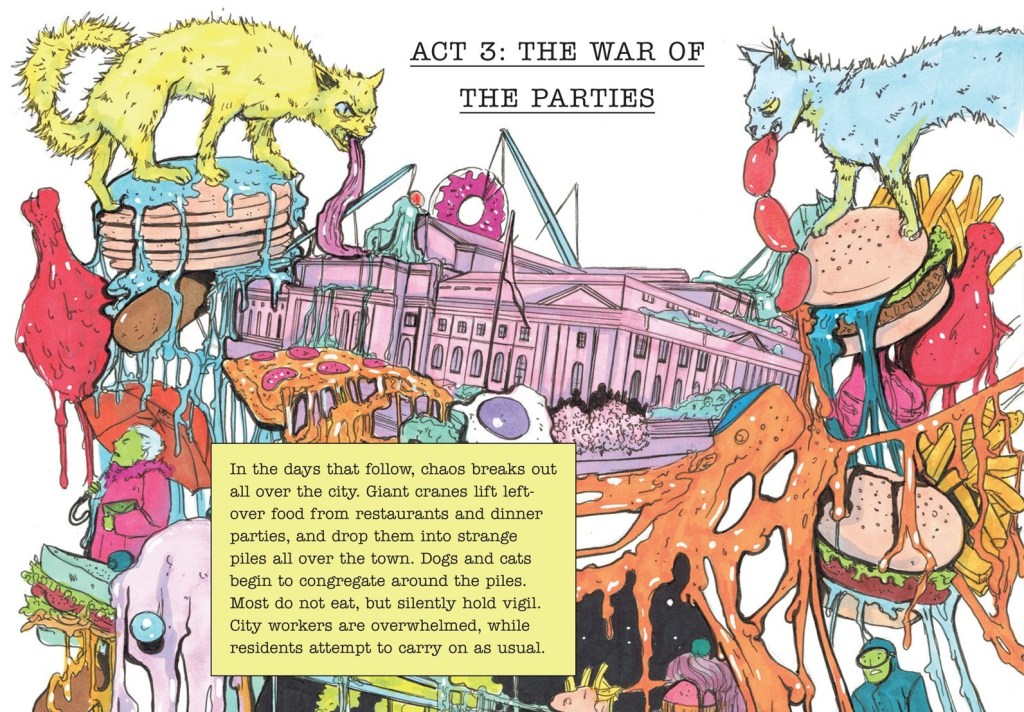
MGM declined to produce the movie in the 1930s but in the 2010s, pop culture historian and author of Fool the World: An Oral History of The Pixies, Josh Frank, decided to try to unearth the original script and bring it to life. He got a hold of Dali’s original handwritten notebook detailing ideas, sketches, and visions for the project and decided he needed a comic writer to help him bring the Marx to the party since there were sections in Dali’s notes that simply said “Marx Brothers antics.”Black Francis of the Pixies recommended absurdist comedian Tim Heidecker (Tim and Eric Awesome Show, Great Job!) and together Frank and Heidecker worked to create a full screenplay, but rather than trying to make it into a movie they adeptly sidestepped the complexities of filming flaming giraffes by adapting it into a graphic novel (Quirk Books, 2019). It‘s illustrated by Spanish comics artist Manuela Pertega, who drew most of the book in classic black and white 1930s style, with pops of color and distortion highlighting the surrealist juxtaposition of the elements that swirl and flow across the pages. It includes plenty of flaming giraffes and roast chicken hats, as well as disembodied hands, lobsterphones, and Marx Brothers antics. There are also 40 pages of historical background notes, images, and anecdotes for context.
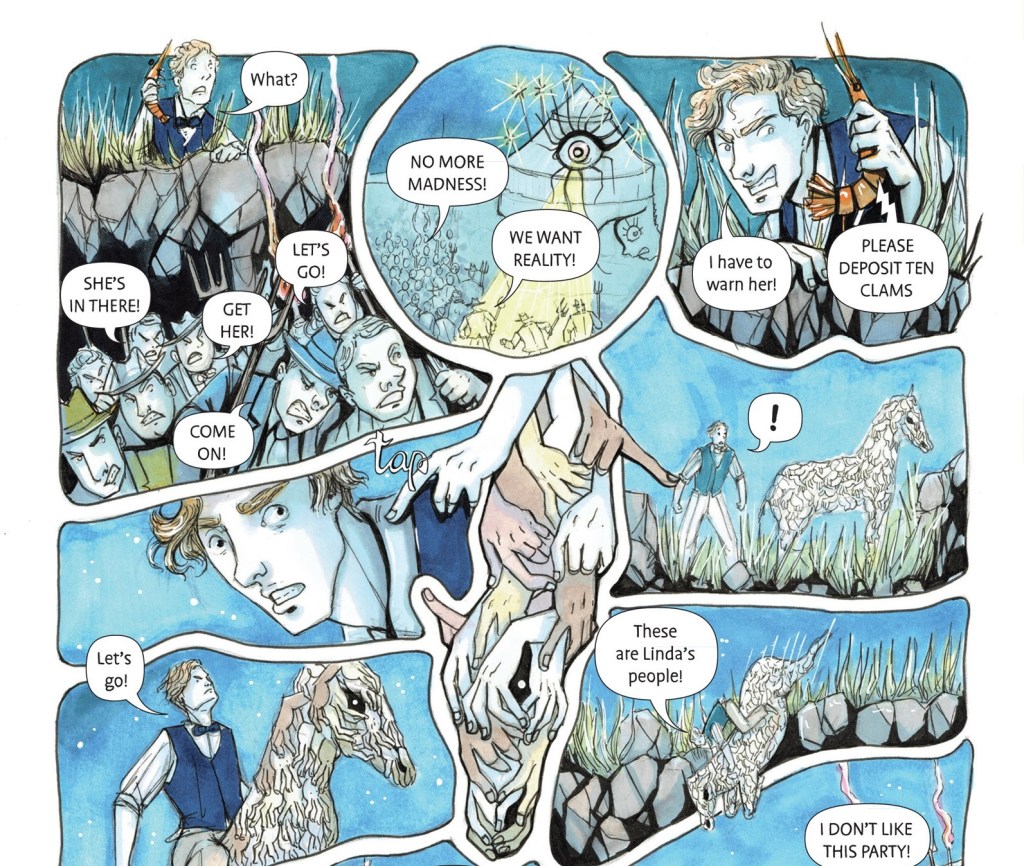
Frank also worked with composer and jazz instrumentalist Quin Arbeitman and Lakeshore Records to release a soundtrack with musical numbers and comedy routines performed by voice actors cast as the Marx Brothers and the Surrealist Woman. Quin brought together musicians from around the world, including Japanese harpist Kaoru Arai-Colucci to play Harpo-esque solos throughout the soundtrack. Dali had envisioned Cole Porter composing the film score so the style has his 1930s band sound with surrealist twists and modern touches, interspersed with cinema announcements and comedy sketches.
Some Dali historians have proposed the theory that he never expected the movie to get made and perhaps that wasn’t even the point for him, but I suspect he might have been pleased with what it finally became. I also suspect that Jodorowsky’s approach to casting for Dune had such a surreal quality to it that many of the actors he enlisted didn’t really expect it to get made either. My bet is that it’s probably been more successful as an epic cinema myth than it ever could have been as an obscure 14-hour saga.
**
Quotes are from Alejandro Jodorowsky’s article, “The Film You Will Never See” on Dune Behind the Scenes, https://www.duneinfo.com/unseen/jodorowsky/
~~~
Alex MacFadyen hopes to someday celebrate an accomplishment in the manner of Dali, who Jodorowsky reported had sealed their contract with “a great dinner where Dalí is named Chevalier of Crayfish.”**
Categories: Screen



I didn’t know about the Giraffes comic & soundtrack. Must dig up.
LikeLike