
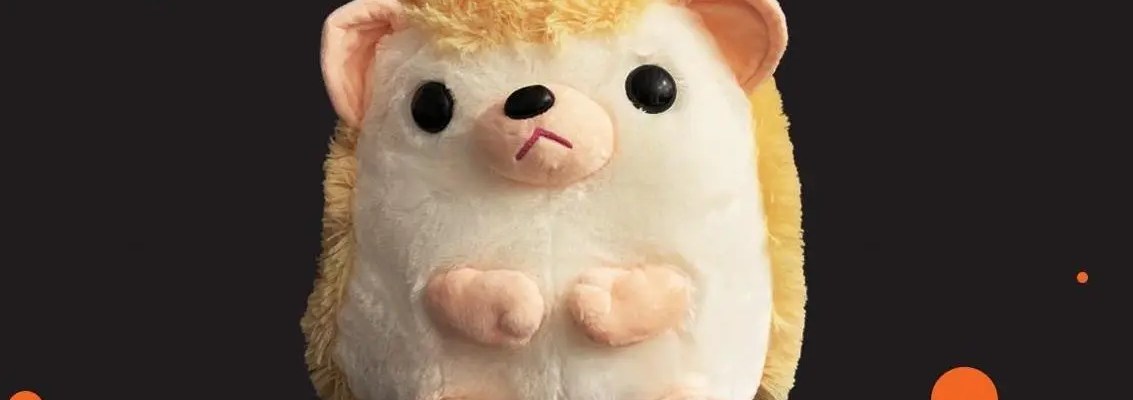
A couple of months ago, Sayuka Murata’s 2018 novel Earthlings was almost literally dropped into my lap by one of my closest friends. They, with some disgust, informed me that the book was no longer welcome in their home nor even in one of the local Little Free Libraries in their neighborhood due to its ‘grossness’ but that I might enjoy it.
Now, pals, it’s worth mentioning that my whole aesthetic when it comes to art is approximately 70% whimsical and 30% upsetting. Earthlings may tip the scales to closer to 40/60, but that’s still well within my tolerance range. Not so for my friend, who insisted that I keep their copy and not attempt to return it. Yay, free book, but also very intriguing.
Earthlings, despite it’s whimsical and I daresay adorable aesthetic, is a reminder not to judge a book by the extremely kawaii depiction of Piyyuk the hedgehog on its cover. This is primarily a story about abuse and trauma, and reminds me a little of Emma Donaughue’s ‘Room’ (both the book and the film) in the sense that they both conceal a deeply dark and disturbing interior beneath a sheen of uplifting joy or, in this case cuteness. It is, like so many things I love, very difficult to recommend because the real story that underpins Murata’s novel is as bleak and depraved as I can imagine. It seems important, here, to give a bit of a content warning that Murata does not provide when you crack open your copy of Earthlings for the first time. This is a story that is steeped in abuse and a graphic violence that is presented so casually through Natsuki’s childlike lens that it makes it feel even more impactful. I suspect both of these are reasons for the peculiar way in which this book was thrust upon me. Even though I’ve watched and read all sorts of horror and similarly difficult material, I found myself needing to take breathers from the intense pace of Earthlings.
Natsuki, introduced at 11 years old, believes that she is gifted with magical abilities. From her perspective, she is steeped in a bubble of her fantasy world that is charming until you learn what it’s protecting her from. Earthlings is a book that is, in part, about the mental gymnastics that Natsuki must undertake and the layers upon layers of rules she must construct around her in order to simply survive the revolting abuse and degradation she endures from her family and from her teacher. It draws you in, making you a part of Natsuki’s fantasy world that is replete with it’s own internal logic, characters, and where Natsuki is both powerful and in control. It’s when you realize, about a third of the way into Earthlings, exactly why this world exists.
Natsuki’s world is a planet called Popinpobopia, and she is being guided there by the adorable Piyyut who is an alien manifested as a plush toy. This world, augmented by her cousin Yuu who she sees only periodically during family vacations but claims as her ‘boyfriend’ even though it’s questionable whether this is reciprocated, is a surrogate for the real one, where Natsuki is ignored at best and actively harmed at worst by everyone in her sphere. While Natuski is openly treated as a burden on her family, Yuu is similarly subjected to a loss of agency over his life and body as his mother calls him an alien (which he internalizes as truth).
Through Natsuki’s lens, we experience – perhaps too vividly – the way in which her teacher methodically grooms and commences a pattern of abuse and molestation. Her immediate family doesn’t believe her, and Natsuki is so permanently scarred – not just mentally but physically – from her teacher’s depravity that both her sense of taste and hearing are damaged. Even compared to other depictions of abuse, especially in literature where it’s realised in my mind’s eye, I found Murata’s depiction to be one of the most affecting and infuriating that I’ve ever experienced. So much so that I had to take a break from the novel and come back to it.
There’s a break in the chronology of the novel around this point as well. Fast forwarding around 20 years to Natsuki at 34, she sees the city and the lives that most people lead – marriage, career, children – to be prescriptive to the point where she describes it as ‘The Factory’ where an unending line of slaves are churned out to feed the machine. She has largely resigned herself away from immersing herself in Popinpobopia and is now in an asexual marriage with Tomoya, who Natsuki describes as “a meek guy and easily impressed.” Her trauma fully internalized and pushed down, Natsuki’s marriage is even less personal than most business relationships, where she has developed a complex set of rules and boundaries to keep hers and Tomoya’s lives separate while cohabitating and maintaining the image of a happy couple to appease “The Factory” despite comparing herself to a silkworm, “made to breed by an invisible hand.”
And that’s when things get weird or at least weirder. Tomoya’s fascination with Natsuki’s childhood retreat to Akishina becomes an excursion there, where the pair meet up with Yuu who is now tending to their grandparents’ home. The three eventually embrace their identities as aliens, viewing their instincts – both for survival and for sexual gratification – through a purely rational and utilitarian lens. Somehow, this leads rapidly into a finale that details murder, cannibalism, and an attempt to return to Popinbopopia that is as much a hard left turn as even the most twisted narratives I’ve read or seen.
Earthlings got me thinking about books and mostly movies I’ve watched and loved, but which affected me so viscerally that I am loath to revisit them again. Veronika Franz and Severin Fiala of Goodnight Mommy (2014), The Lodge (2019), and most recently 2024’s The Devil’s Bath fame have been trading on this for some time. This pair of writer-directors have amassed a filmography that is packed wall-to-wall with projects that I watched once and have been so deeply bothered by their content and ideas that I never picked them up a second time. But each one of their films have, ahem, lodged themselves so firmly in my mind that barely a week goes by where I don’t think about them. I can already tell that Earthlings will be a novel that I won’t stop thinking about for some time, and maybe forever.

Broadly speaking, it’d be fairly easy to reduce Earthlings to a disturbing depiction of abuse and neglect. It’s certainly not not that, but it’s also tapping, more deeply, into a feeling that my favourite horror film – Lucky McKee’s May (2002) – also addresses. Both of these properties feature young women who have been pushed to society’s fringe through alienation and cope with this by constructing an elaborate fantasy world to insulate them and give them a corner of their existence they can control. In the case of Earthlings, it’s Natsuki’s construction of Popinpobopia, while in May it’s a world of dolls that May imagines to be sentient. Both provide a smokescreen behind which a firehose of violence lies. And like May, which has one of the most surreal and mind-blowing endings of any film I know, Earthlings‘ denouement seems to pile disturbing imagery on itself in a way that feels almost decadent. Murata’s novel is difficult and I am still hesitant to unconditionally recommend it, but it offered and delivered the kind of catharsis I crave from horror. In that way, I’m glad it dropped into my lap.
Sachin Hingoo has followed a semi-sentient plush hedgehog back to his home planet.
Categories: Horror




 The Cultural Gutter
1 reply »