

Rygel: This is madness.
Crichton: Could be genius, Sparky. You know there’s a very fine line between the two.
Rygel: Geniuses make plans.
Crichton: “That’s your plan? Wile E. Coyote would come up with a better plan than that!”
Last spring, throughout the day—at lunch, before bed, whenever—I would tune into the 25th anniversary Shout Factory live stream of Farscape* and watch whatever episode was playing. It was unexpectedly comforting. I won’t deny that a lot of how I first watched Farscape was in holiday marathons on Syfy (then Sci Fi). But watching the show wasn’t comforting so much for nostalgia’s sake, but because outsiders, underdogs, weirdos and outcasts trying their scrappy best just to live and maybe oppose some shitheelery always appeals to me. It’s not surprising that Farscape resonates with me right now. We are, in the words of astrophysicist and astronaut John Crichton, so screwed.
John Crichton (Ben Browder) worked on the International Aeronautics and Space Administration’s Farscape Project, focused on wormhole research and potentially using wormholes as a means of space exploration. During a test flight of an experimental spacecraft, Crichton flies through a wormhole and loses contact with Earth. He is spit out in the midst of a battle between a living ship, Moya, and forces of the fascist Peacekeepers. Moya had been enslaved to serve as a prison ship, but was just freed by the prisoners she was carrying. Crichton is brought aboard Moya. And so the first aliens Crichton encounters as a representative of humankind are escaped prisoners: the Luxan warrior Ka D’Argo (Anthony Simcoe); the deposed Hynerian ruler of 600 billion subjects, Dominar Rygel XVI (voiced by Jonathan Hardy/operated by Sean Masterson, Tim Mieville, Mat McCoy, Mario Halouvas, Fiona Gentle); priestess, anarchist and cool blue Delvian space plant lady, Pa’u Zotoh Zhaan (Virginia Hey); Pilot (voiced by Lani Tupu; operated by Jim Henson Workshop puppeteers), Moya’s symbiotic companion who serves as an intermediary between Moya and the crew; and Aeryn Sun (Claudia Black), a Peacekeeper fighter pilot who is declared “irreversibly contaminated” for her contact with Crichton (“Premiere”). After this encounter, Crichton and Moya’s crew are pursued by the vengeful Peacekeeper Captain Bialar Crais (Lani Tupu), who blames Crichton for the death of his brother. By the end of the show, Moya’s crew are pursued by nearly everyone.
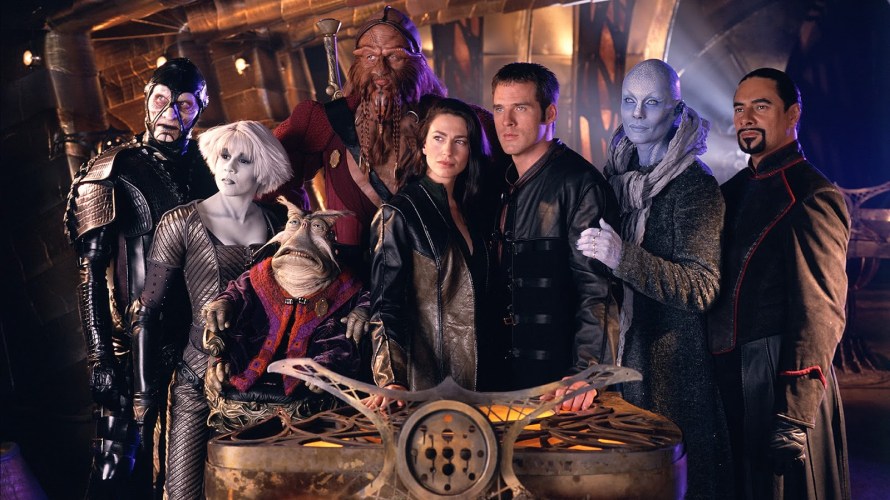
No one on Moya is straightforwardly a hero. The crime that led D’Argo to be imprisoned on Moya causes him shame. Aeryn is an outcast. Zhaan struggles with violence she has committed. Rygel is straightforwardly greedy and cowardly, considering it a sign of his intelligence. Pilot will always put Moya’s life first. But they all have their own moments of generosity, grace and bravery. The crew grows and changes as crew members’ needs and circumstances change. After all, no one is assigned to Moya and everyone can leave her except Pilot. Other characters join the crew as the series progresses—Chiana, Stark, Sikozu, Jool and Noranti. Some journey on Moya without explicit permission. Some leave Moya. It’s not so much flux as it is a reflection of newly freed people’s life on the run.
For his part, despite looking like a dashing hero straight out of an old space opera—handsome, clean-cut, All-American—Crichton and Ben Browder do not play the character you might expect. Crichton is not a gunslinging man of rash action, at least in Farscape‘s first season. Crichton’s a scientist. And when he becomes known beyond the crew of Moya in later seasons, the language used to describe Crichton befits a pirate more than a hero, “Guy was a devil. He raped and pillaged—he popped eyeballs!” (“Suns and Lovers”). Crichton disputes it, while admitting that there had been a little pillaging. (So you know if you plan on watching, Crichton himself is roofied and raped by a Peacekeeper commandant, Grayza (Rebecca Riggs)).
It’s also true that unlike so many fantasies of mostly men traveling to other worlds, whether Mars, Mongo, the Hollow Earth, King Arthur’s court, an isekai fantasy world or the other side of a wormhole, there is nothing special about Crichton or humans, except, perhaps, moxie and persistence. And imagination. Maybe.
Pilot makes this point explicitly in one of my favorite episodes, “Crackers Don’t Matter.”
Pilot: I’m only judging on my experience with you, but I’ve never seen such a deficient species.
Crichton: Have you run the scan on the pulsar light yet?
Pilot: How do humans make it through a cycle, even half a cycle, without killing each other?
Crichton: We find it difficult. Have you run the scan?
Pilot: You have no special abilities, you’re not particularly smart, can hardly smell, can barely see, and you’re not even vaguely physically or spiritually imposing. Is there anything you do well?
Crichton: Watch football. Have you run the scan?!
In this episode, though, the crew is saved at least in part by Crichton’s deficiency. An alien, T’raltixx (Danny Adcock), is manipulating the crew to gain time to seize Moya and restore his species using the light of a pulsar. The crew are becoming increasingly paranoid and obsessed with the space crackers they’ve picked up for supplies. Except for Zhaan who—as a plant—is feeling some kind of way because of the pulsar’s flashes. She retires to her quarters and is not to be disturbed. Crichton is manic, but he is not as susceptible to an alien’s manipulation because he barely perceives anything, at least by everyone else’s standards. Crichton can’t help rubbing it in, dressed not in cool futuristic gear designed to protect him from the heat, blinding light and a hostile alien, but in whatever the crew could scrounge up—including Zhaan’s vomit worked into a paste. Crichton triumphantly asks, “Does this strike any of you superior beings as a little bit ironic? I’m the deficient one and I’m still saving your butts!”
Taking it all in, Aeryn responds, “We are going to die.”
They don’t though. Their janky and always rejigged plans eventually work.
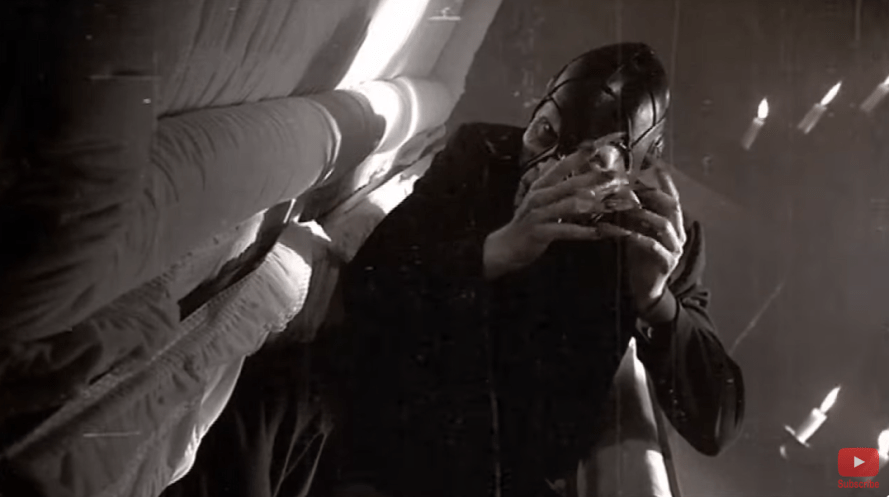
Starting in the second season, Moya’s crew are pursued by the Peacekeeper commander and scientist Scorpius (Wayne Pygram). Scorpius interrogated Crichton in his diabolical Aurora Chair and discovered that Crichton encountered an alien being in the wormhole (“Nerve”). This being took the form of Crichton’s father. Benevolent aliens do not seem to realize that it is, in fact, upsetting to meet people who look like loved ones no matter what aliens and Carl Sagan think. The alien gives Crichton knowledge of wormhole technology, but deposits it in Crichton’s unconscious so that he will organically understand it when the time is right. Scorpius wants Crichton’s knowledge so he can create a weapon to destroy the Peacekeepers’ enemy, the equally fascist but slightly more genocidal Scarran Imperium. Crichton escapes with the help of Moya’s crew, but Scorpius has implanted a neural clone in Crichton’s brain to extract the information from Crichton’s subconscious.
After the Aurora Chair, man, do things change, or at least Crichton does. In terms Crichton might use—and Looney Tunes cartoons definitely do— his merry-go-round breaks down. Radical acceptance of one’s situation and trauma response takes all kind of forms and Crichton’s is to become more manic and even more rascally. He begins to see what he thinks is a hallucination of Scorpius, but is, in fact, the neural clone. He names the clone, “Harvey,” after the pooka only Jimmy Stewart can see in the movie, Harvey (1950). As the clone marinates in Crichton’s brain, Harvey starts to develop his own personality and interests separate from Scorpius. In “Crackers Don’t Matter,” Harvey appears to Crichton wearing a boldly patterned shirt over Scorpius’ thermal suit, urging him to kill Aeryn, cheerfully exclaiming, “Kill her—then we’ll have pizza and margarita shooters!”
When I first started watching Farscape, I struggled with it a bit even though so much about the show is my thing. Farscape was peculiar science fiction from the start. You can see it in the production credits alone. It’s an American / Australian science fiction show shot in Australia created by a screenwriter with the excellent name Rockne S. O’Bannon and Brian Henson, produced in part by the Jim Henson Company and Hallmark, back before Hallmark had settled on its broadcast empire of romances and romance mysteries. That has to be a story in itself. It’s a partnership that’s all the more remarkable given Farscape’s dark and often disturbing edge. It’s definitely Jim Henson Creature Shop designs, but the grimmer ones, like The Dark Crystal (1982).
I didn’t specifically realize what the element I couldn’t quite identify was at first. After all, science fiction has often provided a pleasant fantasy of competence. That certainly was the case with Star Trek: Voyager (1995-2001), Star Trek: Deep Space Nine (1993-9) and Babylon 5 (1994-8), all of which overlapped with or aired just before Farscape‘s run from 1999-2004.** They were science fiction that had a darker edge reflecting their time. So much of genre now is blended with melodrama, but with Farscape and a lot of genre in the 1990s it was horror. The episode that made me realize most explicitly that there was horror in my science fiction was the season 3 episode, “Eat Me.” Crichton, D’Argo and one of my favorite characters Chiana (Gigi Edgley), go on board a derelict Leviathan, another former prison ship. There they discover the ship’s sole prisoner Kaarvok (Shane Briant) has seized the ship and has been “twinning” the crew—creating two of the same person. Exactly the same person, with the same memories and everything. Kaarvok has been doing this to the same people repeatedly. As he tells D’Argo, “Once you’ve been twinned thirty or forty times, you’re not much good for conversation.” And to underscore the horror, Kaarvok enjoys killing one of the twins in front of the other. He kills one of the D’Argos. He kills and eats one of the Chianas. Both Crichtons survive—each wrestling with the existential horror of which one is the “real” John Crichton. This episode freaked me the hell out.
So you might ask, Why did it take so long for me to consciously recognize Farscape as horror, too? That’s easy—the humor, fun and zaniness were primary for me. Farscape also mixes in a lot of other genres and mediums. There’s even a Looney Tunes-themed episode where Crichton’s best friend D’Argo, a Luxan warrior, is trying to kill Crichton.
Sure, being attacked by your friend in an unconscious state also seems like the plot of a horror movie, but there it is animated in the style of a Chuck Jones Wile E. Coyote / Roadrunner cartoon. Sometimes the show looks like Sam Raimi. Sometimes it looks Looney Tunes. And after all, those cartoons have influenced a lot of artists.
After escaping Scorpius, Crichton begins to bring big Bugs Bunny energy to the show. When anyone refuses to leave the people he cares about alone, Crichton might as well declare, “Of course, you realize this means war.” This is the energy I myself am aiming for in these trying times. I’m certainly not a hero. I’m just a deeply silly queer weirdo who likes art, anthropology and fun. Not all of us can be inspiring leaders or super soldiers. Like Crichton and the crew of Moya, we can be the weirdos we can be in a time that might need whatever energy we can bring to it— half-crazed astronaut, space Viking, imperfect healer, difficult scientist, thrill-seeking kid, angry middle-aged man, “traitor,” outcast, troublesome gremlin, trickster with a strong sense of what’s right. “We’re So Screwed” is the title of the show’s final arc. And they are, like we are, so screwed in a universe where powerful people are bent not just on using them but more often on destroying them. There are rarely good options and never perfect ones. And they understand that all they have is Moya and each other. But they try, with their plans that suck. And no matter how screwed they are, and how annoying they find each other, they do their best and come to their own rescue when no one else cares or will.
Farscape has its flaws, but it’s ambitious, audacious and inspiring for me right now when there is no reason to expect competent people with an official status will come to save us or that a brave space station commander will hold the line for democracy against fascism and invasion. It doesn’t give us the pleasures of that kind of science fiction. It gives us the reassurance of horror and screwball cartoons. There IS something out there trying to get us. Our fears ARE real. We ARE so screwed. Our plans DO suck. At the same time, our plans might be madness but maybe they are the genius kind of madness. And if we are smart enough, imaginative enough, lucky enough, stay true to our weird selves, and stick together, we can survive the horror and share the wonder of our lives.
*I watched Shout Factory’s live stream. Yes, this is the Farscape 26th anniversary live stream.
**This includes Farscape: The Peacekeeper Wars (2004).
~~~
Carol Borden would like to assure you all that crackers don’t matter.
Categories: Science-Fiction, Screen



 The Cultural Gutter
3 replies »