The Odyssey is one of the most influential works of literature ever created, and yet its origins remain ambiguous and widely debated. It started as an oral tradition, passed along by aoidos, or singer-poets, and later transitioned to written form; the timeframe of this transition isn’t agreed upon by all scholars. This uncertainty even surrounds the author, Homer, and has produced the so-called Homeric Question, which proposes that history doesn’t know Homer’s identity, that perhaps The Odyssey and The Iliad were written by multiple authors, and that there is much uncertainty surrounding the creation of these poems.
All of this aside, the most important aspect of The Odyssey is not its origins but how it preserves myth across generations. It doesn’t matter who the author is after all this time, because each adaptation takes on the qualities of the time period in which it is made. After the new adaptation is made, it is transformed further by the audience consuming the story, who bring their own inner philosophy and experience to the proceedings. Source fidelity doesn’t matter as much when it comes to the story of The Odyssey specifically, because its very creation cannot be pinned down to a single source. The essence of the tale, that of the human experience, is what grounds it to each new period, and why it has endured for so many years.
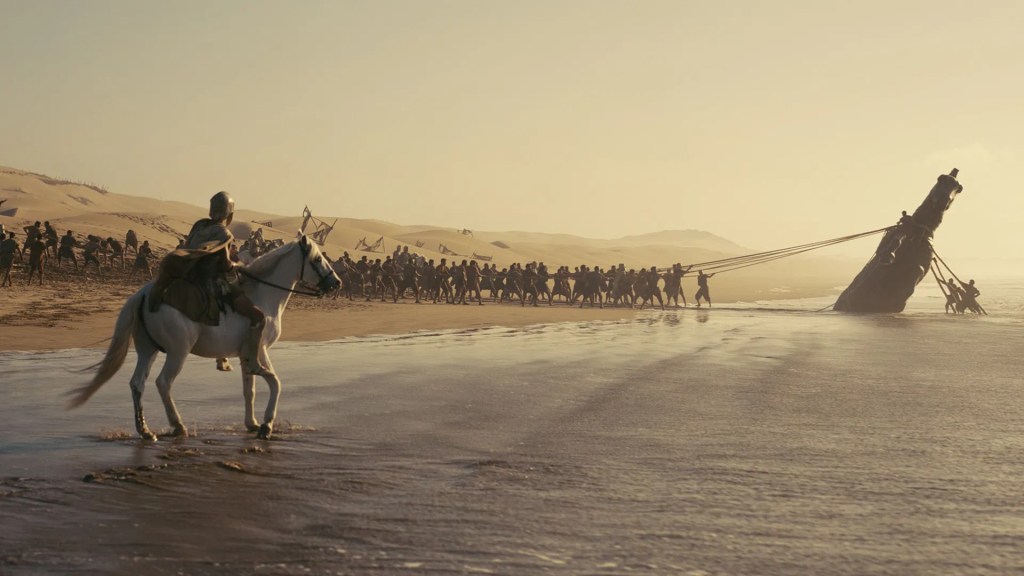
The main question is then: what has Christopher Nolan brought to his version of the poem? His main mode of operation is spectacle and expansiveness. He is in his element when depicting huge battle scenes and elaborate, complex set pieces. The vistas are infinite, the musical score is booming and thrumming, and The Odyssey, as a tale, has several sequences that lend themselves well to this interpretation. Nolan is also obsessed with emotional beats on a grand scale, and some would say simplistic: love conquers all, men feeling the immense weight of their failures, and women solely as props to make the men finally feel empathy or to have something to fight for.
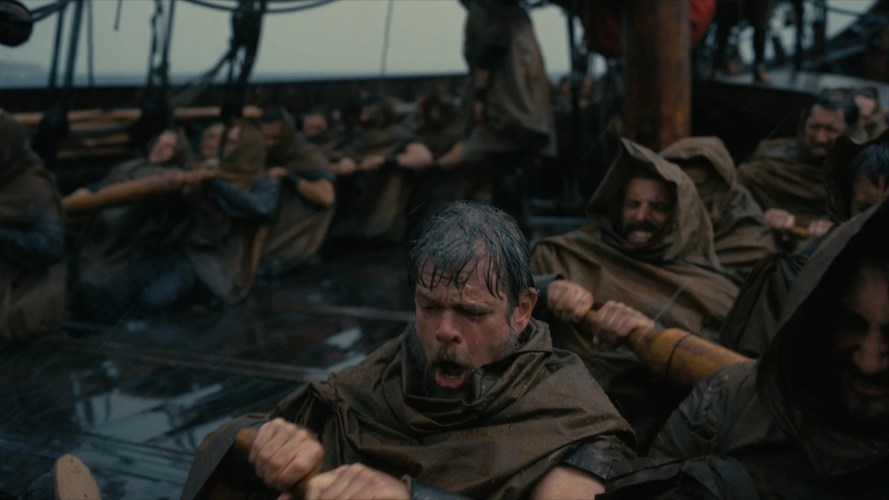
Odysseus (played by Matt Damon) is an interesting character because he is, by default, the hero of the narrative, yet an extremely flawed one. He is consumed by his ego and the idea that by outsmarting the gods, he can control the fates of others, even putting his own men (and himself) in dangerous situations just to prove them wrong.
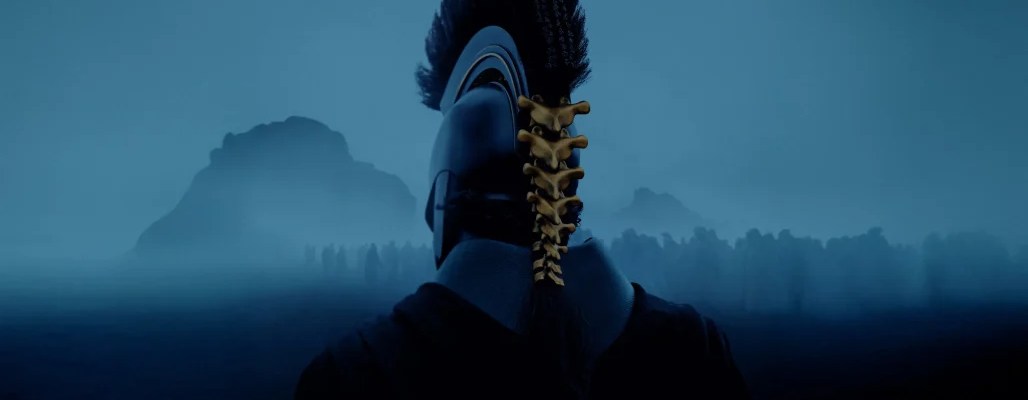
That is not to say the gods are always right; in Greek mythology, they possess many negative human traits, such as greed and jealousy, often behaving more like petulant children than omnipotent beings. Nolan chooses to keep the gods mostly unseen and metaphorical in the film, though he doesn’t shy away from fantastical imagery. At some points, the atmosphere veers into horror territory, specifically body horror, and there is a sequence with the Cyclops that feels like it is straight out of a Ray Harryhausen flick.
There is a concept called hermeneutics, which is the study of principles of interpretation. Initially, it was used only to interpret religious texts, but it later expanded to include other types, such as philosophical and literary texts. Hermeneutics holds that one can never fully understand a text because new information continually emerges, prompting one to reinterpret earlier ideas.
This “hermeneutic circle,” as it is called, is something Nolan likes to play with in his work, using multiple timelines to show the same event from different perspectives. The character of Odysseus is presented through this technique, as the audience is forced to reinterpret him each time a new flashback of his journey is revealed. We understand the work ultimately through the whole, but we can only understand the whole through its parts. Although the film has an epic scope, Odysseus is depicted as complex and troubled. It is impossible to send a man through the horrors of war and have him return intact.
Why even bother to adapt The Odyssey, and not have it reflect the time it was made? The changes are what make the story interesting, as every time it is retold, it is reflected back in a different society, with new problems. Although this version carries some of Nolan’s weaknesses, particularly in its dialogue, it showcases his strengths; awe and emotional payoff. Like its main character, it is uneven and flawed yet completely relatable.
~~~
Michelle Kisner is a film critic, freelance writer, and advocate for physical media.
Categories: Screen