

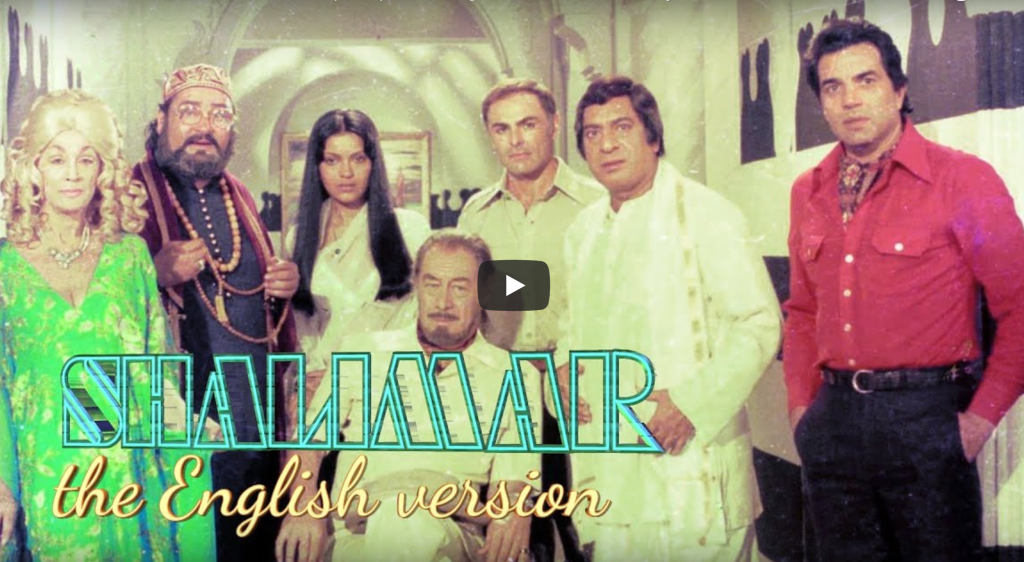
The fact that I have to start a discussion of Shalimar (1978) by specifying that this is the English-language version of the film, which is only 60% as long as the Hindi and therefore almost automatically makes less sense than the fuller work, tells you that we are in for quite a feat. A feat almost as daunting as stealing Rex Harrison’s massive ruby from a heavily-guarded and booby-trapped palace! The full version of this film is overall more enjoyable, in my opinion, partly because it has the fuller story with more context and also because it has fantastic songs by composer R. D. Burman (try the title music here). But I couldn’t find the full version with English subtitles streaming anywhere, so the English version will have to do.*
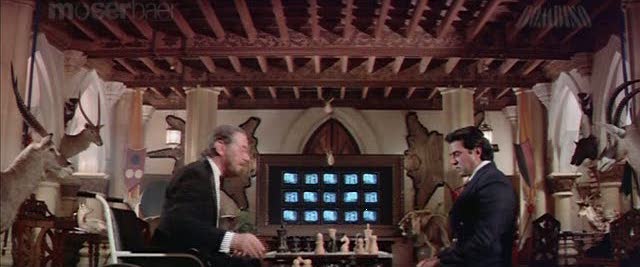
Rex Harrison is in a Hindi film? Yes, he surely is. While his appearance is not quite as unexpected as Bertrand Russsel’s, it’s still way up there on my list of “What are THEY doing here?!?” Here he is delightfully cast as the eccentric thief Sir John Locksley who has received a terminal diagnosis and wants to be sure his prize possession, the Shalimar ruby, goes into the hands of a worthy successor. He invites four top thieves to his private island in the Indian Ocean—pleasingly named San Dismas, aka the good/penitent thief from Mount Calvary in the New Testament—and springs on them the rules of the competition: if they can get into the gem’s high-tech display case and back out again with the gem in hand, they can keep it.

Harrison’s presence is why I call this film “exotic.” His rigid, clipped, blasé Anglo presence suits the character but is a rare bird in the wild and woolly world of mainstream Hindi cinema of the 1970s, especially because he has zero connection to anyone in or anything about this production. Hindi movies regularly contain multitudes, but they almost never contain someone like Rex Harrison, even in the more global movie market of 2024. Seeing him in this film is more discombobulating than more recent appearances by people like Sylvester Stallone or Will Smith. Smith actually makes relative sense, given his musical career, but I digress. (And if you want to know what non-Indian director I think should be given a crack at a huge Bollywood production, talk to me in the comments.)
And maybe that’s not surprising, given that Shalimar’s director Krishna Shah worked in international theater, attended UCLA film school, and directed and wrote for American tv and films (Rivals/Deadly Rivals and The River Niger before Shalimar). His is a truly unusual career for an Indian-born filmmaker of this time, and he really ought to be better remembered for how many international projects he created and participated in. His friendship with John Saxon brought him to the cast as one of the group of invited thieves as Colonel Columbus, and the ubiquitous Sylvia Miles appears as Countess Rasmussen. If my research is correct, this international cast is unique for a mainstream Indian film at this time. Shah and Shalimar are not the automatically multicultural world of the Indian-American team of Merchant-Ivory, whose India-set films like Shakesepeare Wallah and Heat and Dust have international casts and often deal with culture clashes, or the art-house adaptation of Herman Hesse’s Siddhartha (1972).**
Indian experts make up the rest of the cast. The other two thieves are legendary Hindi star Shammi Kapoor as Dr. Bukari and director/writer/actor O. P. Ralhan as Romeo. A fifth thief unexpectedly joins the game when S. S. Kumar (the equally legendary Hindi star Dharmendra, who was surely the biggest draw for most Indian audiences at the time) swipes an invitation meant for another man, claiming to be his son. Helping run the island and protect Sir John and the Shalimar are personal assistant Sheila Enders (Zeenat Aman, also a huge name) and a seemingly endless supply of local guards/servants, led by Dogro (Hindi film camera professional Clyde Chai-Fa).
Sir John explains he helped them escape being held as prisoners of war by a rival tribe. Dr. Bukari accuses him of enslaving them, but then Sheila and Sir John explain that he is very ill and at his death they will be freed and be given control of the island. Sir John takes the competitors on a tour of the palace and its deadly staff and accoutrement. The competition gets underway: the thieves draw cards to see what order they’ll compete in, and they’re off!

The first time I saw Shalimar, I was unimpressed, despite all that’s crammed into it. This time, I’m into its loopy fun. There are several instances in which Shalimar comes across as an ersatz Bond film. Indian cinema loves James Bond as much as anyone else, and there are better versions of the Eurospy formula elsewhere (such as Farz from 1967). The English version is sparse in the kinds of drama and emotional meaning that most mainstream Hindi films have, so it doesn’t really succeed from that angle either. The dubbing definitely hurts the translation of emotions from Hindi cinema conventions into English text, too. Dharmendra is a perfect choice to play Kumar, established in both romantic and action films by this point in his career (although my favorite of his fight scenes in the Hindi version, with fight coordinator and famous henchman Shetty, is cut from the English version). English, however, is, um, not his forte. I genuinely cannot tell whether he is dubbed or if his efforts at a whole film in English make him sound unlike himself (there are reports of him having lessons with Pearl Padamsee, a fixture of English-language theater in Mumbai). Whoever did it, the effect is that they’re aiming at sounding like Harrison—smooth and restrained—rather than the boisterous and brute vibes of Dharmendra’s usual dialogue delivery. Mainstream Hindi cinema is often called escapist (IMO a pejorative overgeneralization, but that’s another essay), but what exactly were audiences being invited to escape into here?
If you’re new to Hindi films, especially the golden age (according to me) of the 1970s, it’s not going to give you a really representative sample of that world, but you’ll meet a few important stars, hear some great music, and get a taste of its maximalist approach. If you’ve seen a Eurospy film before, you might appreciate the application of Bollywood’s more-is-more methodology bringing unnecessary flips, rappelling, catchy music, serene deities, and frankly the most jaw-dropping disguise sequence I have ever seen.

Shalimar flopped, and some people ascribe its failure as the reason Indian filmmakers stayed away from international projects for the next several decades. Is that attribution completely fair? The pragmatics of making movies in India, with its unique celebrity ecosystem around stars, the climate and monsoons, and work visas and tax penalties for foreigners, were against any such projects. I am in no way qualified to discuss Indian economic policies, but any overview of the history of Hindi films discusses how the relaxing of policies towards foreign investment and licensing beginning in 1991 created opportunities for more global involvement, so I wonder what it was like before. When even Coca-Cola was booted from the country, how could foreign filmmakers find workable conditions (admittedly “workable” by their own definitions, not by Indian ones)?
I almost feel sorry for Shalimar. It’s a sort of cinematic Frankenstein’s monster: created by a possibly hubristic madman, assembled from erratically acquired fragments, and not designed with the real world in mind. Almost half a century later, it’s been orphaned by its Bollywood and Hollywood parents, left to lumber through the far Arctic…er, those of us with an interest in pop culture that has been overlooked, forgotten, or maligned. Consider this your invitation from a reclusive millionaire on a tropical island to spend a few hours with this weird, unpolished treasure.

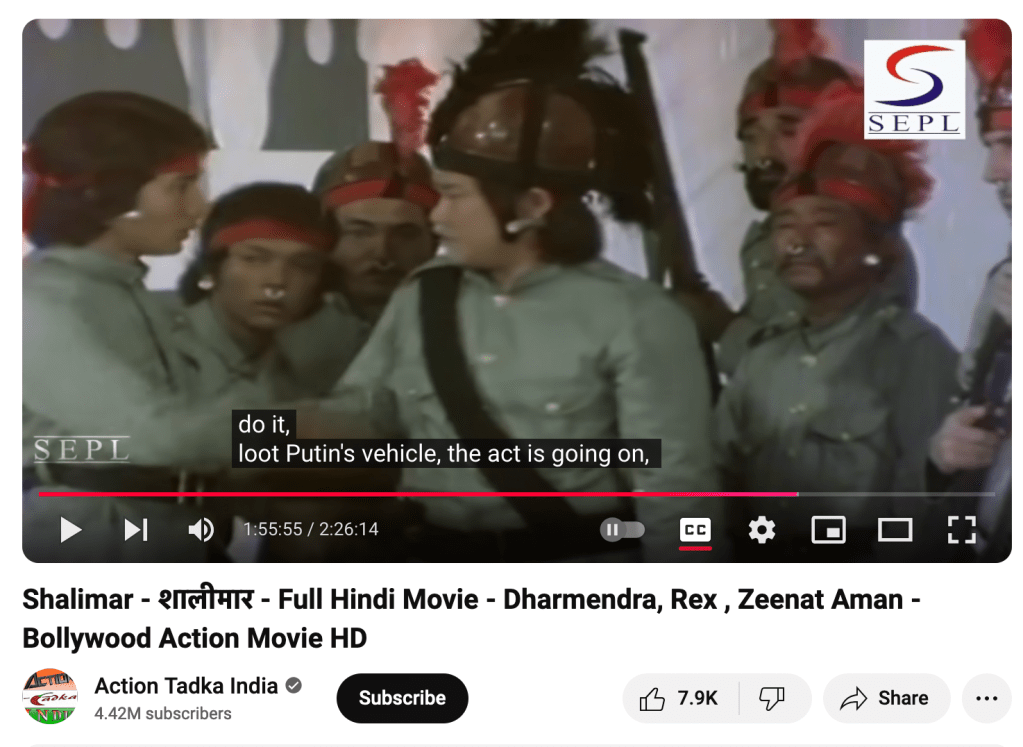
* The English version, called Raiders of the Sacred Stone in its American release, is on Youtube for free. The full Hindi version is there too, but I do not recommend gambling on the automatic English translated captions because when I spot-tested them they referred to Putin, who at the time was in the KGB so maybe really was on San Dismas Island and trying to steal a ruby? I’ve had good luck with Youtube’s translating technology on other films, but here it’s very ineffective. The audio quality overall is not great, and I assume that interferes with comprehending the Hindi properly.
** There is a whole book about the making of Shalimar by Indian film journalist Bunny Reuben that came out shortly after the film. It’s available on Internet Archive. I admit I did not leave myself enough time to read it thoroughly before writing this, but the parts I consulted suggest a chaotic experience trying to get all the pieces in place but then a smoother time once filming actually began. This is just one of several reputable published pieces I found about the film:
- “Back to the Shalimar I & II” by Rishi Majumdar for the glorious but defunct Indian cinema website The Big Indian Picture. (Please note that the Hindi version clearly calls Kapoor’s character Dr. Dubari, and I have no idea why the English version changed it to Dr. Bukari.)
- “Krishna Shah’s Shalimar most expensive movie ever made in India”, India Today January 31, 1978
- “Recalling Bollywood’s past Thugs of Hindoostan-like disasters” by Dinesh Raheja, The Free Press, May 29, 2019
- “The Shalimar Adventure” by Dhruv Somani, The Daily Eye, November 20, 2022
~~~
Beth Watkins awaits you on her tropical island. She has the most marvelous heist planned.
Categories: Screen




 The Cultural Gutter