

At Fantastic Fest this year, I was not only fortunate enough to receive accreditation so I could see movies and report back, but I was also lucky enough to see four very different films that I might not see otherwise. I am back now, my fedora with the press card stuck in the band still jauntily askew on my head and my lanyard slapping me in the chest. My brain feels smooth. My eyes are but bleary raisins in their sockets. But I’m getting you this copy, dear readers, before I flop face-down across my bed. I don’t have the stamina that the Gutter’s own Sachin Hingoo has, but, by Roger Ebert, I’m doing my best.
So join me now for four movies about: women finding themselves; secrets and curses; social media; competing beauty parlors; alien worlds; revenge; identity; and the public presentation of self. Some of the movies are straightforward. Some bear a lot of thought. Two are funny. One is gleefully gory. One is an anime masterpiece. One is campy and queer. And one is anti-colonial Gothic horror.
I enjoyed them all and share them in the order that I saw them.

The Curse (Taiwan / Japan, 2025) written and directed by Kenichi Ugana
CW: a bad thing happens to a dog, but not on screen; a lot of vomit; the curse of social media
Kenichi Ugana’s The Cursehas the punk sensibility, the gleeful gore, the dark comedy, and the sympathy for monsters and outsiders I enjoyed in Ugana’s Visitors: The Complete Edition (Japan, 2024).* And it has a rocking scratchy opening title card that looks like a zine cover. Curse even has an awkward hosting scene that both entertained and disgusted me as in Visitors. And while I am tremendously fond of Visitors, its DIY sensibility, and its homages to Troma and early Sam Raimi, The Curse is a more accomplished film. And while there is some digital blood, there’s still plenty of quality gnarly practical effects.
But where Visitors leaned more towards comedy and science fiction, The Curse leans into horror. It’s a grisly satire about social media that uses a traditional means of expressing one’s rage on other people—a curse. In The Curse, as online, attention doesn’t always come in the form you want and can bleed into real life in the worst ways, but there is a devil in the social media horror movie this time. I won’t say much more, but we do get to see a cool Taiwanese Temple and an alarming home. And we get to see how well rational investigation and ritual specialists do against chat.
I appreciate The Curse‘s underlying consideration of social media. It’s not too heavy-handed in a film where people vomit so much blood. The metaphor works remarkably well. Anger, hate, resentment, envy, feeling disrespected, and feeling betrayed are all reasons people curse others. And while there are positive experiences online, social media dangerously relies on all those feelings to capture attention and generate cash. The Curse has a message for our time. In fact, it has several messages. Don’t open videos sent to you by strangers in comments or chat. Though by the time they’ve sent you the video, it’s likely too late. Use a pin rather than a thumbprint or facial recognition. And never post.

Angel’s Egg (Japan, 1985) Mamoru Oshii & Yoshitaka Amano
I always struggle when writing about masterpieces and Mamoru Oshii and Yoshitaka Amano have collaborated to create a masterpiece. Angel’s Egg is a gorgeously dark dream of a film. A soldier (Jinpachi Nezu) is deposited on the shore of a vast, labyrinthine European-style city. His ship rises from oceanic depths like an enormous evil eye. A girl (Mako Hyōdō) carries a large egg with her, keeping it warm as she forages for water. The two intersect in an apocalyptic city dense with gargoyle sculptures pouring water from their mouths and fishermen hunting the shadows of titanic fish that have left or no longer exist.
Angel’s Egg is a film best experienced on its own terms and then pondered afterward. Don’t look for the pleasures of plot, explication and absolute certainty about what is happening. There are more elements to film than plot and different films emphasize different elements according to their needs. Sometimes that means a lot of silence, a strange vision, an eerie soundtrack, and beautiful art. Make sure to see the new 4K restoration in the theater if you can.
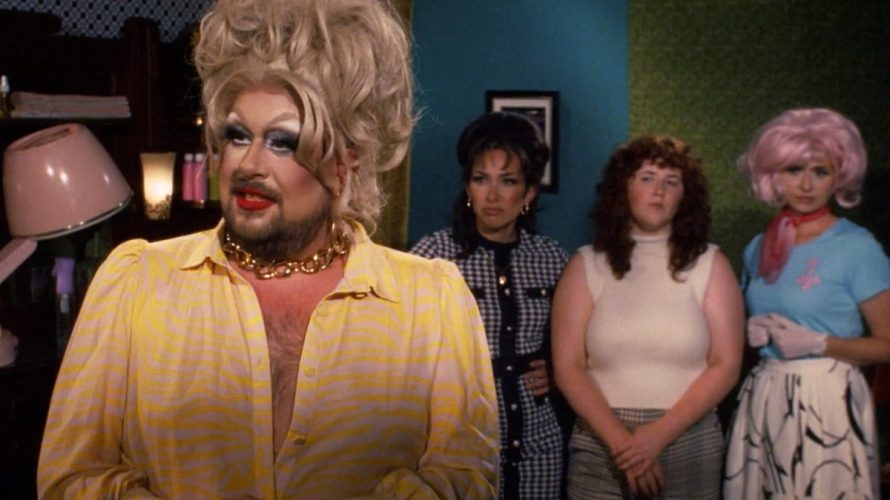
The Cramps: A Period Piece(USA, 2025) written and directed by Brooke H. Cellars
Brooke H. Cellars’ The Cramps: A Period Piece is a period piece in more than one way. It is indeed about an especially bad period and a bad period in someone’s life, but it’s also set in a very John Waters, queer and drag-influenced depiction of 1960s America. There is more than one drag queen with a beard in The Cramps. And director Cellars appears in drag with a magnificent beard as a forbidding father. It is a majestic thing.
Agnes Applewhite (Lauren Kitchen) wants change in her life. Her home life is a smidge shy of a Gothic melodrama. Agnes has quit the job her late father found her as a switchboard operator and loves her new life at the Hairbrained Beauty Shop. Agnes even meets a boy at work! At first, Agnes’s period only interferes in her life in common ways. But it gets much, much worse than dysmenorrhea or even endometriosis. As the witchy Dr. Dolly says, “Vagina problems? They some fickle bitches.” Agnes’s vagina has had it and it’s lashing out.
The period-related practical effects in The Cramps are very entertaining. They made me cackle in the best way. The Cramps: A Period Piece is everything I love about scrappy lo-fi, DIY film-making. It has a unique vision—a unique idea of what filmmaking is and what movies should be about. It does a lot with few resources. It’s creative, delightful, funny and daring. It doesn’t care about the illusion of realism and embraces the artificial. The Cramps just goes with effects made from glitter, glue, and plastic wrap. It expects you to suspend your own disbelief. But The Cramps also has an emotional realism that is completely believable. And maybe riskiest of all, The Cramps is daring in its unapologetic focus on women and its unapologetic queerness. I enjoyed everything about the film and I can’t wait to see it with a Queer audience, especially with an audience of Queer women, enbies and amenable Trans guys.

Mārama(Aotearoa, 2025) written and directed by Taratoa Stappard
CW: child death; the horror of colonial history; straight razors; alarming parties featuring pantomime.
Writer / director Taratoa Stappard’s Māramais a film that bears a lot of thought. I am still pondering it and I doubt I will do the film justice, at least here. So just go see it—especially if Anti-Colonial Gothic Horror sounds like the genre for you. It is certainly the genre for me.
In 1859, an orphaned Māori woman, Mary Stevens (Ariāna Osborne) has traveled to meet a man in Yorkshire, England, a Mr. Anthony Boyd. Boyd sent her a letter claiming he has important information about her family. She stops in the home of a man, Nathaniel Cole (Toby Stephens), who claims to be a friend of Boyd. And is informed Boyd is dead.
Mārama uses classic Gothic horror conventions to relate a story of imperialism, colonialism and decolonization. There are the Yorkshire heaths and moors Mary traverses. There are the crashing ocean waves. There is the remote country house of Nathaniel Cole, his dissolute brother Arthur and Arthur’s daughter, Anne (Evelyn Towersy). There is the lonely grave of Anne’s mother, Emily Cole. There is Peggy (Umi Myers), a recently hired Māori servant, who initially distrusts Mary. There is a secret room and a secret house. There are close, dark halls that Mary walks at night. There is a missing and, perhaps, mad woman. There is a party of terrible white people. There are Mary’s strange dreams and visions. And I don’t think it spoils anything to say that there is the presence of Toby Stephens himself, an excellent choice for the antagonist of any Gothic horror movie. (Stephens is having quite a run on awful family patriarchs lately).
With Mārama, Taratoa Stappard has created a perfectly shot Gothic horror piece. It’s an intense film with a slow burn. Osborne gives a tremendous performance in a film that demands so much from her. And she does an an excellent job as Mary penetrates a house filled with aw men and their terrible secrets. Mārama reveals the horrors of colonialism and the necessity of decolonization in exquisitely intimate contexts that are deeply distressing. And the film never loses site of its heroine as Stappard harnesses Gothic conventions to tell this story of horror, loss, self-discovery and reunion.
*It’s true that I have not see Ugana’s The Gesuidouz (Japan, 2024) and I Fell In Love With A Z-Grade Director In Brooklyn (Japan, 2025). I will fix that. Do not curse me!
I wrote about all these films in a slightly different and longer form at Monstrous Industry. Click through to read more:
The Curse (Taiwan / Japan, 2025) written & directed by Kenichi Ugana
Angel’s Egg (Japan, 1985) directed by Mamoru Oshii / art direction by Yoshitaka Amano, from a story by both
The Cramps: A Period Piece (USA, 2025) written & directed by Brooke H. Cellars
Mārama (Aotearoa / New Zealand, 2025) written & directed by Taratoa Stappard

~~~
Carol Borden is a festival lightweight and always has been.
Categories: Horror, Science-Fiction, Screen




 The Cultural Gutter
1 reply »