
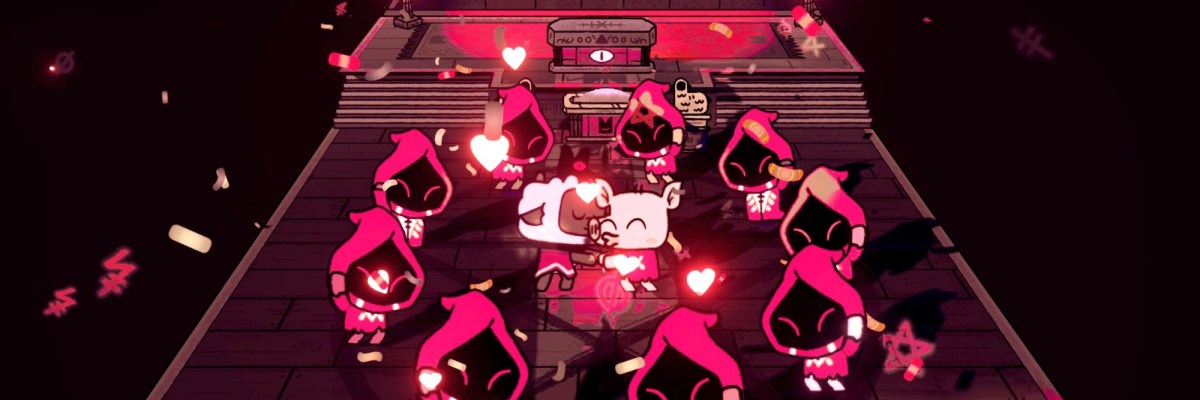
This Christmas I found myself sitting in my recliner watching my kid play Baldur’s Gate 3 on his new Steam Deck in the very boring, adult predicament of having asked for relatively practical gifts and now having no new toys to play with. I decided to remedy my error immediately by downloading a game for myself and landed on Cult of the Lamb, because what’s more festive for the Solstice Season than indoctrinating a bunch of adorable anthropomorphic animals and eldritch creatures into your pagan cult? It’s an (evil) cozy village simulator mixed with a roguelite dungeon crawler and I had been waffling about it for ages even though it looked right up my alley because I was worried that it would make me sad to have my followers die or have to sacrifice them. Turns out that the designers did a brilliant job balancing the cute and disturbing elements to make it an addictively fun game. With a dark Animal Crossing vibe and an aesthetic that seems drawn from a mix of occult horror movies and 2010s cartoons like Over the Garden Wall and Adventure Time, it might just be my favorite game this year.
You play as an (initially) innocent lamb, tied up to be sacrificed to the ancient gods until you are plucked from the jaws of death by a mysterious supernatural being called The One Who Waits and charged with amassing followers to gain enough power to defeat the Bishops of the Old Faith. The gameplay alternates between venturing into the realms of the four old ones to battle their minions and building your commune while caring for your growing cult of worshippers. It’s an innovative combination from Australian studio Massive Monster, who self-describe as “an award-winning indie developer made up of one really big monster and their many ‘pets’ who help them fulfil their game making dreams.” It’s published by Devolver Digital, who also put out Enter the Gungeon, in which you can actually play as the Lamb from Cult of the Lamb, and another of my favorite games, the adorable and Escher-like Death’s Door.
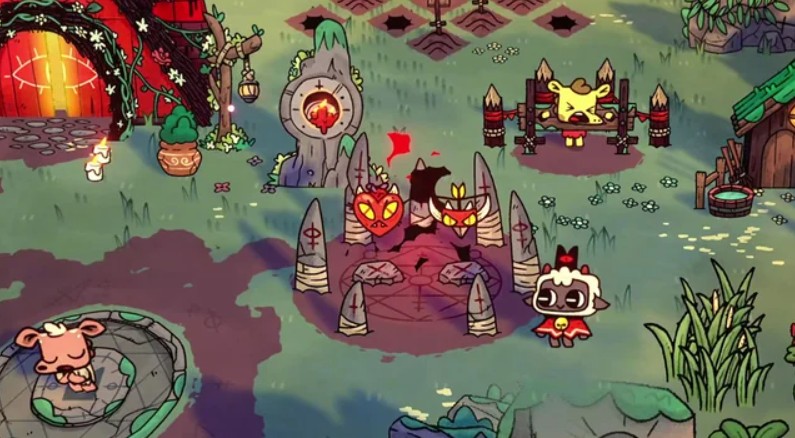
The game mechanics in Cult of the Lamb are really interesting and clever. I’ve seen a wide range of hybrid comparisons, but to me it seems to bring in elements of a bunch of games including Animal Crossing, Stardew Valley, Don’t Starve, and countless dungeon crawlers to create something unusual. The game is narrative driven but highly randomized. The combat rooms, weapons, special abilities, and enemies are procedurally generated so they’re different every time you enter an area, and the followers you find are randomly selected. In the cult, followers have a limited set of dialogues and actions which also feel like they’re decided by the roll of a die, but somehow all those simple individual characters each behaving in random ways combine to create a realistically unpredictable social structure within the cult. They’ll make friends, get into fights that you have to break up, get drunk and break things, or ask you for weird stuff and get mad if you don’t do it. There’s a real complexity that seems rooted in how groups of people actually interact, so it didn’t surprise me at all when I found out that design director Jay Armstrong has a master’s degree in geopolitics.
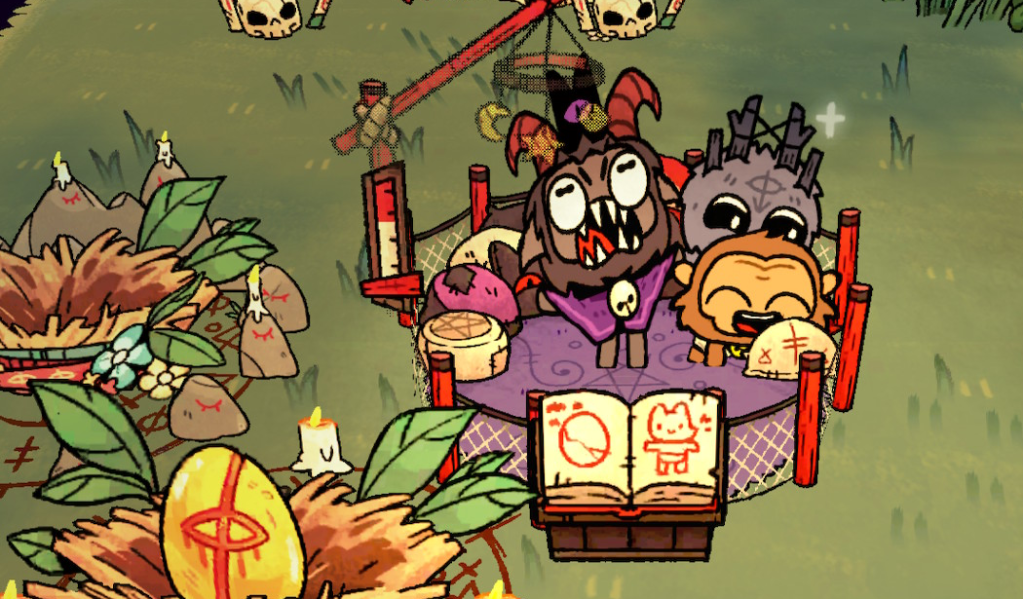
Your cult needs you to take care of them, so advancing the story becomes something you have to make time for in between keeping them happy and busy worshipping you all day. It feels kind of like leaving the kids alone to work a night shift, and who knows what the situation will be when you get back? In my experience so far, things have usually gone off the rails with poop everywhere and at least one crazed, red-eyed follower screaming dissent and getting everyone else worked up. When you get back you have to put the naughty one in the stocks, clean up the poop, make everyone snacks, and send them all to bed. The designers said they decided to make the followers like Tamagotchi so that players would develop affection for them through caring for them in a bunch of basic ways. You get to name them and customize their appearance (in a limited way), and when you reach the expansion that lets your followers mate and hatch eggs, you have to personally nurture and clean up after the babies so you’re stuck at home for several in-game days. Much like kids or pets, it sure helps that they’re adorable when they leave a giant, steaming pile of poop in the middle of your temple!
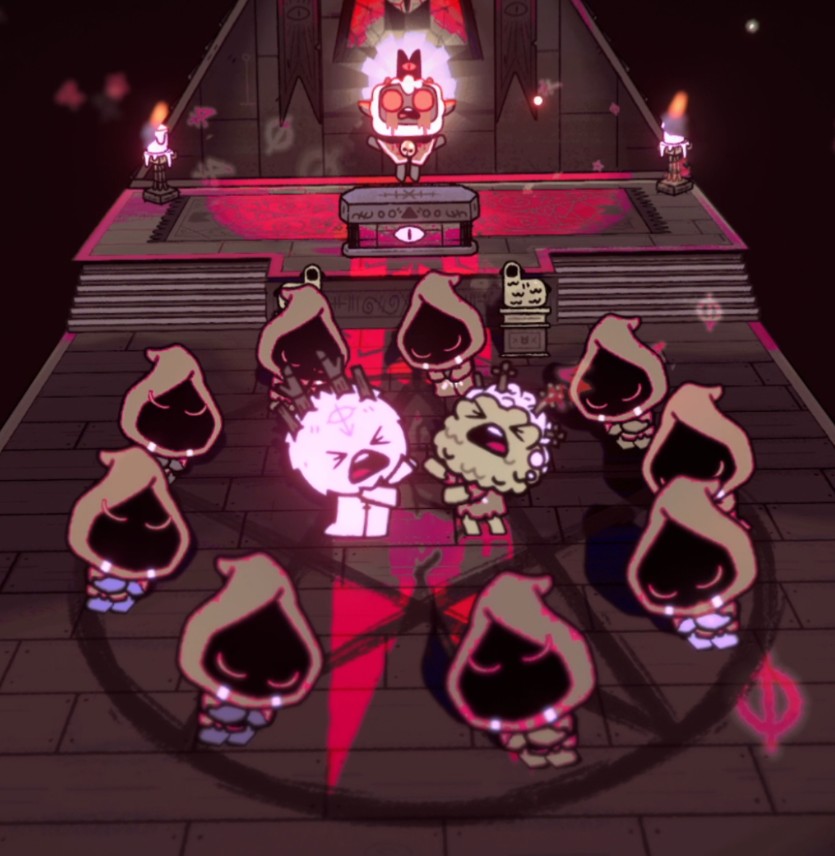
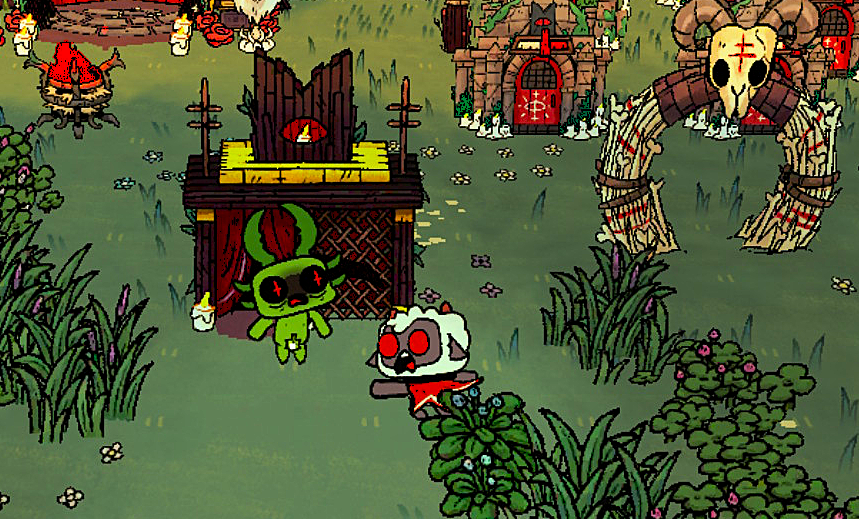
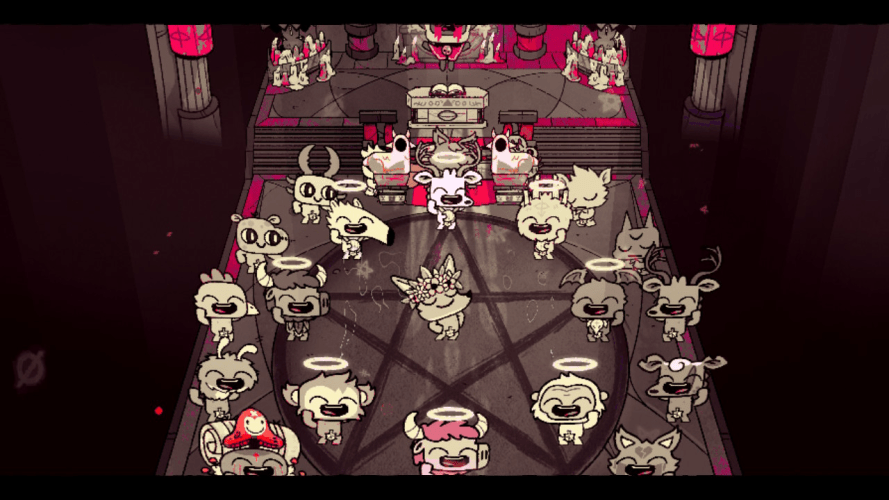
The cult aspect of the game means that ethics also factor into the mechanics and the player experience. The structure of the game forces you to make uncomfortable choices and perhaps also acknowledge how gleefully you make them. The designers expected that sacrificing your adorable, wide-eyed followers would feel difficult at first, but much like the way actual cults progress, unusual behaviors get normalized over time and power tends to breed abuse of power. Creative director Julian Wilton described it by saying, “the mechanics themselves gently nudge you toward evil.”** As the cult leader, there are different rituals and doctrines you can select to mold your cult and followers as you wish, so you do (mostly) have to actively choose evil. Personally, I went for the dancing naked around the bonfire and raising your followers from the dead kind of Dionysian pagan cult vs the inspire fear through sacrifices and cannibalism type of cult. Don’t get me wrong, you still have to sacrifice the occasional follower to appease the gods and your more bloodthirsty followers, but death isn’t forever, even if they don’t always come back quite…right. (chomp)
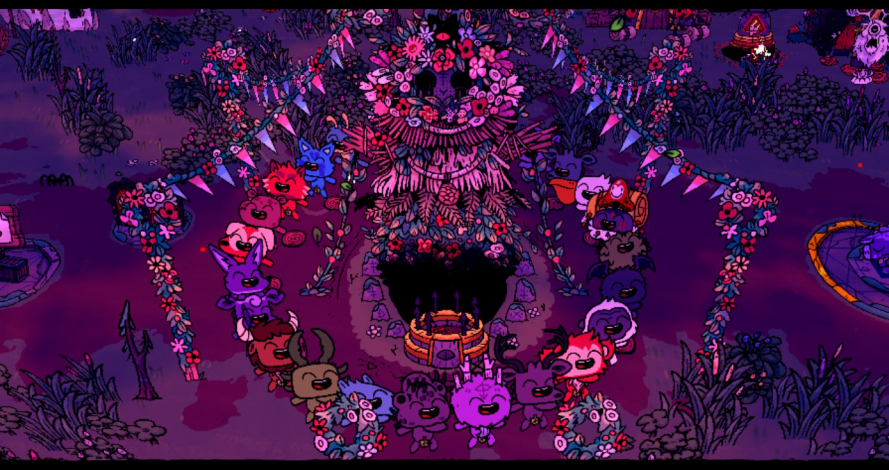
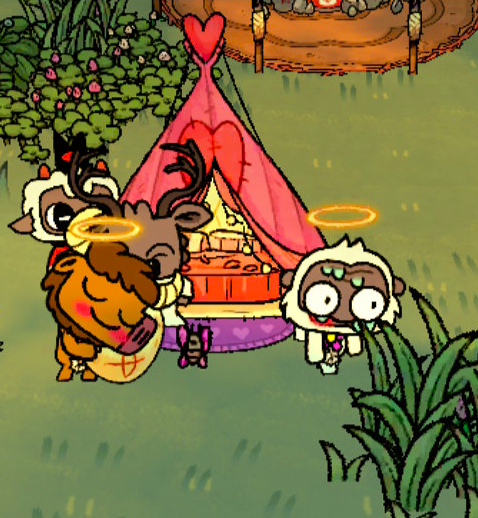
Another thing you spend a bunch of time doing is leveling up your favorite followers until they become Disciples, whose devotion transmutes into boons like extra hearts or ability buffs when you go dungeon crawling. Apparently, there’s also a mechanic to always have at least one annoying follower in your cult so there’s someone you kinda want to sacrifice even if you’re not really into that kind of thing. For me that was a chicken I named Red. Red was a hothead with the personality traits that basically boil down to bully and shit-disturber. Red picked fights, stole my money right out of the confessional booth, and dared me to play mean pranks on the other followers. I coped by sending him out on the resource gathering missions with the lowest chance of coming back in one piece (physically or mentally) but one day I forgot and left him wandering around the camp. I also had a sweet, adorable monkey follower named Splitz that my kid created for me, who I was working on turning into a Disciple. There I was, busy cooking a tasty fish meal for my peeps, when the message scrolls across the top of the screen: “Red has murdered Splitz because he thought it would be funny.” Whaaaaat?!? The next time I needed a sacrifice, I bet y’all know who got sucked into the ground by a bunch of shadowy tentacles. Wilton said that they wanted players to be “kind of angry at themselves for all the horrible things they’re doing but they just can’t stop playing because it’s so fun.” Mission accomplished!
One of my favorite things about the game, though, is what a brilliant job they’ve done of juxtaposing cuteness and horror, both in the concept and the aesthetics. Wilton has cited 2010s cartoons as an inspiration and the art style does remind me of Over the Garden Wall, with it’s bright character colors over darker hand-drawn backgrounds, or Adventure Time with it’s sometimes unsettling mix of the adorable and disturbing. It has that fairy tale quality where cute things might be sinister, surprising players by twisting their preconceptions. It also draws heavily on the narratives and style of occult and folk horror films. The clearest influence to me is Ari Aster’s folk horror film, Midsommar (2019), where a couple get drawn into a cult in rural Sweden that is all light and flowers on the surface and bloody sacrifice underneath. From the white robes the elder followers wear to the flower designs, mushroom trips, and triangular temple, it’s not hard to see Midsommar references in Cult of the Lamb.
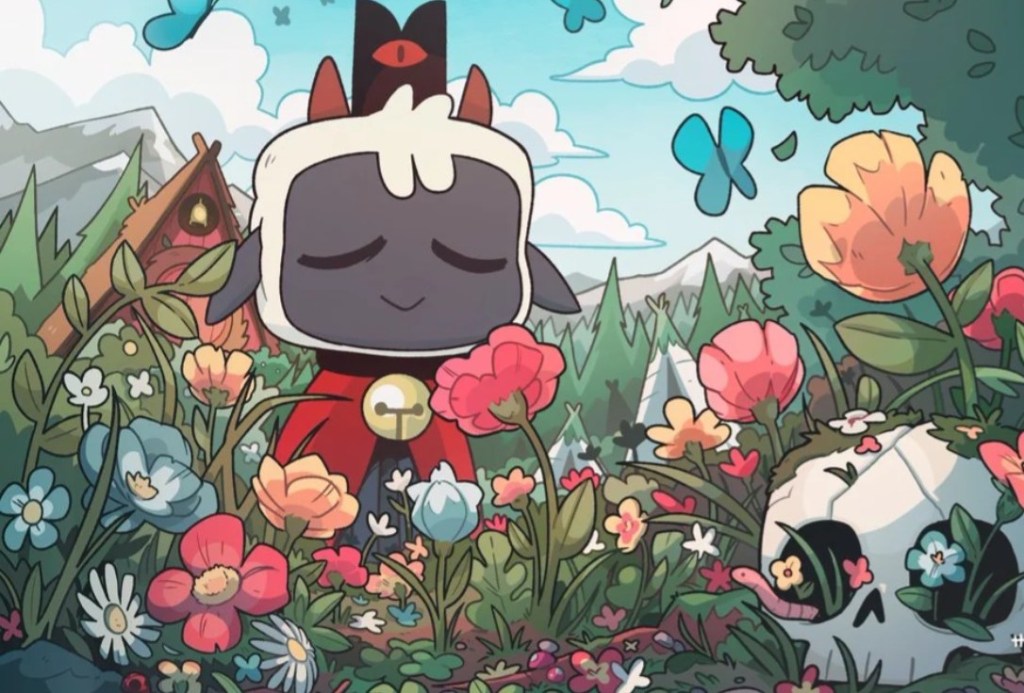
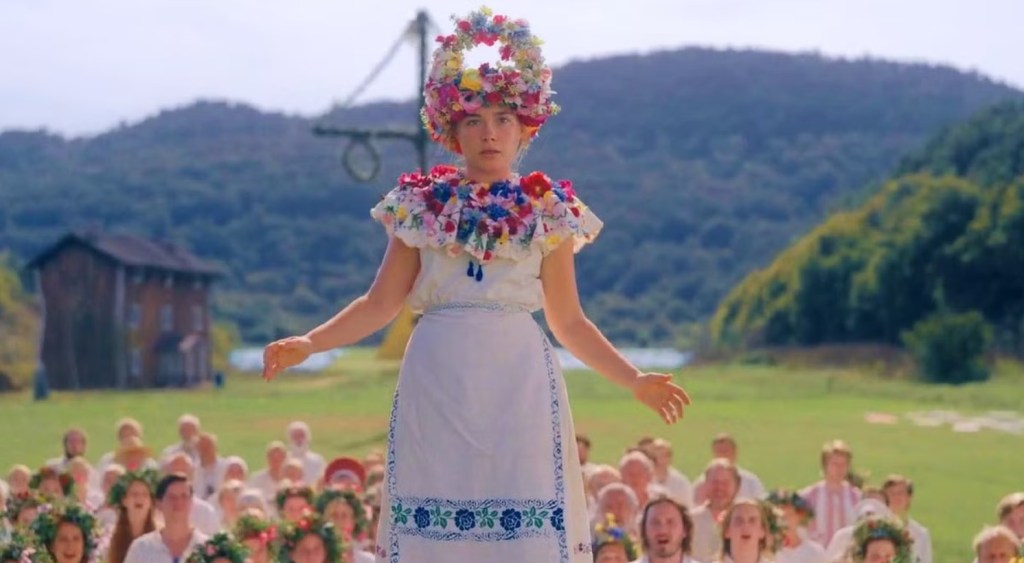
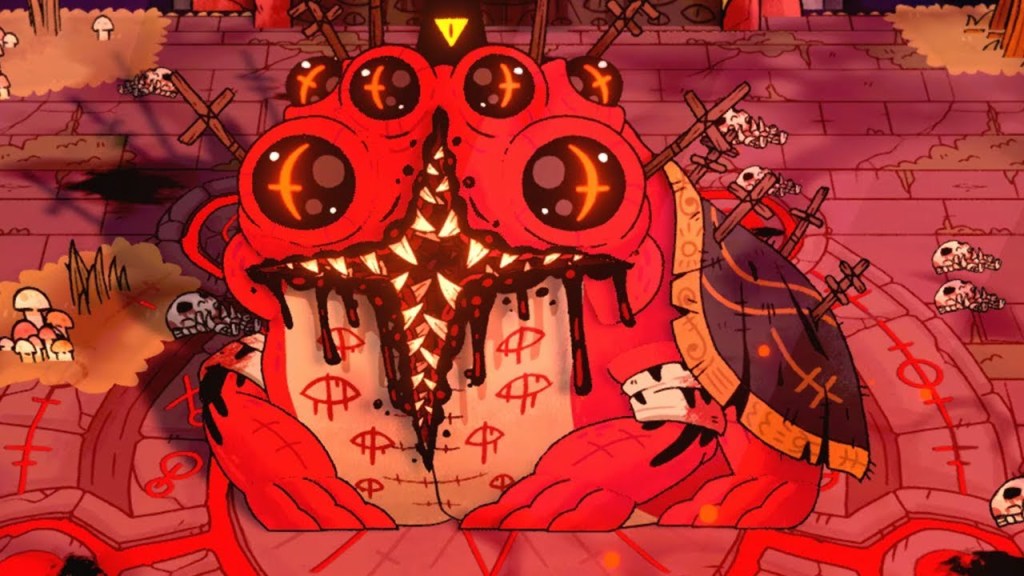
Wilton has said that they threw in references to all their favorite occult films but they’ve done such a good job of melding it into a unified and easily recognizable cult movie situation that I find myself searching for the specific references. The eye symbol on the crown might refer to the all-seeing eye symbol in Eyes Wide Shut, but eyes and crosses are also just classic. You can play as either The Lamb or The Goat, which reminds me of Black Phillip from The Witch (2015). I can see shades of The Wicker Man (1973) and also The Omen (1976), which makes sense since it’s about the biblical end of days and the Cult of the Lamb seems heavily based in the Seven Seals verses from Revelation: 6 combined with a Lovecraftian sensibility. The narrative is The Lamb, who has been sacrificed and resurrected, breaking open sealed doors to the realms of four bishops who wreak havoc on the Lamb’s followers in the forms of famine, pestilence, etc. like the Horsemen of the Apocalypse. The aesthetics tend more towards the Lovecraftian Old Ones – unfathomable horrors with many appendages or eyes and distorted, incomprehensible voices – and rituals involving huge tentacles reaching up through the temple floor to drag sacrificed followers to some other dimension.
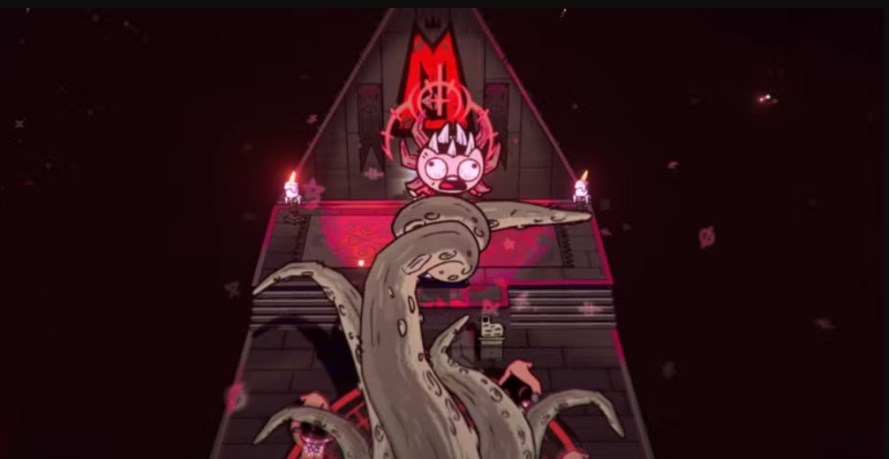
My only complaint about Cult of the Lamb is that it doesn’t support online co-op, so tragically Gutter editor Carol Borden and I cannot create an adorable pagan cult together. But there is a new full-length Woolhaven expansion just released today (January 22, 2026) that challenges you to journey to a mysterious wintry mountain and rebuild your flock, which I suspect means I will be spending a lot more time in the near future cavorting with cute critters and cleaning up messes, now in the snow.
~~~
Cult of the Lamb is available on PS4 and PS5, Xbox, Switch, and PC
**Quotes from the game designers taken from an I.N.T. magazine interview with Julian Wilton, Cult of the Lamb Creative Director and co-founder of Massive Monster
If you like Animal Crossing or Adventure Time, you can get more of them on the Gutter with Crossing Art, Politics, and Anthropomorphic Animals and Unacceptable, one million years dungeon!
For the record, Alex MacFadyen resurrected Splitz after his untimely death and made Splitz both a Disciple and his second husband. ‘Cause he could.
Categories: Videogames



 The Cultural Gutter
One day we will be united again and our cult will be adorable–and evil–but adorable!
LikeLike
Someday our cult shall cover the earth!
LikeLiked by 1 person
I’m seriously tempted…
LikeLike
Join us! Join us!
LikeLiked by 2 people
My concerns were about the same as Alex’s and I am enjoying the game for the same reasons.
LikeLike