Content Warning: cancer treatment and the loss of a child
~~~
She can trick death, even her own.
There is a house in the woods—a house made from the woods. And a witch lives there. She might have lived there since the first Europeans arrived. She offers healing, but, as is always the way, she is feared. There is a young woman looking for a cure. She dreams about a strange woman telling her to meet in the woods on a certain day at a certain time to be healed. And there is the woman’s father, suspicious of the witch and her promises because witches in fairy tales—and films—so often consume and destroy those who encounter their little cottages in the woods. What we see in the opening of Mother of Flies perhaps justifies that fear. The film begins with a voice over as a woman makes love to bloody bones in a charnel pit in the forest.
Life is rhythm. The heart, the drum. But death knows only silence. To woo death, one must love it, lie with it. For three days give your beating, bloody heart to it till death grows ears till death grows warm, till an embers sparks. A dead drum thumps and the blood of light floods in.
From here on, I will be discussing the Adams Family’s Mother of Flies (USA, 2025) in detail.
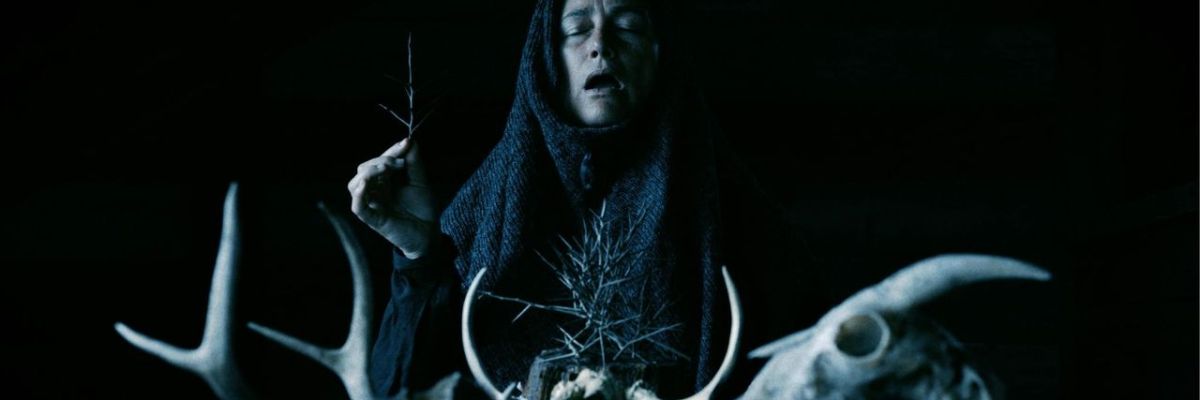
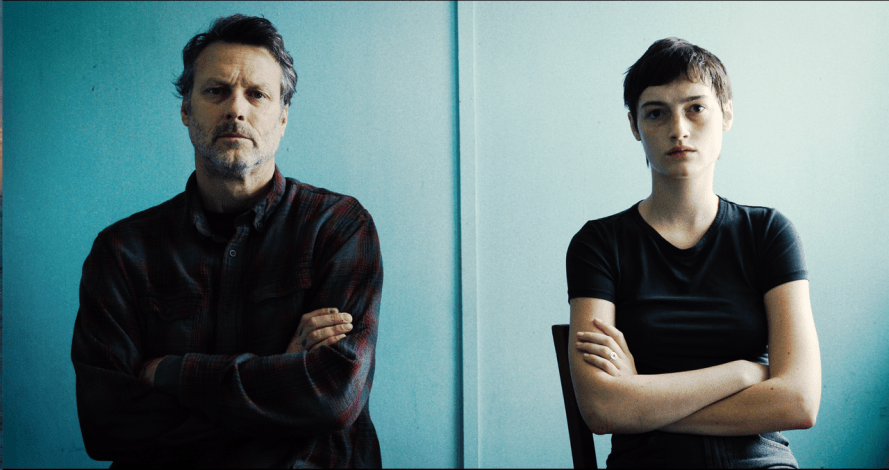
In the early summer, when new life blooms, college student Mickey (Zelda Adams) asks her father Jake (John Adams) to accompany her on a road trip through the forests of Upstate New York to seek a cure from a woman named Solveig (Toby Poser). Mickey has cancer and her prognosis is terminal. As they drive, we alternate between scenes of a father-daughter road trip—diners, reminiscences, hugs—and eerie images of Solveig and her world—the curve of a dead tree, a crow’s head, an altar of skulls and thorns, the body of a dead fawn that draws Solveig’s ritual attention. It’s the best of creepy folk horror, gorgeously arranged and shot. When Jake asks for details about how Mickey heard about the woman, or how she knows where the house is without using a map, Mickey answers vaguely or changes the subject.
She tells her dad, “I know it sounds like a scam. I doubt it will even work, but I gotta try.”
When he asks how much it will cost, Mickey tells him it’s free. Jake replies, “Nothing is for free. Ever.”
Mickey says, “Well, this is.”
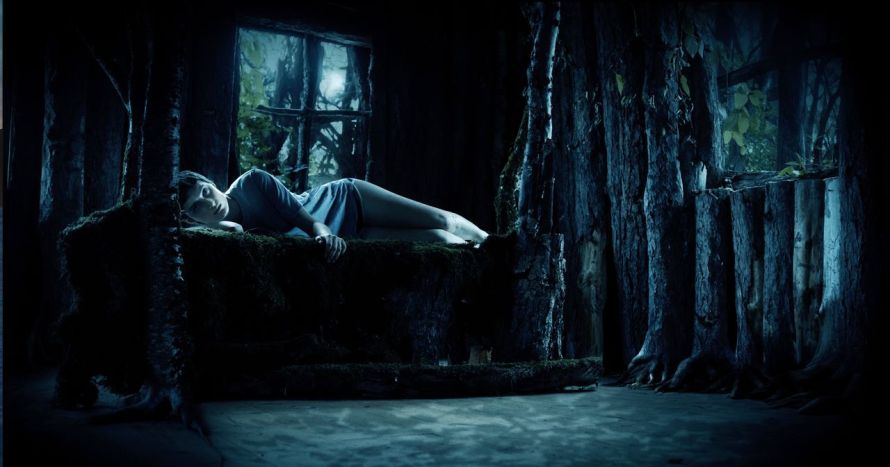
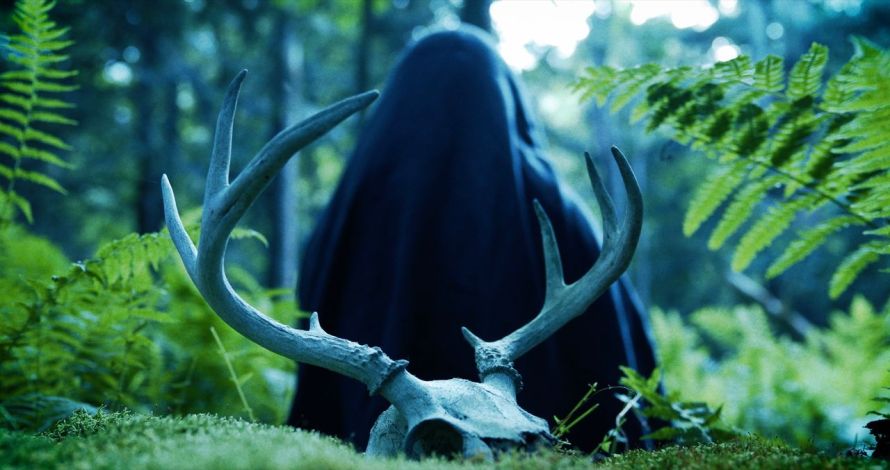
Their underlying conflict is set aside when they arrive at their destination. Father and daughter gaze in wonder at the house and the impressive cairn before it. The house grows from the forest itself. The bed Solveig offers Mickey is formed from living trees and soft moss. Jake, as an interloper, is given a cot in the tree house’s version of a cobwebbed basement. The kitchen is surrounded by walls made from close set trunks. The house is a wonder, just barely this side of impossible, like something out of a vivid dream.
Jake is right, though. Nothing is free—especially not cures from mysterious women living in houses growing in the woods—women who are intimate with death and its secrets. And such women rarely take money in exchange for their aid. Solveig does want something from Mickey. “Your curse is my gift,” she tells her.
Mickey considers herself “scientifically dead” and doesn’t fear death so much as she just wants more life. So Mickey decides to believe Solveig and to believe a cure is possible. Jake desperately doesn’t want his daughter to die. After the death of Mickey’s mother, presumably due to the same cancer growing inside Mickey, he can’t bear any more loss. He wants to support Mickey, but he doesn’t believe Solveig can heal her. Jake does pretend to try to believe for Mickey’s sake—at least for a while.
On the morning after their arrival, Solveig doses Jake with a special healing tea, to “lubricate [his] spirit” after all his grief, loneliness, anger and fear. “The difference between a poison and a cure is the dose, my friend,” Solveig tells Jake as she prepares a hemlock tea for him. It is a pointed parallel between her treatments and medical ones like chemotherapy and radiation, a parallel that underlies much of the film. Then Jake has a realistically messy and surreal psychedelic trip—including vomiting, dangling snot, and a vision of a dead woman in her grave.
Solveig also drugs Jake to get him out of the way. She called Mickey to her through a dream, not Mickey’s father. While Jake undergoes his healing, Solveig takes Mickey into the forest to continue her three days of ritual that are increasingly strange, painful and frightening. I believe the ritual began when Mickey arrives and then sleeps in her bed as the dead fawn we see earlier in the film “sleeps” on its bed of moss. A blurring of one being and another–a basis of sympathetic magic. But not all painful bargains are bad ones. Mickey made a similar trade before when she endured chemotherapy hoping for a cure. And Mickey’s cancer is a key to what Solveig lost and aches to regain. With her magic, Solveig can “trick death” because the boundary between life and death that seems so clear is not just permeable, but interpenetrating. Solveig hopes to transmute death into life for both of them, but not in the way so many witches do in so many other films. And not in the way that Jake fears.
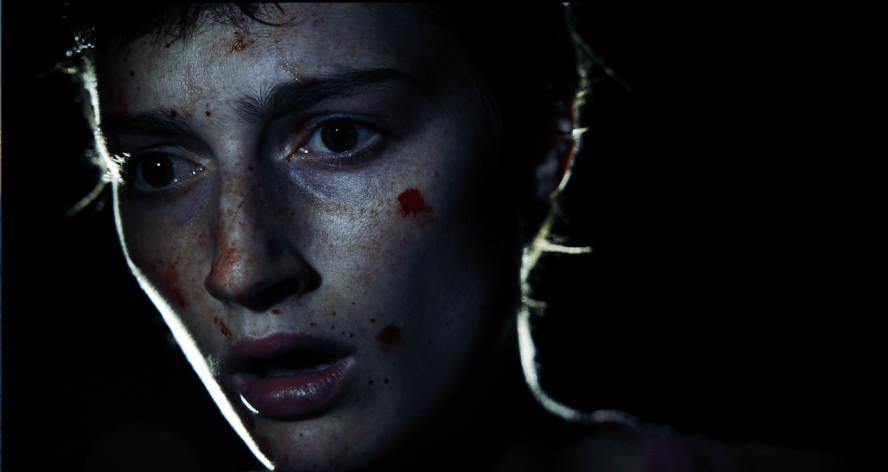
Jake is increasingly concerned. Mickey tells him she wants to continue, but Jake is alarmed by Mickey’s suffering and at the prospect of her being injured or killed through fraud or malevolence. I expect it was hard enough watching Mickey endure medical therapeutics he at least believed in. After seeing the effects of Solveig’s cure—pain, illness, extensive scarring on Mickey’s abdomen—Jake is determined to get them out of Solveig’s house. When the clerk (Lulu Adams) at a nearby hotel tells him that there was an infamous, local necromancer named “Solveig” who was stoned and buried beneath the cairn hundreds of years ago, he becomes terrified for Mickey.
Long ago, Solveig had helped a woman who was carrying a stillborn child. She saved the woman’s life, performing a c-section with a thorn. Then Solveig disinterred the infant and brought it back to life, loving and caring for it. When the townsfolk discovered this secret, they stoned both Solveig and her baby. What Solveig wants is Mickey’s cancer itself to use to bring her child back. Mickey’s curse can be a gift. Her suffering is an unfortunate side effect. Pain is a part of healing. And pain is a part of being alive and possibly, in Mother Of Flies at least, a part of being restlessly dead.
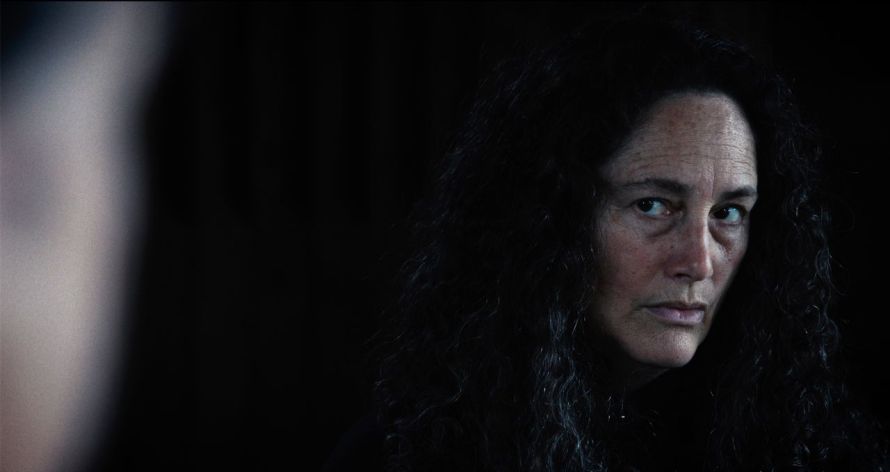
While Mother of Flies has a giallo name, fairy tale elements and cleverly manipulates the filmic traditions of the fear of old women, Toby Poser’s Solveig is a wise woman of the forest, but her magic comes from the intersection of life and death. Unlike her sisters in recent films, Solveig has an innocence about her. She uses anachronistic language—calling Mickey’s cancer: “canker” and “the crab.” Christian utterances appear blasphemous to her. She feeds her guests with the forest’s gifts, but never eats herself and disappears at night. Solveig is also alarmingly intimate, literally so, with death. Her rituals involve thorns, blood, snakes, potentially deadly plants and the corpse of a fawn. They frighten both Mickey and Jake, but Mickey persists, pointing out to her father that chemotherapy, radiation, and surgery are also frightening, sometimes body altering, and cause suffering in an attempt to cure.
It is a good time for witches and witchiness in film, both the classic fairy tale witch and more contemporary sympathetic ones. There is Anya Taylor-Joy’s abused daughter who joins a coven straight out of a Goya painting in Robert Eggers’ The Witch (USA, 2015). There’s the far more cartoonishly evil Aunt Gladys in Zach Cregger’s Weapons (USA, 2025), and Alice Krige plays an updated Grimm’s fairy tale witch in Oz Perkins’ Gretel & Hansel (USA, 2025). Krige is definitely witchy and definitely angry in Charlotte Colbert’s She Will (UK, 2022). (Krige is magnificent in both films). There are the curanderas who save lives in Michelle Garza Cervera’s Huesera: The Bone Woman (Mexico, 2022). There’s the poor woman ostracized by her village and driven into the forbidden forest in Didier Koning’s Witte Wieven / Heresy (Netherlands, 2024). Magpie (Emma Appleton) violently resists patriarchal authority and consorts with a Beast in the woods in Dean Puckett’s The Severed Sun (UK, 2024). And there the non-human witchy demons /demonic witches in the Adams Family’s earlier coming-of-age folk horror film, Hellbender (USA, 2021). Poser is an excellent witch in Hellbender and Mother of Flies. I believe in her power, her loss, her pain and her joy. And I love the details of her magic—the thorns and the blood, the bones and the gifts of the forest. And Poser’s Solveig, like the excellent witch and necromancer she is, underscores all the ways that what we do not understand can be frightening.
The Adams Family are a family of filmmakers. Toby Poser, John Adams, Zelda Adams, and Lulu Adams write, direct, produce, act in, create special effects for, and provide most of the music for Mother Of Flies and all their films. I always appreciate filmmakers following their dreams in spite of low budgets. And it’s particularly gratifying to think of a family spending their time together making gross practical effects, writing scripts and even starting a band. That’s right, Mother of Flies features the return of H6llb6nd6r, Toby Poser and Zelda Adams’ band, in its soundtrack. The Adams Family create fresh, interesting, lingering, and always gorgeous horror with family and friends on a tiny budget. Their films are remarkably polished, tactile, and often disturbing in their moments of gore.
In reading the press materials for the film, I wasn’t surprised to discover that John Adams and Toby Poser are cancer survivors. And that Toby survived the particular pain of uterine cancer, knowing that the same part of her that had given her Zelda and Lulu could kill her. Zelda and Lulu, like many of us, live with the knowledge of their own cancer risks. If we live long enough, we will, inevitably, undergo some health catastrophe and some medical treatment that seems very much like a horror movie. Unlike Mickey in the film and Toby Poser and John Adams in real life, mine has not been cancer so far, though I have lost a parent to cancer. Mine was more giallo and eye-related. But through the other side, I hoped—and will likely hope again—to have more of the goodness of life. All of this complexity and this tangible, real world horror comes through in Mother of Flies. Mother Of Flies is not only a film about the transformation of a curse into a gift. It is not only a film about a harrowing ritual of healing. Mother of Flies is itself a ritual, a rite of healing. In Mother of Flies, the Adams Family’s experiences, the painfully intimate closeness of death and life; the cost of survival; the wonder and joy of being alive; the fear; grief; pain; and loss–all of this is transmuted into art .
I received a review copy of Mother Of Flies. And this piece expands on material from an earlier, shorter review you can see here.
~~~
Carol Borden is relieved not to be called to do thorn-based magic, even if it looks cool.



 The Cultural Gutter
1 reply »