

Yoshihiro Nishimura started out as a special effects guru, providing gruesome make-up and props for films such as Suicide Club (2001), Meatball Machine (2005), and The Machine Girl (2008). His breakout film was Tokyo Gore Police (2008), which became a cult hit in both Japan and the West. Since then, he has directed several features and shorts and has a reputation for making gleefully violent splatter pieces, often on a low budget and with an obscenely high body count.
Before he helmed Tokyo Gore Police, Nishimura directed Anatomia Extinction (1995), an hour-long independent film that explored many of the same ideas. Tokyo is battling overpopulation, and a group known as the Engineers, who house strange biological mutations, is determined to cull the number of people by brutally murdering them. The unnamed protagonist (played by Kisei Ishizuka) witnesses a murder by one of the Engineers on a subway, but instead of being killed himself, he is recruited by them.
This film feels like it is influenced somewhat by the earlier works of Gakuryū Ishii, Shozin Fukui, and Shin’ya Tsukamoto, with its lack of dialogue and frenetic editing and visuals, but it also has touches that would become Nishimura’s trademarks, like saturated blue and red lighting and an obsession with complex organic mutations. There is a subtext about eugenics and fascism; the protagonist has blond hair, and the way he gleefully takes out his fellow countrymen might have tinges of colonizer vibes. Police privatization is also a focus, which Nishimura explores more thoroughly in Tokyo Gore Police.
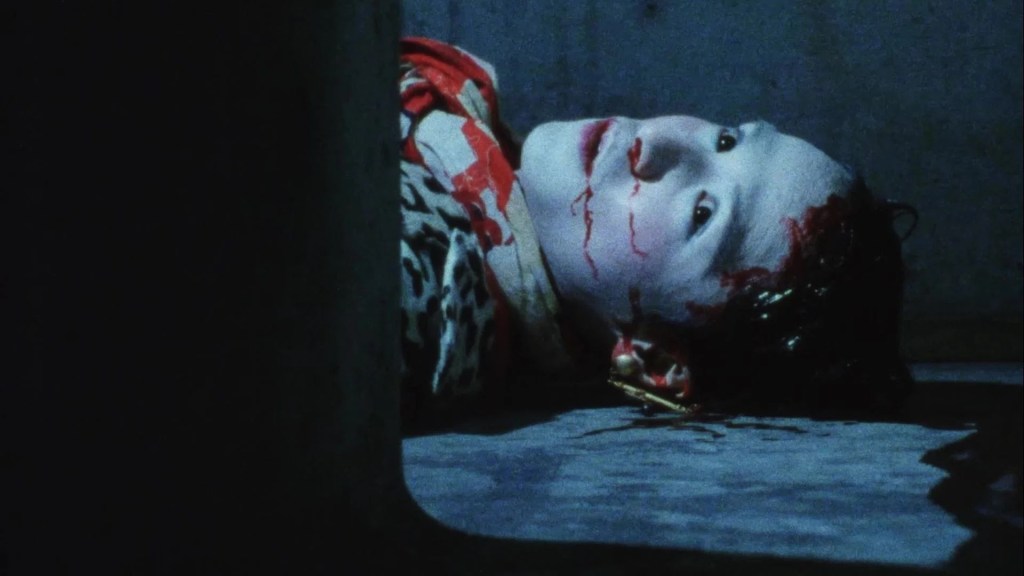
Tokyo Gore Police is a tour de force of crimson fountains, bizarre creatures, and crazy action. Japan has been in the stylized, subversive film business for a while, releasing infamous pinku and pinky violence films (Japanese for “pink,” as in flesh) from the mid-1960s to today. Tokyo Gore Police is a fun throwback to the golden age of splatter films, where anything goes, and decorum is left at the door.
The movie starts with balls-to-the-wall action and never lets up. Eihi Shiina, famous for her role in Audition (1999), plays the main heroine. She does an excellent job portraying the graceful and deadly Ruka, a samurai blade-wielding police officer with a personal vendetta. She is actually somewhat subdued when compared to the rest of the wacky cast, a grounding character amongst the chaos. The fight scenes are frenetic and spastic, filled with anime-style moves and buckets of blood. Physics sometimes does not apply, but everything is so over-the-top that you won’t care. Bodies get mangled up in creative ways with an emphasis on biopunk-tinged amalgamations of flesh and mechanical parts. Additionally, there is a prominent thread of S&M and sexual fetishes that add to the sleaze and titillation factor.
There is quite a bit of gallows humor, which was unexpected and a breath of fresh air. The Japanese obsession with suicide is heavily satirized here with fake commercials touting fancy wrist-cutting blades for girls (that impart a delicious flavor to your blood) and anti-sepukku PSAs. As a side plot, the narrative explores the repercussions of privatizing the police force, and as they slip towards all-out fascism and murder, it becomes clear that the film is not fond of authority figures.
Tokyo Gore Police will probably only appeal to a certain type of horror fan. It’s not high art, but it hits all the right notes as an example of the splatter-film genre. You have to have the right frame of mind to fully enjoy it (some open-minded friends and a couple of beers wouldn’t hurt), but the inventive makeup and character design make for a good time.
Mutant Girls Squad (2010) was co-directed by Noboru Iguchi, Yoshihiro Nishimura, and Tak Sakaguchi. The story is divided into three chapters, with each director taking a segment. An interesting choice: it’s not an anthology film but a single cohesive narrative. All three directors were friends in real life and have worked together on various other projects, so it’s not surprising their styles meshed together so well.
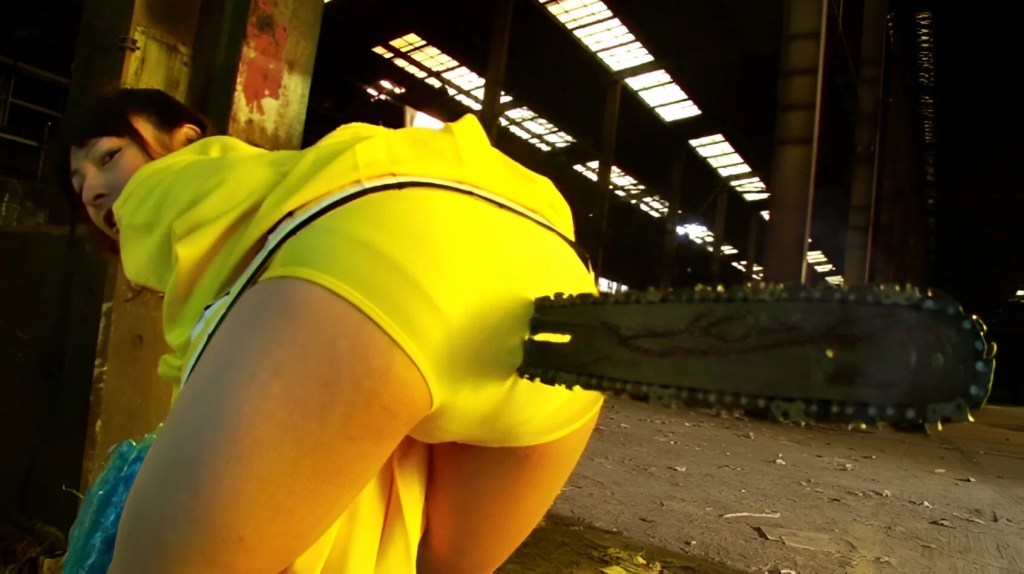
The story follows a high school girl named Rin (Yumi Sugimoto) who is bullied by her peers. After a particularly nasty encounter with a classmate, where she is knocked unconscious, she wakes up in the nurse’s office. The nurse has tied Rin up and informs her that she is “not human”. Once she escapes from the nurse’s clutches and returns home, her parents confirm that she is indeed a “mutant” and that she could have special powers. The rest of the film focuses on Rin learning her abilities and figuring out which side she is on. Apparently, there are other mutants like her that want to get revenge on the humans who have persecuted them. Will she join their violent cause, or will she follow her heart?
Mutant Girls Squad is surreal on a level that the other Sushi Typhoon movies can’t touch. The various mutant girls have ridiculous powers ranging from a chainsaw that comes out of an ass to katana titties, and the fights are absolutely drenched in gallons of blood. There is almost zero downtime, and every second is filled to the brim with zany slaughter and slapstick. It feels like an X-Men homage, filtered through a Japanese perspective; by this point, the Sushi Typhoon house style was prevalent enough to function as self-parody. The script is snappy and funny, and astute viewers will catch many references to other horror films, manga, and anime.
Effects-wise, the focus is still on practical effects (and they are excellent), but a lot more CGI is creeping in, which looks less than stellar. That being said, it is part of the charm and doesn’t detract from the enjoyment of the chaos.
Out of all of the Sushi Typhoon films, Helldriver (2010) might be the most action-packed. Director Nishimura takes a stab at a zombie flick, but with his usual flamboyant touch. Helldriver starts out following Kika (Yumiko Hara), a young woman who is hiding from her sociopathic mother Rikka (Eihi Shiina ) and cannibalistic Uncle Yasushi (Kentaro Kishi). They eventually find her, torture her, and murder her father. Before Rikka can administer the killing blow to Kika, she is hit in the chest by a meteorite (!), destroying her heart. She rips Kika’s heart from her chest and puts it inside of herself, which triggers some sort of strange reaction where black ash starts pouring from her body. This ash covers the northern half of Japan, and anyone who breathes it in is turned into a zombie. Since half of Japan is now zombified, a wall is built to separate the living from the dead. A reborn Kika must use her powers to fight the zombie hordes and reunite Japan!
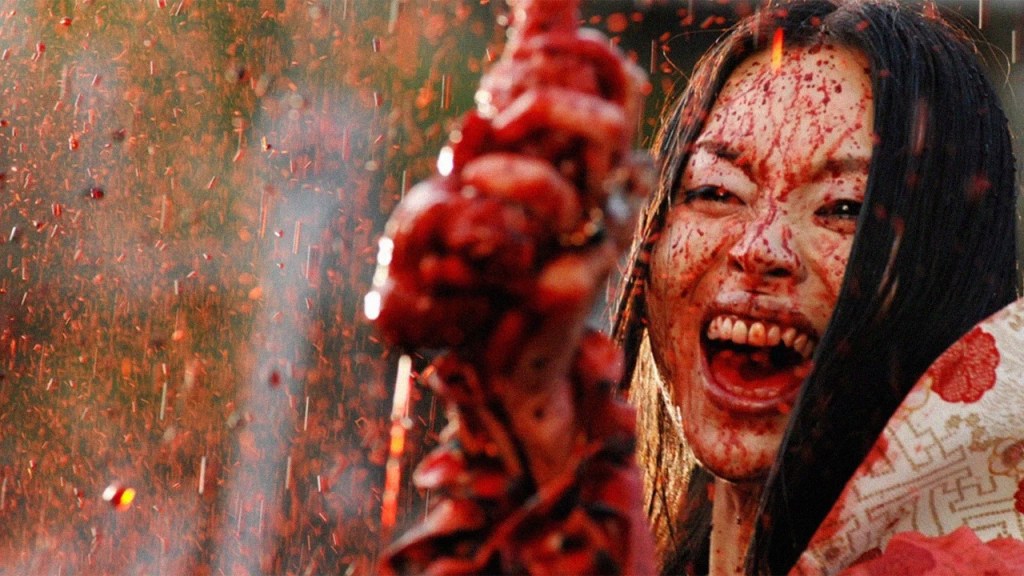
The narrative structure is a little strange, with a somewhat slow setup and the film’s credits not appearing until the halfway point. We don’t have fucking time for opening credits; there are zombies tearing shit up! After that point, it’s balls-to-the-wall splatter action with no time to catch one’s breath. Nishimura’s films always have tough female characters to the point of them being overpowered. It’s great to see the script get flipped in this manner, and it’s fun to see these woman slicing their way through crowds of enemies. Kika has a chainsaw sword with a motor attached to her chest, and as you can imagine, blood and limbs fly all over the damn place everywhere she goes.
The attention to detail with the costumes, gore, and make-up is top-notch. Nishimura takes it to the next level with ridiculous ideas like a car made out of zombie body parts and a zombie AIRPLANE. That’s right, a fully functional plane comprised entirely of the living dead. The last third of the film is borderline overwhelming with all the crazy shit going on. While it’s definitely in the background, there is some interesting political subtext in Japan’s divided landscape, with a few politicians and scientists insisting that zombies should have rights and be considered human. This takes a backseat towards the end of the film. Helldriver isn’t the most coherent movie ever made, but it might be one of the most outlandish!
~~~
Michelle Kisner is a film critic, freelance writer, and advocate for physical media.