
This week’s Guest Star is writer and publisher Anne Perry.
~~~
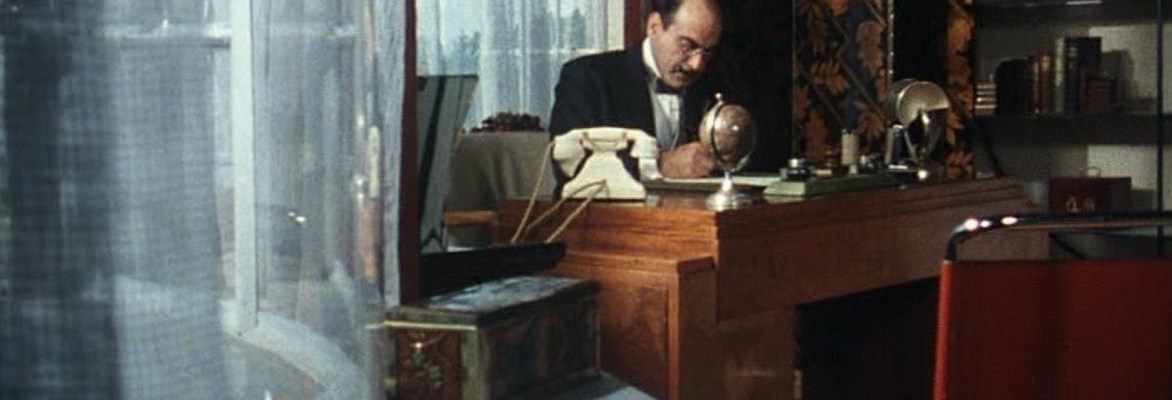
About a third of the way through the 70 episodes that make up David Suchet’s run as Hercule Poirot, (1989-2013), you begin to realise exactly how stylised the series was at its inception: it takes place in 1935 (pretty much for the entire series, despite the relentless march of time outside the series), and, from the beginning, the production designers go to extraordinary lengths to ensure that Poirot’s 1935 London is entirely an art deco London. From his beautiful flat in Whitehaven Mansions, with its soft curves and pastel hues, to extraordinary house after incredible mansion to gorgeous hotel, Poirot’s London, as imagined in 1989, is all gleaming chrome, clean lines and geometric shapes. Stylistically, it’s beautiful.
Even the iconic title sequence, an animated vignette that depicts Suchet wandering through Bauhaus-inspired animations of trains and steamer ships (and floating triangles) is unmistakably deco-flavoured. It screams ‘1930s.’ But it screams something else, too: 1989. Because, into every generation, a Poirot is born. This Poirot is, almost (but not quite) inextricably a 1980s Poirot. And yet, David Suchet and Poirot, manage the impossible: they manage to create a Poirot for multiple generations.
That the earliest episodes of Poirot are so highly stylized should come as no surprise, given the show hit the air during the big deco resurgence of the late 80s; current popular depictions of the late 80s tend to feature the bright colours and boxy squiggles of Memphis modern, but echoes of deco were everywhere in the 80s. Using deco trappings to stylize this new version of Poirot, intended to be more faithful to the source material than, say, the films of Alfred Finney and Peter Ustinov, (both of whom downplayed some of the mannerisms and tics of Christie’s original in their starring turns as Poirot,) made ITV’s 1989 adaptation feel incredibly modern and fresh, especially in comparison to other mystery adaptations also then airing. Despite the fact that the three shows were filmed simultaneously for a few years and took place, chronologically, only a few decades earlier or later than Poirot, the BBC’s Jeremy Brent-starring Sherlock Holmes adaptations (1984-1994), and the Joan Hickson-starring Miss Marple adaptations (1984-1992) feel increasingly dated with every rewatch.
While the ultra-stylized production design made the show feel very different and new in 1989, Poirot’s heightened, deco-forward stylization aged the show in a way its initial showrunners likely couldn’t have anticipated. Where Holmes kept modernity carefully distant, and Miss Marple deliberately avoided the modern, Poirot’s embrace of one very specific historical moment, to the exclusion of all others, tied it not just to the 1930s, but to the 1980s.
In a modern rewatch, the too-uniform settings begin to look almost wrong. Where, the Poirot viewer begins to wonder to herself, is the rest of English architectural history: you know, the Victorian stuff, the Edwardian stuff, the older stuff. Poirot’s early cases take place exclusively in gorgeous deco houses and modern, airy hotels. Watching the episodes one after another becomes a bit overwhelming, in part because they’re so unrepresentative of life in a place like London, where—even in the 1930s—different eras of buildings sat cheek by jowl, giving the city an extraordinary presence. Surely not every factory owner would own gleaming modern factories and not every greedy old pater familia would meet his death on a chrome and leather Guglielmo Ulrich armchair?
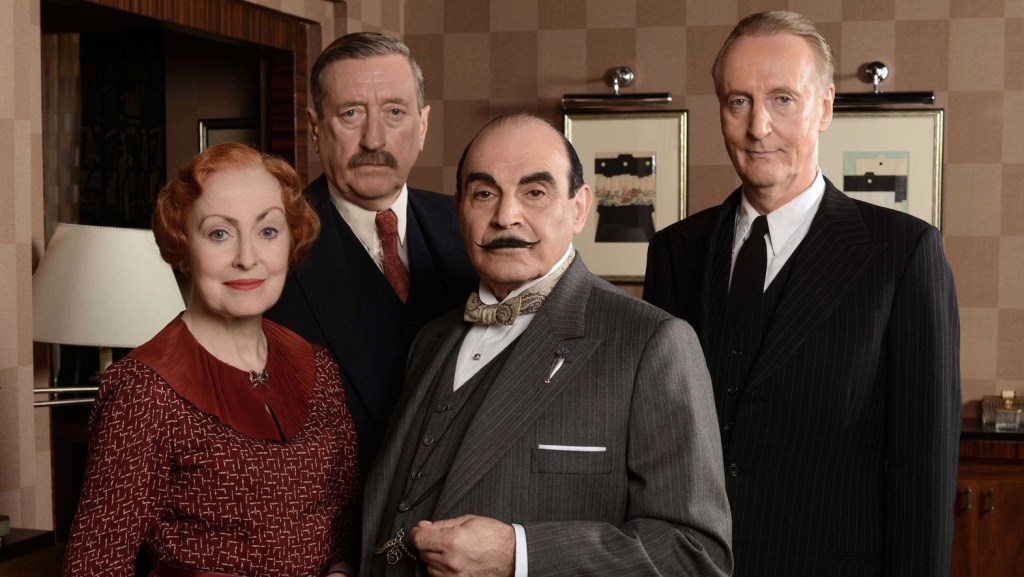
And so, as Poirot the show matured, it moved away from its deco style. Part of this must surely have been due to the fact that there are only so many deco buildings left in the UK to use as interiors and exteriors; the eagle-eyed Poirot viewer might spot certain locations cropping up in multiple episodes. But it also seems likely that the move away from the bright, clean deco trappings of the early Poirot episodes also reflected a larger cultural shift in what audiences wanted to see in their crime shows. The Poirot screenwriters began to reach for darker interpretations of their source material, and the locations and sets became correspondingly darker, as well.
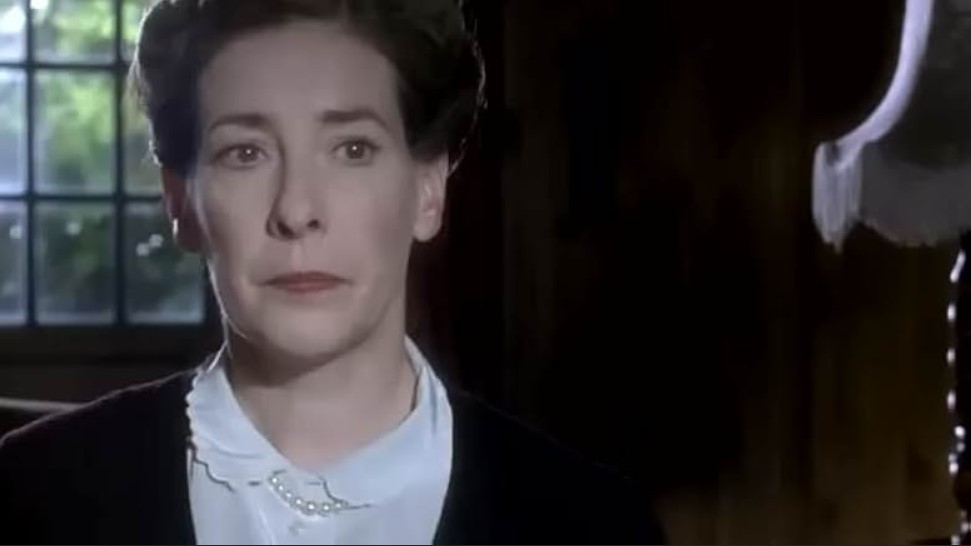
Alongside the rise of Scandi crime, for example, in the 2000s, the darkness inherent in crime stories became a feature, not a bug. Where early episodes of Poirot danced away from thinking too hard about how many folks Poirot was sending to the gallows, later episodes began to lean into the darkness. Episodes of Poirot grew longer, with more cinematic camerawork and bigger-name guest stars, and permitted the characters to spend more time thinking not just about the puzzle-box cases but their broader implications for everyone involved. As the themes of the episodes moved away from the stylised escapism of the show’s early years, so did the show’s look. No longer was Poirot an adaptation of the novels of Hercule Poirot. Now they were adaptations of the work of Agatha Christie, Queen of Crime. Indeed, the series was renamed Agatha Christie’s Poirot in 2003, the new logo featuring Christie’s signature above Poirot’s name, and dropping the title motif nearly entirely.
Moving away from the heightened look of the show’s early years lends its later episodes what we might think of as a more timeless feel now. But that more ‘traditional’ (read: modern to the 2000s) idea of what 1930s England looked and felt like is no less stylised and no less a product of its time than those early episodes. With its focus on sombre, empty mansions, miserable upper-class characters and dark wood interiors, the later episodes begin to hold the past at arms’ length just as the Holmes and Marple series of the 80s did–and which the early Poirot episodes specifically did not.
In 2013, when Poirot ended, cozy crime hadn’t really made its return to the genre yet–and, indeed, was pretty universally frowned upon. Perhaps the most tragic consequence of the show’s move away from its deco roots was the loss of its cheerful opening title song. In the later episodes, it can occasionally be heard at certain points or over the end credits, but by the final seasons, it is entirely absent. Tonally, the motif doesn’t suit the darkness of the later episodes but, like the missing Miss Lemon, Inspector Japp and Captain Hastings, who vanish from later seasons of the show, the motif’s loss detracts from the overall power of the series towards its end. No matter how much higher the production values of those final episodes, they’re mostly joyless and almost entirely airless. Christie was in her grimdark era.
A new adaptation of Poirot—called, fittingly, Hercule—has been announced, starring the handsome 33-year-old Edward Bluemel as a young Poirot. Set to air beginning in 2027, Hercule will depict Poirot during his earliest years in London. Bluemel has demonstrated an ability to play lively, quick-witted characters with a great deal of charisma: none of which are words or phrases I personally tend to associate with Poirot as a character, but is all very much in keeping with the current zeitgeist, which loves to reimagine beloved characters “as you’ve never seen them before!” So this adaptation, too, will very much be a product of its time. What do we want from our young Poirot, now that cozy’s back with a vengeance and we’ve all had to live through both lockdown and Kenneth Branagh’s dour, self-serious Tragedy Poirot? Will this hot young Poirot banter? Will he flirt? Will he run? Jump? Chase after hooligans? Will this Poirot… bang? If Enola Holmes, The Young Sherlock Holmes and The Artful Dodger are anything to judge by: yes.
Very well then. So we will watch, and we will judge, and then we will ask, as we always do: why do we like Hercule Poirot? Why do we keep coming back to Poirot? He’s fussy and egotistical and often irritating, and many adaptations lean away from his (and Christie’s) worst excesses. Poirot does little to hide Poirot’s more problematic—and true to the books—character. And yet we return to Poirot again and again. The answer, of course, is that we watch Poirot not just because we like to inhabit, however briefly, a world filled with elegant cars and beautiful furniture, and not just because it makes us feel good to see justice served. We watch Poirot, from episode 1 to 70, no matter how dark, because of David Suchet.
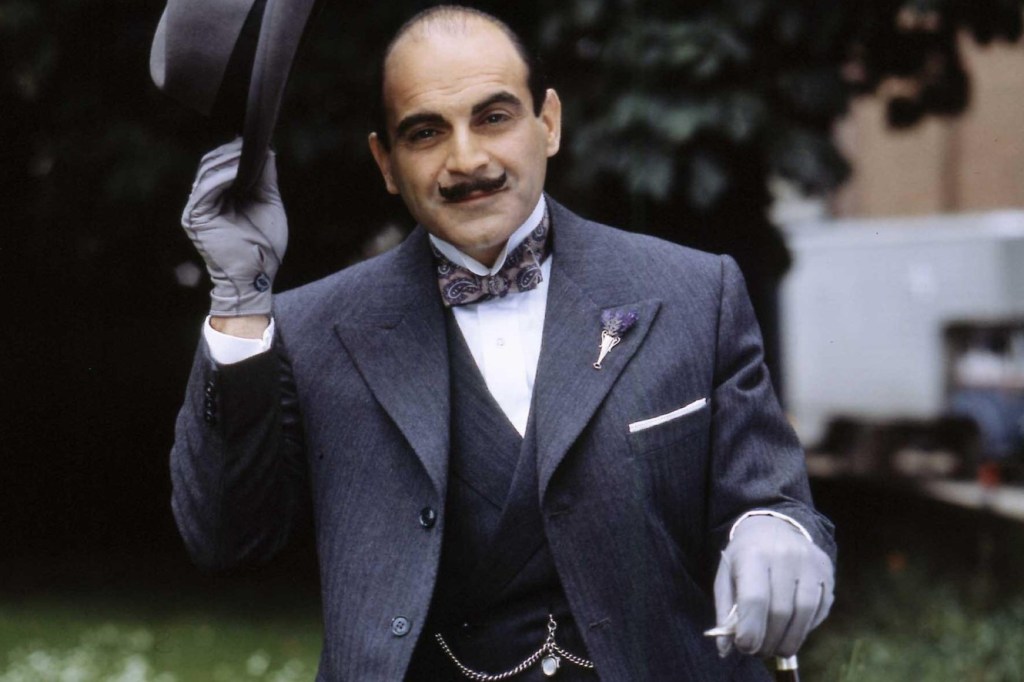
The casting director who hired Suchet deserves a memorial plaque somewhere (probably outside Whitehaven Mansions, so we can all go give thanks when we visit.) Suchet’s incredible ability to twinkle, no matter how dark the events, never fails to elevate the episode—and the spirits. His portrayal is a delight: fussy and precise and formal but so gentle and so loving that it’s no wonder they just kept making episodes till they ran out of source material. No matter how tough things get, no matter who dies or how horribly, David Suchet is there to raise your spirits and reassure you, as all good cozies must, (even the really dark ones, side-eye Curtain) that the bad guys will meet justice, the young lovers will get together, and that justice and order—and happiness—are never far away. We all get the Poirot we need for the time we live in, but with David Suchet, we were blessed with a Hercule Poirot for the ages.
~~~
Anne Perry is an award-winning writer, editor and publisher. She has lived all over the United States and is now based in London. She’s an avid reader, a licensed mudlarker, an enthusiastic fossil-hunter, a fledgling birder, and a font of useless trivia. In a previous life, on the website Pornokitsch, she wrote a long-running column called Monsters & Mullets, about 80s fantasy films. Her debut novel, Stay For A Spell, published under the pseudonym Amy Coombe, is very much about books (among other things).
Categories: Guest Star, Screen