

When trying to decide what to write about this month, I realized director/producer Ram Gopal Varma has yet to appear on the Cultural Gutter—and that simply will not do. Some people reading this essay will assume I might write about one of his thrillers, since horror is a big part of what we do here; others may expect a treatise on Satya, the most significant and esteemed gangster film in Indian cinema. But no, I’m going to look at Naach, a film that I never hear discussed other than as a punchline for its…shall we say “unusual” choreography and costuming choices. And that’s unfortunate. Naach (Dance, 2004) is a Hindi film about the Hindi film industry, and, by simply focusing more on an aspiring choreographer than on an aspiring actor, it’s an unusual entrant in the “Bollywood depicts Bollywood” genre. Additionally, films about women creators are rare, and for that alone, Naach deserves attention.
The film opens with the choreographer character (Antara Mali) dancing in Mumbai streets in a rainstorm.
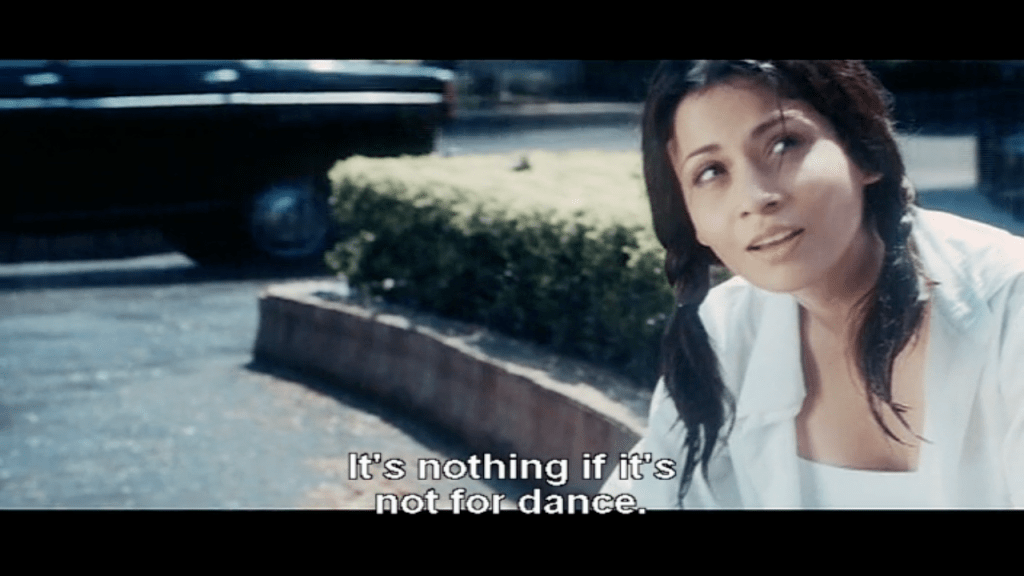
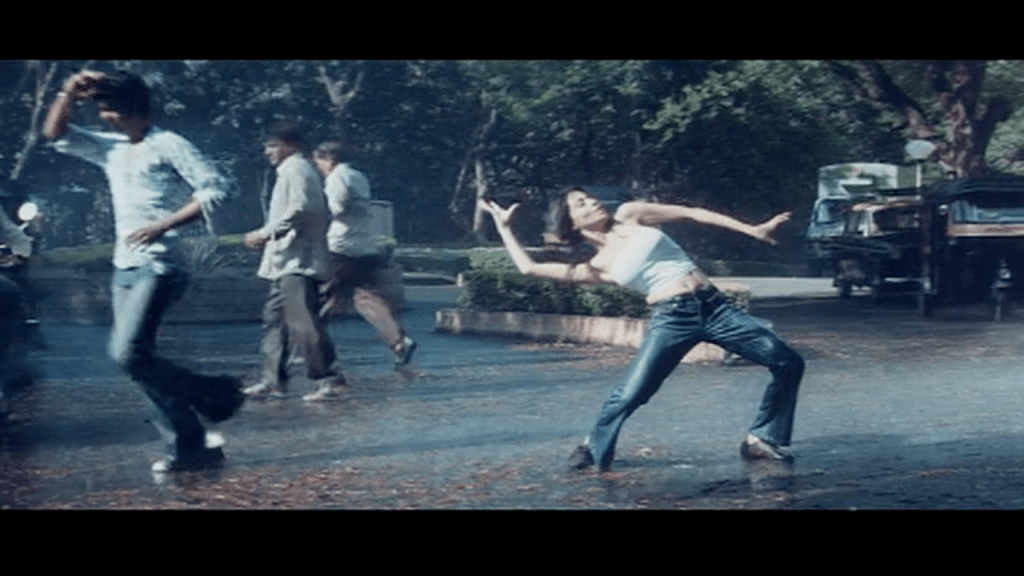

There’s something down-and-dirty about this sequence. Bollywood rain sequences usually appear for heightened drama in a conflict or to make material unexpressed emotions, but here I think the rain is simply an impediment that Reva overcomes as she creates her art; along with rain, she determinedly ignores pedestrians, vehicles, and children crowding her space. And then we see Reva in bed staring at her alarm clock: this was probably a dream, literally and metaphorically. Either way, it was self-authored. She heads to a meeting at a film production office, where she crosses paths with Abhi the actor (Abhishek Bachchan). On the bus home, he says “I’m an actor, but I haven’t acted yet” and admits that he can’t dance—a sin for a wannabe Bollywood hero in 2004. She says she’s a dance director but hasn’t directed anything yet. As far as meet-cutes go, it’s very cute, and it lets them share their opinions about what they do. He’s not convinced heroes should have to dance, but she defends the art well enough that he’s interested in learning more and asks her to teach him. The differences in their artistic ethics become clear immediately: he lies to a new director who wants to cast him that his dancing is merely “out of practice” and asks for two weeks to brush up, whereas she tells the producers that she honestly thinks the music they gave her to audition with is sub-par and walks away. She needs rent money, though, so when Abhi tracks her down to ask for dance lessons, she agrees.
The film establishes from that very first scene that Reva’s art is, to put it mildly, not at all what is usually seen in Hindi cinema. Reva seems to fall into the “is this person a genius or a lunatic” sub-genre of teacher/coach stories, but Abhi trusts her. He wants fame and money and knows it’s in his interest to learn whatever is needed to get them. He doesn’t care if the products are bad. She, of course, is the opposite: the medium of film is necessary to her artistic vision that requires the giant resources and stage that only cinema can offer. This is an interesting distinction: at least according to the subtitles, Abhi doesn’t articulate that he wants to be a star, which makes one wonder why acting is his chosen route to money and fame? There were no social media influencers in 2004, but whatever the equivalent was might have been a better option for him.
Abhi brings his director in to see what he’s learned, and the director walks right past him to Reva, impressed with her style. He sends her a CD of some new music for something he’s working on, and she loves it, finally connecting to art that has come from outside of herself and that might finally be the bridge to professional work that has an audience. The film’s most striking song flows directly from her creative brain; as she narrates her ideas for a song to Abhi in her apartment, we see what she’s imagined. She even takes on the pose of the hero, a stereotypically man-spreading posture with one foot cocked up on her chair.
Unfortunately, the heroine of Abhi’s new film wants a different dance director, so Reva is out. When we see what the actual version made for the film looks like, it’s pointedly cookie-cutter of films of the time. “It’s bad,” says the director, “but it’s business.” As Abhi’s star rises, he and Reva stay together. We know, and he knows, his career is artistically dull and lifeless, and he doesn’t want a matchy-matchy predictable life outside of work. We get more specifics about the effect of stardom for Abhi—money to pay for Reva’s rent, a new car, people hunting autographs—than the details of how he got there, because the film knows his arc isn’t as interesting as Reva’s. Critic Baradwaj Rangan called this character a conformist and realist who makes compromises. As such, he couldn’t be the most compelling person in the story, even if he’s maybe the most relatable, gazing at Reva, starstruck. This simple act of having the lead woman be the juiciest character feels pretty radical, another mark in Naach’s favor.
Reva gets another shot from a director who says he wants something new…and also wants Abhi in the project, and he knows she knows him. She is clearly uncomfortable with being asked to convince him and, more importantly, to tie her success to his—and again she walks away. She wants to work with people who understand her ideas, or she doesn’t want to work at all. She refuses to do any projects that come to her because of him, and he insists she is willfully ignoring reality. When he demands “Who do you think you are?” we know that she knows exactly who she is. Again: score one for this script. Reva’s and Abhi’s principles come head to head, and they part. The film is clear: Reva isn’t a practical person, either emotionally or professionally. If she were, she’d find a way to channel her vision into typical song numbers instead of holding out for a chance to portray her ideas in her own style. She insists on standing absolutely individually as an artist, as a voice, and I admire her for it.
Reva finally gets the chance at working on a music video whose theme is dance, which frankly is a level of meta that is probably too much in a film already called Dance. The director, Diwakar (Riteish Deshmukh), admits he doesn’t fully understand her vision but that he can tell she knows what she’s talking about. He gives her creative control and we finally see her interacting with other people around her work, a simple sequence of her instructing other dancers that I find so satisfying.

Finally her vision is not just in her head; finally there are people she can genuinely collaborate with. Diwakar also insists she star in the video because no one else could possibly execute what she wants. The result is a truly weird spectacle that has a zillion different costumes, sets, and bits of choreography, including tap dance, a form I think I have seen only once in all the Indian films I’ve watched (at about 3:16 in the video below).


The song is a huge hit, Reva becomes the talk of the industry, and Diwakar wants to make a full-fledged musical film with her. You know what’s coming: Diwakar wants Abhi as the co-star. I like to think Reva has already gotten over Abhi and genuinely doesn’t mind working with him, but Reva’s tentative glances at Abhi between takes on the project’s sets make me think she’s submerging her romantic pain for the sake of her art. When they’re working, though, she is in control, able to perform while directing someone she’d rather not see.

[Spoilers in the following paragraph!] We all know stories in which a man tells his woman love interest that he has to leave her/the relationship and go off and prove himself before he can really be worthy of her, and there are moments in Naach when I think that’s where the arc is going. But no. It’s true that Reva and Abhi reunite only when her power and success are at their highest point in the story, but she never staked her relationship to those things—in fact she did the opposite, saying that their work and their relationship were separate. Instead, Reva’s success is proof that her self-knowledge and self-confidence were correct and justified. Only when Abhi sees that, and agrees that she was right, can they come to a new sense of knowing each other and reconnecting. Abhi is successful too, but despite giving him the fame and money he wanted, his work is not satisfying to him the way hers is. And yet I don’t think the film is saying one partner must be unsatisfied in order for two creatives to have a good relationship. Abhi isn’t jealous of her success: he admires her ability to self-define and find her own way instead of doing the derivative types of projects we’ve seen him in and to have had the sense of self that enabled her to make those choices. [End spoilers.]
It’s also impossible to talk about Varma without noting his, uh, lingering gaze on some of his women stars. The film focuses, with great intensity at times, on Reva’s body, since that is the medium of her expression and creativity. But she also exists very much in her own mind, which is not a state Bollywood heroines are often allowed. As much as I want Naach to be a noble stride towards expanding and complicating stories about women, it’s probably also the ol’ exploitationer’s gambit (to quote fellow Gutter contributor Keith Allison): how will we know Reva’s sinuous choreography in drenched, clinging clothes is more than it appears to be if we don’t first see the drenched, clinging clothes? On one hand, the choreographers and wardrobe department could have come up with less overtly titillating options for Mali to perform/wear without diminishing Reva’s creative fire, but on the other, why shouldn’t sexuality be part of her art and vision? After multiple viewings, I think the film is strong enough to be worth putting up with its leering. Reva’s dancing is the representation of her true inner self—unconventional, determined, strong, always present and in motion—and that it is therefore reasonable and fair to focus on the instrument that expresses these ideas to the viewer. Mali had worked with Varma multiple times before this film, so I like to think she signed it with knowledge of how the character might be depicted. (It’s also true that she did only two films after this one, so I have to wonder what happened. “It is difficult enough to be a woman in this industry. And to be a woman with a point of view, you get slotted. They expect you to be a bimbette and if you have an opinion, only god can help you,” she said in a 2015 interview.)
It’s also interesting to consider the casting of Abhishek Bachchan as Abhi. As the son of Hindi cinema’s most popular actor of all time and thus a life in limelight and under scrutiny, he brings specific experience to the idea of desiring fame. But since his father is not just a huge star but also one who broke the mold for what film heroes were like, I wonder if Varma and Bachchan are saying something about being satisfied with being a cookie-cutter star rather than a capital-A Actor. This is knowledge and background narrative that every viewer of Naach would have had, and I’m sure Varma was playing with these ideas. Bachchan and his father both star in other Varma projects, and I assume the director felt safe dabbling in the real/reel contrasts. The film doesn’t touch on nepotism, which twenty years later is an issue more people are willing to talk about, but it does have something to say about other realities of the film industry, like the importance of bankability, networking, and name recognition in gossip columns. Unfortunately, it’s also true that Bachchan is not a particularly good dancer—though he does perform Abhi’s bland stereotypical moves in a way that communicates an uninspired sleepwalking that we can imagine any Bollywood hero might experience—so in the big number “Berang Zindagi” we don’t really see the height of talent and creativity that this song could represent in both Reva’s and Abhi’s careers.

Varma has significant experience both in the mainstream Hindi industry and also outside it, having directed over two dozen films in the Telugu industry too, so he has the distance to say something critical about Bollywood and the insider knowledge to make it land. Combined with his prolific output as producer and writer too and infamous give-no-f*cks attitude about almost everything, he can actually get away with implying that many mainstream Hindi films and the ways they are made are vapid and anti-art without being snobby or self-deprecating. His points aren’t unique, but the casualness with which he makes them is bracing.
For all its strengths as a film about a woman creator and a film about films, for me Naach is also a surprisingly successful love story. From the beginning, Varma doesn’t show us every exchange Reva and Abhi have, even when we can see their lips moving. Their chat on the bus is interspersed with tilted views of the other everyday passengers on the bus, yarning, chatting, paying their fares. We get the idea of their relationship without the particulars, and Varma seems to be trusting that that’s enough. The film’s tight, personal focus on love and understanding other people’s values and figuring out your own priorities feels mature, and both leads perform it well. Maybe I’m too sentimental, but I like the idea of a fiercely self-determined weirdo and a pragmatic normie finding mutually supportive love without compromising, despite the pressures of a cut-throat industry. Making them in related but not directly competing careers is smart; hopefully it means they can continue to understand and be safe harbors for each other as they progress professionally, even if they never work together again.
Naach is available with subtitles on Einthusan (outside India). If you like the idea of a self-directed, self-propelled creative woman in the film industry, Mali’s performance as the aspiring film heroine in Main Madhuri Dixit Banna Chahti Hoon, also directed by Varma, is a delight. And of course RGV’s Rangeela (also with subtitles on Einthusan) is a classic for many reasons, thought for me its heroine is less intriguing than those in Naach and MMDBCH.
~~~
Beth Watkins’ groundbreaking visions for Fauxgyptian villlain lairs will one day be a reality. We just have to believe.
Categories: Screen




 The Cultural Gutter