
Sometimes you just want to watch a quirky investigator irritate people—especially wealthy and powerful people—into revealing they’ve committed crimes. Especially murder. I’ve been enjoying some new and new-ish mysteries lately, Poker Face, Elsbeth and The Residence. All three feature women investigating murders. All are series produced after Rian Johnson’s Knives Out (USA, 2019) made it clear to studios that 1970s-style mysteries with eccentric detectives could make money—or at least not lose it—and that audiences wanted some diversity in this franchise monoculture.And all three have varying degrees of 1970s murder mystery history in them. But when I saw someone describe The Residence ( 2025) as “the new, female Columbo,” I decided I needed to say some things about that. Cordelia Cupp (Uzo Aduba), the world’s greatest consulting detective and dedicated birdwatcher, is not the new female Columbo. She is the new Cordelia Cupp. And aside from being a quirky detective investigating a murder among the powerful, Cupp doesn’t have all that much in common with LA police detective Lieutenant Columbo, or the 1970s crime series (with made-for-tv movies stretching into the 2000s) named after him.* Her style is eccentric. She waits for the murderer to make a mistake. But the detective Cupp reminds me the most of is not Columbo, but Agatha Christie’s Hercule Poirot, which also puts The Residence very much in the spirit of the Benoit Blanc mysteries. The Residence even has charming opening credits and title card paintings by Maira Kalman that feel like a play on Edward Gorey’s credits for PBS’ Mystery.

Brought in by Metropolitan Police Chief Larry Dokes (Isiah Whitlock), Cupp investigates the murder of A. B. Wynter (Giancarlo Esposito), the White House’s Head Usher. You might think a murder mystery set in the White House would be distressing right now, but it is not. The series is set in the near future or an alternate present so none of the current horror is happening there. Based on Kate Anderson Brower’s The Residence: Inside the Private World of the White House (New York: HarperCollins, 2016), The Residence reveals the ways the White House is, like D.C. itself, a Black space. The White House was built by enslaved Black people and there is a long history of Black people running, working in and maintaining the residence while presidents, their families, and their advisors come and go. In its filming and its use of space, The Residence feels a bit like Only Murders in the Building. Like that series, The Residence focuses on one murder over the season, has a lot of humor, and has a playful sense of narrative structure. For most of the season, the episodes occur during and after an Australian State Dinner, where clearly, the US has to make amends after some never-explained huge mistake. I have my own assumptions about that, but they are not confirmed. I do like that this implies that there is a future for us after the current shitheelery.

Cupp has President Morgan (Paul Fitzgerald) lock down the White House so that she can interview every person present during the dinner. Unlike Lt. Columbo, Cupp doesn’t try to get the people she interviews to lower their guard with disarming questions and friendly behavior. Cupp invites no one to underestimate her. Instead, she sits staring unnervingly at her interviewees till they start spilling everything in their heads. The show retroactively illustrates that evening as each person relates what they saw and did. It even intercuts earlier accounts, which is particularly fun—especially regarding moments with Jane Curtain and Jason Lee. Cupp takes breaks from her interviews by trying to see all the bird species Teddy Roosevelt noted on the White House grounds.
FBI Special Agent Edwin Park (Randall Park) is assigned to assist Cupp. Park is a competent agent, but he’s inclined to the most pedestrian investigation and analysis, which is good enough for most crime. Cupp reasonably suspects that he’s been assigned to her to monitor and interfere with her investigation if it becomes politically messy. With the elegant setting, the black tie evening wear, Cupp’s disdain and her occasional grudging admission that Park has a point, it’s like if Poirot were saddled with Inspector Japp by the Home Office to investigate a case that touches sensitive matters. But overall Cupp is not Hercule Poirot or Lt. Columbo. Cordelia Cupp is Cordelia Cupp. And The Residence is an excellently made, narratively complex, funny show that knows you worry that it’s a waste when Giancarlo Esposito is dead at the start.

There are, however, two other current shows featuring women solving crimes that are much more Columbo-coded. Elsbeth (2024-ongoing) follows lawyer Elsbeth Tascioni (Carrie Preston), a recurring character in The Good Wife (2009-16) and The Good Fight (2017-22), as she moves from Chicago to New York to supervise a consent decree governing the NYPD. She becomes a de facto detective for what appears to be a Manhattan-based major case squad led by Captain C. W. Wagner (Wendell Pierce). Officer Kaya Blanke, (Carra Patterson) is assigned to Elsbeth and together they solve crime while becoming friends.
Of the three shows, Elsbeth follows Columbo‘s formula most closely. While Elsbeth is not a police detective, she works directly with the police and her cases result in arrests, prosecutions and incarceration. Like Cupp, Elsbeth is likely neurodiverse. Unlike Cupp and like Columbo, she likes other people and immerses herself in their lives and professions—developing a love of opera, trying to declutter, signing up for suspect’s spiritual retreats and dance classes. As with Columbo, almost every episode begins with a murder committed by a wealthy or famous person played by a guest star. We see the murder and we see why it happens. Like Columbo, Elsbeth irritates the hell out of her prominent, wealthy and powerful suspects. Elsbeth doesn’t exactly invite people to underestimate her, but she knows how to use it. She even does variations of Columbo’s “one more thing.”
Unlike Columbo, though, there are overarching story arcs, and sometimes characters involved in previous investigations return. In fact, the season 2 finale involved several returning guest stars and a delightful musical number. It reminded me of Paddington 2 (UK, 2017)** and I like to think that Elsbeth would be pleased by that association. Elsbeth seems like someone who loves Paddington 2. Elsbeth’s friendship with Kaya and Captain Wagner as well as Kaya’s decision to pursue her detective shield play out in longer arcs. Elements and plots related to the consent decree mostly play out in season-long arcs, too. The use of a consent decree is an interesting solution to making a murder mystery that doesn’t feel like it ignores the reality of police abuse, corruption and killings. It’s an interesting take on current screenwriting style, too. And the arcs don’t interfere with the real Columbo-esque pleasures of Elsbeth. Each week we enjoy seeing more or less sympathetic guest star—Keegan Michael Key! Jesse Tyler Ferguson! Linda Lavin, who wasn’t in Columbo, but could have been! Retta! Gina Gershon! Blair Underwood! André De Shields! Jane Krakowski! Mary Louise Parker! Murray Hill! Nathan Lane!—murder another guest star playing a more or less sympathetic victim. We see Elsbeth have a sense that something’s off—or even suspect someone right away. Then we watch Elsbeth, Kaya, and an array of department detectives solve the case with the backing of Captain Wagner.
There are only two cases where we don’t know who the murderer is until the end. The first one is a struggle for Elsbeth, not because the murder is so ingenious, but because Elsbeth is struggling with who she is. The second, in the most recent season finale, helps Elsbeth rediscover her belief in trying to do the right thing in a legal system where the innocent are punished and the powerful escape justice. But while these things are all still true, I have to say it is incredibly enjoyable to watch a fantasy where the powerful are subject to the law and are irritated by a middle-aged Midwestern woman who wears brightly colored, wildly patterned, astonishingly textured clothes and an inconceivable number of tote bags. It’s even better when the cast and characters are as diverse as they are and the crimes are contemporary.

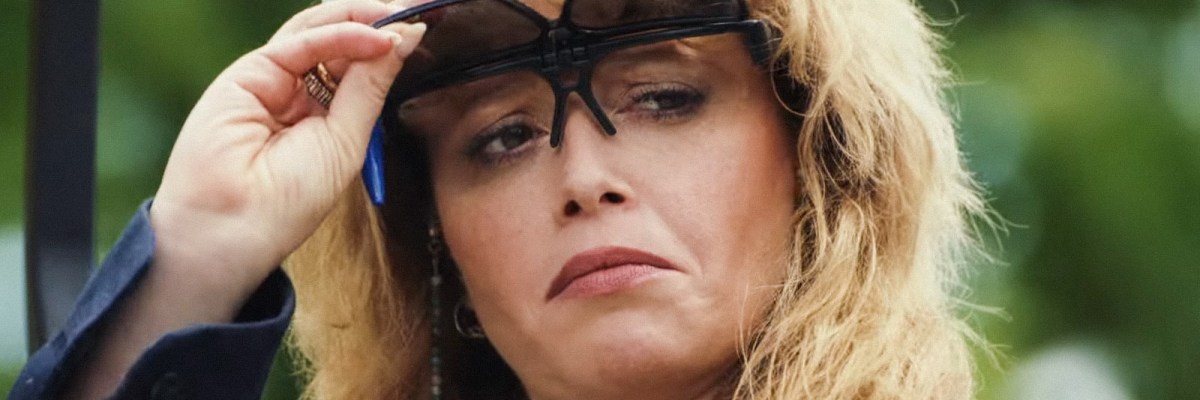
But if we’re just going by sheer Peter Falk embodiment, the “new female Columbo” is unarguably Natasha Lyonne’s Charlie Cale in Poker Face (2023-ongoing).*** It’s not entirely surprising since the series was produced by Rian Johnson. (It’s showrun by Nora & Lilla Zuckerman). Charlie has the twin powers of channeling Peter Falk as Columbo and being able to tell when someone is lying. Charlie smokes, but instead of smoking resplendently nasty green cigars, she smokes cigarillos and later vapes—techno-cotton candy cartridges. And instead of being a police lieutenant, she’s a former gambler and cocktail waitress solving murders because no else one will. Poker Face also resembles Columbo visually. It has the classic 1970s yellow opening titles. The grainy rich look of tv shot on film. Poker Face could be an alternate universe NBC or ABC Mystery Movie in the 1970s and 1980s. Charlie even has a signature automobile—a 1969 blue Plymouth Barracuda, which admittedly is more in keeping with Rockford‘s Pontiac Firebird than Lt. Columbo’s beat up 1959 Peugeot. But then a police lieutenant needs a different vehicle to disarm upscale murderers filled with hubris. What Charlie needs is speed and a car with limited electronics.
Poker Face starts with Charlie Cale working in a Los Vegas casino. The owner, Sterling Frost, Sr. (Ron Perlman), hired her because he wants to keep an eye on her. When her friend Natalie (Dascha Polanco) is found dead, Charlie has every reason to expect Natalie won’t receive justice from the system. So Charlie begins to investigate all the things that don’t add up. In the first season, Charlie solves murders all over the country while she’s on the run from Sterling. In season 2, Charlie embraces her drifter lifestyle after talking over the CB with a trucker called Good Buddy (Steve Buscemi). Like Elsbeth and Columbo, Poker Face is all about the guest stars—Kunail Nanjiani, Chloë Sevigny, Margo Martindale, Luis Guzman, Cynthia Erivo, Jameela Jamil, Clea DuVall, Hong Chau, Tim Meadows, and Phil Tippett’s hands and animation work. Each week a guest star murders someone. We see why and how. The mystery is always how Charlie is connected to them, why she investigates and how she solves the murder.
Unlike Cordelia Cupp, who can afford to travel the world to observe rare birds and Elsbeth who made a lot of money as an attorney in Chicago, Poker Face‘s Charlie, like Columbo, is working class. Though Lt. Columbo was likely comfortably 1970s middle class with a house, shag carpeting, a yard for his dog, Dog, and all that. Charlie is living out of her car, first on the run and later seeing the country and helping people like some other tv shows around Columbo’s time—from Route 66 (1960-4) to Renegade (1992-7). When Poker Face adjusts its formula, it sticks to the more or less sympathetic guest star murdering another more or less sympathetic guest star and changes the overarching arc. Contemporary screenwriting tends to focus on the arc as the most important story element and not the thing-of-the-week. And a car chase or fist fight á la Jim Rockford, absolutely doesn’t cut it for a B plot, no matter how much 1970s detective series are in style. So I appreciate that both Elsbeth and Poker Face prioritize the episodic stories. And I can’t even believe I’m saying that when I used to be so intrigued by the idea of season long or series long arcs in episodic series. But I am starting to feel oppressed by it.
One thing I really appreciate about Poker Face is how much it makes me feel for the victims: the highway sandwich shop worker / Marine vet Damian (Brandon Michael Hall) who posts videos of special sandwiches he makes and recognizes another man is starting to spiral into something ugly; George the BBQ pit master (Larry Brown) who has become vegan and wants to do something else; Felicity Price (Cynthia Eviro) working on her art in a camper in the wood in an episode where Cynthia Eviro is both the guest star murderer, the guest star victim and 3 more roles; and Joseph the class gerbil in a college prep elementary school. So many cozy mysteries are so focused on the puzzle that the humanity—though rarely the gerbility—of the victim can be lost. Possibly their very coziness relies on forgetting the humanity of the victim. But most of the time in Poker Face, I absolutely do not want the character to die and am happy to get to spend more time with them after their death.

Unlike Cordelia Cupp and Elsbeth, Charlie mostly doesn’t work with the police. She helped FBI Special Agent Luca Clark (Simon Helberg) a few times when it helped her, too, and she worked with a minor league baseball fan who was also a retired cop to solve a player’s murder and save the stadium. Charlie recognizes that for her and most people, law and justice are not the same thing. As she tells a killer who scoffs at the case against him holding up in court, “I’m not a cop.”
The police are a presence in Poker Face, but it’s more like Charlie brushes up against and must navigate them somehow. Charlie’s search for justice and desire to help people is a response to the world we live in—a world where the powerful and the state-sanctioned get away with it all the time and are working extra hard right now to keep it that way and to make it legal and official that they never have to face any consequences. Charlie tries to help and do the right thing outside the legal system. Cordelia Cupp gets sucked into contact with the legal system for a while, before escaping to birdwatch again. Elsbeth struggles with how to find justice and do the right thing—whether it’s worth even trying to—as she is embedded within the legal system from nearly every position—defense attorney turned police monitor turned homicide investigator turned subject of judicial abuse turned accused turned detainee. They all struggle and their screenwriters all struggle with what justice means, how to depict justice being done, and what the enjoyable fantasy of a world where justice is done looks like.
But before I go, though, there’s just one more thing. You got me. I confess. It doesn’t really matter to me which detective is the most Columbo. It was just an excuse to talk about The Residence, Elsbeth, and Poker Face. They’re all good and all three shows—four if you count Columbo—are worth your while. If you haven’t watched Columbo yet, you should watch that, too. I hear Mrs. Columbo****is a big fan of them all.
*Yes, old tv weirdos, I am aware that Columbo was part of an alternating line-up of detective shows aired under The NBC Mystery Movie and then The ABC Mystery Movie. Enjoy my piece on The Snoop Sisters.
**I am not explaining this. You’ll just have to watch both.
***Just imagine a Wings of Desire (Germany, 1987) with Lyonne!
****I do not acknowledge the existence of Mrs. Columbo, the show starring Kate Mulgrew.

~~~
Carol Borden peels out in a red Mustang with white stripes on the hood. Later gators!
Categories: Screen




 The Cultural Gutter
I only read the last part with one eye as I have not seen the latest series of Pokerface but all the hell yeahs and whistling the Mystery Movies theme even now and wanting to watch Elsbeth and The Residence all over again.
LikeLike
I am gratified! Do it! Watch them all again!
LikeLike
“Sonata for Flashlight and Synthesizer” by Henry Mancini!
LikeLiked by 2 people