

This movie raises an eternal question: is this plot Bollywood or is it Dickens?
Note: technically I have read little Dickens, so we’re going on ✨VIBES✨!
Soldiers at the Indian frontier who are more interested in poetry and whiskey than fighting. A kindly religious father figure. A villainous gang. Juicy coincidences. Secrets concealed in a lunchbox. Tell-tale tobacco products. Mistaken identities. Twins. There’s no spontaneous combustion, and more’s the pity, but there is jumping out of a pilot-less burning plane, and I think that’s a fair trade.
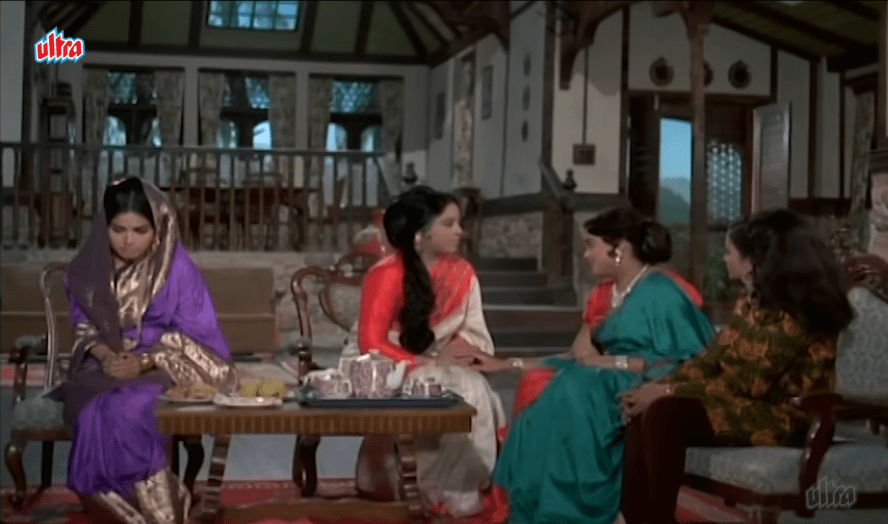
Sharmeelee is a study in contrasts and opposites. Twin sisters—Kanchan, the distressingly shy sister (below right), and Kamini, the relaxed and outgoing one (below left) (both played by Rakhee)—are entangled in the same complex fate, and in their subsequent decisions and actions, we see them grow beyond their basic characterization. There is nothing in the first quarter of this film to suggest where it will zig and zag in its remainder, so I don’t want to say much more about the plot, but know that it somehow packs in all the elements above without toppling over into ridiculousness. Some suspension of disbelief is required, but nothing too strenuous—and not about anything that matters beyond device.

The meaning of this film is full of substance regardless of the details of the action. What happens would be as at home in a noir as it is in this romance-tinged masala. What matters is not one but two young women getting to learn and try to navigate what life throws at them. Sharmeelee is an exceptional gift, and, especially because it’s packaged so beautifully in vintage candy colors and Himalayan snow, I find myself drawn to this film again and again. In my 20 years of experience with the Indian film blog- and social media-spheres, it’s also highly under-discussed. I regularly encounter film fans who have never even heard of it, so I’m really pleased to bring it to the open minds at the Gutter.
Sharmeelee’s primary symbolism is the natures of two identical sisters, but almost everyone in the film serves as an opposite to someone or something else. There’s Ajit (Shashi Kapoor, below right), a captain in the army whose colleagues love his poetry so much that we never hear a word about his prowess as a soldier. Their colonel (Iftekhar) is more interested in Ajit’s mental health and genially providing tourist support to civilians than in any strategies or missions. Father Joseph (Nasir Hussain, below left) is a Catholic priest who cares greatly for those in his neighborhood, as well as serving as a father figure to Ajit, but fails to take decisive action or offer ethical advice at key moments. WWJD? Pretend one twin is the other in the face of life-altering decisions, right?

The sisters’ mother (Anita Guha) is a more machiavellian version of Mrs. Bennet from Pride and Prejudice. Instead of offering comfort and support to Kanchan, who from a 2025 perspective clearly experiences social anxiety disorder, she argues with the families of prospective grooms, trying to convince them that a girl who cannot even look them in the eye is a good match for a son who values education and independence. Her actions will lead to the setup of the second half of the film, and I don’t want to spoil things, but just know her meddling affects everyone else in the story—and even Indian national security! There’s a reason Mrs. Bennet wasn’t allowed near MI5.
What sets Sharmeelee apart from the other Indian films I’ve seen about twins and other character pairs of opposing traits or meanings is that it modifies and complicates them as it goes along. (Again, I’m trying to avoid spoilers, but if you are very averse, skip to the next paragraph.) Here it isn’t as simple as one is good and one is bad, the latter either dying in sacrifice (and to let the audience know their past is being punished or having due consequences) or having a huge change of heart that renders their past actions forgiven and their identity re-integrated into a good, or at least better, family unit. Nor do the two join forces to defeat a common enemy, even though the same villain imperils both of them at different times. In fact, Sharmeelee dis-integrates the family system rather than stitching it back together. Kanchan and Kamini have a harmonious co-existence at the beginning of the film, but by the middle they are on paths that are not only radically different but also in conflict, and they never come back together.
Very surprisingly for a mainstream Hindi film of any era, it is Kamini—loud, attending graduate school, wearing short skirts, generally taking up space—who is almost everyone’s favorite in the first part of the story, including Ajit’s. Kanchan—bonded to woodland creatures, good at managing a household, with no education worth noting (“What good is education for a girl?” says her mother)—is so shy that her overall life is impacted and curtailed. She’s not coquettishly or modestly shy: she’s pathological, physically twisting herself to avoid seeing or being seen. According to the film, neither of these modes of living is enough. You may have smarts and verve, but you must apply them carefully and thoughtfully, with regard to others and to society. You may be upright and harmless, but you must recognize and engage with reality.
Ajit also has to integrate the sides of himself: the poet eventually has to fight, and the “but I was right!” golden boy has to stop feeling sorry for himself and confront what’s actually happening. He loves easily but is also suspicious; he’s a hero by training but also foolish. In the song “O Meri Sharmeelee,” for example, he runs through the forest, trying to sing to the wrong twin—and we can tell he’s made a mistake, because as the song starts he immediately trips over a rock and falls. He’s literally on the wrong foot.
Because of the presence of an espionage plot, I think the film suggests that these more complex, more reconciled versions of people are necessary to the health of the nation (in addition to the individuals’ own stability). India needs women who do what is right for tradition and for reality. It needs brave men who are also in touch with arts and emotions. It needs parents who work to understand who their children truly are, and it needs leaders who are actually paying attention. The film’s repeated use of grounded fantasy sequences, in which characters imagine something that could be happening but isn’t actually, suggests that reality is crucial.
Both of the leads deserve praise for handling with ease the varying components of their characters, especially Rakhee, who has twice as much to do. Despite how much there was going on in the movie, with plot twists every fifteen minutes or so, the characters themselves never lurch. They progress and adjust, but every change makes sense. Rakhee is an actor whom I see discussed more in her later years, when she is the mom to heroes in the 1980s and 90s, than I do in her own heroine era. I know why this is (because those heroes remain hugely popular to this day, and she had some fierce and impactful roles in their films), but I wish we could expand the conversation to talk about her when she was a lead in her own right. I think she got a little squeezed out of public consciousness, first by the more popular and slightly more established Sharmila Tagore (they’re both from Calcutta and working in both Bengali and Hindi films), later by the more brazen and carefree-seeming actors who caught public attention as heroines shortly after her (most notably Parveen Babi and Zeenat Aman). Rakhee is absolutely the star here, playing not just the initial twins so convincingly but also altering them as the film progresses, showing them facing shocks, pushing through fears, and putting themselves in great danger. There are a few moments in which the film wants you not to be completely sure which twin you’re watching, and she’s great at that demand, but otherwise you can always tell which one is which. Costuming helps, of course, but Rakhee has made Kanchan and Kamini their own unique individuals, each one with their own pleasures, hurts, and secrets. Shashi Kapoor is always reliable in romantic dramas, and he plays the good-natured but imperfect Ajit with oodles of charm. It’s really fun to watch Rakhee and Shashi flirt their way through the encounters, especially when she smiles with big-hearted affection or when he leans in dangerously close with poetic sweet-talk.

(There is a much nicer upload of this song here, but it cannot be embedded.)
You can—and should!—watch this film immediately. It is lovely, it is expertly managed, and it is just so interesting. For all the moments of hijinx (which I have largely not touched due to spoilery reasons, including an entire subplot that is wild), the film tackles the very human questions of what constitutes a good person and a good relationship. If all that sounds a little too thinky for your current mood, you could also just turn this on and let the visuals and songs wash over you. I haven’t specifically called out the music by film composing legend S. D. Burman, but I should (✔) because it is expressive and so hummable.
Sharmeelee is available with English subtitle) for free on Youtube. Content warning: this film has a scene of attempted rape. It is more implied than explicit, but I found it pretty hard to watch, even though I’ve seen this film many times. If you want to see more Indian films with twins, there’s a huge list on Wikipedia. My other favorites in which one actor plays both twins, which is a far more interesting challenge (and reward for the viewer), are Seeta aur Geeta and Chalbaaz, both of which star women as the twins.
~~~
Beth Watkins appears in vintage colors.
Categories: Screen




 The Cultural Gutter