
Please welcome our newest Editor at the Cultural Gutter, Michelle Kisner!
~~~
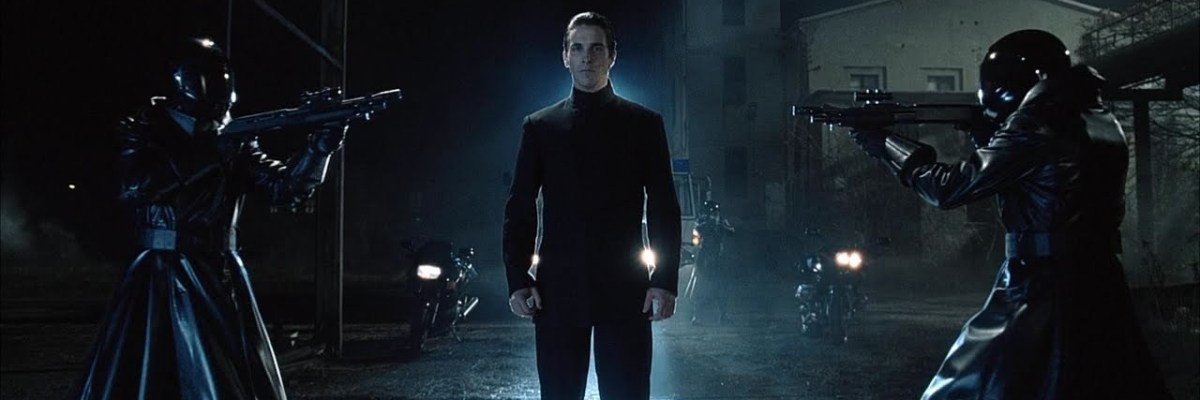
Despite lukewarm reviews and poor box-office performance in 2002, Equilibrium has captivated audiences and become a cult hit in the decades since its release. That isn’t to say it’s a film without issues; the main one is that it is quite derivative at times, with echoes of Fahrenheit 451, 1984, and The Matrix, but it runs with these inspirations, crafting a unique aesthetic and universe.
In the opening monologue, the narrator neatly lays out the lore of the film:
In the first years of the 21st Century, a third World War broke out. Those of us who survived knew humanity could never survive a fourth that our own volatile natures could simply no longer be risked. So we have created a new arm of the law: the Grammaton Cleric, whose sole task it is to seek out and eradicate the true source of man’s inhumanity to man: his ability to feel.
As a response to the endless violence and the near eradication of the human race, the population that is left is forced to take Prozium. This strong antidepressant dampens all strong emotions, both good and bad. A common criticism of the film is that it is inconsistent in depicting individuals who don’t feel emotions, but this stems from a misconception that they have no emotions. Antidepressants target the neurotransmitters in the brain and can alter levels of serotonin, norepinephrine, and dopamine. The emotions are still there, but the chemical release that causes the highs and lows is severely diminished. Therefore, the microreactions and subtle emotions the characters exhibit aren’t a failure of the writing; they’re a realistic portrayal of heavy medication.
John Preston (Christian Bale) is a cleric, one of the best, and his commitment to the Tetragrammaton Council, a Nazi-like fascist dictatorship, is unwavering. Even when his wife Viviana was executed for committing “Sense Offences,” Preston continues his work as a cleric, searching out and killing resistance members and other Sense Offenders. His partner, Errol Partridge (Sean Bean), has been acting suspiciously, which prompts Preston to look into his extracurricular activities outside of work.
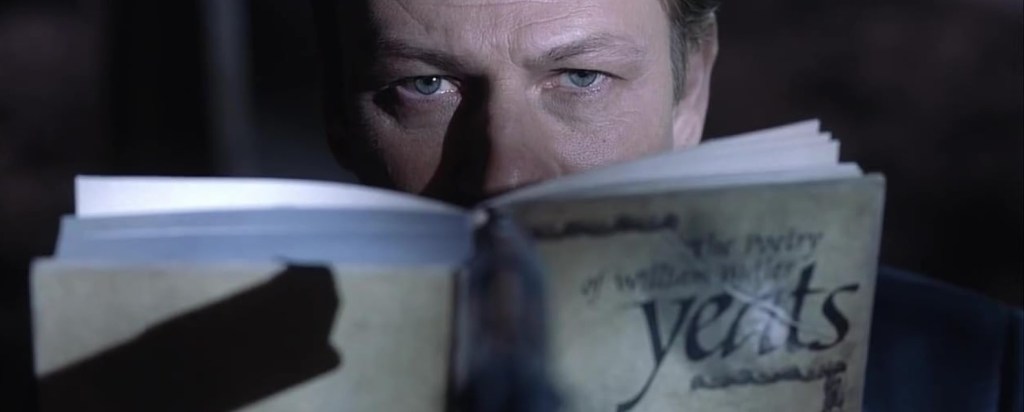
Preston finds Partridge in an abandoned church, reading a book by W.B. Yeats, specifically, “Aedh Wishes for the Cloths of Heaven,” a poem about emotional longing:
Had I the heavens’ embroidered cloths,
Enwrought with golden and silver light,
The blue and the dim and the dark cloths
Of night and light and the half light,
I would spread the cloths under your feet:
But I, being poor, have only my dreams;
I have spread my dreams under your feet;
Tread softly because you tread on my dreams.
On the surface, Equilibrium can be read as an allegory about the dangers of fascism and how, once it takes over, one of the first things to go is art and creative freedom. That aspect of the narrative is the most cliché and full of tropes. Underneath, however, it is also an exploration of toxic masculinity and the way that men are forced to hide their emotions from a young age, which hinders their ability to feel empathy. Preston embodies the false stoicism of a man repressed for most of his adult life and punished for showing even a hint of love or compassion. Society itself has been carefully curated to function as a prison where he is both the prisoner and the guard enforcing the subjugation.
Partridge is a man in touch with his feelings, who craves love and tenderness but struggles to express it without facing criticism from his peers. “I have spread my dreams under your feet; Tread softly because you tread on my dreams,” he whispers to Preston, desperately trying to appeal to his humanity. It represents two sides of the same male ideology competing for control. Unfortunately, Preston isn’t ready to confront his own feelings. However, he does hesitate slightly before shooting Partridge, suggesting he may be grappling with his own inner conflict.
Although it is not explicitly stated that it’s banned, the film shows no female Clerics. In fact, aside from Partridge, all the other prominent Sense Offenders in the narrative are women. The first one shown is Preston’s wife, and the second one is Mary O’Brien (Emily Watson), who is captured after a raid. Mary is a stand-in for Preston’s wife emotionally, and as he starts to awaken to his feelings after skipping his medication, their interactions are tinged with sensuality. It is less on her end and more that Preston is conflating all of his new sensations with arousal.
The most poignant scene has Preston fully awakening to his emotions after the Prozium has fully left his system. He tears the covering off of his window, put there to block out the beauty of nature, and he witnesses a gorgeous sunrise shining through the brutalist buildings of the city. He has gained empathy and achieved self-actualization, and his eyes are finally open to the world’s state.
Although this is a story about humanity, it is also the story of a single man standing up to oppression, even if he must do so alone at first. The Tetragrammaton Council encompasses many forms of oppression; it has the trappings of many religions (specifically aspects of Christianity and Catholicism), Nazi allusions with both the symbology and the Gestapo-like aesthetic of both the soldiers and the Clerics themselves. All the ways that those in power can control man are wrapped into one entity.
When Preston finally defeats Father, the movement’s leader, Father asks, “Is it really worth the price?” Preston coldly replies, “I pay it gladly.” The price of being human is suffering, but the love that we can feel makes it worth it.
Equilibrium captured the imagination of Gen Urobuchi, an infamous Japanese writer who is known for works such as Saya no Uta (2003), Fate/Zero (2006), Psycho-Pass (2012), and Madoka Magica (2011). He mainly worked in visual novels and anime and is beloved by his fans for his incredibly brutal treatment of his characters, earning him the nickname “Urobutcher.” For those uninitiated, visual novels are basically what we call “motion comics” in the West: static scenes are drawn in an anime style, with music, sound effects, and voice acting.
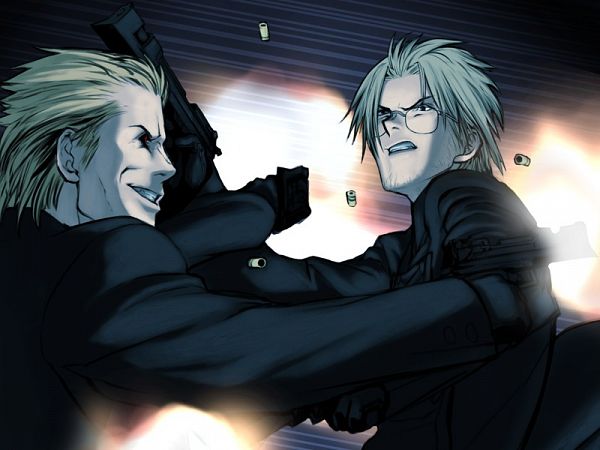
In 2003, Urobuchi wrote a self-published visual novel titled Jouka no Monshou, which translates to Emblem of the Sacred Flame. This work serves as a prequel to the film and follows two clerics: Bartholomew Tirelli, an older, more experienced cleric, and his younger protégé, Melvin Bernard. Unlike most clerics, who tend to work alone, Tirelli and Bernard are more effective as a team. They skillfully combine their gunkata techniques, making them nearly unstoppable when confronting agitators.
Although gunkata is a fun aside in the film, and the narrative takes time out to explain how it works, Urobuchi is clearly enamored of it and goes into intricate detail about how it operates and the different ways it can be used in battle. He uses gunkata as a device to explore the cleric’s relationship with each other as they battle together for their ideology. After one such battle, Bernard happens to catch Tirelli smiling slightly as he executes someone, prompting him to investigate whether Bernard could be a Sense Offender. Preston has a small cameo as well, as Bernard goes to him for advice on the situation, which is ironic given Preston’s eventual character arc in the film.
In a shocking twist, it turns out that Tirelli is, indeed, a Sense Offender, but in a sinister way. Instead of embracing feelings of love and empathy, he has stopped taking his Prozium to relish the euphoria he feels after murdering someone. Since killing people is sanctioned by the Tetragrammaton Council, he has been secretly enjoying a mass murder spree co-signed by the government. It is telling that the act of murder is not a crime in this universe, only the act of having any emotions afterwards.
Bernard is ambushed by Tirelli, who locks him in a room by himself to allow the effects of his medication to wear off. Unfortunately, this means Bernard must confront the worst human emotions for the first time, including terror, despair, and paranoia. After he is freed, his last battle with his former partner is intense, as gunkata depends on the user being calm and collected, and both men are teeming with feelings. Urobuchi is fantastic at subversion, and his take on the Equilibrium universe serves as an intriguing (but unofficial) expansion of the lore.
In 2016, writer Pat Shand and artist Jason Craig collaborated on a three-issue comic series that continued the story after the film’s events. While Preston was the catalyst for Libria’s freedom, the Tetragrammaton Council is reluctant to give up its power. Although most of the population has stopped taking Prozium, the resulting chaos has attracted opportunistic groups eager to capitalize on the situation. The Clerics are still present, but they have tightened their regulations, not even allowing members to have names; they are identified by numbers instead. One such Cleric, known as 654-0, is secretly a Sense Offender, and he is working on the inside to get rid of the order once and for all.
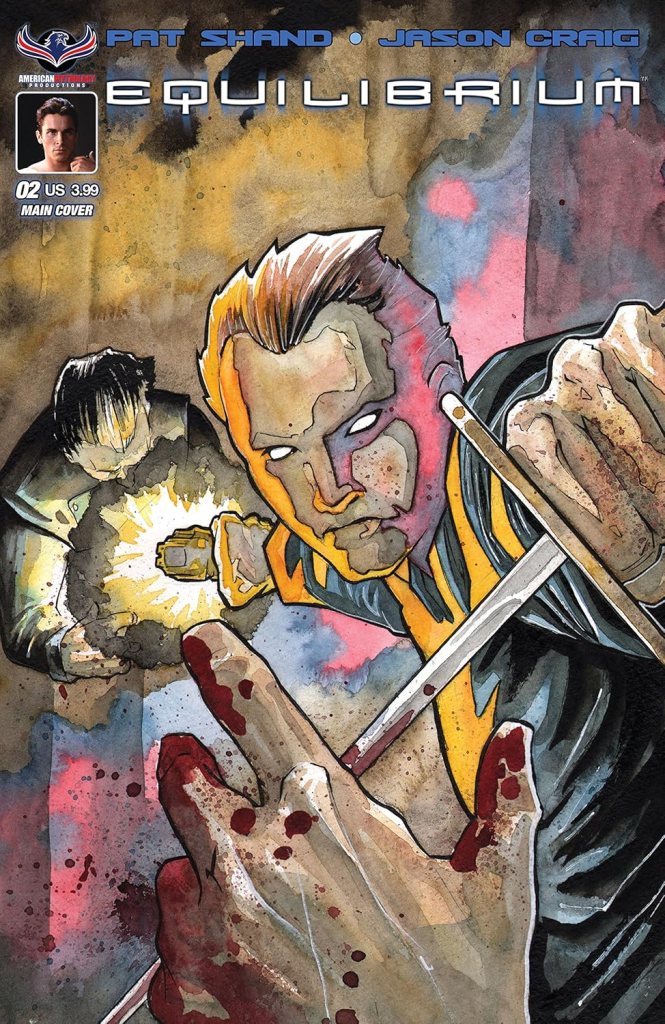
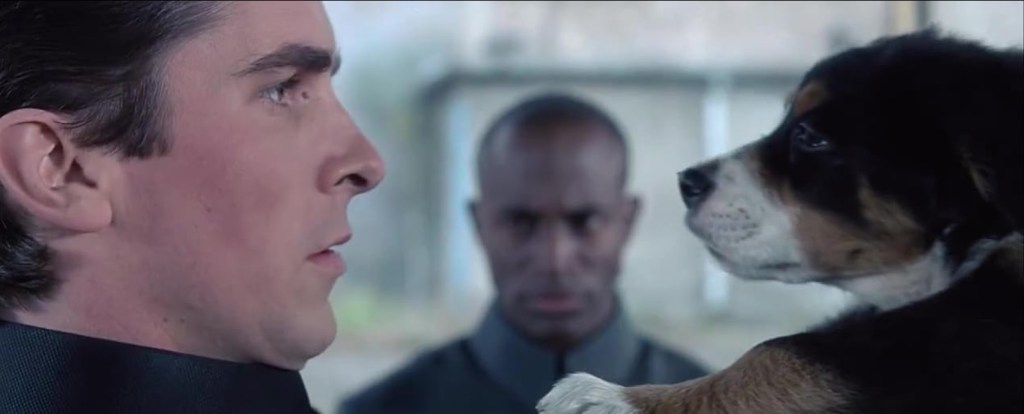
Unfortunately, the comic series had grand ideas but not enough time to tell its story, which makes it feel very disjointed and rushed. Preston is back, living off the grid with a shaved head and his two children, with his dog Yeats, the cute puppy he saved in the film, now full-grown. 654-0 finds him and recruits him to the cause, which is to prevent the council from using drones to douse Libria with a huge dose of Prozium. With the narrative moving so quickly from point to point, there isn’t any time to explore the characters, and they come off flat as a result.
One great sequence has Preston injected with a dose of Prozium, and he has to fight through the drug apathy to find his motivation and center. There is an interesting theme that explores the addiction that Prozium causes, comparing its effects to being “light” and the burden of having emotions as “heavy”, signifying the struggle that humanity goes through with extreme feelings. It’s an interesting addition to the Equilibrium story, but it feels unfinished.
Equilibrium has entered the dystopian canon and inspired artists to create new stories within its boundaries. It seems prescient in every subsequent decade as we forge ahead with new problems and enemies of our freedom, and it serves as a hopeful beacon that good can ultimately prevail over evil.
~~~
This week’s Guest Star is Michelle Kisner. Keep up with her on Instagram at @robotcookie! Make sure to keep up with her recent essay for New Wave Films’ release of Sion Sono’s Strange Circus!
Categories: Screen




 The Cultural Gutter