

As so many people did over the last month, I set out for my local multiplex to engage in a practice called Barbenheiming. If you’ve been insulated from any sort of news or media this summer (in which case I envy you, friends), this means pairing up a viewing of Christopher Nolan’s extremely serious biopic Oppenheimer with Greta Gerwig’s candy-coated Barbie, a film based on a toy line from Mattel. My intentions, however, were thwarted due to scheduling, and I found myself Oppendrac’ing instead. This meant following up Christopher Nolan’s three hour bomb film with Andre Øvredal’s “Dracula At Sea” movie, The Last Voyage of the Demeter.
The Last Voyage of the Demeter is, like Barbie, a movie that does not present as being very serious on the surface. Heady horror like Beau is Afraid or NOPE this ain’t. It’s the kind of jump scare-heavy, easy-to-watch fare that one expects from studios like Blumhouse. Unlike Gerwig’s film that tucks a deadly-serious message about the patriarchy, consumerism, and no small amount of cosmic horror under the hood of that pink Corvette, Boat Dracula is pretty much as unserious as it appears. But, I’d assert, maybe that’s (K)enough.
Demeter feels like the middle of the story, largely because it is precisely that. Øvredal’s film expands on a roughly twenty-page portion of Bram Stoker’s original Dracula story called “The Captain’s Log”, and whose events could probably be covered in the running time of a short montage within a film adaptation of the whole book. We know where this ship is headed, and while I’m usually pretty okay with the main crux of a story being how (rather than if) we get to the Dracula-in-London factory, it feels a little bit thin, especially when paired with the painstaking, heartbreaking, large scale narrative of Oppenheimer.
That might be a feature, not a bug in this particular instance though. The glossy charms of Gerwig’s Barbie (which I ended up seeing later that week) clearly make for the perfect comedown or counterpart to Chris Nolan’s laugh-a-minute nuclear meltdown, based on the teeming crowds of pink-clad folks in my Oppenheimer screening, but so does Dracula.
Of The Last Voyage of the Demeter’s faults, of which there are quite a few, one cannot say that it’s a film that wastes time. We don’t get a ton of set up before it’s clear that the doomed ship and its motley crew are transporting a large wooden crate that’s absolutely packed with Drac from Romania to England. Captain Eliot (Liam Cunningham) is unaware of his cargo, but you get the impression that he probably wouldn’t care much either way, and is just looking to get this last voyage under his belt so he can retire. The always wonderful David Dastmalchian’s First Mate Wojchek is much more wary and ornery, both at taking on this unusual cargo and the last-minute addition of Clemens (Corey Hawkins) as the ship’s doctor. This is kind of understandable since he’s set to inherit command of the Demeter, and is not prepared to abide any bullshit.
Hawkins, one of the most versatile actors working today, is more than capable of smoothing over any rough edges in Demeter’s plotting and as the film’s main character, um, anchors things well. He muses about wanting to understand the increasingly chaotic world and his place in it, and immediately bonds with both Eliot’s grandson Toby (Woody Norman) and a mysterious stowaway buried in one of the crates with an ominous symbol on it. Dracula, always the Scout, has planned ahead for mid-voyage munchies and has brought along some takeout in the form of Anna (Aisling Franciosi), who he’s been feeding from for some time back in Romania. Her village decimated by the ravages of the vampire’s hunger, she is packed into one of Dracula’s crates and, when revealed, is saved by Hawkins with a series of blood transfusions.
There are some frustrating ‘don’t go up those stairs’ moments where the crew of the Demeter are in steadfast denial about the threat that lies among them, even in the face of steadily mounting evidence of Dracula’s power and hunger and Anna’s frantic warnings. But all of that is in service of the back half of the movie which is loaded with the kills and carnage that you presumably bought a ticket for. Nolan’s titular Oppenheimer certainly has much, much more blood on his hands, but he’s not out here ripping throats. And ripped they are, because another thing you can’t say about The Last Voyage of the Demeter is that it pulls punches, kill-wise. From the very earliest moments of the film, we know that Dracula’s going to get loose and run roughshod over the crew of the Demeter in very violent fashion, and maybe that’s why it makes for such an intriguing pairing with Oppenheimer. Not because the films are similar, but because you can contrast the understated feeling of impending dread and tension in Cillian Murphy’s pained performance with Demeter’s more surface-level, in a way more comfortingly transparent scares*.
I do love a good pairing. Whether it’s in the name of entertaining myself with the movies themselves, or when I used to move copies of Jack Frost (1997) next to Jack Frost (1998), two films with almost the exact same premise despite one being a horror movie about a murderer trapped in a snowman and the other a saccharine Michael Keaton family film about a dad being trapped in a snowman, next to one another at my local Blockbuster. Pairing up movies isn’t new, but I think it’s nice to see that an increasingly attention-lacking audience (myself included) at large is receptive to it, rather than wandering off or closing the Netflix tab halfway through an 88 minute movie. This is especially true for two fairly long movies like Barbie and Oppenheimer, which commit you to somewhere in the neighborhood of five hours total between them. Later in the week, I found myself unable to resist the pull of Gerwig’s Barbie, and decided to pair it with another multiplex movie that I’ve been drawn to. After my second multi-hour outing to the theatre inside of a week, an activity I usually reserve for film festivals, I found myself immediately thinking a lot about the connections between these two women-led stories. In one, a woman is plagued by thoughts of death and forced to confront a rift between her world and a nightmarish alternate reality. The other one is A24’s seance horror by first-time directors Danny and Michael Phillipou, Talk To Me.


Now, I’m very aware of the problematic nature of movie theatres’ newfound model of extracting two admissions when normally a night out at the movies to see a single feature can be pricey enough, and I’m not quite ready to say that juxtaposing two films together is a “victory for cinema” like Francis Ford Coppola has expressed. But at least it’s creating some decent memes, which counts as some kind of comfort these days. One might be the joking-not-joking push for “Saw Patrol”, where moviegoers are invited to pair up a viewing of the newest (and somehow, tenth) installment of the Saw franchise with the second Paw Patrol movie.

And even Jigsaw himself is in on the joke.
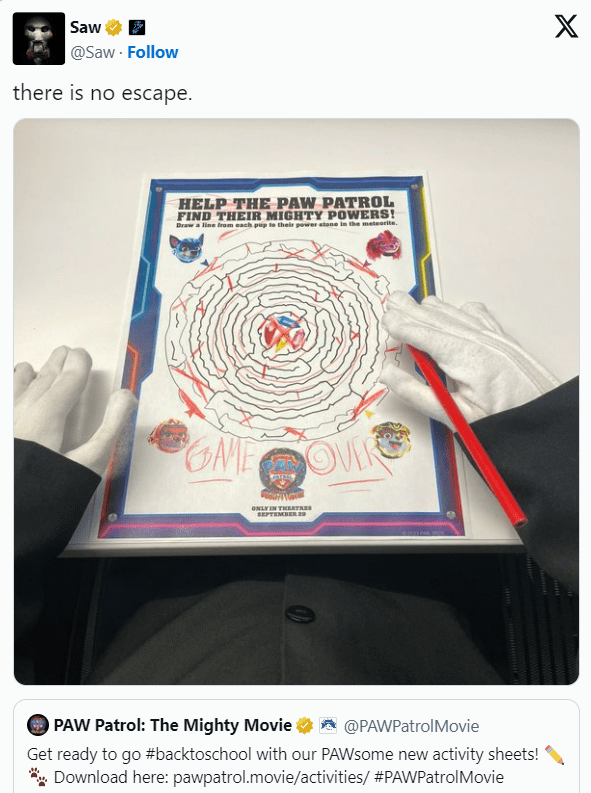
Pairing a dark or challenging film with something more fun, or at least more easily digested, has always been pleasurable for me. Sometimes you just need a chaser, or sometimes you just want to connect two disparate films to see how they feel. Whether we’re Barbenheiming, Oppendrac’ing, 2 Jack 2 Frosting, or partaking of Saw Patrol, two is almost always better than one.
* And, of course, Oppenheimer is a true story of tragedy and a catastrophic moment in human history, while the veracity of Dracula’s saga is still kind of up in the air.
Sachin Hingoo is best paired with a Minoru Kawasaki film.




 The Cultural Gutter
1 reply »