

Generational trauma knows no particular race, ethnicity, or personal experience but there is a unique and uniquely bitter flavour when it sets itself on Black lives. In communities where violence can be routine but the lasting effects and the voids it creates are anything but, trauma is often passed down, spread like a contagion, and manifests in a multitude of ways.
In Bomani J. Story’s Frankenstein-riffing horror The Angry Black Girl and Her Monster, the focus is heavily weighted toward the former in the title than what you might think would be the more compelling latter. The monster, and I guess this is true of most horror, is usually the one who gets all the attention. Not here, though. The eponymous girl in the title, deemed ‘angry’ after the stereotype of Black people (especially women) being seen as aggressive when they stand up for themselves, is Vicaria (Laya DeLeon Hayes).
Vicaria’s motivations and her battle with her own trauma, guilt, and her contribution to the violence in her community take centre stage in The Angry Black Girl and Her Monster. The result is a story that’s distinct from the usual Frankenstein treatment. It’s also distinct from many films that depict Black trauma and struggle in that Vicaria never feels like a victim, and is firmly in charge of her own fate even as her world crumbles around her and her control over her monster begins to slip.
Vicaria is surrounded by death. Her brother and countless others have been casualties of the drug trade in her neighborhood, all run by the young kingpin Kango (Denzel Whitaker) who rules over the community like a king from a burnt-out couch on a park lawn. The prevalence of death in Vicaria’s world leads the brilliant young science-minded prodigy to the belief that death is, in fact, a disease. And diseases are curable.
Seeking to reverse the circumstances in her community, Vicaria steals and keeps the bodies of the victims of violence in her neighborhood streets, including body of her deceased brother Chris, in an abandoned warehouse-turned-lab. Meticulously documenting her work and her findings in a notebook emblazoned with, cheekily, The Modern Prometheus, she researches and performs surgeries in an effort to reverse the effects of death and to bring him back to life. When one of these experiments succeeds, Vicaria’s necromancy produces a vicious, unrelenting killer who’s unleashed on Vicaria’s community, indiscriminately mowing down both her enemies (at first), and those closest to her.
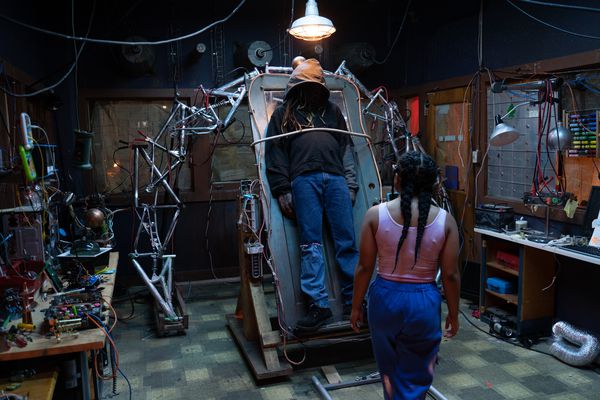
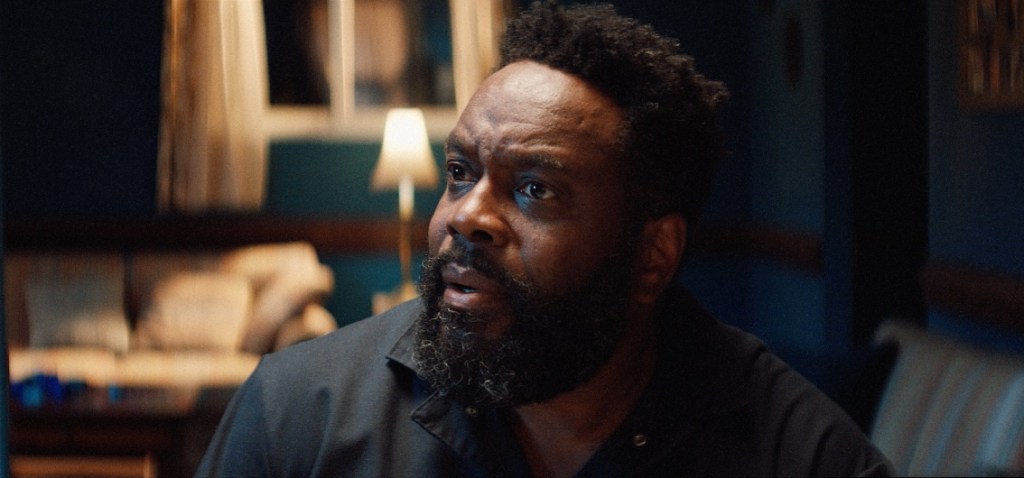

Story’s film, from the moment you glance at the title, is keenly aware of and seeks to subvert perceptions of Black people both as ‘angry’ and as ‘monsters.’ Vicaria is smart and outgoing, and her attempts to stand up for herself in class have a teacher talk down to her, and then call school security to physically restrain her. Like so many cases that have happened and continue to happen in schools in America, Vicaria is branded as angry and aggressive, which feels like a way to squash her immense intelligence and potential. Fortunately, her father Donald (Chad Coleman) is there to back her up and advocates for his daughter, and Vicaria’s brilliance is undeniable.
When considering The Angry Black Girl and Her Monster, I think of another film I’ve seen recently, Cord Jefferson’s American Fiction (based on Percival Everett’s 2001 novel Erasure). American Fiction and Erasure grapple with the often one-note, stereotypical depictions of Black lives and culture using a satirical story about a Black author, played by the wonderful Jeffrey Wright, whose works aren’t considered ‘Black enough’ and then revolts by writing (under a pseudonym) what he thinks is an on-the-nose parody of a Black novel. Predictably, the parody is taken at face value by a doting (and very white) publishing industry and becomes an overnight sensation. Though the two films, both feature debuts by Black directors, don’t have a ton in common on the surface, they both feel like meditations on representation and how Black people are perceived and often othered in media (in American Fiction) and in schools/society (in The Angry Black Girl and Her Monster). Both lead to dangerous stereotypes that Black people are violent, aggressive, and figures that need saving or pity, robbing them of their agency. American Fiction and The Angry Black Girl and Her Monster both address the dangerous idea of painting whole groups with broad brushes, because even the best-intentioned strokes are usually patronizing and paternalistic.
But it’s also spooky season, and it must be said that The Angry Black Girl and Her Monster is, in addition to all the things I’ve said about it so far, a profoundly beautiful and often scary (in an enjoyable way) film as well as having immense cultural resonance. Scenes of Vicaria carving through flesh, sewing it back into place, and her ghastly creation (and his path of terror) show that traditional horror elements are in no way taking a back seat here. Story’s love for the game is apparent throughout, and even when he’s hitting traditional slasher beats and notes they’re being gradually upended in ways so subtle that you won’t notice until the end. The Angry Black Girl and Her Monster is also filled with outstanding performances, led by Hayes’ portrayal of Vicaria as the defiant student, and then as the mastermind who is in awe, and eventually terrified, of her own creation. It’s expertly mirrored by Chad Coleman’s Donald too, who has the same awe of his much-smarter daughter, and perhaps shares the same fear of her capabilities, even (and especially) when he doesn’t fully understand them. The supporting characters of Vicaria’s family and friends, as well as the more menacing elements of her community such as the young criminal Kango and his goons never feel one-note, and are fleshed out to feel real enough to care about them–either positively or negatively.
The Angry Black Girl and Her Monster is a dark and tragic story, expertly crafted for a first-time filmmaker. It manages to battle with heady themes and ideas, while working enjoyably as a horror film and a fresh riff on Mary Shelley’s classic, punctuated with moments of intense joy. It takes generational trauma and carves it up, bringing it full circle to something that resembles hope, or whatever passes for hope in a horror context, and perhaps a new form of catharsis from a world of hurt. For a Halloween selection that’s got a little more, ahem, meat on its bones, The Angry Black Girl and Her Monster is something very special and resonant, and I hope that Bomani J. Story continues to produce works of nuance and poignancy just like it.
The Angry Black Girl and Her Monster is currently available on Shudder from RLJE Films.
~~~
Sachin Hingoo was cobbled together from various parts of deceased bloggers.




 The Cultural Gutter
1 reply »