

Everything is real and everything is possible in Latitude Zero. It is both a secret utopia beneath the sea where scientists and artists work in peace, waiting for the day when humankind will be ready to embrace Latitude Zero’s wonders, and a Japanese/American science fiction spectacle directed by Ishiro Honda. Latitude Zero (1969) is a film that constantly escalates with wonder after wonder. It is a film that understands sometimes more is better. It is not enough that there is a super submarine, an underwater city or a secret utopian civilization. Any one of these elements would be enough for another film. But this is just the beginning in Latitude Zero. There is also Akira Ifukube’s soundtrack; Eiji Tsuburaya’s special effects; the story treatment by “screenplay advisor” Shinichi Sekizawa; the screenplay by Latitude Zero creator Ted Sherdeman; and the astonishing gold lamé-inflected fashions of the undersea utopia by Kiichi Ichida and Linda Glazman. Like Latitude Zero itself, it is a film that rewards those ready to put aside their prejudices about what film should be and embrace what it has to offer. Ever more, ever daring, ever refusing limitations and constraints in pursuit of a vision. I imagine it was heartening in a time of war, authoritarianism, anti-democratic impulses, bigotry, cruelty and injustice. It was heartening during World War II, during the Cold War, and it is heartening to me now.
Latitude Zero originated as a 1941 radio play. Ted Sherdeman generally receives full credit for creating and writing the series, but Anne Sherdeman receives first name credit on a 1941 volume of 17 episode outlines and a synopsis of the overall story. It’s hard to say how much she wrote, but the volume does include episode outlines written in two different hands. But her involvement is beyond my scope and the scope of the materials I have beyond those two intriguing facts.

The first episode surfaces online occasionally and I have listened to it a few times. Latitude Zero was also almost a 1955 television series written by Herb Purdum, with notes from Warren Lewis, Dick Buel, and Ted Sherdeman. (Lewis went on to supply “additional dialogue” for the 1969 film. It’s unfortunate that the series never aired because I would have loved to see the 1955 take on Latitude Zero’s world, especially its creatures and “demon trees.” As it is, I believe Latitude Zero reached its truest form in Honda’s film.


In the film, three men descend into the ocean’s depths in a bathysphere. Two are scientists, Dr. Ken Toshiro (Cultural Gutter favorite Akira Takarada) and Dr. Jules Masson (Masumi Okada, who was, in fact, born in France). The third is reporter Perry Lawson (Richard Jaeckel). They are researching the Cromwell Current when their bathysphere is detached from its line and plummets towards the ocean floor. They are saved by Captain Craig McKenzie, played by a dapper and jaunty Joseph Cotten, and his advanced submarine, the Alpha. Like Captain Nemo, McKenzie, his submarine, and his crew–Dr. Barton (Linda Haynes) and Kōbo (Kin Ōmae)–belong to no nation. Unlike Nemo, however, McKenzie is working to create a utopia for all of humankind. In the Latitude Zero Outlines, the undersea city is repeatedly and explicitly compared to Shangri-La, the hidden, Himalayan utopia of James Hilton’s 1933 novel, Lost Horizon, which was first adapted as a film in 1937. Toward this end, McKenzie and strike teams from his undersea utopia have been approaching scientists and artists, faking their deaths,and bringing them to Latitude Zero to await a time when humanity has grown beyond nations, wars, and general destructiveness and is ready to embrace the future Latitude Zero offers. And I must quickly note, that includes McKenzie’s fashions. In Latitude Zero, you will see Joseph Cotten wear an array of amazing outfits including a lacy pirate shirt with a kicky seafoam green neckerchief and thigh high patent leather buccaneer boots, a brown velour shirt with gold leather discs embellishing it, and a full gold lamé body suit.
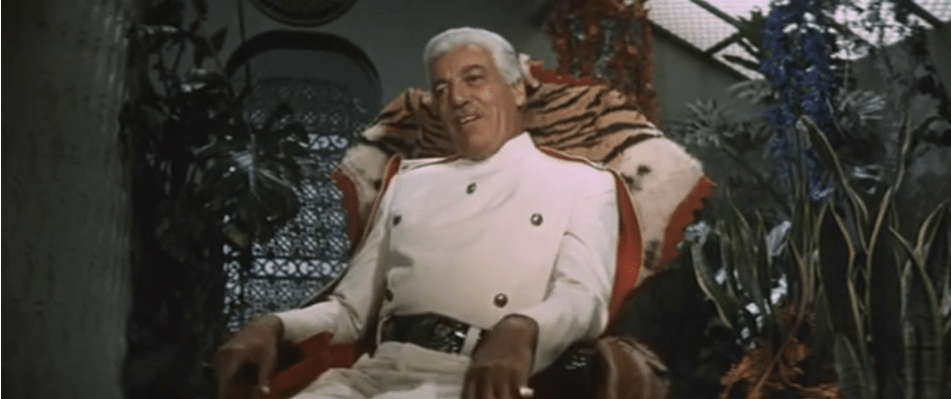
McKenzie’s foil is Malic, whose very name evokes malice. Malic is his former schoolmate and colleague, and a year younger than McKenzie at 203, but has now become a mad scientist with a magnificent villain lair, Blood Rock. Aided by the gloriously caftanéd Lucretia (Patricia Medina, Cotten’s real life spouse) and Kuroiga (Hikaru Kuroki) the commander of the evil super submarine, The Black Shark, Malic aims to destroy Latitude Zero and everything it stands for. Well, everything except some of its treasures he wants to keep for his own nefarious scientific and fashionable ends. At Blood Rock, Malic swirls his capes and skirts and lounges nonchalantly on a be-tiger-skinned throne wearing evil naval whites and thigh high patent leather buccaneer boots. Malic gives villainous monologues, menaces the innocent, and performs horrifying surgeries. Threatening Dr. Okada (Tetsu Nakamura), a scientist Latitude Zero is intent on recruiting, Malic says:
“You’ll force me to get the information my own way. By surgically removing your brain and dissecting its memory bank.”
“That’s impossible!”
“Not for me.”
On the recommendation of Dr. Barton (Linda Haynes), McKenzie orders the Alpha back to Latitude Zero where Jules can receive treatment for a traumatic head injury. As Jules recovers, Ken and Perry are astounded by all Latitude Zero’s offerings, from science (an artificial underwater sun), fashion (gold lamé), athletics (trampolining), dinner (anything and everything at the push of a button) and the casually fabulous wealth of people who can transmute sea water into gold and use diamonds as vase filler for their houseplants. A skeptical Perry asks if the diamonds are real, and MacKenzie answers, dismissively, “Everything in Latitude Zero is real.”
Ken is less skeptical than Perry, and I feel kinship with a man who recognizes utopia in a gourmet automat. As they learn more about Latitude Zero and its mission, McKenzie receives news of Dr. Okada’s capture. It’s time for a dangerous mission to rescue Dr. Okada and Okada’s daughter (Mari Nakayama)–but first there are invulnerability baths, fuzzy robes and then even more gold lamé!

Where another film’s climax would be the daring rescue, Latitude Zero is far more generous. The film keeps giving as the Alpha’s crew battles Malic’s hybrid monsters like human-sized rats,“batmonkeybears,”–as the human bat hybrids are called in my circles*–and finally, a griffon Malic created by grafting a condor’s wings to a lion’s body and then transplanting a human brain into the lion’s skull. This surgery involved a condor puppet, Haruo Nakajima (Godzilla in Godzilla (1954)) in a fun fur lion suit, and a pleading submarine captain. In Eiji Tsuburaya: Master Of Monsters (Chronicle, 2007), August Ragone notes that the American production company pulled its funding from the film late, leading to cutting costs on Tsuburaya’s creature designs. But despite the “unrealistic” creatures, this surgery legitimately upsets and disturbs me. Sometimes ideas and the intensity of an actors’ commitment to their role and experience –having one’s brain removed and placed in a lion’s cranium—get you. Or at least, me. Of course, despite Kuroiga’s anger towards Malic, he uses science to enlarge her and then exhorts her to attack the Alpha. And so we even get a giant griffon (Nakajima) versus submarine battle, but not the one Malic expects.

While Latitude Zero is a charming and optimistic 1960s science fiction film with definite kaiju and tokusatsu elements, many of these elements exist in the earlier radio drama and television pilot. The pilot closely follows the first episode of the radio series. The radio drama itself is in line with 1930s and early 1940s American pulp science fiction. In episode outlines, we meet the batmonkeybears as “bat zombies” controlled by Malic and Lucrezia. And there is a loyal evil crew member transformed into a griffon.
There are differences, of course, The Alpha was originally christened The Omega. I suppose it’s a more optimistic choice when Omega is so often associated negatively with endings and death. Alpha is the beginning, a hopeful view of the world we could have if we just worked together. And while all three versions of Latitude Zero begin with a rescue and men being taken onboard McKenzie’s submarine, in the radio and television shows, it is McKenzie and a crew member who are rescued from the beached Omega. McKenzie subsequently destroys the men’s fishing boat and then offers to enrich them and drop them anywhere they like if they will serve on board the Omega for one voyage. In the radio drama, the excellently and extremely 1940s named characters Brock Spencer, Tibbs Kennard and Burt Collins rescue McKenzie and Simba. They are not scientists or journalists, but rather men with military and engineering skills. With Simba, they become the Omega’s new crew, aiding McKenzie in his pursuit of Malic and Lucrezia, who have stolen a statue of Kali from a temple in India as part of a plan to strengthen their worldwide cult of crime.
Perhaps the biggest changes, though, are in characterization. Lucrezia has a much stronger presence in the radio drama than Lucretia does in the film. She is the primary antagonist in these first episodes. McKenzie calls Lucrezia, “Madame Lucifer,” and warns Brock, Tibbs and Burt against her necromantic powers and her deadly gaze. Lucrezia commands the surface vessel, the Shark, which becomes Kuroiga’s Black Shark. In the radio series, it is not Malic, but Lucrezia who creates the griffon. She uses a transformative cabinet and tells the hapless crewman, Hartog, that she will restore him after he destroys McKenzie.

From handwritten notes in the synopses, it’s clear that Sherdeman or the Sherdemans were doing research to explain both her vampiric gaze and Simba’s “black magic” referencing in particular “Soudanese magic,” chapters on vampirism and “divination by ring and glass” in The Encyclopedia of Occult Sciences (New York, Robert M. McBride. 1939) and magic words from The Enchiridion of Pope Leo. In the 1969 film, Lucretia has much less to do other than lounging in the sweet recreational area on Blood Rock and asking Malic when he’s going to replace Kuroiga.
But if Lucrezia is diminished in the journey from radio drama to tv pilot to feature film, McKenzie’s taciturn and loyal companion is much improved. The handwritten notes in the script outlines and the scripting itself shows how much careful research was being done about magic words, Sudanese magic, and the sub’s position in the world. But it is disappointing that Simba ends up serving as the massive, usually monosyllabic and devoted brawn to McKenzie’s brain. Simba is described as a “robot” in the notes and in the radio drama might have been better off as one. Research was clearly done for his character–Simba is Senegalese and speaks French, as many Senegalese people do. Simba’s characterization is not as bad as that of other Black male characters in the pulp fiction–and literary fiction–of the time, but he is still described as a “monstrous negro.” And he practices black magic, which Sherdeman researched and could work if done carefully, but is just so fraught and not easy to avoid racist stereotypes around with African men. Simba’s loyalty stems from Mckenzie rescuing him from slavers in what was likely the early 19th Century. But while better than other portrayals of African men, Simba portrayal is irksome even for 1941, after all, a lot of interesting things were happening in Senegal at the time the Sherdemans were working on Latitude Zero and the stories would have benefitted had they reflected that. It was certainly researchable.
By 1955, Simba was renamed “Mengo,” because Lewis and Buel in a note to Sherdeman, felt that audiences were very familiar with the Swahili word “Simba” and that it means “lion.” As well as changing his name, Mengo becomes less monosyllabic in the pilot. But by Latitude Zero (1969), Shinichi Sekizawa and Ted Sherdeman had re-envisioned the character as the taciturn and devoted strong man, Kobo, who is a Japanese man whose burly taciturnity is not linked to racial stereotypes–especially in a film with an extensive Japanese cast in a variety of roles in a Japanese / American co-production. And it’s just so nice to see someone grow and get there. It gives me hope.

In fact, one of the pleasures of going through scripts and synopses has been seeing someone take their artistic vision and improve and expand on it over decades. Sherdeman refined his vision of how his Latitude Zero should be presented. As he tells Warren Lewis in his notes on Latitude Zero tv pilot:
“Mr Purdum should not so religiously adhere to the type of dialogue contained in the radio scripts. It served its purpose in 1939, in radio, but adaptation of it today is just too puerile for my taste, for one. I truly believe that the more adult we can keep the talk–though much of it be doble-talk–the more audience appeal we will have. Brock can be more physical than Tibbs, but he shouldn’t be the All-American half-back type whose vision or ultimate capacity is limited to the belief that all the world needs is one-hundred percent Americanism, Mom’s apple pie, and a root beer float at the corner drug store. A little more sophistication will be just fine.” (Omega Outline, 1955)

*Kerry Gately Fristoe named them, “batmonkeybears,” during a Drive-In Mob livetweet of Latitude Zero. See her film writing here.
Thanks to Ed Glaser for sharing his research materials from the American Heritage Center at the University of Wyoming with me, including copies of: the first episode of the radio series; a 1941 volume of outlines for the first 17 episodes; Ted Sherdeman’s and Dick Buel’s 1955 notes on a Latitude Zero television pilot; the pilot teleplay; Shinichi Sekizawa’s 1968 treatment for the film; and the final revised Latitude Zero film script by Ted Sherdeman. (And thanks to Ed for the use of “escalating” as a description of the film).
Thanks to Kate Laity for helping me determine The Encyclopedia of Occult Sciences (1939) was likely the book cited in the radio drama notes. And thanks to Kate for sending me a copy of Ken McCraigzie’s Live Gold: The Latitude Zero Guide To Life (2024). Thanks to the Gutter’s own Angela Englert, Kate Laity, Brian Kirby, and Ed Glaser for listening to my excitement about discovering occult science sources late at night.
Incidentally, I recommend the English-language version of Latitude Zero over the Japanese dub, if only because you can hear all the actors voices. Even Akihiko Hirata’s who plays Dr. Sugata in Latitude Zero and played Dr. Serizawa in Honda’s Godzilla (1954).
~~~
Carol Borden’s position is longitude one hundred eighty degrees… latitude… ZERO!
Categories: Science-Fiction, Screen



 The Cultural Gutter
7 replies »