
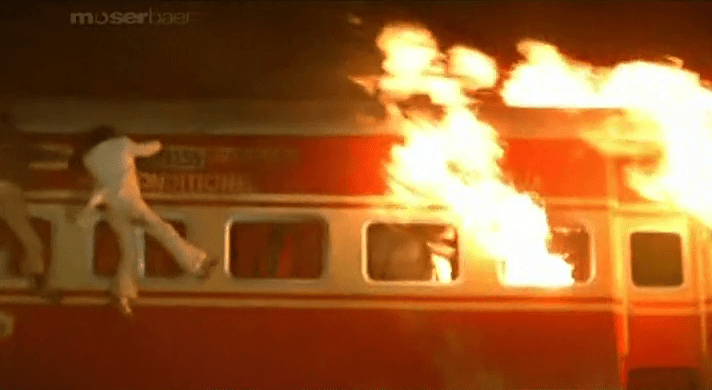
[Spoilers!]
You can tell from the title: The Burning Train is a huge disaster movie imperiling half of the Bombay film industry’s contemporary A-listers, and I couldn’t be more delighted.
Pick up your #2 pencils and answer the following:
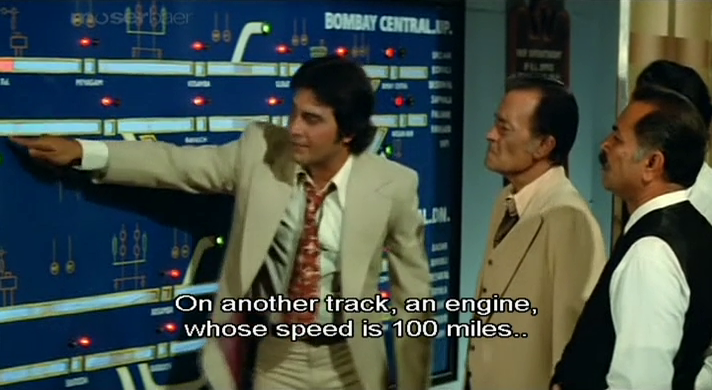
1) What is the maximum possible speed of our train if it contains all of the following:
a. a vamp-like singer in bright red putting on her lipstick while a soi-disant holy man leers at her,
b. a comic relief uncle boasting about his military exploits,
c. a thief’s moll smuggling diamonds in her bra, and
d. no fewer than 1 but no more than 5 men running on the roof?
2) If a junior engineer proposes to stop the runaway train by means of routing it up an incline, at what angle and length of track must the incline be built before the train crashes into Bombay Central Station?
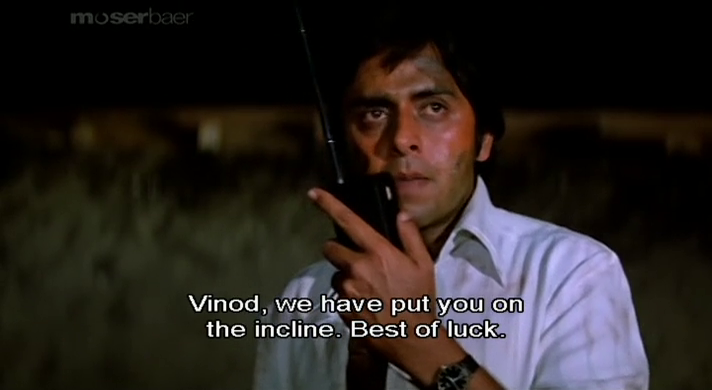
3) Propose a formula to express the potential to stop the train emitted by children’s prayers set to music.
It takes longer to list who is in this film than it does to recommend it. Fully half of the stalwarts of the Hindi language film industry of the late 1970s are either trapped on an unstoppable burning train careening towards a huge city or they are panicking in Delhi and Bombay desperately trying to find a way to stop it.
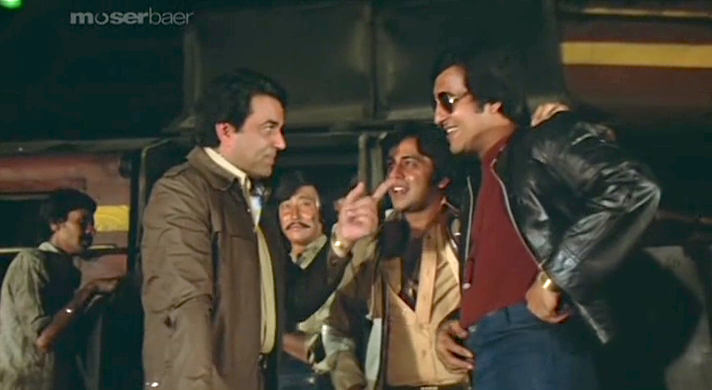
While one could, with very little effort or malice, reasonably ask for more from this movie: More developed characters, particularly any of the women; romances with more flesh on their bones given how motivating the love stories seem to be; a childhood prologue that has more to do with the rest of the story; a slightly less prominent nod to An Affair to Remember. But it will take a stonier heart than mine to do so. I was so happy about playing “Oooh, there’s ______! And hey, isn’t that ______?” (even on a rewatch) and the bromace-turned-bitter between Ashok (Dharmendra) and Vinod (Vinod Khanna) that I was perfectly willing to overlook the film’s flaws in favor of hurtling along with the cast of thousands. Anyway, who has time to develop more commentary on India’s rail culture and infrastructure when a giant train with 500 passengers is literally on fire and hurtling to the center of a city of 8 million?
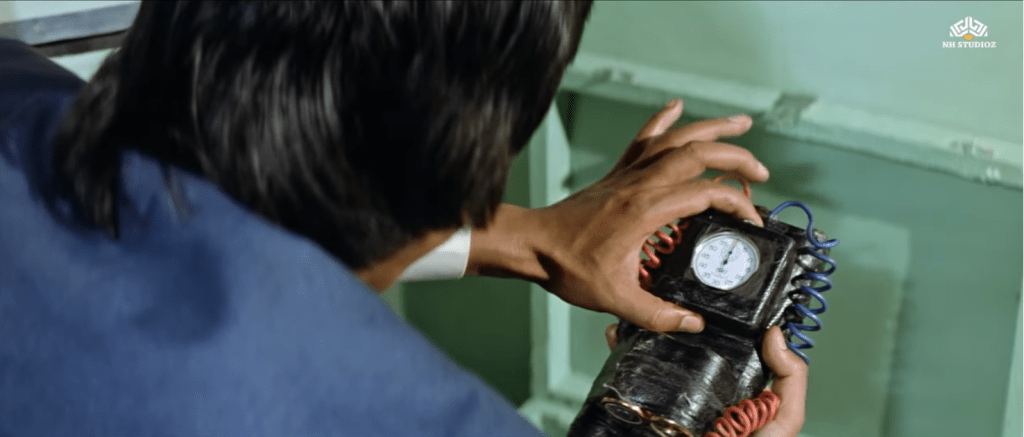
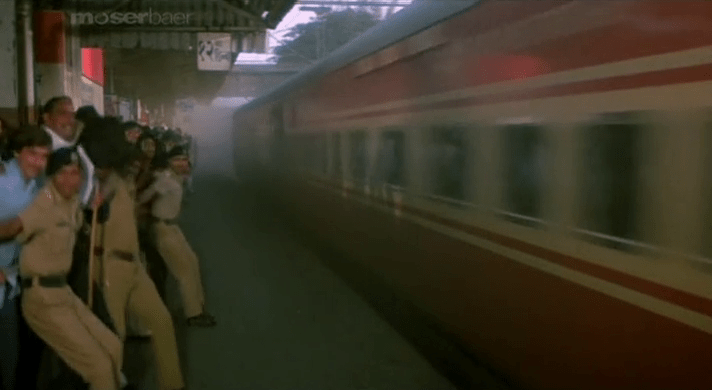
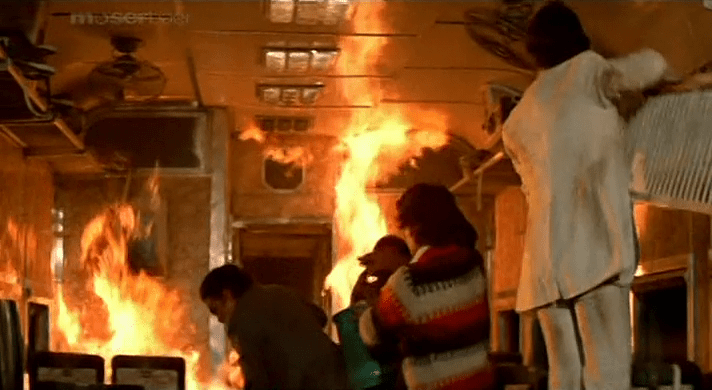
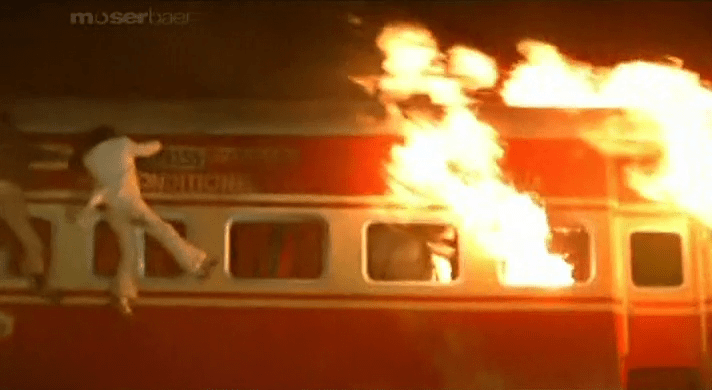
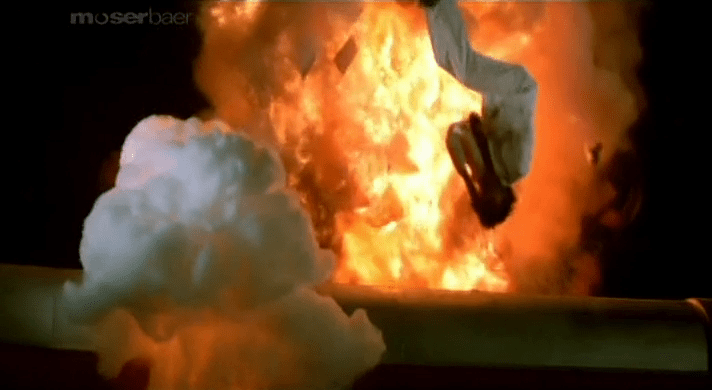
Please excuse a brief tonal shift while I share a thought that occurred to me on my recent re-watch of this film.
I would never call The Burning Train breezy because it is 3 hours long and depicts a lot of suffering and wrong-doing of many kinds, but I only just realized that it might be referring to one of the darkest eras in subcontinental history. When the British empire left South Asia in 1947 and divided the area into India, Pakistan, and East Pakistan (now the independent country of Bangladesh), and millions and millions of people migrated across the new borders. Trains were a critical piece of this movement. Over and over again they were attacked, including with fire, pulling into station carrying thousands of corpses. (If you don’t know these stories at all, I recommend taking a deep breath and googling “Partition ghost trains”). I can detect nothing else in the film that indicates an intent to reflect on the traumas of Partition. If anything, the film is more interested in looking forward than into the past. Characters have brief discussions about technological progress in creating a high-speed rail project in India and the continued relevance of trains in an increasingly plane-oriented world, and they rely on countless technologies (old and new) to try to stop the disaster. They also touch on the need to focus on the loss of the train’s whole population as measured against concern for specific individual passengers.
The film shows the potential tragedies for everyone involved in the story. Several people die in the second half of the film, and many more are threatened and make physically and emotionally difficult decisions. The unity idea is (I think???) underscored by the very final moment, which puts text on the screen reading:
“This picture is about the people of INDIA & in particular those of the railways—their sense of duty, courage, & heroism. ‘THE BURNING TRAIN’ therefore is dedicated to the soul of INDIA which has remained uncorrupted.”
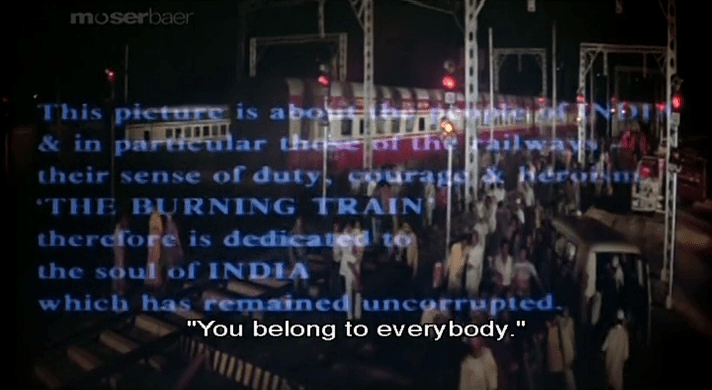
I can imagine why it’s there—this film definitely owes a lot to the assistance of rail professionals—but it’s also so obvious as to be unnecessary. The soul of India is defended only when people act with courage and expel the sinners. I reckon that’s the message in at least 40% of mainstream films made at this time, so why did The Burning Train say it out loud? But maybe this is in fact evidence of the makers thinking about a national history and/or a national story, even if not explicitly Partition? Producer B. R. Chopra and his son, director Ravi Chopra, are the brother and nephew, respectively, of one of the major makers of Partition-influenced films, director and producer Yash Chopra, so I keep circling back to it being on the minds of some of the people involved here.
After I started thinking about Partition, it colored the rest of my experience with the film. I kept seeing so much suffering in the story, even when those moments are coupled with fireballs and helicopters. The Burning Train also departs from the “mix” aspect of the Hindi masala film template in its second half: there’s basically no relief from the drama or the pacing of the action, and even the song sequence with a group of school children and their saintly teacher praying to be saved is heavy, with the despairing, sooty-faced passengers looking on.
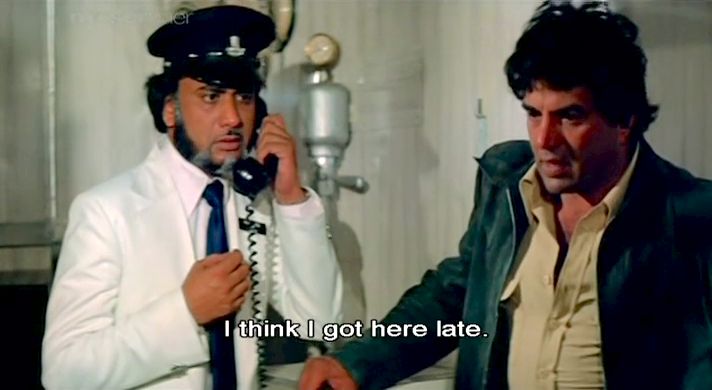
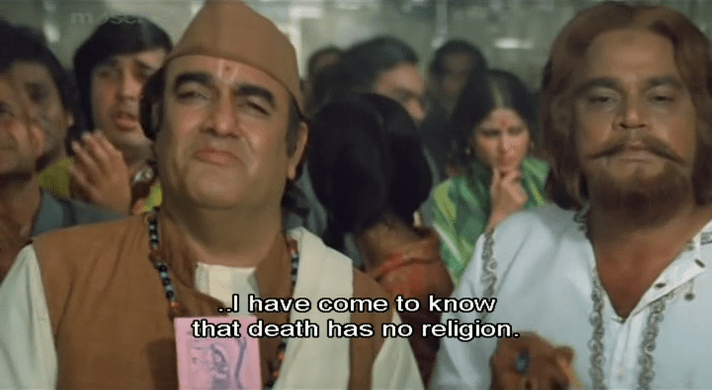
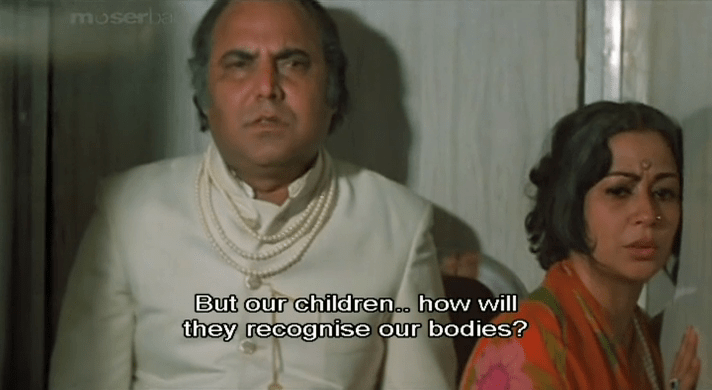
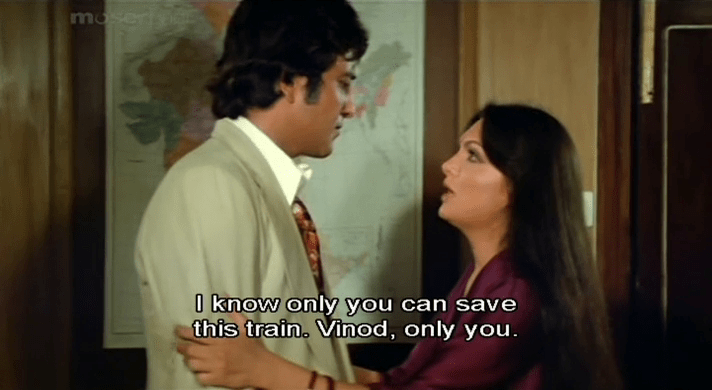
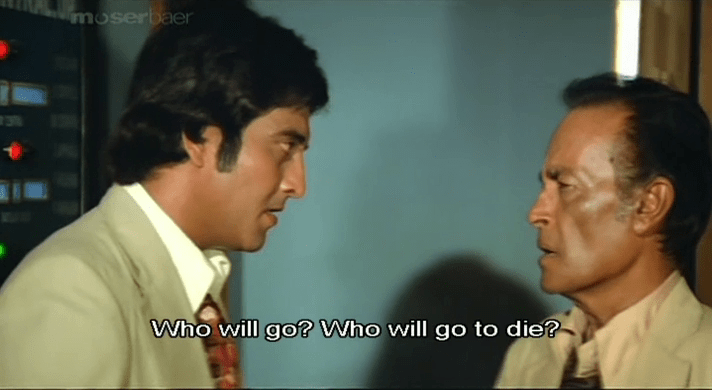
On my first watch of this film, I questioned the relevance of the disaster film genre as an experiment within Hindi cinema, which often creates extraordinary and complicated circumstances for heroics without more imminently endangering so many people. But again, I’m seeing this in a new way. The mechanics of this disaster are industrial and immediate, even though the impetus is much more human. This villain doesn’t want money (which I gather is the motivation in the 1975 Japanese film The Bullet Train, to which this bears some resemblance), like we see in so many Bollywood smugglers and other criminals, and they’re not making a political statement of national purity or dominance. This feels like an attack on progress and success, even if subconsciously. I don’t want to spoil why exactly the villain sets out to destroy the train and everything on it, but I find the explanation very appropriate. And it’s so powerful and deranged that it requires not one, not two, but three major heroes to defeat it—and that’s not even counting the smaller scale heroics by side characters who do things like supervise the building of the terminal incline or share alarming information at rail stations as the train speeds by. Upon rewatching, I think it’s a testament to just how unhinged the villain is.
Even with all of that, this film is still incredibly entertaining. First on the list of its joys is “Pal Do Pal Ka Saath Hamara,” a qawwali on the train. Fans of vintage Hindi films tend to love qawwalis, and this one is, as they say, A BANGER, and not just because it features a woman singer and has surprisingly moving lyrics about friendship and taking all the joy you can in the present moment.
Train songs also appear in many Indian films, and this might be one of the best, in my mind second only to the iconic “Chhaiya Chhaiya.” Most of composer R. D. Burman’s music is bold and exciting and stylish, especially this and the title song.
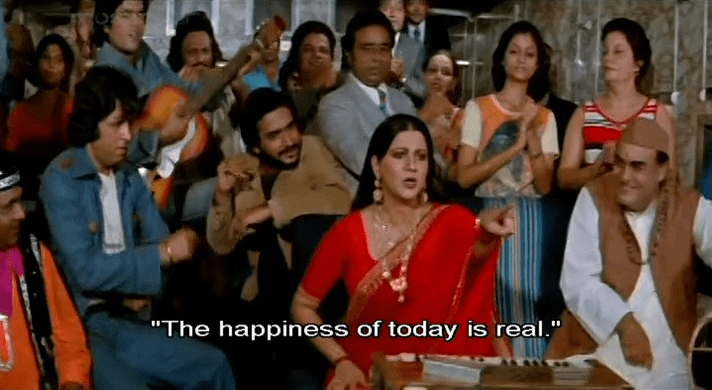
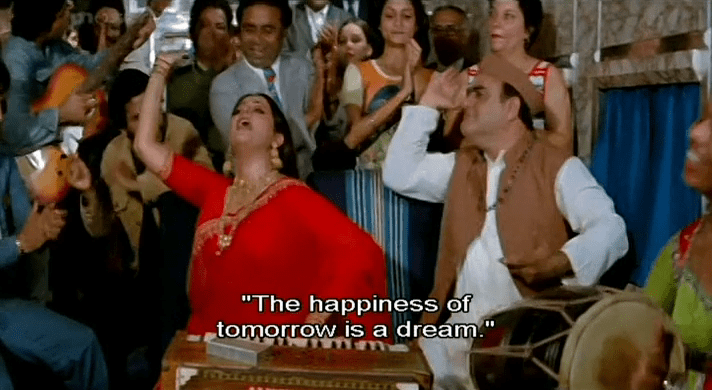
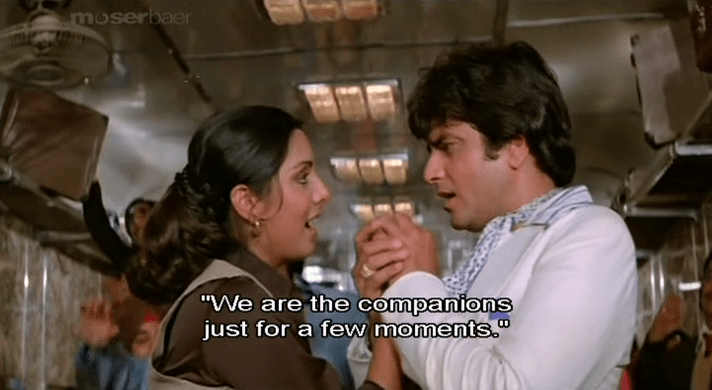
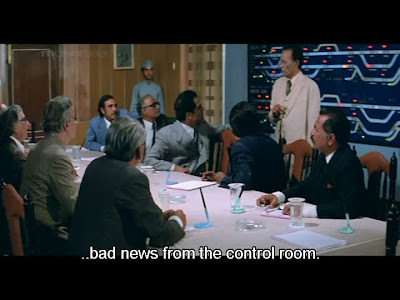
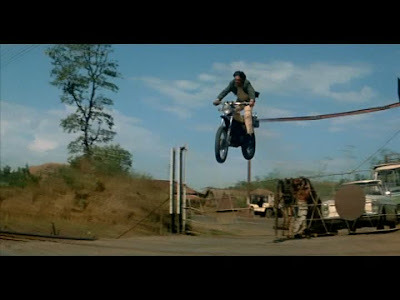
I don’t know what year this was filmed, but the late 70s fashions are a delight. I already alluded to the range of technologies used to try to stop the disaster, and among them is a fantastic light-up rail map. There are various frantic car and motorcycle sequences; fights as various people try to stop wrong-doers; and other action sequences abound as passengers try to escape the blaze or move around on the outside of the train cars.
In short, basically everything about The Burning Train is fantastic. From the slew of practical pyrotechnical effects to the relentless energy of the second half to the bromance of Vinod and Ashok, the film is crammed with things to enjoy. And it’s available with English subtitles for free on youtube (and for rent there as well, but I didn’t try it so cannot tell you if one of these uploads is superior)! Note: This particular upload is about 30 minutes shorter than other versions, but I do not know where cuts happened or if perhaps it got sped up.
~~~
Beth Watkins would like a light up railway map and would definitely use it to monitor the situation.
Categories: Screen




1 reply »