

Sometimes the Netflix algorithm gets it right, instead of serving up its usual tendency to knock you unconscious with a malfunctioning neon drone to the head, as happens to Best of the Best’s Maya at her high school talent show.
The loosely Bollywood-related setting is right up my alley—the world of competitive Bollywood fusion dance teams at American universities—but much more significantly I was moved by its core friendship between two young women and how they learn to take better, more informed care of each other across their first year living away from home.

You don’t need to know anything about collegiate Bollywood fusion dance competitions to understand this film, but I promise you that it’s more effective, as well as funnier, if you do, so please forgive me this paragraph that has been promoted from footnote status. BOTB writer/producer Hasan Minhaj made a documentary about Bollywood dance teams, now streaming on his Youtube channel.1 Here’s what I learned: “Bollywood dance” is a heavily theatrical genre featuring 10-minute vignettes telling stories through a combination of influences from modern pop culture and traditional Indian dance forms. It is the current iteration of different formats of South Asian dance events and competitions that have been held on American campuses for at least 40 years . The documentary focuses on the 2022 season for teams from the University of Texas at Dallas. Minhaj’s brief introduction to the documentary also provides excellent context for the demanding world the fictional characters on BOTB are navigating. If you don’t have time for the rest of the 3-hour documentary—although you should, because it’s great—watch an entry from one of the teams on Youtube.
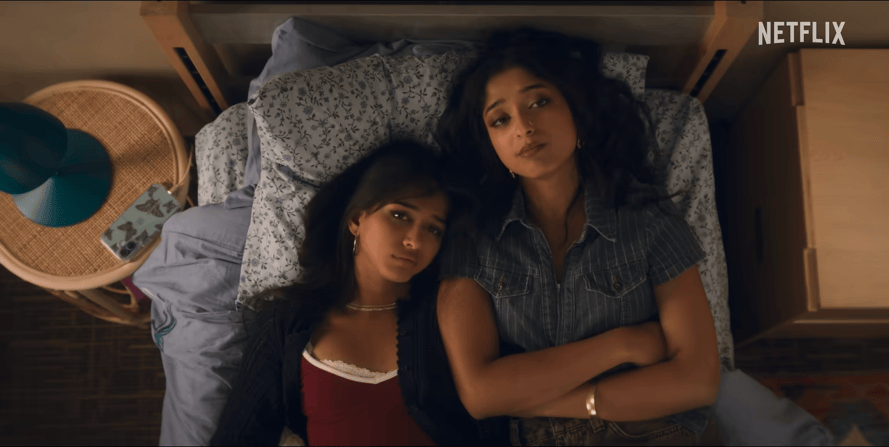
Best of the Best centers Maya, a crankily unstoppable Maitreyi Ramakrishnan (the star of Mindy Kaling’s Never Have I Ever, where her tempestuous character’s decisions are narrated by John McEnroe, probably my favorite stunt of 2020s tv so far) and Anjali, the deceptively wide-eyed Priyanka Kedia. They’re life-long friends who are now roommates as they start their college career studying computer science at UCLA. Maya is the smart one, and she takes academics in stride. Anjali is more interested in getting out from under the influence of her rigid and fearful mother, who threatens her with the consequences of academic failure. Anjali is desperate for parties, her face alight with joy at being noticed by boys, but Maya gives a giant eyeroll to stereotypical socializing.
That is, until they attend a South Asian Student Association mixer and learn about Agni (“fire”), the school’s Bollywood dance team. They hear how rigorous rehearsals are, and Anjali worries she won’t be able to keep up with classes. Maya promises to have her back with schoolwork, so they audition and make the team. Anjali quickly falls for the team leader Ronak, and Maya keeps bumping into Arjun, the most refreshingly low-key and mature of all the people in this universe, played by Chaneli Kular (Anwar from Sex Education) with admirable sweetness and solidity.
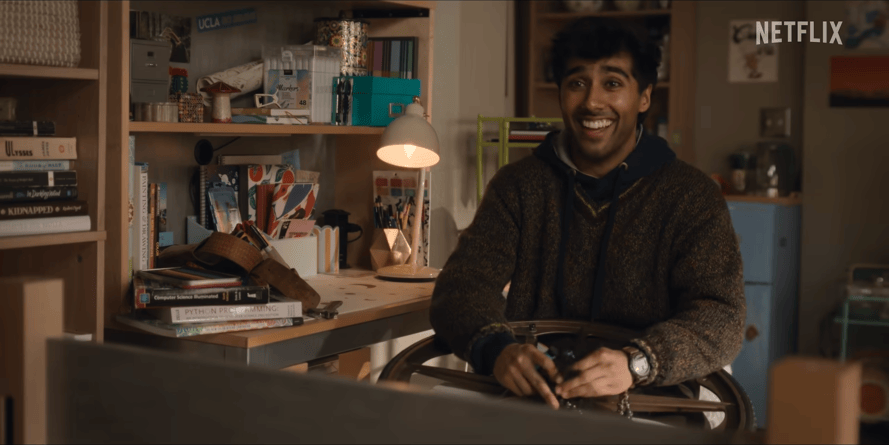
Maya is desperate to make her mark creatively on the team by arguing for a more interesting narrative theme than “traditional Bollywood weddings.” I am totally with her on this, although Ronak’s assessment that nostalgia is the key to the judges’ hearts does track with my experience of the wider internet discourse about Bollywood and its resonance within the American desi (South Asian) community. Maya is shot down and put in charge of props. Arjun has a part-time job at a hardware store—see? so normal!—and helps Maya with a rogue idea to create a smoke- and flower-breathing tiger to carry the bride and groom in the performance.
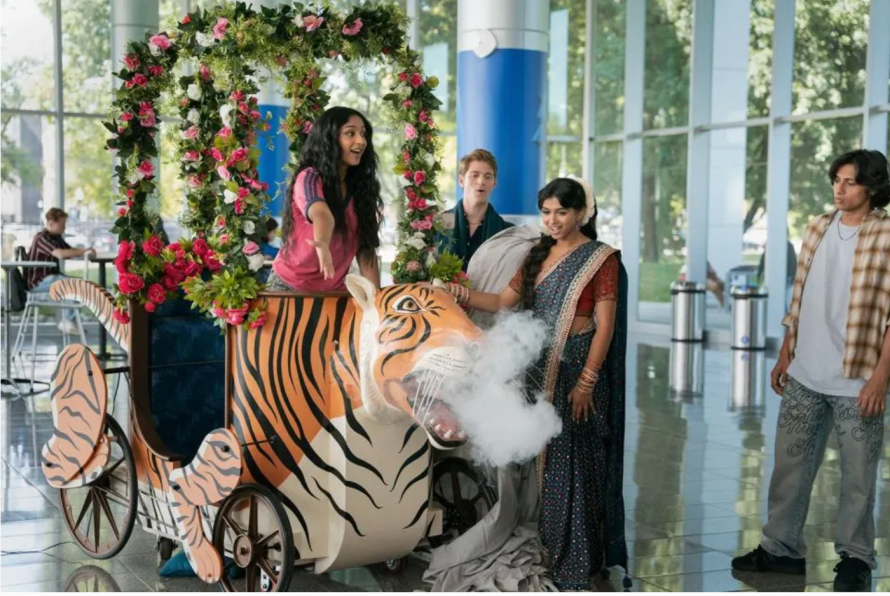
In their first competition round, Maya fires up the tiger despite Ronak telling her not to, and chaos ensues, harkening back to her high school drone strike mishap and leaving Anjali physically worse for wear. There’s a quietly funny theme in this film about devices going awry, which I hope is a jab at the flattened, model-minority stereotype of Indians in the US being great with tech. The demoralized team needs to raise funds to charter a bus to another qualifying performance round, so they participate in the SASA date auction. Anjali fetches a thousand dollars and runs off to celebrate with Ronak and the rest of the team. When it’s her turn on stage, a very reluctant Maya grabs the emcee’s mic to question the appropriateness of this event, and nobody bids on her…until Arjun arrives. I don’t want to give away the details, but this yucky event is the perfect setting to see our heroines accidentally at their worst: both of them break agreements they have made, and both of them let other people and self-doubt distract them from each other.
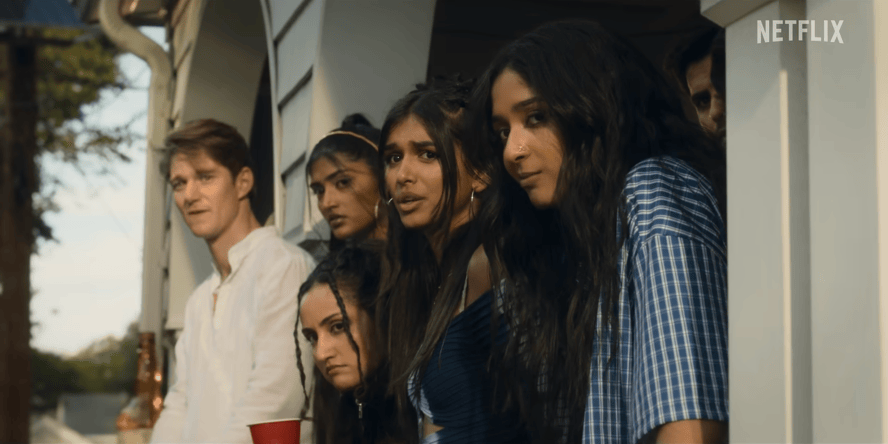
The rest of the film plays out as you expect, given that this is a team-based competition movie with an amusingly overdrawn antagonist as well as the women’s own internal struggles as they figure out what to do with a life-long friendship in their brand-new independence. Best of the Best is an admirable entry into the relatively small list of films about women’s friendships that are tested because of how they interact with each other and their true natures rather than because of competition with each other. Anjali and Maya have conflict, but it’s not because of a scarce resource like a questionable boyfriend or an unlikely corporate job. They have problems because they have taken each other for granted in the chaos of coming of age, even as they choose to share a dorm room or be in the same dance team or even do an unplanned performance in front of a crowd of drunk frat boys.
I read a review by an Indian woman who said she wished a film that centered on South Asian women could have been written by them as well, and that feels absolutely valid to me. Why it took a man to get a story like this made probably has an answer we all know, but that doesn’t make it easier to bear. In an interview at Forbes, the writers say that they revised the central friendship based on notes from Ramakrishnan, Kedia, and director Lena Khan.2
It’s not for me to say whether the cultural specifics resonate, but from a semi-informed outsider’s perspective, I can recognize points I’ve heard Indian-American students discuss: the pressure to study a field parents assume earns big salaries; a love-hate relationship with the tropes of Bollywood that feel cheesy yet inalienable; dance as a huge part of heritage that, depending on the size of the Indian community in their hometown, they may not have shared in front of big crowds. (These are all very clear in Minhaj’s documentary.) Maya and Anjali seem completely comfortable in their skin as Americans going to an American university, and we see them choosing to interact mostly with other South Asian students while clearly taking artistic influence from non-desi sources like hiphop. The Bollywood fusion dance style the team practices, combining traditional Indian forms with modern global pop culture, is a great analogy for what the characters are doing. They are confident that the fusion lives they lead are valid, exciting, and relatable, but it takes a huge amount of work to get all the components to function together in an effective and individually authentic way.
Best of the Best gets better as it goes along. It is to Minhaj and co-writer Prashanth Venkataramanujam’s3 credit that Anjali and Maya are not stock characters, at least to me, and that they spend time establishing who these women are (including in little flashback clips showing their friendship as children) before the height of the drama. Both characters are struggling to learn who they are as individuals and as friends, now that they’re away from home and finally have a chance to be different. I think at its heart the film is interested in exploring whether the women will choose to grow and change in ways that include each other…or not.
The dancing sequences are really fun, especially, of course, the championship round, but for me the best part is the two confronting each other over what it has been like to live inside the template of their friendship, their sisterhood, for 18 years. Neither of them consciously hurts the other, but pain has metastasized anyway. The aches within familiar, generally loving bonds are so deeply relatable. A scene in which one of them finally sees moments from their history—some of those same flashbacks we’ve all seen—through the other’s eyes made me tear up as much as she did. Maya and Anjali need to hear someone else point out that there is a path back to each other, but the choice of whether to take it is absolutely, uniquely theirs.
Best of the Best is streaming on Netflix. Watch the trailer on Youtube.
- It’s a fundraiser for the organization that manages these competitions, so please turn off your ad blocker! ↩︎
- Some interesting statistics about women writers at streaming services, courtesy of San Diego State University School of Theater, Television, and Film. ↩︎
- Venkataramanujam went to my own alma mater (I’m also an employee of 25+ years), where he was in the South Asian a capella group Chai Town (many of our students are from the Chicagoland area—get it? GET IT?), so maybe it’s no wonder the BOTB kids look so recognizable to me. ↩︎
~~~
Beth Watkins regularly arrives at brunches on a smoke and flower-breathing tiger.
Categories: Screen