

No one will be more surprised than I am that I enjoy Ramsay Brothers films. Since the 1970s, this family’s output has occupied a special place in Indian horror cinema. Working primarily in Hindi, the seven Ramsays made over 30 films (not quite all of them horror). For the purposes of this essay, if you don’t already know who the Ramsays are, just know that their oeuvre has a lot in common with mainstream Bollywood cinema, especially in terms of structural elements like song sequences and some genuinely A-list talent, as well as with much lower-budget, more fringe horror. To me, it usually feels situated somewhere in between the two. There is much good writing on the Ramsay Brothers by people who know a lot more about horror than I do, and I thoroughly recommend the piece “Ramsay International” by Rishi Majumder and the book Don’t Disturb the Dead by Shamya Dasgupta.
I realize that for many readers, me starting off saying “these films aren’t scary” is not a selling point. But I scare very easily, and in the world of the Ramsays I can safely enjoy fake blood, shaggy monsters, rubber masks, ominous predictions by priests with white shoe polish on their hair, etc. without having to turn away from the screen.


I love how these films use (and ignore) the filmmaking conventions of their more mainstream Hindi contemporaries. In addition to the anthropological detours that horror always provides—what does the evil say about what we fear in this particular time and place—Ramsay films are fascinating variations on masala formulas. While there’s admirable creativity in some ways, I also admit that I can’t keep most of their movies straight in my head: specifics of stories and scenes repeat, as do some of the on-screen talent. But as with any formula film, as long as you enjoy the ingredients, you’ll probably be relatively pleased with the output.
If we want to be literal about it, Purana Mandir (The Ancient Temple, 1984) teaches us that its audiences disliked monsters who rapes brides, sucks the blood of children, and eats corpses. Opening with a flashback to 200 years ago, we the monster, Samri, attack the local king’s daughter, and once soldiers capture him, charges of his other misdeeds are read out before he is executed. Thinking strategically, the king orders his head be cut off and kept separately from his body. The king decides to bury the body in the titular temple and takes the head to the palace, and a priest advises he guard the head with the protective power of the god Shiva’s trident. Before he dies, Samri curses the king’s family: all the women of the family will die as soon as they give birth.


This is not the most efficient curse, because it means that the lineage can easily continue, but I appreciate that Samri is more interested in instilling dread than in rushing to the end result. He’s an artisanal demon. The narrator brings us up to today (1984 “today,” anyway), where the current king lives in Mumbai and has a university-aged daughter named Suman. Suman is in love with Sanjay, happily ignorant of the curse that causes her father to dread her maturing into likely-to-be-a-biological-mother years. “Why don’t you just adopt?” does not come up—purity of the royal bloodline and all that.

After trying to separate Suman and Sanjay on economic grounds, her dad eventually tells them of the curse, and they, being intrepid modern 20somethings, zoom off to the ancestral palace to get rid of the source of the curse once and for all, accompanied by Sanjay’s friend Anand and his wife Sapna. Anand, played frequent villain actor (and also star of a Hindi version of Superman!) Puneet Issar, is my favorite person in the film. He’s almost always in a cheerful mood except when he leaps into physical altercations, which is admittedly frequently. Anand is the attack golden retriever of this group of friends.


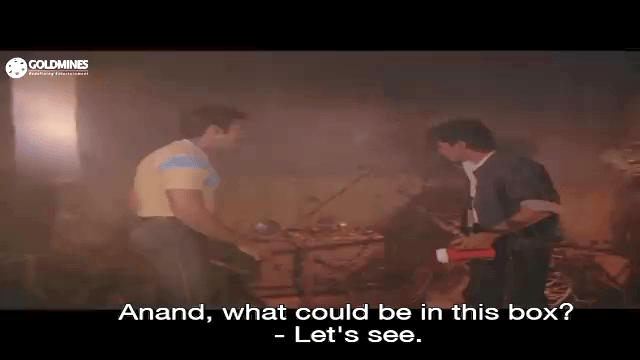
With help from various locals—the helpful caretaker and his cackling mother, the weird and decidedly unhelpful woodcutter, a whole slew of villagers who have their own side plot spoofing the mega-popular and influential film Sholay with industry stalwarts in a comedy track that I fast-forward through every time I watch the film—the kids explore the grounds and learn more about the curse. I won’t say who, but of course someone thinks the chest with the head in it actually contains a treasure, so it gets opened and the monster body finds its head and Sarmi is resurrected and goes about doing his monstrous things. A final fight brings on the torch-wielding villagers and the remorseful king, and eventually all is well.



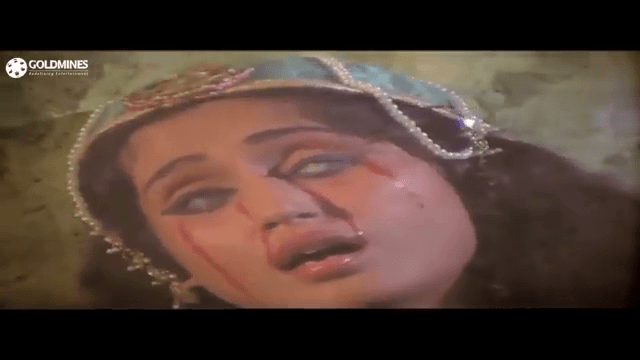
The body count in this film is not exactly low, given how many named characters there are, but it’s still fully watchable, even to a scaredy-cat like me. The creepy bits of the palace and grounds are fun, if maybe a little austere. In addition to generally dark, dusty ruins, Samri’s face looming in Suman’s nightmares, and more blood dripping from places blood definitely shouldn’t be, there’s a painting of the original king that looks from side to side and eventually bleeds from its eyes, just like we saw happen to that king’s daughter when Samri attacked her in the flashback.


As for the morals of the story, if I put my thinking cap on a little bit, maybe I would propose that because Samri seems to prey on groups thought to be fairly defenseless (the young, the virginal, the dead), his terror is a threat to the power, and therefore dominance, of those members of society typically considered the protectors and/or owners of said groups, namely adult men. And yet the king, who is of course the embodiment of the ultimate social power in the story, forgives his daughter for disobeying him and even comes around to her choice of a less-prestigious love interest, admitting that Sanjay has demonstrated his good character by going after Samri. There’s a nice unspoken compromise between the generations here: dad is right that there’s peril (and in fact it’s even worse than he fears, because Samri attacks Suman even though she’s not a mother), and the kids are right that it can be defeated.

While the Ramsay Brothers generally have no problem with dabbling in slightly sleazy sequences, in this film, at least, the most sexually forward women are not killed, keeping this out of exploitation territory. And while I could very very happily do without the comedy plot, that’s almost always true for me in Hindi films regardless of their formula or tone, so I can’t really detract any points for that either.
What Purana Mandir does most interestingly, is find a way to integrate the emotional lifting power of song sequences. The romantic songs, as usual, demonstrate what characters are feeling, and in this particular context those feelings are evidence of or context for the effects of Samri’s curse and haunting. A number in a nightclub before the friends go off on their quest establishes their modernity in contrast to Suman’s dad’s apparent traditional values. Suman is pitiable figure not just because she’s Samri’s automatic target due to demographics but also because she pines sadly when her boyfriend has to pretend to abandon her in order to get information out of a village belle. And in time-honored Bollywood tradition, that same woman eventually uses her dance to help free people who are wrongfully imprisoned.
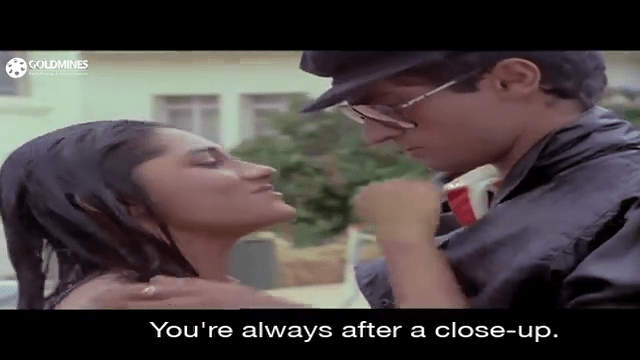
I am unqualified to talk about how Ramsay Brothers films fit into horror films globally, but if you’re looking for an introduction to the history of Indian (specifically Hindi) horror, I can’t think of anything better. Despite me not being able to remember which of their films is which—a lot of them have a dusty palace, ruins, a shaggy monster, and/or a young woman taking a shower in her swimsuit—this one seems like a solid start. According to Dasgupta’s book, Purana Mandir was among the highest grossing Hindi films of 1984, so clearly whatever it was doing worked for audiences at the time, particularly in the Ramsays’ target markets outside major metropolitan centers.
Purana Mandir is on Youtube without subtitles, but downloadable subtitles are easy to find. It’s also available on a Mondo Macabro DVD, though the company has a warning at the beginning of it that notes they were unable to find film stock up to their standards and did the best with what they had. If you want scarier Indian films, my yellow-belly recommendations are Tumbbad (on Prime) and Bulbbul (on Netflix). And if you want to sample much less competently made Hindi horror, many of us associated with the Gutter (such as beloved colleague Todd Stadman) are…fans, for lack of a better word, of Shaitani Dracula, a film that must be seen to be believed (and, pleasingly, its director shares a name with the king Samri names in his curse pictured above! Coincidence???). We even got it to trend on Twitter!
~~~
Beth Watkins prefers that all her demons be artisanal, whether in the particularity of their curses or in their donning of styrofoam wings and roll ominously about on office chairs during the visitations in our world.
Categories: Screen




 The Cultural Gutter