

Merchant and Ivory’s India-set films tend to rip out my heart and stomp on it—in a good way. Two years ago I wrote about Shakespeare-Wallah for Switcheroo Month, and here I am again, this time with a sort of bildungsroman, complicated by imperial socio-political goings-on.
Heat and Dust (1983), adapted by Ruth Prawer Jhabwala from her own Booker Prize-winning novel, flips back and forth between present day of the 1980s and the last decades of the Raj, both in the same location in India. We’re 40 years past the “now” of this film, but it still resonates deeply, primarily because at its core it looks at how humans treat each other at the core, underneath the privileges and demands layered on top of them by their cultural context.


In the modern day, Anne (Julie Christie) has found letters written by her great-aunt Olivia (Greta Scacchi) about her life in India in the 1920s. Newly married and newly arrived in the white neighborhood of Satipur, Olivia has more time on her hands than she knows what to do with while her husband Douglas, a lower-level official, is off working. She doesn’t like the other English women (memsahibs) with their performative superiority and incessant chatter about nothing in particular, and the women of the local Indian ruling household are largely inaccessible, thanks to their own class system, custom of purdah, and Olivia’s ignorance of the local language. The companions she eventually finds are the Indian nawab (prince), played by Shashi Kapoor, and his friend/hanger-on, Harry (Nickolas Grace).
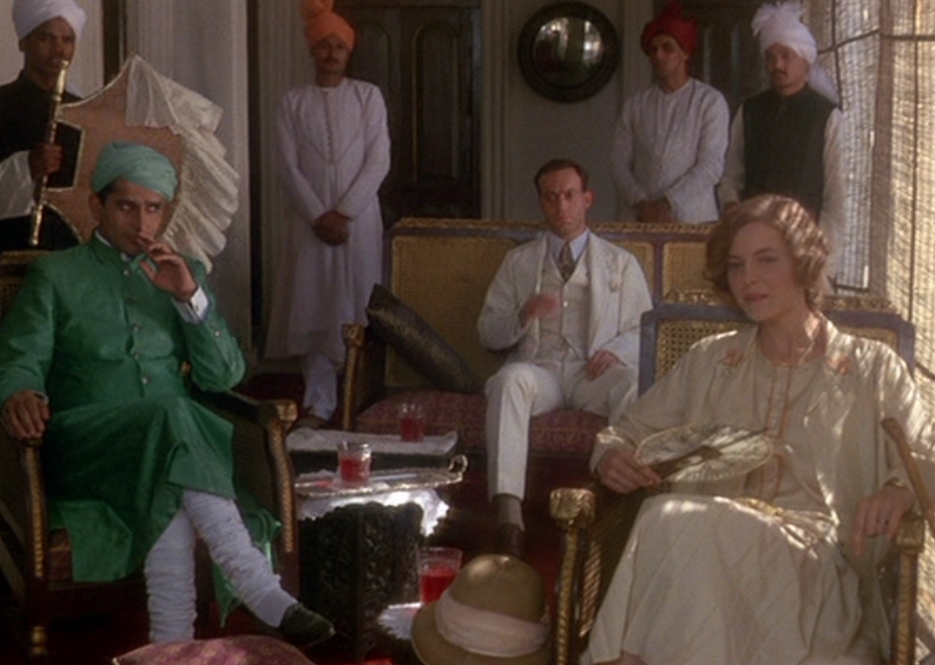
Harry survives the subsequent decades; now back in England, Anne interviews him about his time in Satipur. Based on his intelligence, Anne goes to Satipur and rents a room with a local family. The husband Inder Lal (Zakir Hussain) is her main guide and interpreter, but the Indian women Anne meets make just as strong an impression. Her life begins to mirror Olivia’s, as she gets to know another white foreigner, Chid (Charles McCaughan), who has immersed himself in local culture, an overzealous American convert to Hinduism who babbles on about true essence and union of spirits and is every bit as cringe as you imagine.
Of the paralleling stories of Anne and Olivia, Anne’s story is the easier one to make sense of: she’s in India in search of something, and she’s not entirely sure what when she starts out but seems to find contentment by the end.
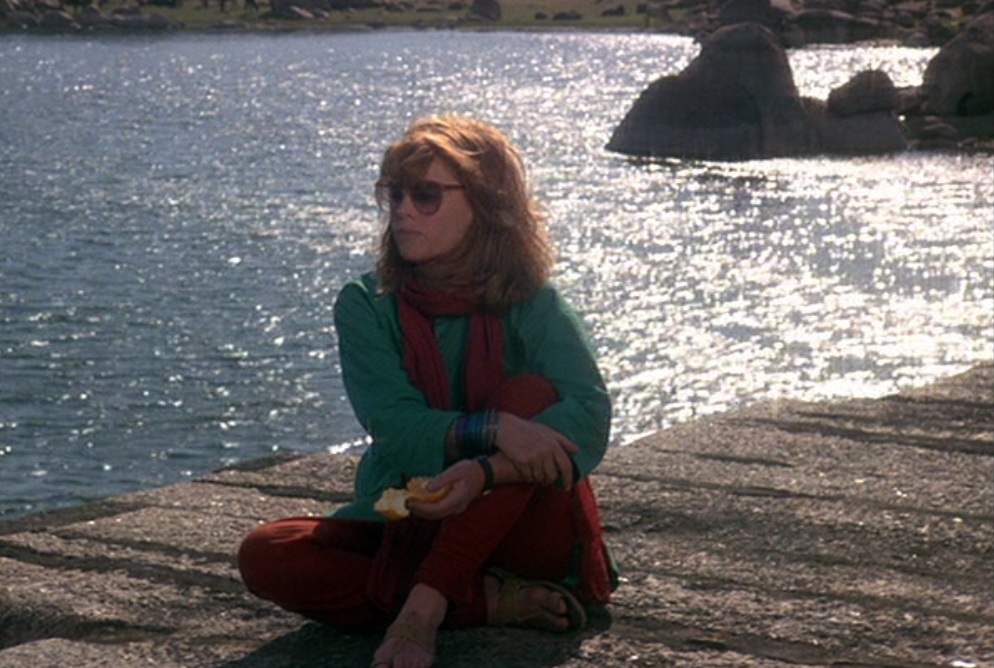
I’m not sure if Anne is partially a parody or not; Chid certainly is, but Anne is much more careful and thoughtful than Chid, and when she stumbles, she can take care of herself. Even so, by the time Jhabwala wrote the novel this film comes from in 1975, white hippies seeking meaning and truth in subcontinental mountains and beaches were an established punchline in India. The film closes on Anne about to enter the next big phase of her life in a way that made me roll my eyes at her a bit.

In the 1920s, though, life is more complex, as life in movies seems to be when social norms prevent people from doing and saying what they really want. (The question of social norms comes up in Anne’s story too; most of the major points in Olivia’s life have parallels in Anne’s.) All the characters want something, and everybody has something ugly in them, something to color how you interpret them. Olivia is probably the least skewed, and she comes off more ignorant than anything else. Like young Lizzie Buckingham in Shakespeare-Wallah, naive Olivia has to navigate her attraction to the nawab, a manifestation of the more sophisticated and equally rule-bound Indian culture. I am again unclear about whether the film thinks Olivia is exoticizing the culture she finds herself in. She tries to engage with her new world as best she can, given that she is kept at a distance from it and given oversimplified versions of it by both the English and the Indians. The only person who really seems to be her equivalent and true friend is Harry, who’s not Indian by any stretch, but seems to have no use for or interest in the world of the English. Everyone in the flashbacks has complicated motives. The nawab is broke and grasping for cash, Olivia’s husband worries about his job competency, the higher-up English officers do everything they can to minimize the threat of rebellion, and all of the women seem to obsess over social niceties that are much more about exclusion than politeness.

At the same time, the characters’ hidden agendas and run-ins with customs and boundaries lead to awkwardness that is funny to watch. Olivia has the most trouble, of course, but everyone at some points has to choose what to do with social expectations and obstacles. There are many conversations about how to behave and how to think about other people. Upon first arriving in India, at a formal event Olivia is offered a snack she can’t stomach and has to make desperate faces at her husband, who mimes to spit it out in her hanky.

Another of my favorites is bit of dialogue from a paranoid memsahib’s advice to Olivia about Indian men when she first arrives: “The only have one thought in their heads, Mrs Rivers, and that’s to you-know-what with a white woman.” It’s funny on a basic level—racist, emotionally unstable memsahib spouts nonsense—and it’s juicier when you know that the actor is Shashi Kapoor’s wife in real life. Other lines like this—for example, Anne all but rolls her eyes while supposing contemporary English people move to India trailing after some guru or other—make me think that the team of Merchant, Ivory, and Jhabwala have a keen sense of humor about the stereotypes that float about in the sea of Indian-Anglo culture and relationships. (It could be that they were also having fun with real life stories: in addition to Kapoor’s Indian-English love story, Julie Christie was born and raised in India.)
But does the sense of humor guarantee they’re not falling into exoticizing, demeaning ideas and depictions? I really don’t know. Orientalism is a charge frequently levied at Merchant and Ivory, but personally I haven’t found it to hold up in their other India-based movies. For example, what do we make of Kapoor’s unctuous nawab? He loves the trappings of his status and the lifestyle he’s had, but he also orchestrates an appearance of playing along with the Raj while agitating politically behind the scenes. Is he a decadent, impotent dandy or a clever independent? Or Anne’s host family, who tries to cure Inder Lal’s wife Ritu’s unexplained illness with chickens, fire, and a pilgrimage to a holy site? This little arc was the most troubling to me because it’s presented with no information. We don’t know what’s wrong with Ritu, who screams and thrashes at night but seems perfectly lovely and competent during the day, and we don’t know what the bowl of fire and waving a chicken over her are supposed to do; we only hear that Anne tries to take her to a specialist doctor and Inder Lal declines.

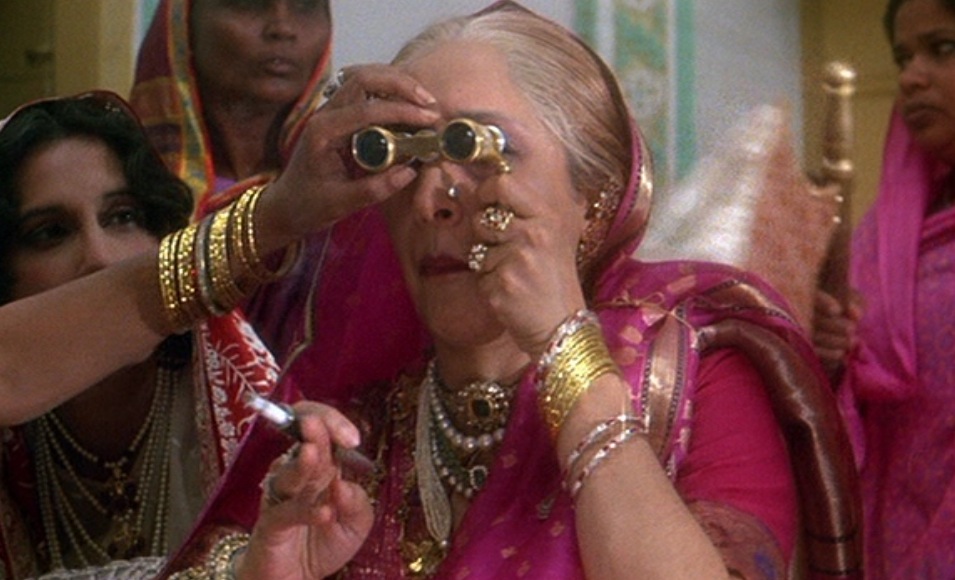
Stereotypes abound, voiced mostly by the racist British officers, but the film is certainly criticizing and mocking them. Most of the language they use is so appalling and unsubtle that it’s hard to believe the filmmakers would have them use it for anything other than easy targets. The nawab’s mother (Madhur Jaffrey) is another hater; she loves viewing the pomp of the English and making the ladies squirm by her pointed questions or shunning them altogether.
Both Indian and English characters in Heat and Dust present a variety of opinions about the Raj and about each other. Everyone in this movie has prejudices, some nastier, more ignorant, or more harmful than others.
Like Shakespeare-Wallah (and The Householder and Bombay Talkie, which I’m sure I’ll cover in subsequent Switcheroos), this story is emotional and biting. I was really choked up at parts, mostly those that moved at the personal level of responding to one’s attachments and attractions. Ultimately, I think Heat and Dust is about the importance of finding the people and situations that make you happy and doing whatever you can to be ensconced in them.
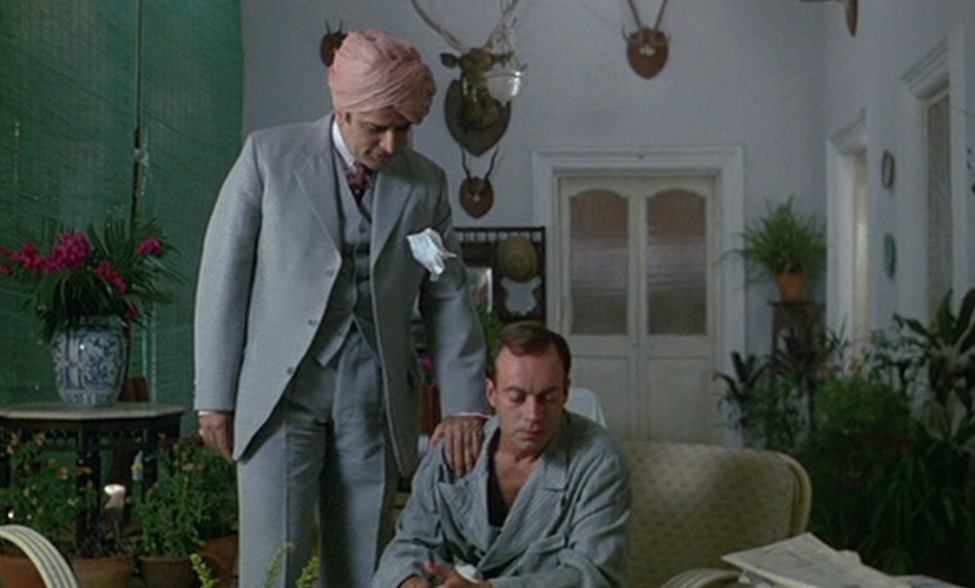
Before I close, though, I need to talk about Harry. When I first watched this film over a decade ago, I wondered if we were supposed to read his relationship with the nawab as a closeted love affair. Now, though, I am certain. When Harry falls ill and moves in with Olivia, the nawab is upset and tries to win him back while one of the other memsahibs tries to get him passage back to Britain. More than anyone else, Harry embodies the potential troubles of bucking social norms too dramatically. His valuable insider-outsider perspective comes at the price of precariousness: he has no protection and no fixed position from family, marriage, job, or land-owning. Harry, Olivia, and the nawab are the center of the story and all share this instability. Harry is white and male, but shaky; Olivia is white and linked to the government, but also a woman unwilling to do as she’s told; the nawab is rich and male, but othered by ethnicity and culture. Like dust whipped up by a summer windstorm, our true identities seep into every corner, irritating and agitating until dealt with. Self-determined agency, seen in Anne, might be the solution for happiness, but you still must tread carefully.
Heat and Dust is available for free on Tubi and to rent/buy on Youtube.
~~~
Beth Watkins, too, enjoys watching pomp through opera glasses.
Categories: Screen




 The Cultural Gutter


Agree with her.In fact,he was a quiet silent showman. And few knew his grand parties which were bigger than any other actor including his own eldest brother Raj Kapoor.He was very popular in England & North Africa. And above all he was most well mannered actor & used to come on time on sets
LikeLike