
[somewhat spoiler-y]
My current slot to publish at the Gutter falls just a day before the Hindu/Jain/Buddhist festival for snake deities, Naga Panchami, so I take this auspicious coincidence as a sign to bring forward another Indian snake film. If my research is accurate, the first Indian snake film to appear on the Gutter was Nagin (simply “female snake” or “female snake deity”), and since that was 8 long years ago, allow me to re-introduce the basics of India’s glorious tradition of films with a condensed version of what I wrote then:
Snake movies tend to follow certain conventions, whether the film is a mainstream release made with robust budgets and popular actors (like Tum Mere Ho, Sheshnaag, or Nagina that I’m covering today) or a niche project aimed at more specific audiences. Every example I’ve seen involves deities or religious practice. Sometimes the inclusion of the divine is almost perfunctory, getting a passing mention as the source of a snake’s ability to shape-shift into a human, but in other films it’s at the very center of the story, with multiple scenes of worship, displays of the gods’ powers, or direct divine intervention. Once they have appeared, serpents are always integral to the resolution of the story or the restoration of order and morality. Additional snake characters might be forces of greed or chaos, but in my experience they tend to be innocent puppets of some nasty human, such as a tantric whose devotion is focused on a snake god, who has wrongfully gained knowledge of how to control snakes and then harnessed their powers for their own evil-doing.
Snake films often elaborate on this basic formula and are full of shape-shifting, curses, revenge, magical gems, travel between earth and the heavens, and eyes that shoot lightning bolts. They also typically include song and dance sequences like much of popular Indian cinema, opening the door to impressive serpentine choreography and costuming.
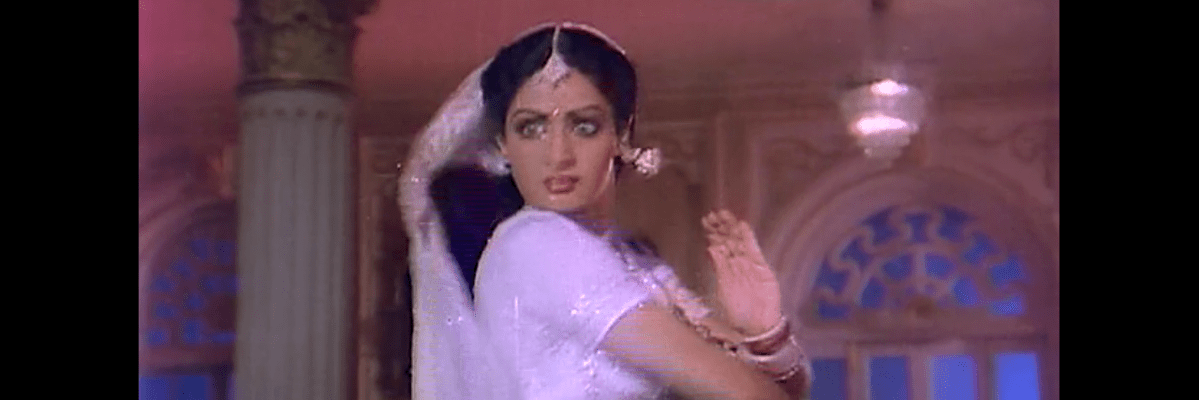
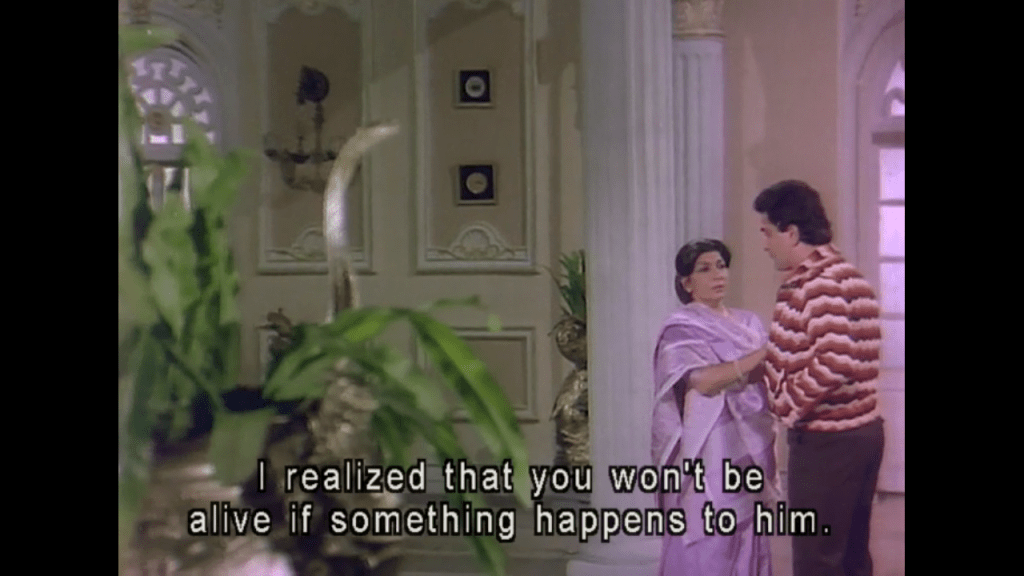
Nagina (1986) was a huge hit with audiences. Featuring superstars Sridevi and Rishi Kapoor, it is a relatively sedate take on the snake movie formula. Wealthy son Rajiv (Kapoor) returns to his family home in India after spending most of his life in Britain. Touring his landholdings by horse carriage, he pulls up next to the abandoned ancestral palace and quickly encounters a snake who spooks his horses and then tries to bite him. He escapes unharmed, but unbeknownst to anyone, the snake hops on his cart and follows him home, hiding in a houseplant and watching Rajiv interact with his overprotective mother (Sushma Seth).
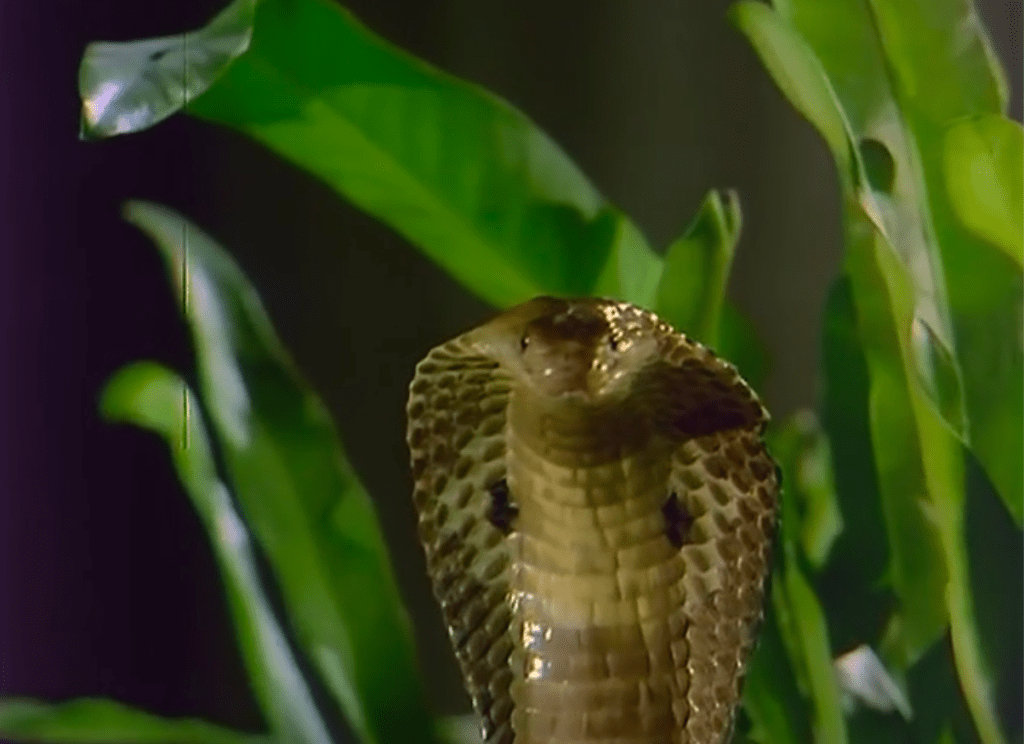
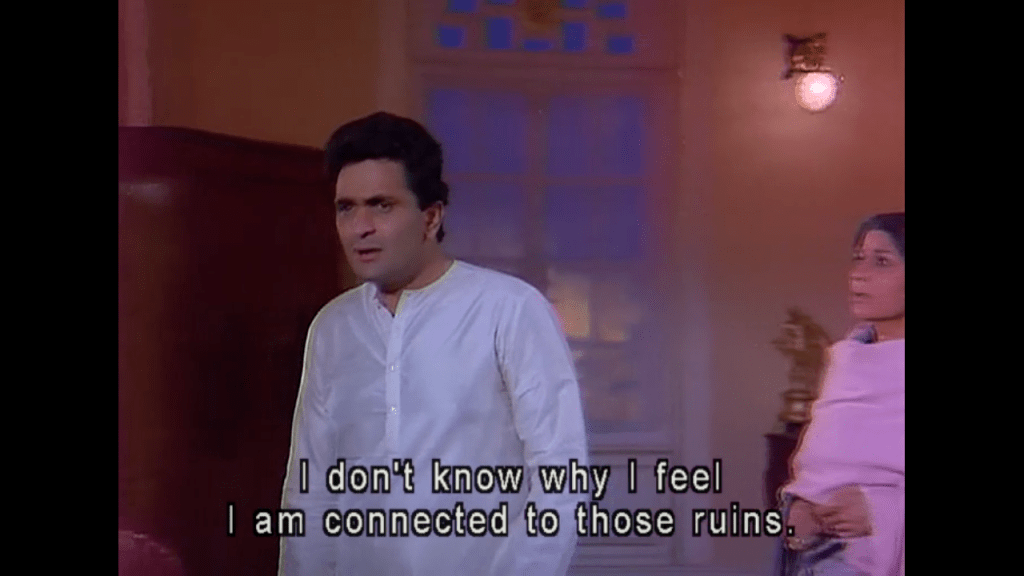
Rajiv feels compelled to explore the old palace more fully, and there he meets Rajni (Sridevi). The crew of Nagina know exactly what kind of movie this is and lay on the “mysterious heroine” material pretty thick, with Rajni scampering around in tinkling anklets and hiding behind columns singing a haunting song in billows of mist until Rajiv is almost frantic.
She introduces him to the palace grounds, including a Shiva temple, and talks about how much time they used to spend together. Rajiv has no memory of any of this, but maybe this can be chalked up to him having been sent off to Britain when he was only 6 years old? HMMMMM. At home, Rajiv muses to his mother and to his diary about how drawn he is to the palace and to Rajni. Their romance is fast and thorough, and they decide to marry.

Unfortunately, Rajiv’s mother has arranged a marriage for him with the daughter of Ajay Singh (Prem Chopra), who I think is the estate manager, and he flies into a rage at the insult of the orphaned Rajni connecting herself to the landowning family and denying him the connection he feels he’s owed after serving the family for so long. He sends a henchman to dispatch of Rajni, and here, an hour into the film, is our first clear look at what’s truly going on: we see Rajni stumbling along a riverbank, caught by the villain’s lasso, and then we see a snakes chasing him back to his jeep. He drives away but not in time, as they glare at him through his windshield, wrap around his foot on the brake, and bite him, sending him careening into a lethal accident.
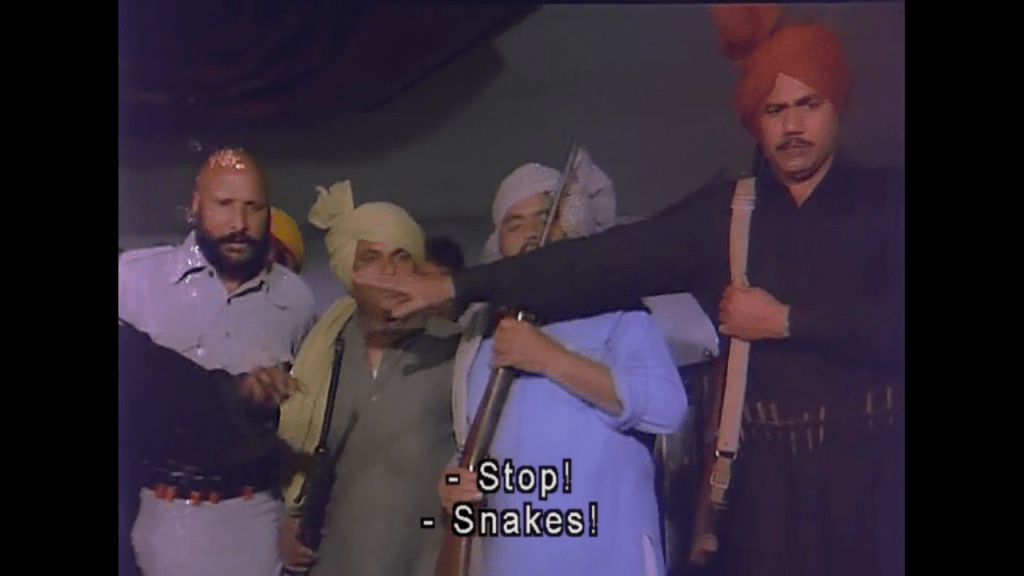
Unharmed, Rajni allows Rajiv to bring her home, and ma, who is ridiculous for reasons we will see later but is not a complete monster, is won over by the demure magic that is Sridevi in this role, because resisting Sridevi is just not done. At their wedding, Ajay Singh tries his evil plans again, but snakes threaten away his armed goons.

Even ma is delighted by her new daughter-in-law, but unfortunately a problem bigger than a greedy estate manager shows up: it’s evil tantric Bhairon Nath! You can tell he’s evil and not just devout because he’s wearing all black and red, has his eyebrows cranked up to 11, and is played Amrish Puri (if you don’t know Puri as Bollywood’s absolute favorite villain, then you’ll know him as the infamous Mola Ram from Indiana Jones and the Temple of Doom) (now that I know about Hindi cinema, I realize what a redundant title that is, because any cinematic facility where Amrish Puri practices it is automatically a temple of doom). He senses the presence of a “poisonous snake” in the house and begins to play the “snake charmer” music we all recognize, and in another part of the house Rajni’s brown eyes turn blue and an image of a snake is superimposed on her face. He returns another time, demanding that Rajni be recognized as evil and thrown out, but fortunately Rajiv has angrily burst into the living room and interrupted proceedings, so she’s safe for the moment.
Ajay Singh is not done causing trouble, and the family cannot find the papers needed to maintain their ownership of all their lands and resources. But Rajni can, and snakes turn out to be impressively useful office assistants, nudging the right file into Rajiv’s path. I don’t know how this was filmed, but it is an absolute treat to watch a live snake deal with paperwork.
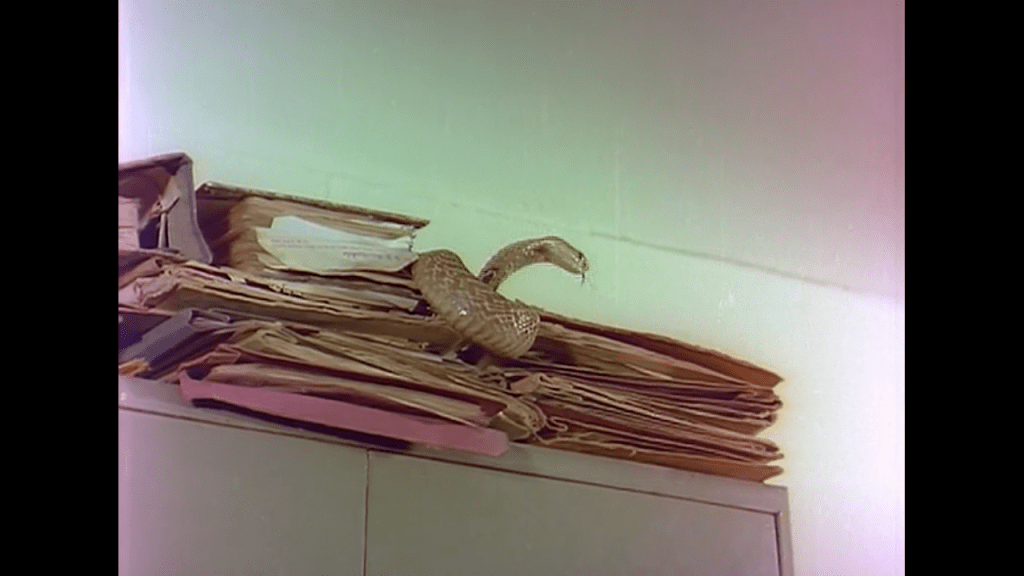
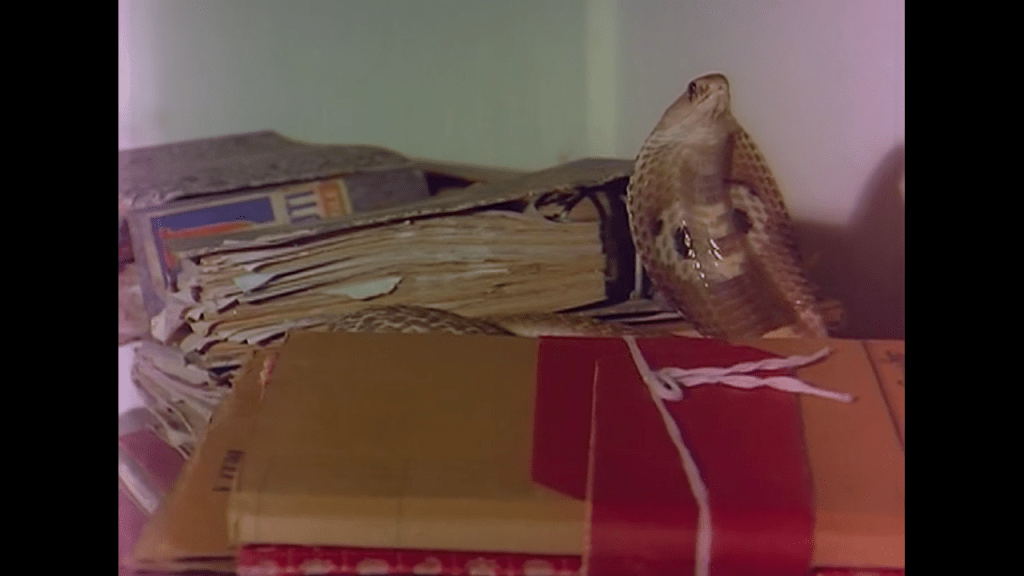
Knowing Rajiv is unsafe, she also does some slithering dance moves to try to tempt him to stay home instead of taking those papers to the lawyer. If Rajiv watched more Bollywood, this would be enough for him to understand what’s going on with his wife, but I guess spending his formative years in Britain meant he didn’t have access to the right media, and when he eventually sets out, he is set upon by Singh and yet more goons. Fortunately Rajni’s powers are ready, and Singh is punished, but not before injuring Rajiv with his rifle. Rajni watches over Rajiv in the hospital, but Bhairon calls on the Snake King to help him, and we get an impressively bloody (and I fear very inhumane) fight between two live snakes on the hospital floor. Rajni confronts Bhairon, accuses him of misusing his powers, and lets him know that nobody can mess with the power of a devoted wife.
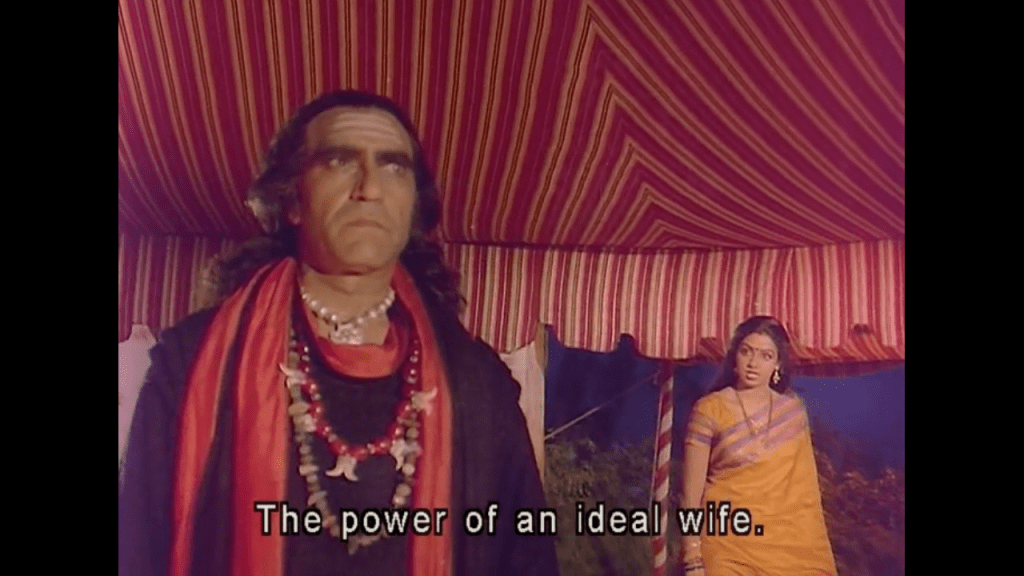
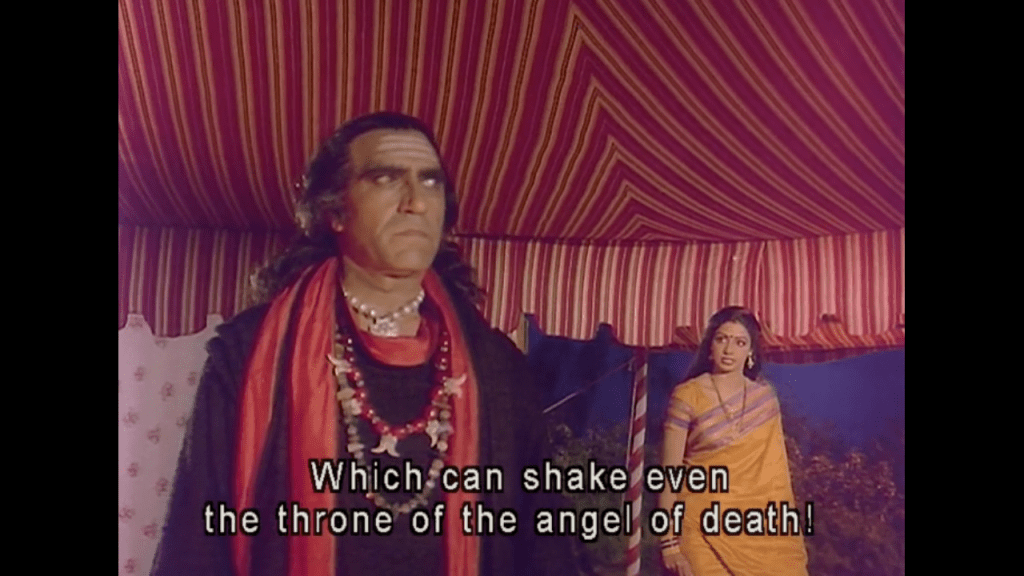
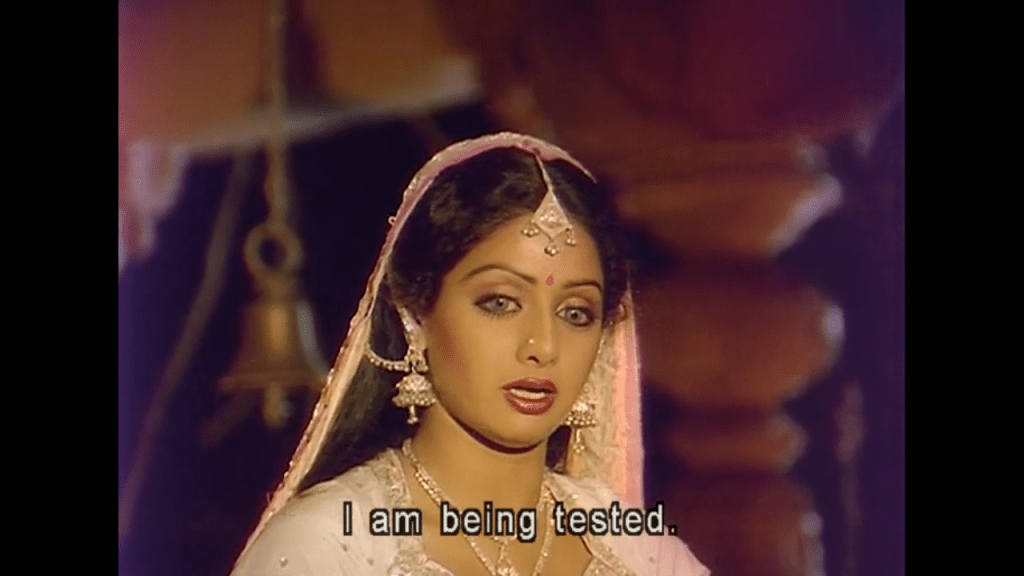
Bhairon tells ma that her daughter-in-law is not a simple village girl but a she-snake, and ma sets out to find out for herself. She gets proof, but Rajni volunteers an explanation. When Rajiv was a little child, he was bitten by a snake at the family’s old palace. Bhairon used music to draw another snake to heal him, the life force and soul of the second snake transferring into the dying child. This savior snake was Rajni’s husband, which is why Rajni was so eager to see Rajiv when he returned from abroad. Her initial plan was to bite him, freeing the soul to go back to its original snake form, but when she followed Rajiv home in the carriage, she saw how much his mother loved him and was moved to join him as a human partner instead.
However, Bhairon also discovered that the husband snake and now Rajni have a powerful gem, and he would like to relieve them of it. We never see this gem (unless the upload of the film I watched had some thoughtless cuts made to it), but it’s enough to know that Bhairon is going to use his mighty meditative powers to get it.
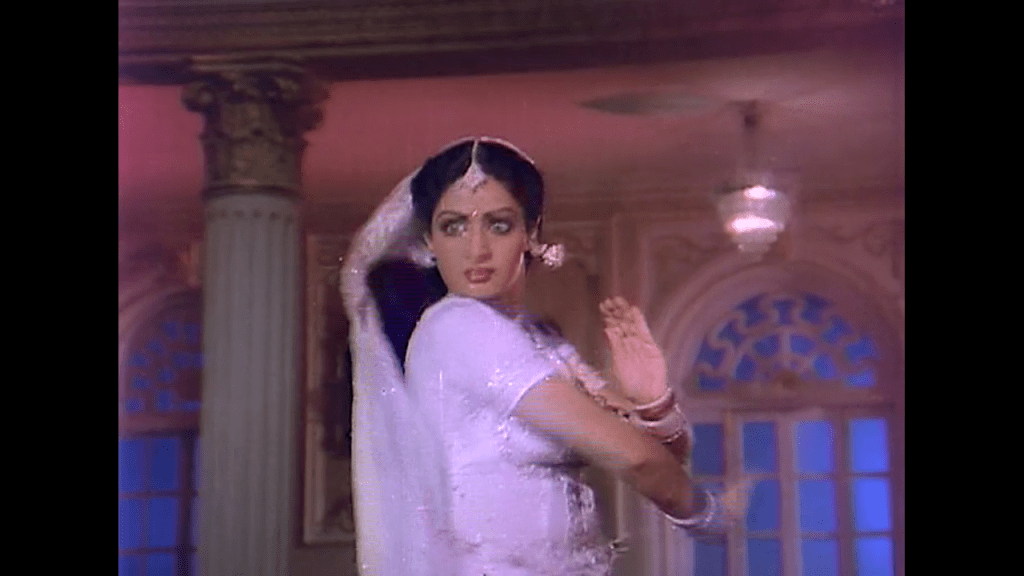
The rest of the film is a showdown between Rajni and Bhairon, culminating in probably the best-loved snake-movie scene in Hindi cinema (and maybe Indian cinema more broadly): Sridevi performing 8 minutes of exhausting, gymnastic choreography as Rajni’s snake form in “Main Teri Dushman” (“I’m Your Enemy”), violently resisting the lure of Bhairon’s flute as he tries to bend her to his will.
This is not the actual end of the film, but it should be, because Sridevi vs. Amrish Puri is more interesting than Rishi Kapoor vs. Amrish Puri, which is the sort of “hero vs. villain” thing Bollywood does all the time.
Somehow all of this is, to me, just so lackluster. And it really shouldn’t be! You know what has lots of luster? Palaces! Dance costumes! Snakes with secret gems! Bright blue contact lenses! Rishi Kapoor and Sridevi! Why is this film so blah? To me, Nagina is generally perfunctory far more often than it is inventive or exuberant. With a few exceptions, it adheres to snake-movie beats in a letter-of-the-law sort of way, which frankly is very disappointing, especially given the lead actors. For example, it’s not necessary to put an actor performing snake choreography in shimmering green or scaly sequinned costuming to make clear the spirit they’re evoking, but when you have the opportunity, why wouldn’t you? You don’t have to add flying snakes or lightning bolts coming from a protagonist’s eyes to your grand finale fight scene, but again, why wouldn’t you?
The major innovation I see in Nagina (other than a wrinkle in characterization at the very end that I won’t spoil) is using human mother’s extreme love of her son as a force of chaos. This particular familial relationship is a staple of many Bollywood films but one that is less common in snake movies, as far as I can tell—and I wonder if this is actually the first snake movie to use it. Rajiv’s mother’s interference and her insistence that she knows best repeatedly make his life worse, and I can’t think of another film where the mother is so frustratingly meddlesome in things well beyond her ken. One of the most revered Hindi films of all time, Deewaar (1975), has famously important mother-love power, but in a way it is a much simpler (and sadder) form: a mother has two sons who end up on opposite sides of the law, and the one she loves more is the one who strays from what is right. Nagina’s ma made me skeptical from the jump: for reasons not made clear (at least in the subtitles), she never went to visit her son in Britain in all his years away. The film tells us Rajiv is sent away for his own protection, so I understand why he didn’t visit home, but if he’s her sole reason for living (more or less the vibe we get), why didn’t she go see him? If she had, maybe she could have conceived of her son as an individual with intelligence of his own and listened to him and his chosen partner instead of a clearly creepy guru. Released 4 years after Nagina, the snake film Tum Mere Ho also plays with the negative impact of mothers, but the parent is a snake: its main serpent is grieving and avenging a murdered child. Wreaking havoc on a specific human or community through as acts of vengeance is generally what cinematic snakes do for a variety of rationales.
“Main Teri Dushman” deserved more than this film. When you compare it to things like Nagin, where the snake takes many different forms and kills 6 different baddies with a song for most of them, it’s so dull. But maybe I’m thinking of it wrong. Despite its title, maybe Nagina isn’t really a snake film. It’s a family revenge drama with a few snake elements tossed in.
To see what I’m talking about, please, please go read The Filmi Snake Spotter’s Field Guide, in which the author lays out the tropes of snake films and gives examples of their glorious iterations and interpretations. (My laptop did not like that URL, so I accessed it instead via the Wayback Machine.) Even browsing the photos in FSSFG will show you why I am relatively unimpressed by Nagina: when the formula gives so many opportunities for drama, emotion, and sparkle, why be so pedestrian? But once again, my opinion is clearly not that of the audiences for whom this famous artwork was intended, so do try it for yourself.
Nagina is available with English subtitles in a very condensed form on Youtube and on Einthusan (free signup required and well worth it if you have any interest in films from across India). You might also enjoy friend of the Gutter Todd Stadtman’s more enthusiastic take on Nagina.
~~~
Beth Watkins is not a nagin. She is a perfectly normal human being with an interest in nagin films.
Categories: Screen




 The Cultural Gutter