My friends in film, Fantastic Fest 2024 is over. The awards have been handed out. The writers at more reputable outlets are sharing their thoughts. And here at the Gutter, even though I attened remotely, my brain is tired from watching movies, thinking about movies and writing about them. I could honestly do a piece about each of these films–and then probably write more about them in different pairings. But for now, I’ve gathered my quick thoughts on the five films I saw this year. I was happy to encounter two new folk horror films, three films that appreciate nature, three films where foul men get their comeuppance–2 via creatures and 1 via martial arts ghost–and two films that appreciate the value and dramatic possibilities of patently “unrealistic” props. This year’s festival was a nice time and I’m so glad I got to write about it for you.

AJ Goes To The Dog Park (USA, 2024) written and directed by Toby Jones
AJ Goes To The Dog Park is zany, absurd and cartoonish in the best way. AJ (AJ Thompson) has a pretty sweet life that he loves. It’s pleasant. It’s low-pressure. Every morning he has cinnamon toast with whipped butter–which is the best–before he bikes to work at his low level, largely stress-free job. He has dinner with his dad or his best friends, married couple Morgan (Morgan Davy) and Danny (Danny Davy). He loves his chihuahuas Biff (Biff) and Diddy (Diddy). His favorite thing, though, is taking Biff and Diddy to the dog park. Unfortunately for AJ, Biff and Diddy, the Mayor (Crystal Cossette Knight) has replaced the local dog park with her pet project, a blog park, where bloggers can gather to blog in nature. After a discussion with his father (Greg Carlson), AJ decides to embark on a quest to accomplish interesting but low stakes feats in order to replace the mayor and set the dog park, and his world, to rights. He undertakes training and there is even a montage.
Writer/director Toby Jones is a former writer and story boarder for the animated series, The Regular Show. AJ Goes ToThe Dog Park, while based on Jones’ real life friend A.J., has much of the same sensibility as The Regular Show, but with more human beings doing human stuff. It does have a muscle man like The Regular Show, though.There are some bits in AJ Goes To The Dog Park that are straight up zany cartoon bits–like when AJ literally creates an impact silhouette when confronting the Mayor or when AJ cries a torrent of digital, heartbroken tears. And there is some gaming in there, too, it’s not as evident as in Hundreds Of Beavers, but AJ’s quest feels both mythically mundane and a list of questline tasks that must be accomplished on a Nintendo Switch. Maybe a cozy quest.
AJ Goes To The Dog Park does remind me of other micro budget movies like Lake Michigan Monster (USA, 2018), Jesus Christ Vampire Hunter (Canada, 2001)*, and, to a lesser extent, Hundreds of Beavers (USA, 2022), especially in how it embraces a particular locale. I love the film’s affection for Fargo, North Dakota. It also reminds me of those films in how it embraces and works with the constraints imposed by a tiny budget. To wit, I loved how AJ’s dogs were replaced by plushies when necessary. I loved the pointedly obvious hairpieces and wigs. Anyone can do cheap, but not everyone can make it funny. And I am refraining from sharing a twist in the ending, but if you see this movie, know I love the costuming in the epic, metal finale, too. Make sure to say through the end credits for a new song by Rebecca Sugar.

Ghost Killer (Japan, 2024) directed by Kensuke Sonomura; written by Yugo Sakamoto
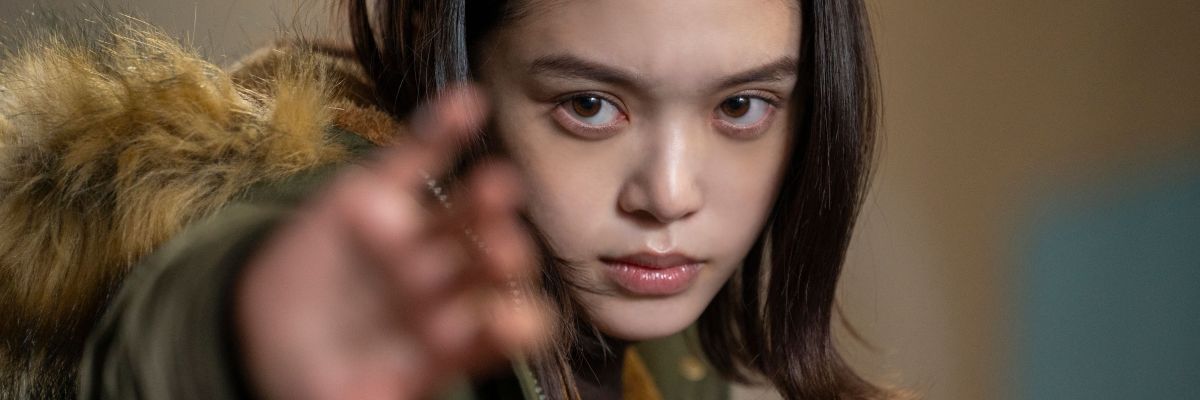
In Ghost Killer, a woman is haunted by the ghost of a murdered assassin trapped on Earth by his desire for revenge. Frequent Sonomura (and Sakamoto) collaborator Akari Takaishi (Baby Assassin I-III) plays Fumika, a college student who is beset. She gets by as a waitress at a drastically understaffed restaurant. She has hopes of working in the entertainment industry or becoming an influencer, but the influencer she goes to for advice is a predatory douchebag. Her best friend has a manipulative and violent boyfriend. Ghost Killer is not exactly feminist,but it has a lot of sympathy for Fumika and the shittinesses she and her friend face, especially in a film about a woman and her ghost assassin friend. Fumika feels like a real person and her experience–while entertainingly unreal–feels grounded in real life. One day, Fumika finds a haunted shell casing housing containing the grudge of a murdered hitman, Kudo (Masanori Mimoto). They discover that if they clasp hands, Kudo possesses Fumika. This turns out to be useful when fighting for survival–or punishing “shitty men”–is necessary. And while she is horrified by violence, Fumika decides to help Kudo take revenge so he can move on. Which is complicated for Fumika and Kudo, but great for the audience.
Ghost Killer has all the conventions of a hitman with a heart movie paired with comedic possession. Kudo is a gruff hitman who comes around to doing the right thing. If there isn’t much of a transition from cold-blooded killer Kudo to caring Kudo, well, these are conventions I enjoy. Spectrally, we see Kudo lurking around Fumika, but during most possession scenes, Takaishi plays both Fumika and Kudo. Takaishi does a good job, taking on both Kudo’s attitude and physicality and in presenting Fumika and Kudo arguing with each other in her body, a staple of comedic possession.
Takaishi handles a good chunk of the film’s fights, Masanori also appears as Kudo during these fights so we can appreciate his skills and his duels with other trained martial artists and stunt performers. And these moments provide an opportunity to show Kudo’s emotional investment in keeping Fumika alive. While there are a lot of influences evident in Ghost Killer‘s the fight scenes and action set pieces, there is a strong John Woo flavor–especially when Fumika, Kudo, and Kagehara enter the gang’s lair and begin a probably doomed confrontation with some balletic slow-motion.
I don’t think sharing any of these details spoils Ghost Killer for anyone looking to watch a martial arts / action movie about a woman and a ghost hitman. As always, the pleasure in such things is the particular ways the conventions are employed. And Ghost Killer is definitely a nice time.

The Life & Deaths of Christopher Lee (UK, 2023) written and directed by John Spira
There is very little more unwieldy than a life, but somehow The Life and Deaths of Christopher Lee handles his sprawling life story with a fluid grace. Writer / director John Spira and his collaborators make the story of Lee’s life flow while underscoring the artificiality of recounting a life as a story by embracing that very artificiality. This is made clear from the start when we see blurry images of the crew setting up, are presented with a grayscale Christopher Lee marionette, and see footage of Peter Serafinowicz finding his Christopher Lee voice in order to narrate the film as the voice of puppet Lee (Olly Taylor & Lynn Roberson Bruce). I loved all of the film’s conceits–from the playfully macabre opening credits, to the puppet, Serafinowicz’s voice work, the animations, and the illustrations.
There are more conventional documentary elements, but what I enjoyed most were the more unconventional elements in a documentary about an actor, especially in a crowdfunded documentary about an actor beloved by classic film fans, horror fans, Star Wars fans, Lord Of The Rings Fans, b movie enthusiasts and aficionados of Symphonic Metal. The Life & Deaths Of Christopher Lee is almost a collage of traditional documentary elements with illustrated and animated segments depicting these stories and histories, including work by Andrew Gill, Astrid Goldsmith, Dave McKean and Cornelia Skrole. All are thoughtfully done, choosing, for instance, a comic book format for Lee’s training as a pilot during World War II, but Dave McKean’s short has stuck with me. It depicts Lee’s heart surgery and includes a story about the importance of Tolkien and The Lord Of The Rings trilogy to him.
The Life & Deaths of Christopher Lee does an admirable job. And while I have no idea what Lee would have thought of it, it seems to me that the best response to an artist and their art is more art. And The Life & Deaths of Christopher Lee certainly delivers the tribute of more fantastic art in Lee’s memory.
The next two films pair well. I might actually write about them together, or maybe on a whole slew of contemporary folk horror films that I think would be interesting to think about with them. Both are folk horror films with female protagonists trapped in abusive and patriarchal religious communities. Both find salvation in the woods, though the forest in The Severed Sun is far more immediately welcoming than the forest in Witte Wieven / Heresy. And both women are aided by the beings that inhabit the forest who have, in the words of The Severed Sun’s Magpie, “a taste for foul men.”

The Severed Sun (UK, 2024) written and directed by Dean Puckett
The Severed Sun‘s opening credits have the perfect blood red font on a black background. The story itself begins with an almost Vermeer tableau shot in golden light as Magpie (Appleton), her son, and her stepson David (Lewis Gribben) wait for abusive family patriarch Howard (Eoin Slattery) to join them at breakfast and drink the poisoned tea she has set out for him. Magpie and her family are a part of a small, rural conservative religious community led by her father the Pastor (Toby Stephens). Divorce is not possible here, so Magpie joins a long history of wives who poison their abusive husbands before no fault divorce. Magpie sees something in the woods, something that watched with glowing eyes as she disposes of Howard. The community calls it a Beast (James Swanton), but it stands upright with horns and has the overall appearance of something between animal and arboreal. (As with the spirit in Witte Wieven). It’s deep black and it seems to have tendrils. And as Magpie later says, “It seems to have a taste for foul men.” When a man is brutally killed in his home, the community turns on Magpie, accusing her of conspiring with the Beast and heresy.

While The Severed Sun is firmly in the British folk horror tradition, one thing that struck me was that the forest was far more enticing than the civilized areas the Pastor’s flocks inhabits. The Beast that dwells there does kill, but it is hard to say it is worse than the “foul men” it stalks. As in Witte Wieven, it is nature, speaking the truth, and perhaps the pagan past that is the only salvation at hand for those trapped in the community’s bunker of patriarchal religion. And maybe not salvation only for women, but for anyone.

Witte Wieven / Heresy (Netherlands, 2024) written and directed by Didier Konings
Witte Wieven is atmospheric folk horror set in a small village in the Netherlands in the Middle Ages. This is not the fun Middle Ages–skipping to the sackbut and krumhorn, everyone telling bawdy jokes and having affairs as nightingales sing the wood. No, this is the depressing, Devil- and God-haunted Middle Ages where there are punishment cages, everyone eats gruel, and somehow women are responsible for everything and men are sympathized with and feted no matter what they do. Witte Wieven is as much gender horror as it is folk horror. It is a beautiful, sad, rage-inducing, and possibly ultimately hopeful film, depending on how you feel about the spirit in the woods.
Frieda (Anneke Sluiters), is considered entirely at fault for the difficulties she and her husband Hikko (Len Leo Vincent) are having at conceiving a child. Her husband appears caring when he notices her surreptitiously checking under the covers to see if her period has come and tells her she should not hide it from him. But later, when Frieda tells him the local priest believes that eating the meat of a pregnant wild pig will help them conceive, Hikko lashes out, “Never imply this is my problem. This is on you.” There is no help, only blame for the women in the village. And it’s clear that the only value they hold for those around them is their ability to bear children. Which, I have to say, is particularly resonant at this time. When a man attempts to “help” Frieda by raping her, she runs into the woods. There in the forest the villagers shun as demonic, something saves Frieda and brutally attacks the man. The villagers blame Frieda, not only for the attempted rape and what happens to him, but for surviving the woods at all. The villagers begin to accuse her of conspiring with the devil. Then Frieda returns to the woods and encounters whatever resides there and it transforms her. The sequence where the spirit gives Frieda a gift is gorgeously surreal and affecting. Incidentally, the costuming and art design are wonderful in the whole film. And all of this is remarkable for working with such a brooding color palette.
Witte Wieven is part of a series of made-for-television horror movies assembled by filmmaker Martin Koolhaven for Koolhaven Presenteert. The film does have a prestige television feel, especially in its pacing and economy. It never feels rushed or incomplete. Even Frieda’s revelation in the woods has all the time it needs to be effective. And while I certainly felt all the wonder and anger I was meant to, I was glad that Konings did not linger overly long on the daily cruelties and indignities visited on the women of this nameless village. Unsurprisingly, I loved the thing in the woods.
As an aside, the woods in Witte Wieven are foreboding and dark, entered only at night, very different from the sun-dappled leaves of the forest in The Severed Sun. And while they give different gifts to the women who enter them–Frieda has a child without the burden of her awful husband and Magpie enjoys sex on her own terms without the control of her father and her community–the forests do offer these women freedom. But I’ll stop for now before I share too much. That is probably an article for another time.
I wrote about all these films in a slightly different and usuallu longer form at Monstrous Industry, click through to read more:
The Life & Deaths of Christopher Lee
*written by the Gutter’s own Editor Emeritus Ian Driscoll!
~~~
Carol Borden hopes one day to be friends with all the things in the woods and all the dogs in the dog park.
Categories: Screen



 The Cultural Gutter
2 replies »