
It’s not meteorological summer here in the Northern Hemisphere yet, but it’s June. It’s hot and my a/c is on. I have been sticky with sweat and sunscreen. I have had my first Arnold Palmer of the season.(And my first Dinah Shore—lemonade with seltzer). It is summer as far as I am concerned. So let me provide you with some reading suggestions. I have included all the popular summer genres: Hardboiled crime fiction, biography and autobiography, thoughtful art criticism, two volumes of fantasy, and even a classic Western. There is a well-researched autobiography of Charles Schulz, some interesting analysis of folk horror, a woman finding out who she is, an angry teen boy, a heist gone wrong, a nice portrait of an extremely stubborn and righteous 14-year-old girl, a heroic demon and even some witches!
This time the books are in roughly alphabetical order because this time around there are two sets of sequels that I decided should be listed together.

Crossroads, Folk Horror in the United States #1: The Long Decade (2026)
With Midsommar, Litha, and Lammas/Lughnasad all lined up like corn in a row, summer is the perfect time to enjoy folk horror. But maybe you wish there were more thoughtful writing on folk horror in the United States. Well, there is now. Crossroads is a new journal focused on American folk horror. The premiere issue features an essay from the Gutter’s own Editor Emeritus Angela Englert, “What No Man May Know Nor Woman Tell: The Sacrifice of Patriarchy in Harvest Home.” It features art—and a sticker pack—by friend of the Gutter Kimberly Lindbergs. And if that isn’t enough, you also get a variety of thoughtful pieces covering art, cultural anxiety and Satanic panic from 1969 to 1981.
What more do you want?!
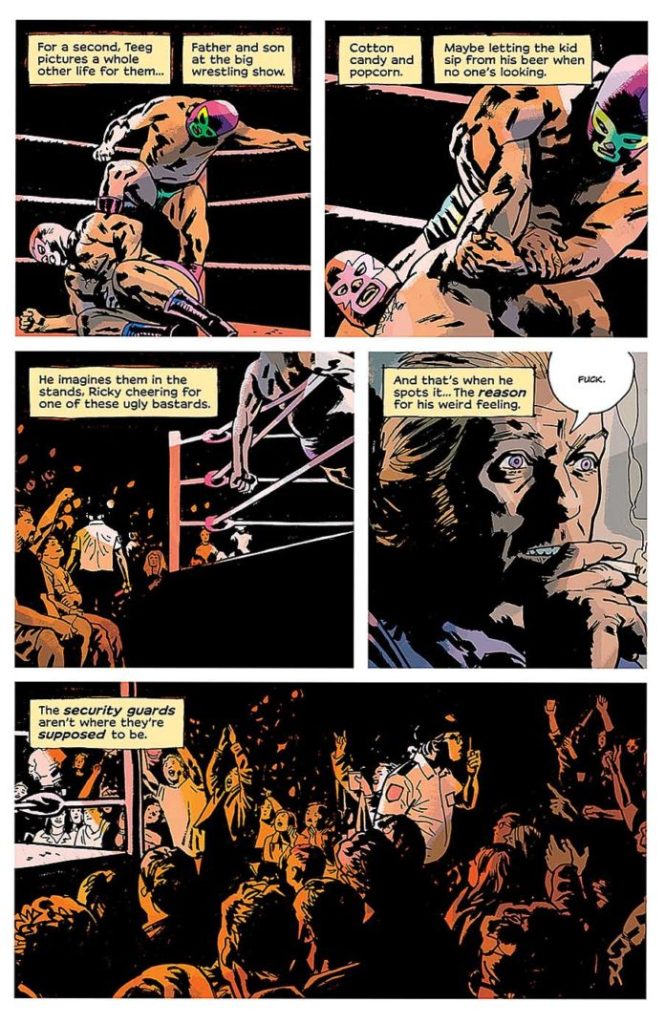
Cruel Summer (Image, 2020) Ed Brubaker, writing; Sean Phillips, art; Jacob Phillips, colors
Much of Brubaker and Phillips’ ongoing hardboiled crime fiction comic, Criminal, is bleak. But Cruel Summer somehow feels bleaker than the stories that came before. It might be because the collection is a precursor to the rest of the series, and so you see how it’s set up in the future. Or it might be that all the characters are self-destructive—some chasing money, some chasing a feeling of freedom, and at least one because he’s a sap who has deluded himself about a woman he wants. It’s the early 1980s, Ms. Pac-Man has hit the arcade and Ricky Lawless is a teen just out of juvenile detention. He’s angry at the world, he’s angry at himself and he’s angry at his father, Teeg, for a variety of reasons. But Ricky still pulls a robbery to raise money to spring his dad from jail. Ricky’s happiest memories were when Teeg and Teeg’s then partner ran a pickpocketing racket. Now Ricky only feels alive when he’s escaping something, and he creates a big something to escape in Cruel Summer, something that lands his father $25,000 in debt. If Teeg doesn’t pay, Teeg’s local boss will have Ricky killed. Meanwhile, a woman named Jane has escaped a powerful man and he’s hired a private investigator to find her. The PI is a sap, but like most saps, he’s dangerous and thinks he’s going to save Jane and, through her, himself. When these characters finally intersect, everything goes to hell. Cruel Summer has one of the better depictions of a femme fatale. And there’s a heist at” Wrestle Madness,” so you can enjoy Phillips and Phillips’ luchador art.
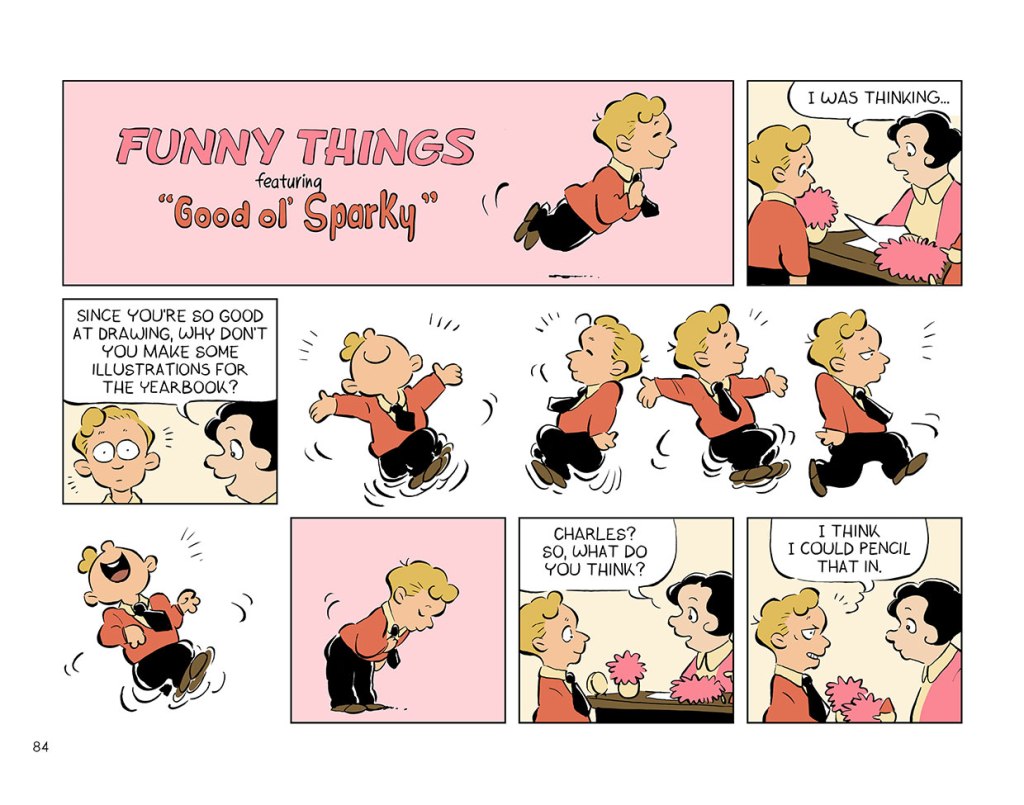
Funny Things: A Comic Strip Biography of Charles M. Schulz (IDW Publishing, 2023) by Luca Debus and Francesco Matteuzzi
What would a summer reading list be without a detailed biography of a significant figure in the arts? Funny Things is a biography of Charles M. Schulz in the form of comics strips. Debus and Matteuzzi do a tremendous job of creating an art style reminiscent of Peanuts and condensing Schulz’ biography into the form of black and white “daily” and color “weekly” comic strips. It is a remarkable achievement in itself. While the whole book is delightful, my favorite part is probably their depiction of Schulz as a child. Seeing child Schulz in the style of his characters is a joy, especially bundled up in the same winter clothing Charlie Brown, Linus and Lucy wear. But Funny Things doesn’t avoid more difficult parts of Schulz’ life including his parents’ deaths, his ambition, his affair, his divorce, and his death. Of course, the book doesn’t go as in depth as some biographies, but they include a bibliography to read more.
Martha Wells Special Section
My hold on Platform Decay at the library came in while I was working on this piece. I have finished it but haven’t had time to ponder so I’m going with two other books by Martha Wells that I recommend for summer fun time reading. Since they are sequels, I am sticking them here together and destroying the alphabetical order.
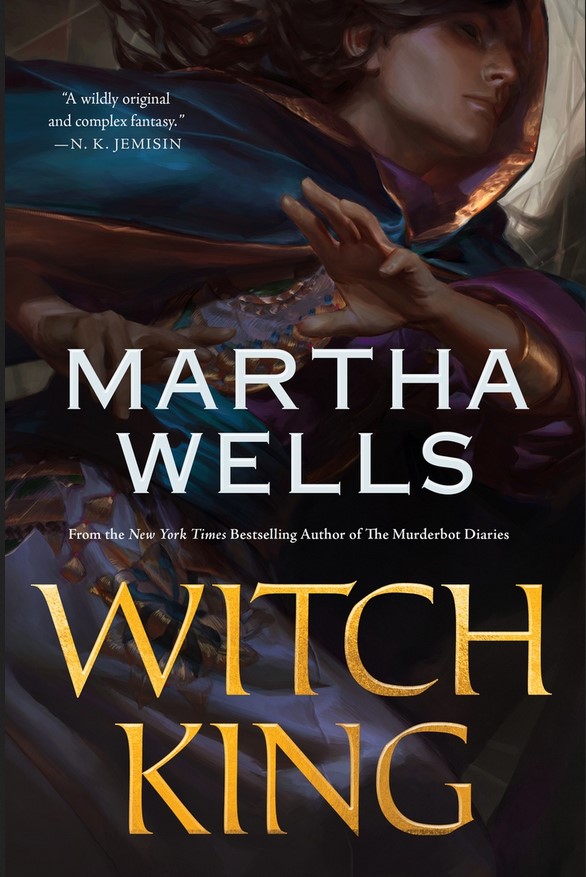
Witch King (Tor, 2023) by Martha Wells
In Witch King, Kai, a demon in a human body, loses his family in the human world when his people are attacked by an army of the genocidal Hierarchs. Captured, imprisoned and cut off from his extended family in the underworld, Kai joins an ad hoc rebellion led by Prince Bashasa. It goes surprisingly well. The book alternates between Kai’s past and his present, and it does so without relying on easy cliffhangers to keep the reader engaged. Wells has a great talent for choosing just when to switch between the timelines. One thing I really appreciate is that Kai is not an outcast as a child. He’s part of his community. He’s understood. He might be disliked by some, but he is loved. Instead, Kai becomes an outcast as an adult. It’s refreshing that King Witch doesn’t posit that bullying and ostracism as a child are the reason why Kai becomes a hero. He experiences loss as an adult. He fights for others and the world because of what he has lost, the person that lost world made him, and the resilience it gave him. And it makes the delicate connections Kai begins to form with his allies all the more moving. I also appreciate the respect for fantasy Indigeneity in Witch King (and Queen Demon) and I see it in some of the decision not to make Kai a bullied outsider among them. Wells has also created a fresh and surprising fantasy world. And I appreciate the slow revelation of things like how magic works or what Kai is. Characters share information as they would naturally about things that they take for granted in their world—magic, witches, and horses with claws. That’s right there are “horses” with claws.
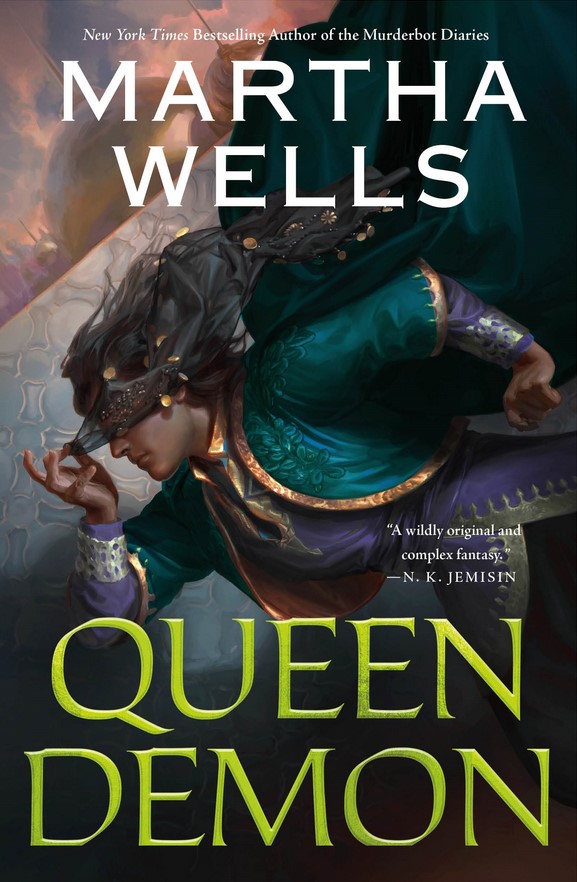
Queen Demon (Tor, 2025) by Martha Wells
Queen Demon continues the story of Kai and his allies as they fight against the Hierarchs’ plan for their world. It had seemed like the Hierarchs had been overcome, but things are so rarely over for good. Kai, the Witch Ziedi, the Immortal Blessed Tahren, and Tahren’s Brother Dahin (goddammit Dahin) search for the source of the Hierarchs’ terrible power, we once again follow two time lines. One in their present. The other in their past. It’s excellent fantasy and, as with Witch King, feels effortlessly done. I do want to note something else I especially appreciate: People working together. Kai needs help and sometimes even seeks out help despite his desire to save everyone and take all the damage himself. Even more, I appreciate that Kai and Bashasa are not always right. Our heroes are sometimes wrong and other characters’ concerns are not foolish obstacles that waste time. And I appreciate the characters’—as well as both books’—kindness around the experience of terror and trauma
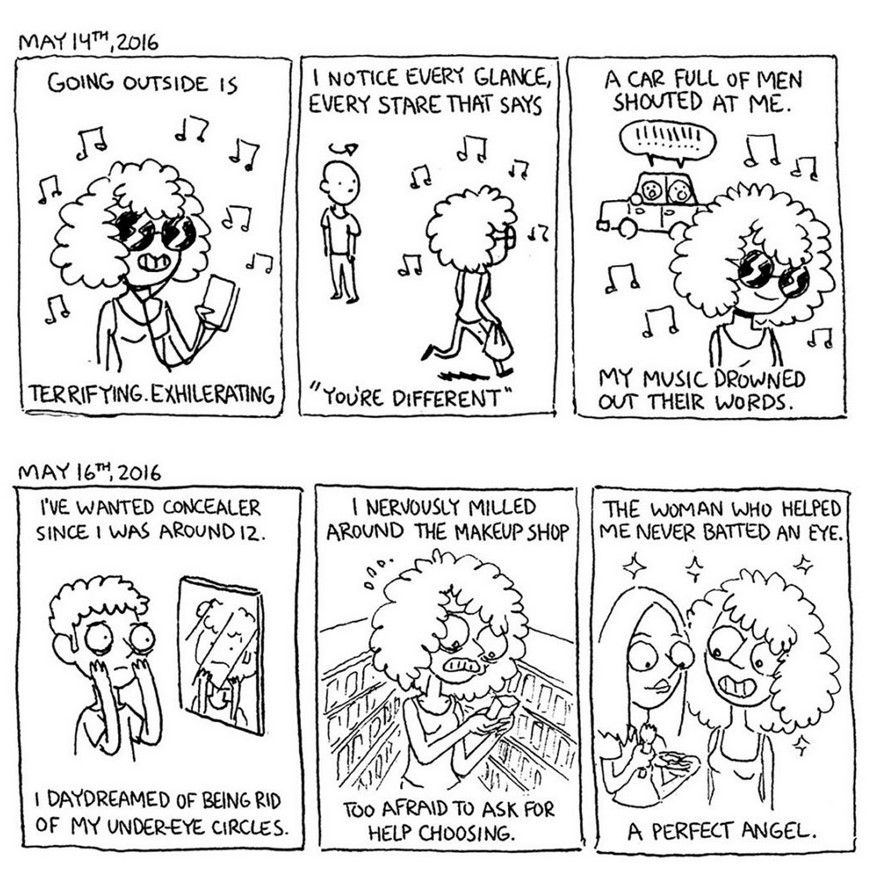
Super Late Bloomer: My Early Days in Transition (Andrews McMeel, 2018) and My Life in Transition: A Super Late Bloomer Collection (Andrews McMeel, 2021) by Julia Kaye
It’s more daily strips, but this time autobiographical ones. Julia Kaye’s Super Late Bloomer collects a series of daily, autobiographical comic strips about Kaye’s life as she begins gender affirmation treatment. In My Life in Transition, we see Julia years later as she finally has the space to discover and express who she is without the pain and difficulty of constant dysphoria. The books share little scenes from Julia’s life. We see her dealing with serious things— struggling with dysphoria and misgendering, rejection from her biological family, falling in love, falling out of love, finding a chosen family and a city she loves. But we also see silly little moments in her day to day.
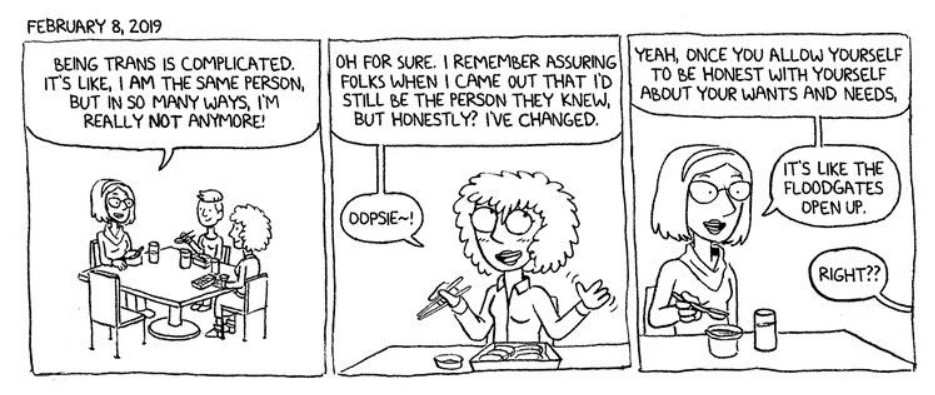
Both books are funny, enlightening, often relatable even when Julia’s experience might not be exactly your own. Super Late Bloomer and My Life in Transition are basically everything you want in indie autobiographical comics. Which is mostly where I am with comics right now.
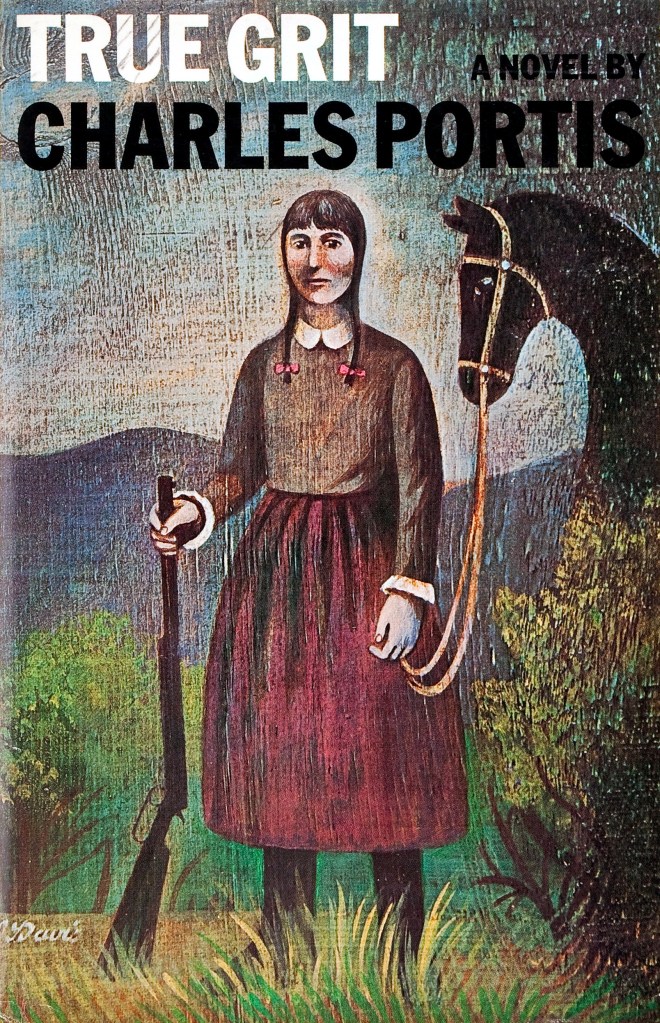
True Grit (Recorded Books, 2006) written by Charles Portis and read by Donna Tartt (originally published by Simon & Schuster in 1968)
The thing about True Grit is that it’s much funnier than I expected and it has a remarkable portrait of a 14-year-old girl, Mattie Ross. The novel begins with Mattie in her 60s recounting when she was 14 and searching for justice after the death of her father at the hands of the scoundrel Tom Chaney. Set in 1878 Arkansas and the then Indian Territories (now Oklahoma), Mattie travels to Fort Smith to pester, hire or both a U.S. Marshal to hunt down Chaney. She settles on Rueben “Rooster” Cogburn, a man who drinks too much and has a record of shooting the men he’s sent to apprehend. But there’s also a Texas Ranger after Chaney, LaBoeuf, who wants to collect a bounty on Chaney. Cogburn and LaBoeuf don’t want to work together and neither of them want to bring Mattie along. Mattie, however, is determined and cannot be stopped by a U.S. Marshal and a Texas Ranger.
There are some of the things you might expect in a 1968 novel about 1878 America, including racism and sexism. But there are also surprises that reflect the complexity of people in 1878, 1968, and now. And there is a horse death that is heartbreaking, but not at all gratuitous. True Grit is a fine book and an excellent summer read. True Grit has one of the best portrayals of the indomitable power of a 14-year-old girl that I have read. Mattie is independent, righteous, tenacious, parsimonious, stubborn, absolutely determined her way is the right way and determined to bring Chaney to justice. And Donna Tartt does a fantastic job reading/voicing her in the audiobook.
~~~
Carol Borden retreats to her SPF 70 tent on the beach to wait for the water to hit 64 F/ 17.7 C. Till then it’s all beach tacos and books.
Categories: Comics, Science-Fiction