

Even if you don’t watch Indian films, I can promise you that you’ve very probably seen, or at least heard, some of this movie. It gave the world an incredibly infectious song that crossed international borders to appear on tv with The Cramps, on stage with California band Heavenly Ten Stems, in the feature film Ghost World, and later in a Heineken commercial.* You know the one, right? Five solid minutes of masked twisting, twitching, thrusting, and shimmying to a tune you canNOT get out of your head.

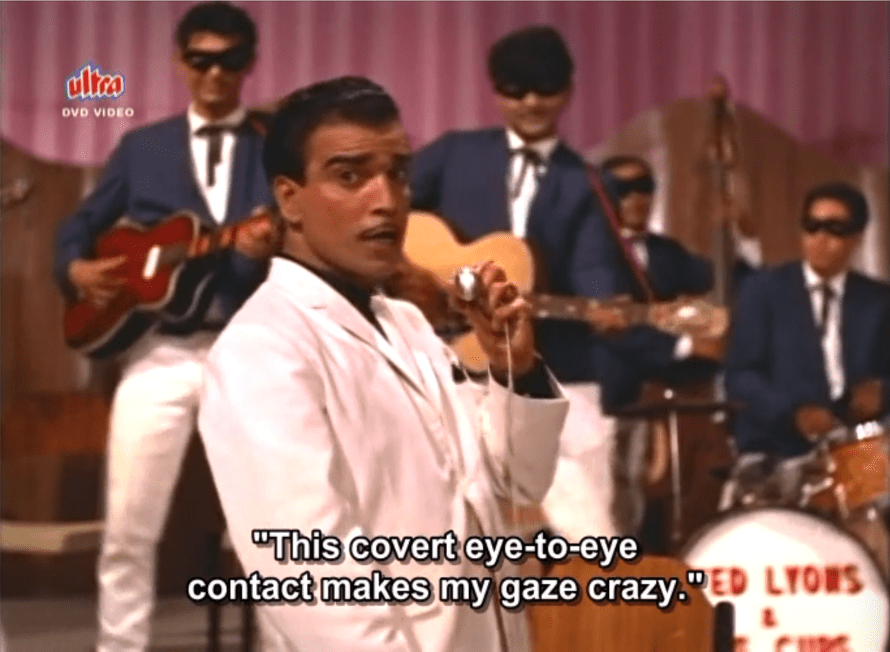
Fabulous song aside, Gumnaam (Anonymous) is built on very secure footing: it’s an adaptation of the stage play version of Agatha Christie’s And Then There Were None. I would be shocked if a mainstream Hindi film of the 1960s had used the book’s original ending. Christie’s moral ferocity is more bleak than instructive, and besides, the book’s structure leaves no room for an attractive hero to be played by a bankable star. But even if you know the book or the play inside out, Gumnaam still has some tricks up its sleeves.


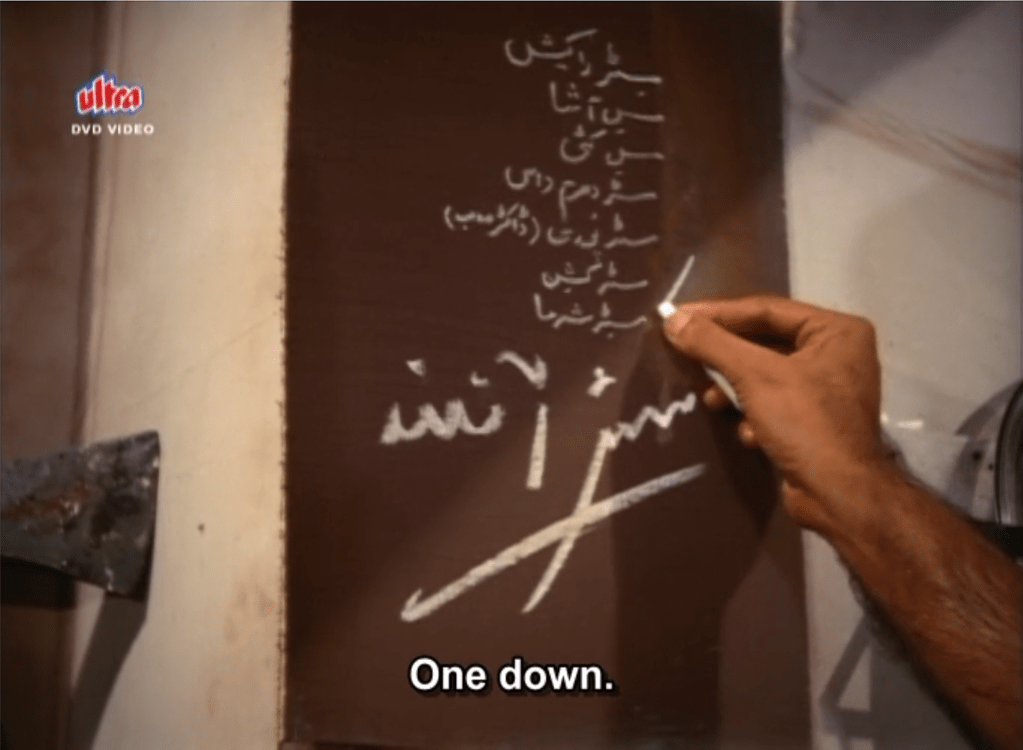
The film opens with someone being run down by a car in the street as a man looks on from a window across the street. A silhouetted figure enters his room, he hands a bundle to the figure, and then makes a series of phone calls. Before he can finish, the silhouette returns and kills him.

After the credits and the famous song, the MC at a swanky nightclub announces the winners of a contest who will go on a 2-week foreign holiday, aka the ruse to assemble everyone away from home. They are:
- Rakesh, a lawyer (played by the legendary Pran, last seen on the Gutter in Gaddaar)
- Dharamdas (Dhumal)
- Kishan (Manmohan, also in Gaddaar)
- Kitty (Helen)
- Dr. Acharya (Madan Puri, ALSO in Gaddaar)
- Sharma (Tarun Bose)
- Asha (Nanda), whom we’ve already met as one of the phone call recipients in the opening sequence, the niece of the car accident victim.
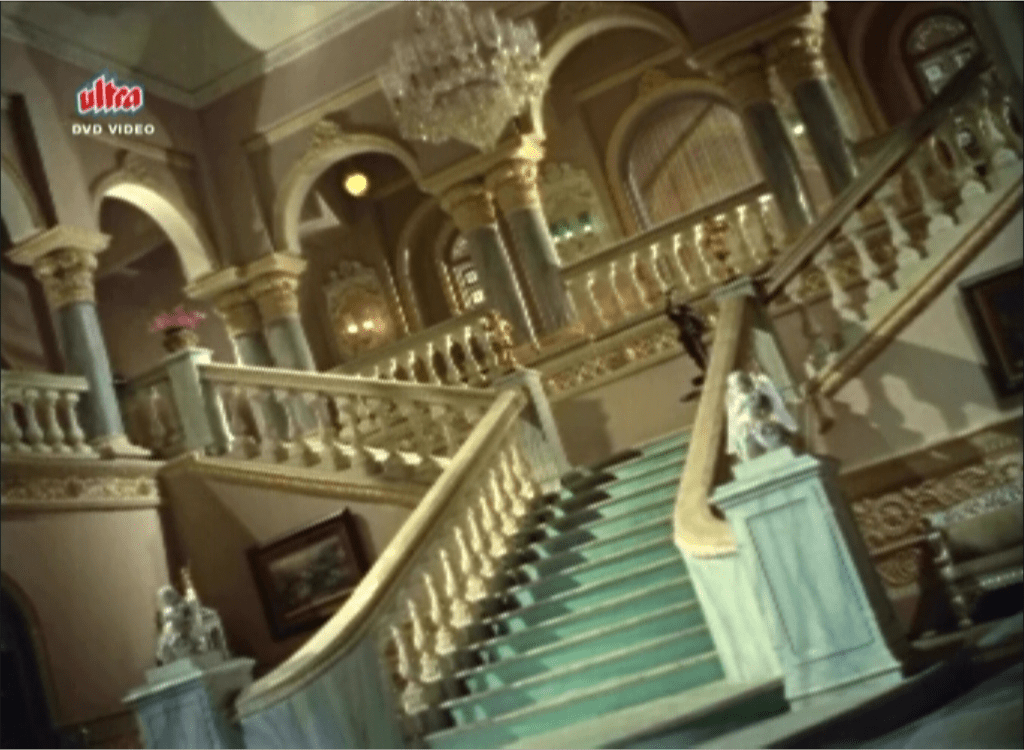
The travelers’ plane makes an emergency stop on an island, deposits them, and then flies away, leaving the 7 “winners” and the flight attendant. They find a mansion on the island, staffed by a helpful butler (comedy star Mehmood).
Over their first dinner, the characters find a diary that explains a few things (in lieu of Christie’s LP). It narrates the characters being brought together for their final journey because of their role in a conspiracy. As the flight attendant Anand (Manoj Kumar) reads it out, we hear cutlery drop against plates. “Everyone is a killer, a criminal, and a convict, and you are called here to be punished for your crimes. Death to each one of you, one by one.” As they splutter their outrage, a woman’s disembodied voice sings about unknown figures and spoiled reputations. The rest of the action unfolds as you expect, with tensions mounting and people getting more frantic as the characters are murdered one by one.

Thanks to Hindi film stock ingredients, you’ve never seen Christie quite like this. The first spectacular feature is, of course, the musical numbers. “Jaan Pehechan Ho” is the most famous outside of India—and it does a lot of work to set the tone of the film, with the entire room of people wearing masks that semi-obscure their identities and its lyrics about knowledge and special nights— but the whole soundtrack is fantastic. The film’s theme music (which will also sound familiar because it borrows from Henry Mancini’s “Charade,” certainly a strong choice if one feels like copying from another mystery film) is heard repeatedly, usually as an eerie voiceover or instrumental version. It also runs in full as the characters wander across the island in search of anything that can tell them where they are and why. There’s a steamy love song in a nighttime rain storm, a very atypical girls’ night bender, and a tonally discordant hand-clapping beachside frolick.

I suspect some of you would absolutely HATE the addition of musical interludes in this story at all, but please trust me when I say that the makers of Gumnaam know what they’re doing. All of the songs either enhance vibes, advance the plot, or provide moments of welcome relief from the crazed murderous tension. The same goes for the comedy track handled mostly by Mehmood, with occasional help from Dhumal, another veteran comic actor.
The notion of a romance is in Christie’s play, so that aspect doesn’t count as a Bollywood addition, although I suspect it’s given more weight here than in the play. (I haven’t seen it, so let me know in the comments.) But just like the songs, the emotion is a pleasant, if maybe a little perfunctory, release from the high stakes of the basic plot. This is very unlike the way tension is handled in the film I wrote about in my last Gutter entry, Gaddaar, where there is no relief from its mystery and dread. Gumnaam is a much more famous film, and I suspect the paucity of musical numbers and lack of romance in Gaddaar are one reason it seems to have vanished from the public consciousness.
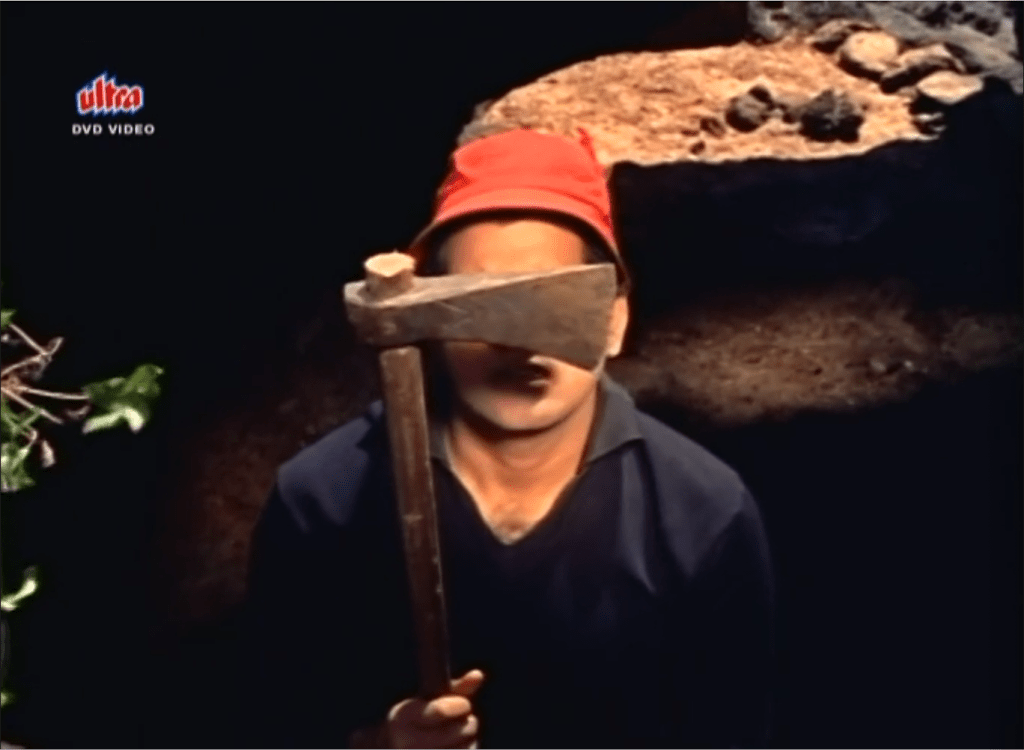
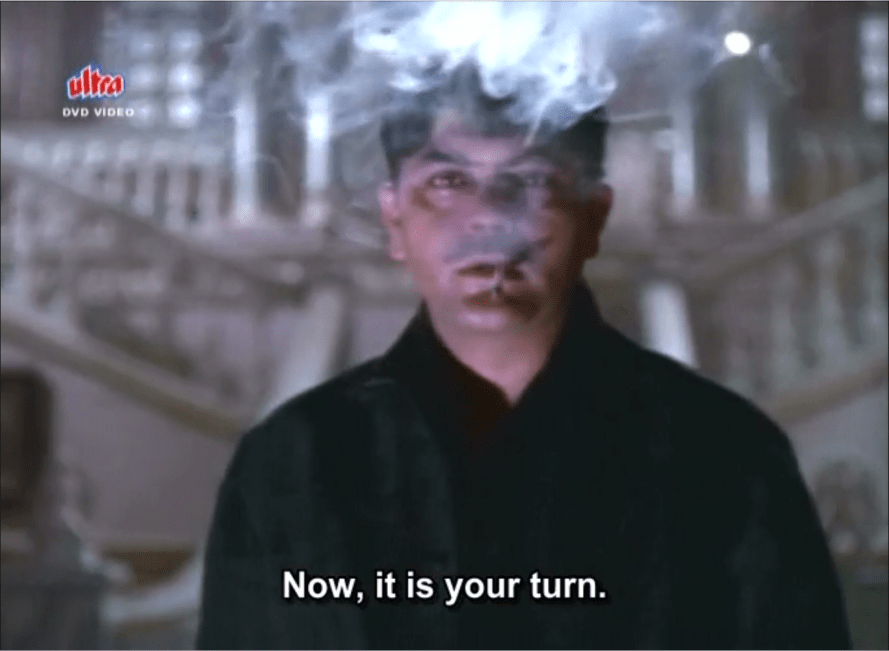
Rambunctious Bombay cinema is not afraid to get the camera into the action. Director Raja Nawathe and cinematographer K. H. Kapadia use closeups to show the characters sweating buckets as their nerves fray, Dutch angles to highlight the instability and peril of particular moments, and overheads to isolate a character in a huge, menacing space. The camera also takes on individual characters’ points of view a few times as they look from one person to another, spinning in a circle, feeling surrounded and confused. There isn’t much by way of action sequences in Gumnaam until the end. The most critical deeds are generally off-camera; we see people discovering the murders rather than murders being committed. Yet this is somehow a very active film, with a constant series of people hiding, seeking, and sneaking. The visual intensity of the attacks increases as the characters die: the first four are discovered dead, but the later ones are seen to struggle with the attacker while the camera still avoids showing who the attacker is.

I was absolutely gripped by And Then There Were None the first time I read it and again the first time I saw an adaptation, and I wonder if I would have had the same reaction to Gumnaam had I not already known the basic story. But on the other hand, Bombay cinema of this era tends to cast actors in the types of roles audiences expect, so having three actors who are known for being henchmen or outright villains may have added to the misdirects already in the script. [The rest of this paragraph contains potentially spoiler-y information!] I also wonder if casting Helen was a confusing factor to contemporary audiences: generally known as a featured dancer and a moll (if she got any lines at all, which she often didn’t), she could be almost as likely as some of the men to be “bad.” Her Kitty gets more of an arc than most of the characters in Gumnaam, resisting Rakesh’s insistence that she join him in his constant drinking, eventually giving in, becoming friends with Asha, and trying to cheer up everyone with a party on the beach. I went into the film assuming that all she’d get to do is dance once, flirt with a few of the men, and quickly end up dead in the way of most molls, but Kitty is so much more.


As Christie-in-India goes, Gumnaam is not my favorite. It’s more of a remake than an adaptation with cultural specificity, which generally feels like a missed opportunity. However, I enjoy it very much as a mid-60s Bombay murder mystery, inserting the strengths of its cinematic tradition into a frame that was relatively unusual for its time. No surprise, given that the script is handled by Dhruva Chatterjee, who wrote most of the mid-century Hindi suspense films I’ve seen. I suppose it’s Bombay in the “how” of film—music, comedy, and romance in addition to mystery— rather than Bombay in “what” or “why.” I went in assuming that there would be some kind of moral education at the end, some kind of redemption for errancy or at least a chance for a representative of law and order to comment on the depravity of the killer. Instead, as the film ends, I felt that its basic point that a lot of people are bad and get away with it—or even “an eye for an eye leaves the whole world blind”—echoes Christie’s work. For all of its Bollywood methods, Gumnaam leaves me a little chilled.
Gumnaam is available on Amazon Prime and Einthusan.tv (outside of India). Do not read the Wikipedia entry about this film; even the character list has spoilers.
* https://atulsongaday.me/2010/08/16/jaan-pehchaan-ho-jeenaa-aasaan-ho/
~~~
Beth Watkins is ready to be a nightclub patron in a mid-1960s Bombay murder mystery!
Categories: Screen




 The Cultural Gutter