
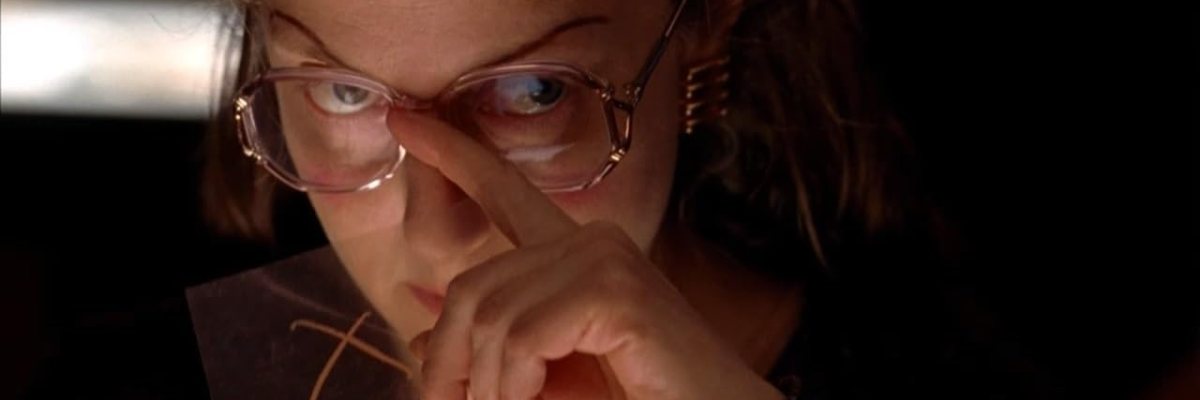
Sometimes you encounter a movie late at night. A movie you didn’t even know existed. And you discover that the movie had basically disappeared for 30 years. Cindy Sherman’s Office Killer was supposed to be the first in a series of low budget art house horror movies. It premiered at the Toronto International Film Festival’s Midnight Madness program in 1997. It was picked up by Miramax, released in a limited run of art house theaters and then it was just gone. I learned all this in retrospect. When I first came across the film online in 2014,* I couldn’t believe I’d never heard of it. It seemed like I should have. Office Killer is an intriguing mix of genres—not just satire and sardonic horror, but office noir with a mousy copy editor as the movie’s killer. I love its mix of art house and low budget horror.
Office Killer is pretty representative of 1990s filmmaking: indie, genre-bending, sometimes grisly, a mix of high and low brow, often lush colors and lighting, plus the fashion and styling. It’s also a very 1990s film in its depiction of anxiety about downsizing, layoffs, the “death of print,” and imposed technological change with no plan for the people displaced by it. It’s a little time capsule of the practices that have led to the corporate devastation we now live in.
From here on out, I discuss some plot elements of the film. I do not describe the murders.
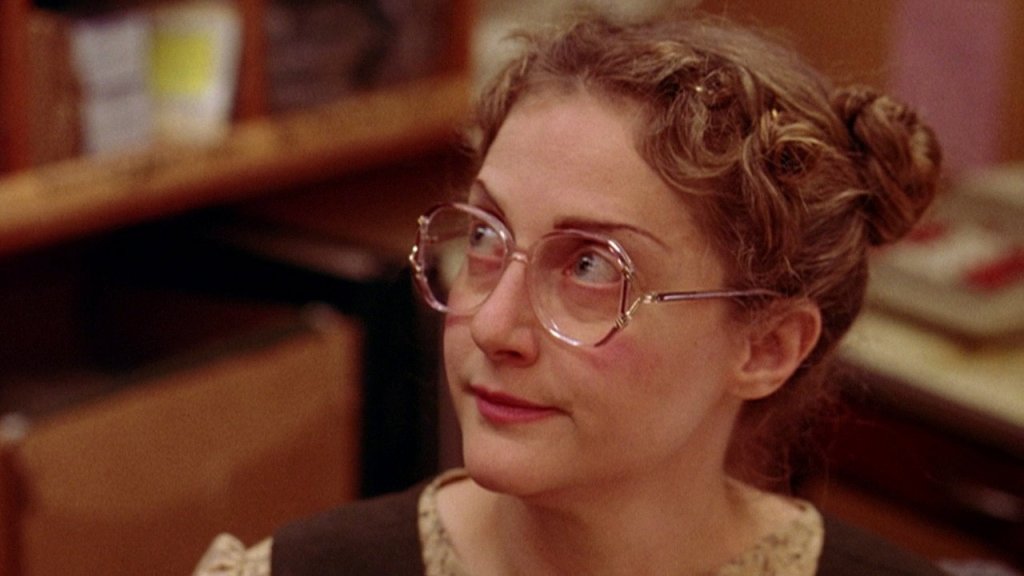
Office Killer opens with Dorine Douglas (Carol Kane) reading a dear colleague letter as it is printed on screen. The letter informs her and other staff at Constant Consumer Magazine that their positions are being “modified.” Staff are being shifted to part time and work from home. They are warned that if they cannot adapt to the changing business environment and new technology, they will be terminated. It is a metaphorical bloodbath paralleled soon enough by a murder spree in the office.
Dorine works in the copy department. She is an excellent copy-editor, but she’s mousy, shy, and socially awkward. She wears a chunky sweater, sensible shoes and her hair wound up in two buns like ears on the top of her head. She is supposed to be frumpy—especially compared to office mean girl Kim Poole (Molly Ringwald)—but I do dig Dorine’s hair. I suspect her shoes and sweater read more fashionably now than they did in the sleeker, shinier late 1990s. Kim disdains Dorine viciously. Kim’s friend, the new office manager Norah (Jeanne Tripplehorn), thinks Kim should lay off Dorine. Kim thinks Norah should stop complaining that she has been directed to hand out the dear colleague letters. Norah wanted to be office manager. Now she has to give people the ax.
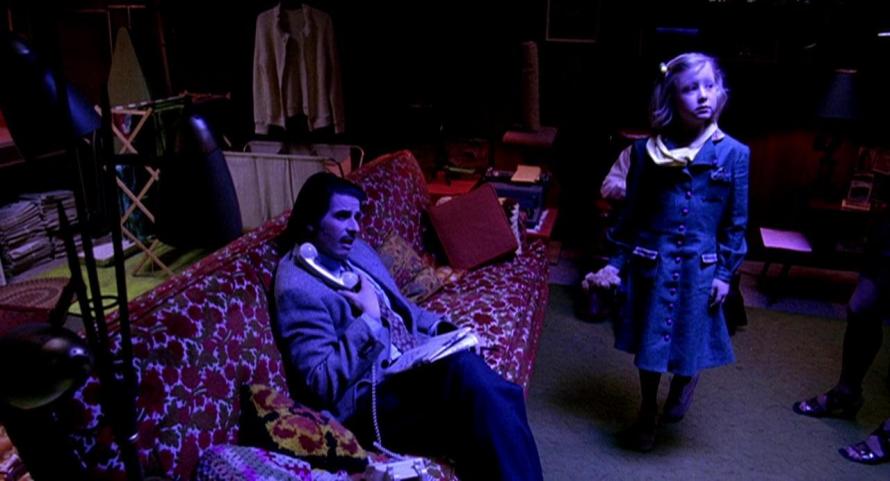
That night, Dorine stays late working on a piece with staff writer Gary Michaels (David Thornton). Gary is styled wonderfully with excellent late 1990s player hair and a presumably ironic sleazy mustache. When Dorine’s computer is having problems, Gary tries to help her. He does so in a condescending, skeevy, space-invading, and verging on belligerent way. He is visibly irritated by Dorine’s nervous response to him and deliberately pushes her boundaries. So when Gary is accidentally electrocuted while sticking a screwdriver in a remarkably unsafe electrical socket, Dorine decides not to call 911. Instead, Dorine loads Gary onto a hand truck and lugs his body into the basement of the home she shares with her disabled mother (Alice Drummond) and memories of her predatory father (Eric Bogosian). Seated on a red floral print couch in front of a TV, Gary becomes the first of her at home co-workers. Dorine covers Gary’s disappearance with an email written from his account. People at the office find the email exasperating, but plausible. Dorine explains that Gary frightened her, she fled and she has no idea what happened to him after she left work. Norah tells Kim, Gary is “either in detox or he’s hiding from a bookie with a gun.” Everyone is far more panicked about the article he was supposed to turn in—except for Kim. She’s been sleeping with Gary and while it is not a relationship I want to know more about and they are both awful people, Kim does care about him. Kim is the only one who does and she loudly accuses Dorine of hiding something about that night. The magnificently Arianna Huffingtonian editor-in-chief, Virginia Wingate (Barbara Sukowa), makes Dorine and Kim stay as late as necessary to reconstruct Gary’s article. Kim tries to play nice and goes out to get them some food, but when she returns Dorine is gone.
The next morning, Kim discovers that Dorine has turned in the article. Kim starts making what appear to be wild accusations. She is sure that Dorine has something to do with Gary’s disappearance. Everyone else considers Dorine harmless. Everyone is pleased with Dorine’s work. Everyone has seen Kim be cruel to Dorine. And so two editors fire Kim in Virginia’s absence. Because while Kim was out getting food, Dorine killed Virginia. In fact, after Gary’s death, Dorine has been busy killing people who have offended her or who she disapproves of—from Virginia all the way down to the mail boy. When Dorine finally tries to kill Kim, Kim escapes. She didn’t see her attacker, but she knows it’s Dorine. Kim tries to tell Norah, but Norah dismisses her again. Kim’s relentlessly mean approach to Dorine (and most other people, to be fair) has destroyed any willingness her co-workers— even her best friend—have to listen to what she says anymore. Kim aside, no one much notices the disappearances because 30-50% of Constant Consumer Magazine‘s staff has been, well, consumed by the recent downsizing.* Staff have been shifted to work from home, laid off, fired or have quit. Virginia might have suddenly jetted off to Greece or Prague. Why would you notice someone is missing when almost everyone is gone?
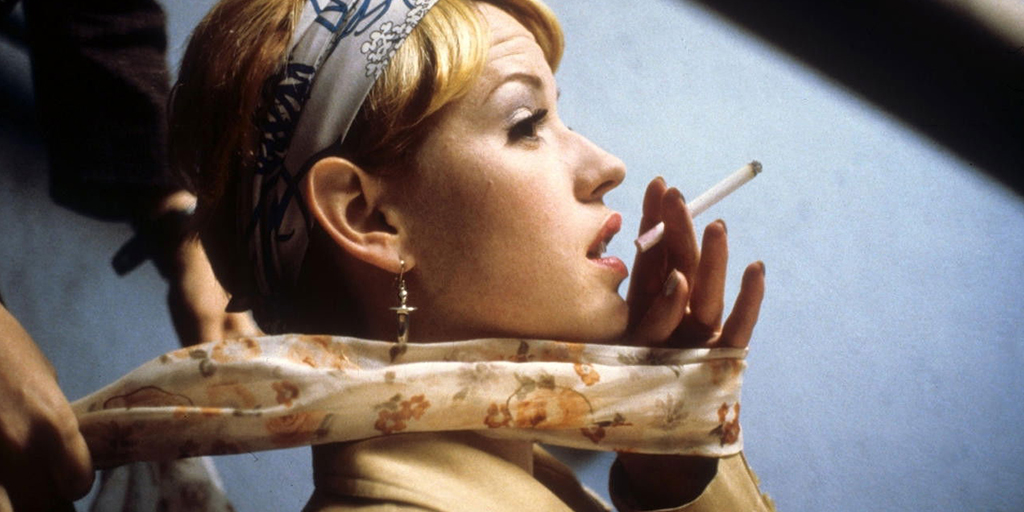
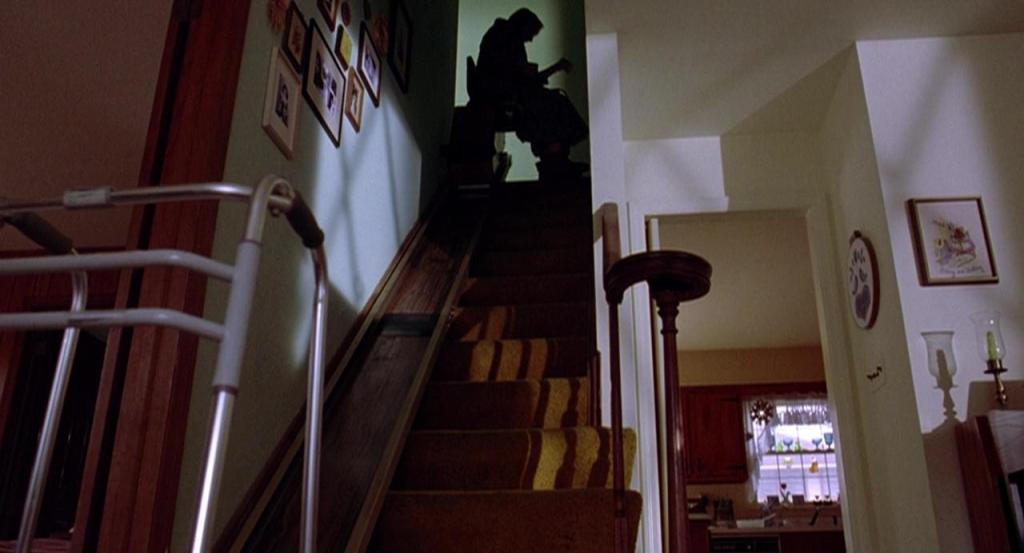
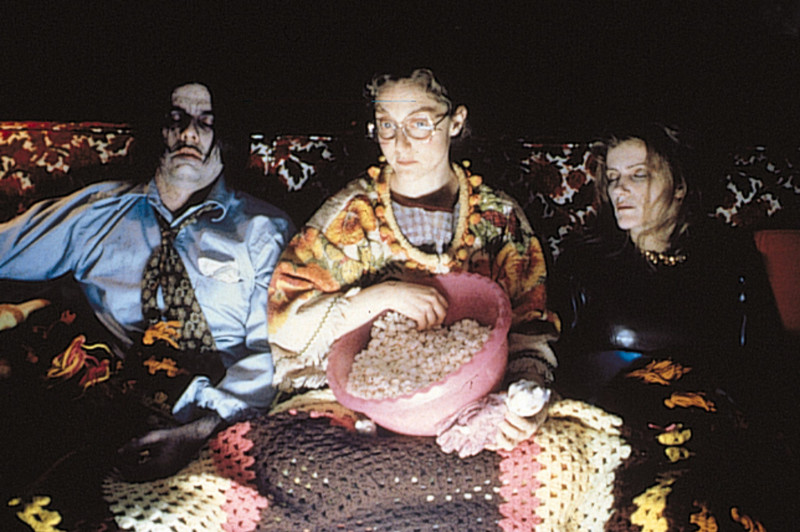
For her part, Dorine is flourishing as she kills her way to self-confidence and success. Murder has helped her find herself and it shows. She’s increasingly comfortable with her luggable laptop and all the new skills she’s learned. She’s effectively using the office’s email network to cover up any absences. She’s making new fashion choices—taking wardrobe items and tips from each person she kills. And her social life, while creepy and definitely messy in every sense, is better than it’s ever been. She’s even setting boundaries with her mother by unplugging the stair lift so her mother can only come downstairs sometimes. As Dorine tells us: “It is true that to grow up in a warm nurturing environment is everybody’s dream. But as we grow up, we also need to experience independence and adventure. That is the key to a successful mother-daughter relationship.” Dorine is opening herself up to independence and adventure. And while Dorine did not grow up in a warm, nurturing environment, she’s working on giving herself one now. She’s making a new chosen family with her dead coworkers and a pair of hapless Girl Scouts. They watch the late movie and eat Girl Scout cookies and popcorn together in the basement.
Office Killer was directed by photographer Cindy Sherman as part of a proposed “Good Fear” series of low budget art house horror movies. I would have loved to have seen the whole series. Sherman is renowned in the art world for her photography, especially her “Untitled Film Stills” where Sherman creates images from imagined films. She is her own model in each of her photos, recreating film tropes. While Office Killer was Sherman’s only foray into film, it’s also an outgrowth of her photography. Her sensibility shows through not only in the variety of female characters, but in the film’s visuals, and some shots recall Sherman’s photographs—in particular when the camera lingers on Virginia’s face after her death.
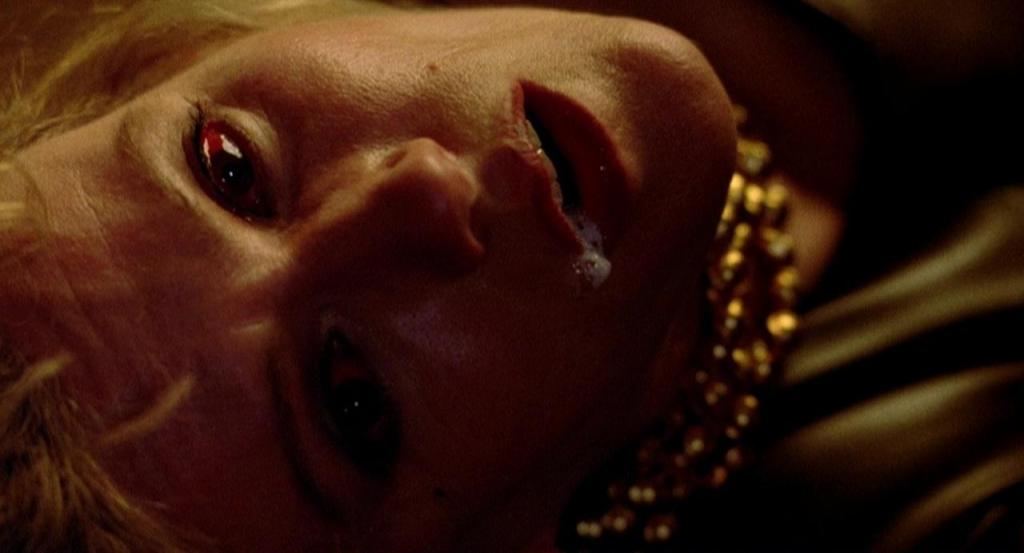
There is also a fondness for the materiality of office work: the equipment, the machines, the ephemera, the furniture, the space itself. In an interview for Vinegar Syndrome’s recent release of Office Killer, cinematographer Russell Lee Fine says that he tried to recreate the look and feel of Sherman’s photography in his footage. Fine’s gorgeous and gorgeously scored opening credits are projected on office equipment and furniture and use the sounds of late ’90s office work. It’s one of my favorite credit sequences in all of film history. And there is a glorious scene of Barbara Sukowa’s Virginia lit by a photocopier’s illuminated platen glass while it makes copies.
Shortly after my first viewing of Office Killer, I did some research to try to figure out why I had never heard of a film that was so very much my thing. I found some reviews in The New York Times (Dec. 3, 1997) and Variety (Aug. 20, 1997) panning it and discovered that by the time I watched it, Office Killer was not only considered a flop, but a bad movie. I was almost as surprised to discover that as I was to discover Office Killer. I have had some time to ponder why Office Killer didn’t do well since then. I think the people most likely to rush out to see a film by Cindy Sherman expected something different from her, not a low budget office noir / horror satire—even though Sherman’s work reflects her familiarity with genre film including crime and horror films. And horror fans might have found Office Killer not scary enough, gross enough, or not quite the right kind of knowing horror comedy in the year of Scream 2 and I Know What You Did Last Summer.
I also assumed that gender was involved. After all, Office Killer focuses on a female outsider and a group of white collar women. The conventional film distribution wisdom was that studios should try to attract young men, because women will go to films that appeal to young men, but young men won’t see films that appeal to women. The new release’s interviews gave me some answers, but the specifics weren’t quite what I thought. Office Killer was acquired by Miramax for distribution. And, as those of you who enjoy indie and genre film probably know, Miramax notoriously acquired a lot of films on spec, would focus group them, and then shelve a lot of them. Dahlia Schweitzer writes in Cindy Sherman’s Office Killer: Another Kind Of Monster (Intellect Books, 2014).
When Miramax set up focus groups to watch early screenings of the film, its target audience was young males who had seen Kids (Clark, 1995), I Shot Andy Warhol (Harron, 1996), Basquiat (Schnabel, 1996), and subUrbia (Spheeris, 1996), films viewed as having similar appeal. “More Molly Ringwald” was the dominant response, both in terms of more screen time, and literally, as in more of her body. However, these kids obviously did not get the movie, and neither did Miramax, who had the rights to Office Killer for a year before deciding not to release it. Strand Releasing picked it up, gave it a very select distribution in a handful of art houses nationwide, and then sent it to the grave of the VHS/DVD bin[.]
Appropriately enough, my first physical copy of Office Killer was a bargain bin DVD set called “Midnight Horror,” that advertized the incredible value of “8 Features” in “Over 12 Hours.”***
The new Blu-ray release includes interviews with Cindy Sherman and Molly Ringwald that addressed another gendered element I had wondered about. That’s right, we are going to discuss Dorine’s eyebrows! Incorrectly or inaccurately applied make-up is a common way of signaling a woman has become unbalanced. It’s almost always lipstick smeared outside of a woman’s lips. Usually, a woman starts with normative demure, naturalistic make-up and then is shown applying lipstick in a crazy way as she goes nuts, becomes possessed or whatever afflicts her femininity. And near the end of Office Killer, Dorine does wear pink lipstick that smudges down past her lip a smidge after killing Virginia, but it reads as being unfamiliar with using lip liner. What is notable is Dorine’s application of eyebrow pencil. Even before her first kill, she aims for the thin drawn on eyebrows that were fashionable at the time and absolutely misses. She creates lines that appear to be crawling out from underneath her glasses. Her real eyebrows remain visible with lines like stress fractures above them. She is trying to be something she is not. Dorine is trying to pass and failing.
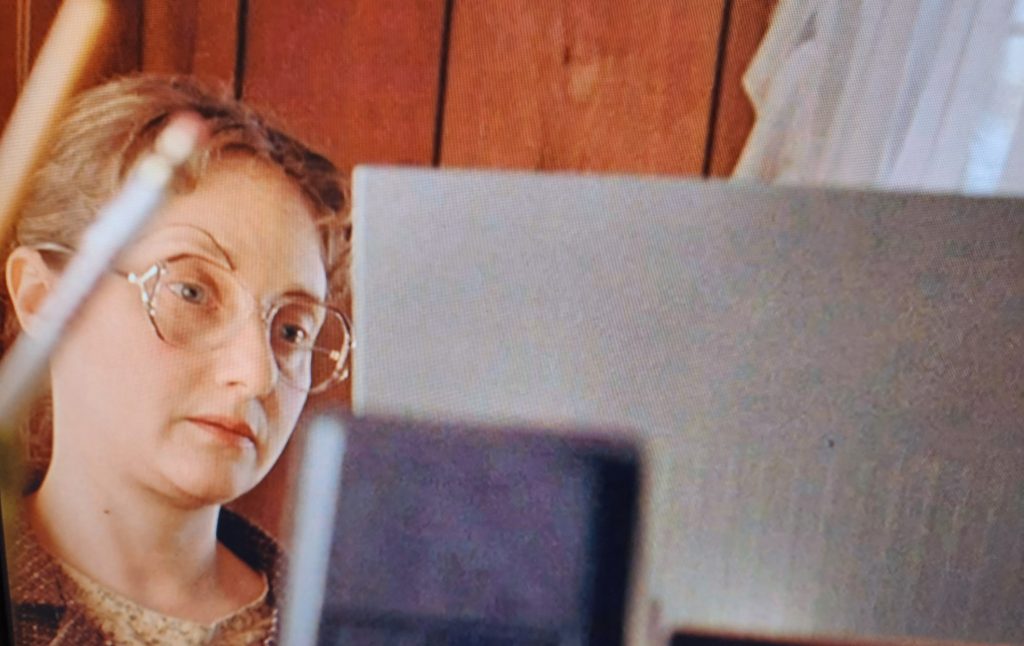
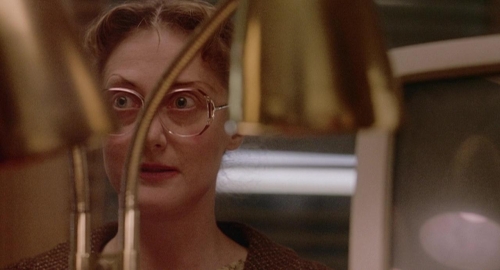
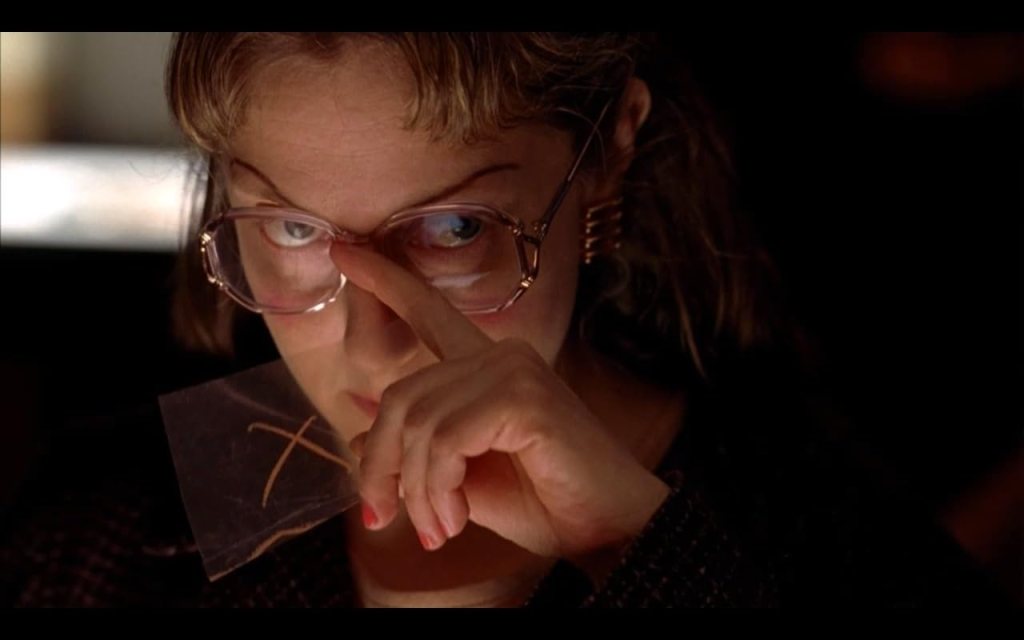
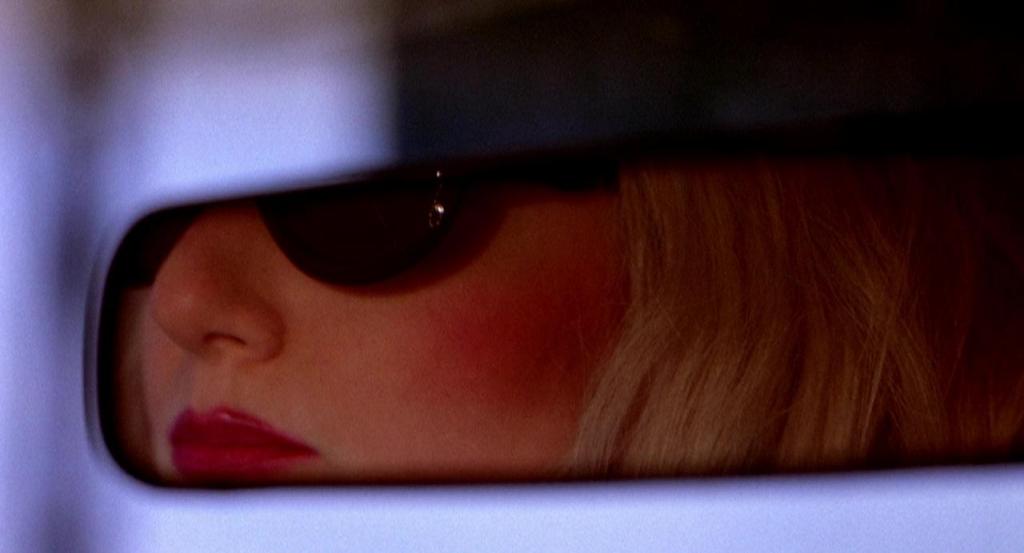
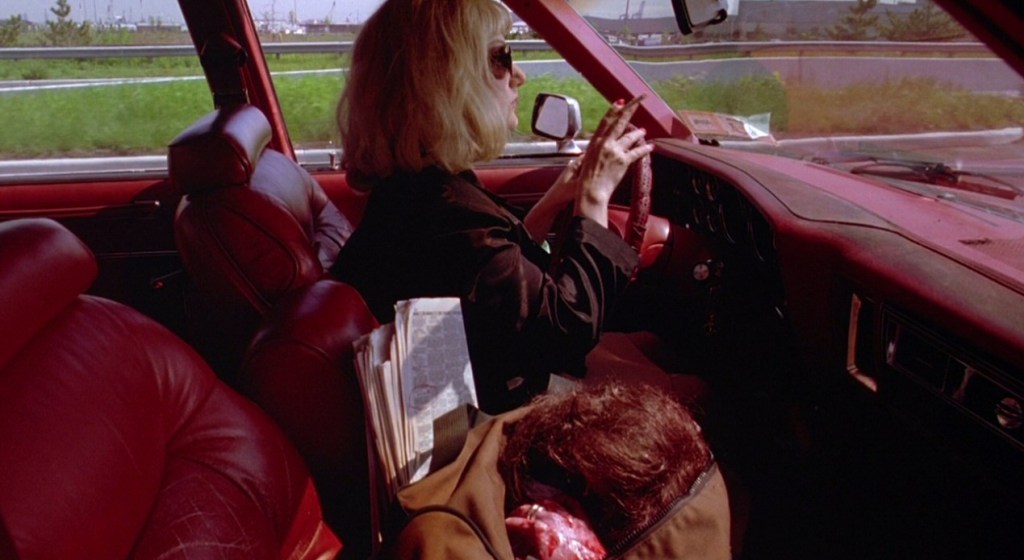
Her eyebrows are a far more effective visual shorthand than if we watched Dorine mashing a tube of lipstick around and around her lips and perhaps leaving a slash of bright red smeared on her cheek as a toy piano plinks. This detail was so crucial that Sherman herself drew on Dorine’s eyebrows for Carol Kane. And in a reversal of the usual convention, where a woman’s make-up goes awry when she loses her mind, the only time Dorine’s eyebrow pencil appears on point is at the end of the film. (Similarly, her hair becomes less and less tightly wound until Dorine releases her mane and ends with a chic bob). Dorine’s final look is a perfect neo-noir femme fatale’s as she glances in the rearview window of her red 1970s sedan cruising the highway in search of a new opportunity.
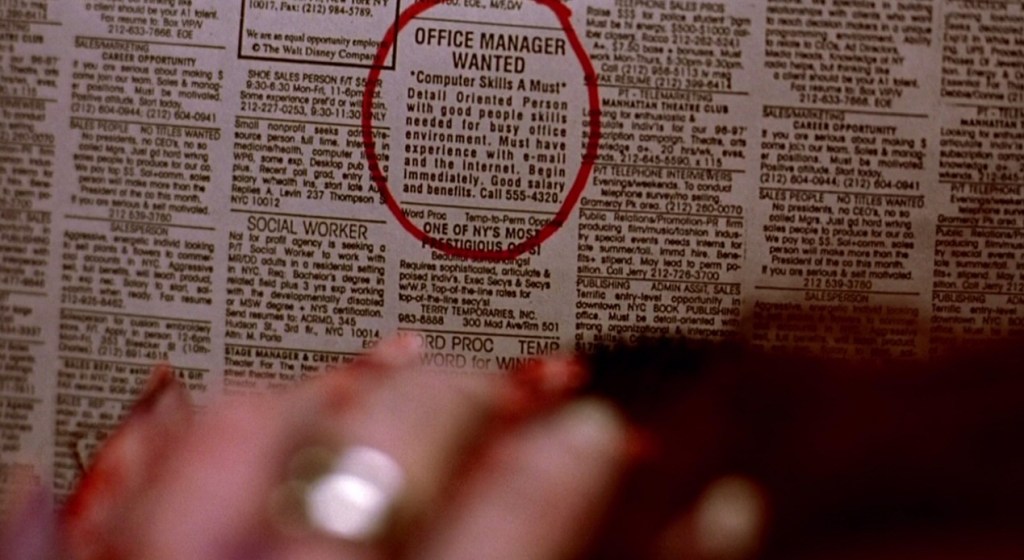
In this portrayal of murderous self-actualization, an office imploding and the anxieties of white collar workers as comedy and horror, it’s possible that Office Killer was a bit ahead of its time. Only two years later there was a small efflorescence of films with a similar sensibility addressing white collar work, downsizing, austerity, downward mobility, passive aggressive corporate management, and the destruction of the final remnants of meaningful office work, upward mobility, lifetime employment and reciprocal loyalty from companies. Unlike Office Killer, these films focused on alienated men, mostly white men. Office Space (USA) was released in 1999 and is a satire about office work at the end of the century—and the millennium. Mary Harron’s satirical horror comedy, American Psycho (USA, 2000), is an obvious companion piece to Office Killer, with its serial killing protagonist who is successful in business and in murdering people for many of the same reasons. Fight Club (USA, 1999) fits in with these films, more with American Psycho and Office Space than Office Killer, but it has a similar sardonic tone about the new corporate order, alienation and violence as a solution. And Office Killer both premiered and disappeared well before the horror-comedy Severance (UK/Germany, 2006) told the story of a group of workers on a bloody team-building retreat in Hungary. Office Killer also predates the American version of The Office (USA, 2005-13) as well as the original British sit-com (2001-3). There is a little bit of unexpected resonance with the American version, though. In The Office, Michael Scott (Steve Carell), regional manager for the Scranton branch of the Dunder Mifflin paper company, tries to make the people he works with his family and friends. Like Office Killer, the series starts with the threat of cuts in a dying industry and continues through a variety of changes in the workplace: restructuring, firings, corporate buyouts, and clandestine romances. And like Michael, Dorine is looking for connection. Since she’s in a horror movie and not a sit-com, Dorine makes her chosen family by arranging the bodies of the people she’s killed in the basement of the house she shares with her mother. And when that family doesn’t work out, she’ll find a new workplace and a new family.
I don’t think Office Killer influenced all these other films and shows. Though it’s possible. Their creators were likely familiar with Sherman’s work, at least as a photographer. I do think that while Office Killer is very much a film of the late 1990s indie filmmaking scene, it’s also a film with a unique perspective, style and tone. And that is challenging. Some people struggled with Office Killer‘s eccentricity when it was released. Some people still struggle with it now in a time of much more rigid generic categories, generic conventions and a hegemonic aesthetic that “realism = good.” But the things that are presented as Office Killer‘s failures–its tone, its mix of genres–they’re like Dorine’s eyebrows. They are deliberate, pointed choices. And these things are part of why Office Killer is one of my favorite films.
~~~
An addendum on the extant of the Office Killer‘s release: Martin Cleary notes that Office Killer appears to have been released in the UK. He wrote me on Bluesky, “It was given a certificate by the BBFC in 1999, which is why I wondered if it was given a DVD release (I can’t find one) it may have appeared at a festival here too – or just dropped completely.” He added later: “I managed to find out that it was released on vhs and vod here (uk) by Buena Vista but it really wasn’t a wide release at all.”
* At least 2014 is when I first wrote about it, I think. It might’ve been 2013. I wrote more about Office Killer for Biff Bam Pop in 2023 here.
**Dahlia Schweitzer also discusses this in her interview for the Vinegar Syndrome Blu-ray release.
***It includes another Miramax film, Philip Ridley’s similarly genre-bending, The Reflecting Skin (Canada, 1990)
~~~
Carol Borden has worn her hair in buns like little ears on her head.




1 reply »